hand sanding video, a couple tips- Pro photos of finished knife added

Glad it might help somebody out :)

Here's what I normally have set up... It doesn't move, period. I use this sanding stick too... with 320X glued on as I can sand with it a little longer before swapping out a new piece.

If you guys want full details you'll have to buy my new video and book. :p Oh wait... I don't have either one of those things. :foot: Damn it! :grumpy: :D

standard.jpg


standard.jpg


The support in the video is for sanding clips. If you see the part where I adjust the support screw under the blade, you can see I just automatically go to adjust the other screws, but they are set up different on this support.

That is indeed Tim's book. I wish it had 100 times the in progress shots it has, but it's a GREAT coffee table piece with lots of information and ideas... and a fantastic tribute to a great mean and amazing bladesmith. :) Mine is even signed ;) :D

I usually hollow grind daggers. The process is much the same, just with sanding blocks that match my grinding wheels. I can grind a hollow grind to a mirror on machines, and then come back with whatever final grit I want... which is MUCH faster/easier. But only if the grinds are dead nuts on.
 
Fantastic! Great video and sanding blocks. I'm going to start working on a set-up and sanding blocks like yours.

How does the Windex compare to Mobile 1 for a lubricant? That's what I've been using so far.
 
Any tips on where to find Tim's book aside from Amazon? I see none on ebay, knifekits, texasknife, etc.
 
Nick:


I just caught onto this on the 3rd time around watching...

When you say you made the sanding support from "wide flange"
You mean, you cut down a piece of I-beam/H-beam?
b02.gif


Interesting idea.
I guess it's more rigid than angle iron?
I've mostly seen angle iron clamped into in a swivel vise

Very interesting clamp design on this fixture with the bridge over the top and the drill press clamp.


Re the windex
It's much thinner than oil, gives a little lubricity
& when you wipe it away it wipes off clean & dries right away & doesn't hide any scratches.

I've got a problem using it because the ammonia fumes give me a headache & shortness of breath.
You're using the windex with ammonia, not the ammonia free solution ?

Would a thin dish soap solution , maybe with a bit of alcohol - in a spray bottle do more or less the same thing without the fumes?

I know you've tried it all before you settled on this way of doing it.
What would you say is the advantage to using windex over oil or other solutions?


Tim's book

I'd like to buy it, but since it's $100 + shipping = $125 ish
Can you give us a bit of a review from a knifemakers perspective.?

I won't spend that on just a pretty picture book when there are so many other tools I need.
But if it would help me be a better maker, I can justify that.
In your opinion, what can I learn from this book?
 
Last edited:
Any tips on where to find Tim's book aside from Amazon? I see none on ebay, knifekits, texasknife, etc.


I found that when I used the link from Tim Hancock's page
http://www.timhancock.com/books-for-sale/
It took me to an Amazon link & wouldn't ship to Canada

I tried Amazon directly
Amazon.ca -Not available
Amazon.com -
http://www.amazon.com/Tim-Hancock-Western-Bladesmith-Knifemakers/dp/9659090722/
It seems like I can get it shipped to my Canadian address


Also found here.
http://www.knifeandgun.com/ProductDetails.asp?ProductCode=PUWB

and here
http://www.americanbladesmith.com/i...ct&subsection=product_category&category_id=22
 
Last edited:
I usually hollow grind daggers. The process is much the same, just with sanding blocks that match my grinding wheels.

Nick, could you post a picture of one of your hollow grinding sanding blocks? I bought a giant semi-finished hollow-ground tanto from a guy... ;)
 
Nick ,
I appreciate very much your video & time spent sharing all this . I have trouble with sanding the hollow grind though I have a curved block to match my grinding wheel . It is easy enough to keep the sandpaper taut on a straight edged block but how do you do it with the curved block ?
 
Hey guys-

I'm really not sure where all you can buy Tim's book... but I bought mine directly from him while we were attending the ABS Expo in San Antonio. I'm pretty sure you can still get one directly from Tim.

To answer the question about it. I think if I didn't know Tim, and look to him as an inspiration, an amazing bladesmith that always answers my questions when I see him, and a friend... then maybe I would not like the book as much without that personal connection. But even without that, I think it's a great book. David Darom snapped photos as Tim built a dog-bone dagger. As a maker, I wish there were more photos of that. But since the book wasn't aimed just at makers, David edited those down. But the photos of him working that are there, are enough to give someone a ton of ideas if they really look. The majority of the book is a tribute to his work. So while I felt privileged to buy the book from Tim... I think if you bought it strictly as an instructional tool you would probably not be as happy with it as I am.

Lubricant- I use WD-40 with 320X, 500X, and 800X... anything over that I usually use Windex. KoolMist or Simple Green work fine too. It's just something to wet the blade and not load up the paper QUITE as fast. I have tried Mobile 1 and other very thick, similar oils... and I just feel like they're TOO thick (viscous). It feels like smearing oil around rather than cutting the blade's finish TO ME. I feel like I've given it an honest go, and I just don't care for it. With really high grits like 1500-2500... it just seems to keep the paper from ever making contact with the steel (which does make me feel good about it as a motor oil! :) ).

I WOULD sand dry if I could get the little bit more life out the paper that I do wet... as I much prefer how you can SEEEEEE the blade while dry.

So my like for Windex at the higher grits was summed up well by #'s above. WHICH BTW- I would like to know your actual first name since I feel like a tool calling you "#'s" all the time. I don't need your phone number, social, home address and bank pin codes... just a first name would be nice. :)

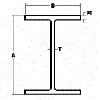
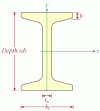
Oh, and no, I mean WIDE FLANGE. Get a welding degree and have one of the instructors scream "It's not f'ing I-beam, it's f'ing wide flange!*!&!*!%!$!!" every time somebody got the two mixed up, and you'd hold your ground on it just like I am. ;)

Wide flange is typically pretty uniform in cross section all across the flange (and often the web as well)... I-beam has a greatly varying cross section, and TECHNICALLY is supposed to be relegated to trolleys. :)

The only reason it really matters here, is because I'm an anal retentive, detail oriented dick. :foot: ;) Okay, maybe... but that's not why. The WIDE FLANGE is still very rigid, but allows you to clamp pretty easily with things like the quick clamps. The OTHER sanding fixture IS I-BEAM.... hence the "bridge" mount I built for the clamp. It won't slip off.
WideFlange.gifIbeamStype.gif


Angle iron works fine. I used it for several years. I like the T-cross section I have with the current set-up because I like the support to have a dagger profile. The dagger profile allows screws around it's perimeter... and I can have the blade set-up so MOST of the cutting edge has support right under it. Maybe I'll snap a couple pics to show this, since I'm confusing even myself here. ;) :)

Robert- I'll try to remember to do that today. :)
 
Thanks Nick,

I'm going to try some of the other lubricants and build a sanding setup and blocks like yours. I'm not sanding the blade right now, I'm shaping the handle on my first but I can try some sanding on a blade I've got roughed out.

I'll post pic's of my first knife soon (I work slow, please be patient).

BTW, My name is Randy
 
Hi Nick, thanks for sharing as usual.
You call that a "dirty 1500 grit finish".....I think it looks amazing.
I normally only go up to an 800 grit, but then, I am going more for a satin finish...or maybe I am just lazy?
I would also appreciate to see what you have for hollow grinds. At the moment I use sanding blocks that I clamp in the vice and rub the blade on it. Opposite to what you do and it works but I think it requires a lot more effort and a lot of energy is being wasted I would think because a lot of the force is being used to just hold the blade and direct it.
thanks,

Mike
 
Thanks Nick - that was very helpful. I still remember my first good glimpse at hand sanding was when I got to watch Don Fogg give a demonstration at Ashokan a number of years ago. It was so incredibly helpful to me, as there's really no substitute for watching someone with great skill and experience do his thing. Now your video clip has added several new elements and once again I find myself thankful to have had the opportunity to watch and learn. Thanks man

By the way, I'm certain you've travelled the far ends of the earth searching for the ultimate abrasives and have likely tried them all, but, for what it's worth, I've become pretty darn fond of Norton 3x. Just works for me I guess :)
 
Nick, what do you start with on the hollow-grind sanding blocks?

That tanto has ~ 10" hollow grind, so you need around a 3" section of a 10" radius, right? Aside from cutting a section of 10" pipe, I'm not sure how you made that :)
 
Last edited:
thanks for a great video nick i have just learnt so much, now Im going to have to make a sanding jig and resand that fighter i got from you
 
Thanks Nick! Great video I will be making some new sanding "Blocks" today. I might have missed it, but do you go from "Dirty" 1500 to Clean 1500 with the rubber coated block?
 
Sorry I haven't followed up with the hollow stuff yet guys... been very busy with orders, puppies, trying to be a fatherly figure and all that ;) :D

***(then how'd you manage to post pics of your new filing fixture?!?!?! says the peanut gallery) *** :eek: :foot:

Ryan, I don't use the rubber block until the very end. I'll try to get, say... IDK, maybe 80% with just the steel blocks. All to do my best to maintain the crisp grind lines.

Some guys use leather faced blocks. I have quite a few and do like them. The thing I like about the rubber better, is it doesn't compress and get harder and harder over time like my leather ones did. So a blade I sand with it today, will be getting the same durometer of rubber backing as one I sanded 3 years ago. Does that make sense?

Derrick- I actually think the 3X is one of the better sandpapers, which just seems funny since you can get it at places like Home Depot. Until SuperGrit started carrying 120X.... I was buying the 120X Norton 3X for my disc sander.

I just haven't found a paper I like better for both the disc and hand sanding. Burt Foster turned me onto the Rhynowet several years ago when I was complaining to him about how the grit came off of my Mirka paper in about one revolution of the 9" disc. Initially I just used the Rhynowet on the disc, and the other for hand work... but found I liked it better for everything. I've sent "sample packs" to some of my good friends that are either Ms or do Ms level work, and most of them have switched over to this paper. One friend that's an Ms bought some and felt like it was okay for cheap paper. I feel like it's better than the expensive paper!

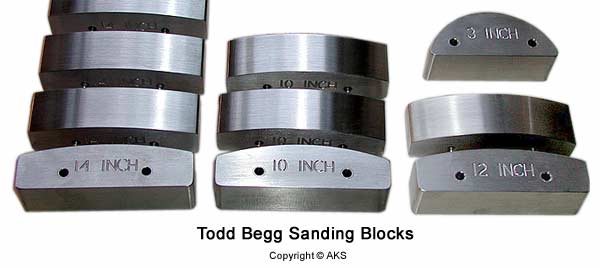
Here is a picture of the sanding blocks that Alpha Knife Supply carries, made by Todd Begg.... these look quite a bit like mine.... just a lot nicer! :)
ToddBeggSandingBlocks-s.jpg
 
Well you've convinced me - I'll definitely give the rhynowet paper a try
 
Back
Top