hand sanding video, a couple tips- Pro photos of finished knife added

Thanks Nick- I really appreciate that you take the time to share what you've learned. I spend so much time re-inventing the wheel: finding complicated ways to do easy tasks! When you post helpful tips like this, it bumps all of our skills up a notch and makes it so we can concentrate more on the creative side of blade making.
Andy G.
 
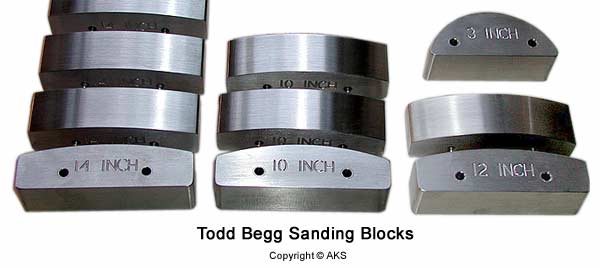
Here is a picture of the sanding blocks that Alpha Knife Supply carries, made by Todd Begg.... these look quite a bit like mine.... just a lot nicer! :)
ToddBeggSandingBlocks-s.jpg

Oh geez -- I didn't know such a thing existed! Thanks Nick!
 
Nick

What's your grit progression?

What is your last belt grit?

Then which is your first hand rubbed grit, are you stepping down a grit from belt to sheet?

Then when you hit the sheets, do you use every grit they offer, or do you skip any?


9 X 11 RHYNOWET REDLINE SHEETS 120
9 X 11 RHYNOWET REDLINE SHEETS 280
9 X 11 RHYNOWET REDLINE SHEETS 320
9 X 11 RHYNOWET REDLINE SHEETS 400
9 X 11 RHYNOWET REDLINE SHEETS 500
9 X 11 RHYNOWET REDLINE SHEETS 600
9 X 11 RHYNOWET REDLINE SHEETS 800
9 X 11 RHYNOWET REDLINE SHEETS 1000
9 X 11 RHYNOWET REDLINE SHEETS 1200
9 X 11 RHYNOWET REDLINE SHEETS 1500
9 X 11 RHYNOWET REDLINE SHEETS 2000
9 X 11 RHYNOWET REDLINE SHEETS 2500
 
Right off the top of my head, I'm blanking out. Mostly because I seem to change my process with every few blades.

But if you look at that thread in the custom section about the run of fighters I did, I had it fresh in my mind and listed it all step by step there.

As far as paper. I use 320, 500, and sometimes even 800 on my 9" disc.

I hand sand with 320 at the most coarse, usually start with 500 if I can. Then 800, 1200, 1500, 2000, 2500. But it's rare that I go that high anymore. I can make a coarse finish look pretty fine on a hand-rubbed monosteel blade. I usually take damascus to 800 before etch. The last few differentially hardened blades I took to 1500 and have been really happy with that going into the etch/polish cycles.


I just shot a second video showing some of the stuff people asked me about after this first one.


***** Just for the record, I know my videos pretty much suck- they're boring, the camera moves a lot, I stammer tens times more than I do in real conversation, and probably a dozen other things... But I'm taking time out of my work day to share this stuff that's taken me years of working on my own, as well as getting help from countless others... to do. If anyone wants to complain about it, they can either just not watch them, or they can write a formal complaint, then go into the bathroom and file it into the big white porcelain complaint box. :)
 
Here is part dos.... :)

And yes, I now know after watching this, that I clamped the blade down with the point sticking out too far when I was doing the clip... I always screw up when people are watching me! :eek: :foot: :o Thankfully I somewhat redeemed myself when I put the blade on the main bevel support. ;) If I had an extra 40 minutes to waste I would have went back and re-shot it. ;)

[video=youtube;QguLGtn4eIM]http://www.youtube.com/watch?v=QguLGtn4eIM[/video]
 
I got two pm's asking me what I consider clean. To me, clean means everything is uniform, and looks like it was done on purpose. A video shot with a little Nikon point and shoot isn't going to show enough detail to show that the finish was NOT uniform before. I am happy with it at this point... ready to start the etch and polish stuff. :)

What probably looks like splotches in the video, is the differential hardening stuff starting to pop up. :)
[video=youtube;9scj8bgwN70]http://www.youtube.com/watch?v=9scj8bgwN70[/video]
 
Just for the record, I know my videos pretty much suck- they're boring, the camera moves a lot, I stammer tens times more than I do in real conversation, and probably a dozen other things...

Nick, your videos are fantastic! Content is vastly more important that production quality, which is more than enough to see/hear what you're teaching us :)
 
OK so I put some of Nick's tips and suggestions to work last night and all I can say is WOW:eek: talk about a time reduction in my sanding, Thanks Nick for sharing:thumbup:
 
Hey Nick thanks for taking time to make those vids! Good stuff. Just a quick question about your sanding sticks. It looks like you are just using the edge or corner of the sticks and not the flats. But at the beginning of the first one you talked about having the paper sit flush on the flat and I got confused. Is the corner sharp or slightly rounded?
 
Thanks Nick. Just posting here so I can find later. ;)

EDIT: Wow posted from the first page because I had been looking for this thread. Didn't see the pics above. Very beautiful, as always.
 
Nick, just wanted to say thank you for the videos. I just came in from sanding my KITH blade and took your advice and got it clamped down nice and tight. Then I laid out plenty of strips of sandpaper. Way more than what I thought I'd use. Once I started sanding, I really laid into it and I can't tell you (like you already know...lol) what a huge difference it made! If I hadn't run out of sandpaper, I'd be done now but WOW! The one side I got done is the best I've ever done. Thanks agains!
 
That's nice work Nick
You've been knocking them out lately.


Your plunge lines are very square and sharp.
Mine are much more rounded when I use a Jflex off the platen.
Are you getting that sharp plunge on the rotary platen, or glass platen or how ?


In the second pic, it looks like Coop missed wiping off a fingerprint on the shiny part of the guard.
& I can't stop looking at it.

It probably wouldn't show in a magazine photo.
 
You guys are welcome, I'm really glad this stuff actually helped a few of you out. :)

Sam- I'm trying :) The hardest part for me is staying focused long enough on ONE knife to finish it. :o

If I typed somewhere that I'm using J-flex belts on my blades, it was an accident. I LOVE them for handles, but I don't use them on my blades unless there's one on my rotary platen that will work for feathering an edge in. I cut my plunges in pretty darn close to final shape with the 60X, then closer with a 120X, and then if they need dialed in more, I do that sandpaper glued to the block of steel thing (like I did for Lorien's knife thread).

The rotary platen isn't quite stiff enough to do a sharp plunge, so I have to use the "gator" belts to get into a sharp plunge with it. They work since they have a more substantial backing. I had asked Rob a long time ago about the possibility of a stiffer/thicker belt for the rotary platen and the jist of his response (which was polite and friendly as always) was that the belt he is using for them was optimal for the function of the platen, durability, etc. I could have taken the initiative to try and find a stiffer timing belt, but didn't need to bad enough to do it.

All that aside, I keep using my variable 9" disc more and more. My buddy Mike Quesenberry isn't going much past a roughing belt on his blades before going to his disc, and I'm not that far from that at this point. If I can achieve the same (usually better) results with the disc and a half dozen $0.45 sheets of paper, than 4 or 5 belts that cost $4-8 each, it's impossible to overlook that.

I don't think I ever do anything exactly the same though.... I'm always trying to see what works better for me. And that isn't just faster or cheaper, it's got to be a better final product (or at least as good).... but in this case (meaning the 9" disc) it's a happy accident that it's cheaper, faster, and better. :)

Edited to say, your monitor must be better than mine- I'm not seeing a thumb/finger print. I was thrown by the appearance of a large secondary bevel, since the edge is super thin... but I think it's just shadows. I just got this and another print from Jim in the mail, and they are AMAZING (I suppose I could check for the fingerprint there, but usually I just see a faint reflection of Jim's camera on my mirror polished guard lugs :D ).
 
Back
Top