Handle contour input requested

Thanks to all for the great tips and pics; it gives me a lot to think about and try out. I will play around some more with the clay, and then try some shaping on a pine board before I get back to this knife.

I appreciate everyone's assistance!
 
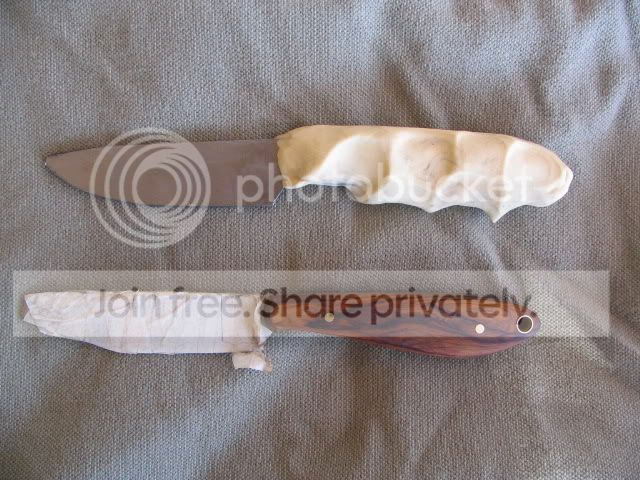
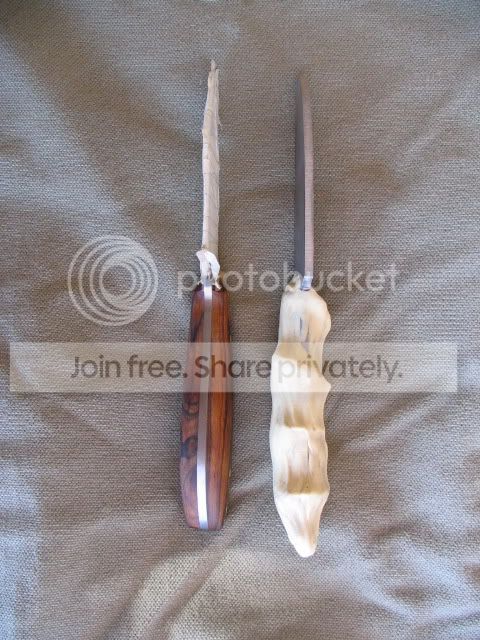
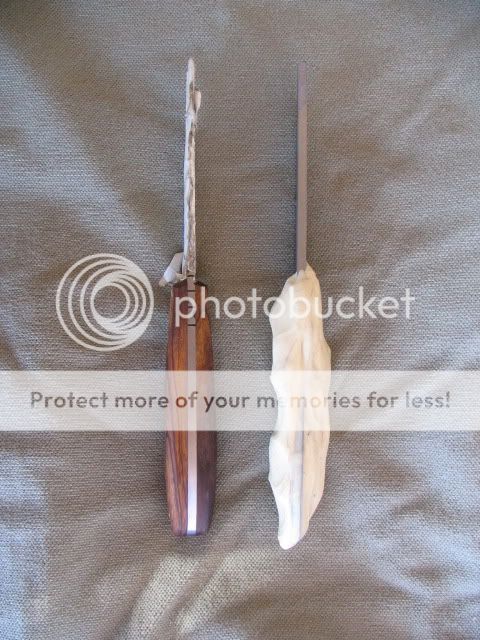
I had another blank mostly profiled out to match the third knife above, so I stuck some clay on either side of the blank and squeezed it, removed the excess, squeezed, removed excess, etc. until it felt good in my hand. I'm still getting a somewhat amorphous blob and I'm not 100% sure how to interpret the results. I get finger 'grooves' and thinner on the finger tip side, and thicker and rounder on the palm side.

If anyone can help with what conclusions to draw from this, or a different/correct method of shaping/squeezing the clay that will help me learn more from the exercise, I would appreciate it.

profile:
IMG_1663.jpg


from below:
IMG_1664.jpg


from above:
IMG_1665.jpg


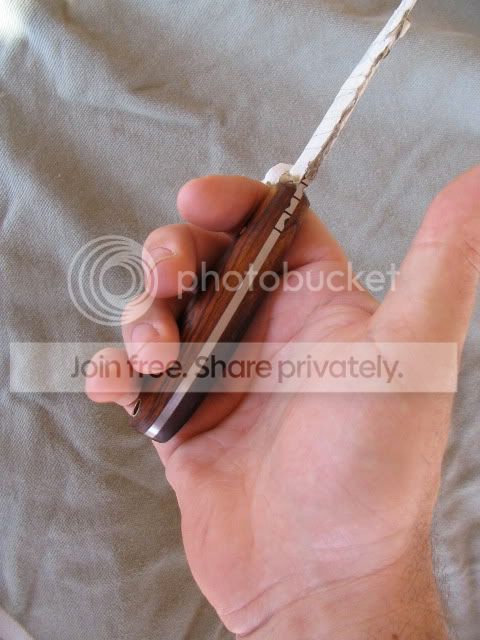
For fun and for scale, a couple in the hand:

IMG_1669.jpg

IMG_1666.jpg
 
Last edited:
It's not a way to get a exact picture of handle shape. You are not necessarily suppose to squeeze the bejesus out of it. It's more of a way to play with shapes and get a general feel for where bulk is needed and where it's not.

Hope this helps.

Pat
 
Heres a few of mine....i love sculpting handles.....

I do no two the same...some very flared and sculpted, some less, depending on how specific a task I think the knife will be used for.

1.jpg

3.jpg

2.jpg

2.jpg

4.jpg

8.JPG

3.jpg
 
David, your handles have always inspired me. And they've also allowed me in my mind to keep mine thicker than the norm, and still feel like I'm not doing something wrong. Thanks bro.
 
David, your handles have always inspired me. And they've also allowed me in my mind to keep mine thicker than the norm, and still feel like I'm not doing something wrong. Thanks bro.

I think you need to look no further than common tools to realize that a thick handle is not an issue if done properly. If a knife is to be a chopping tool, theres a pretty good chance that thousands of years of trial and error have deemed a hatchet-handle shape to be effective. I also find that lots of ergonomic umbrella handles make good knife handle shapes, in addition to contoured bike handles that are used in BMX biking.

The things I hate with extreme passion are beautiful knives with handles that are shaped like a square box with sharp edges, or are straight and round like a broomstick with little thought to the shape of a human hand. I also think many people make their fulltang knives with handles that are simply too thin and it feels like you're holding a ruler. Thin handles make some things like sheath design easier, though...

Handles, to me, are simple trial and error. Take a piece of wood, grip it as tight as you can and see where it hurts the most, then remove material from that area until the handle naturally fits the hand and your grip gives nice even pressure all around. I also think sometimes we get too caught up in making things symmetrical when in reality, hands strongly favor a certain shape from left to right. If a customer wants, I'll always swell the handle into the plam if they let me know their dominant hand.
 
AHA!

Now you can see in the clay the obvious difference between a right handed knife and a left handed knife!

Some folks like to make an ambidextrous handle...while other strive to do both...


Here's another all makers have to decide upon...

Good experiment!

SHane
 
Thanks for the additional input and pics, folks; it all helps and gives me things to think about and try out...
 
I also think sometimes we get too caught up in making things symmetrical when in reality, hands strongly favor a certain shape from left to right. If a customer wants, I'll always swell the handle into the plam if they let me know their dominant hand.

Great tips in your whole post, but that really jumps out at me. As you and Shane both say, and Paul's clay experiment shows, a handle doesn't HAVE to be symmetrical. I think that's part of the appeal of stag handles; sometimes they curve just right to lay in your palm nicely.

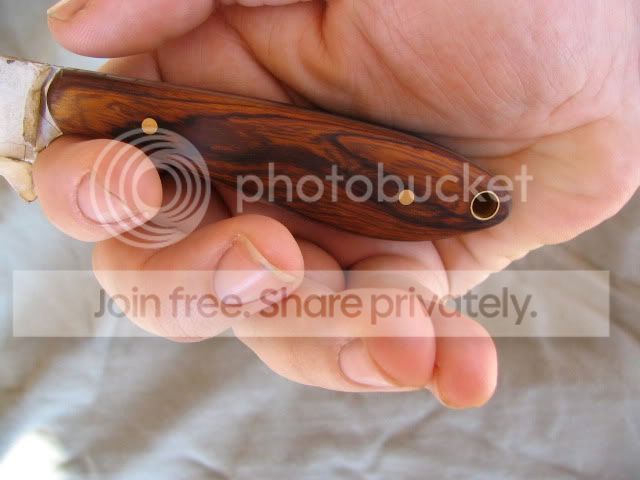
Paul, thanks for posting that in-hand pic. To me, the handle looks too small for your hand (not by a whole lot). I would rather it be a little on the big side than too small. Personal preference, of course. Blocky edges are a big no-no in my opinion, regardless of size.
 
Paul, thanks for posting that in-hand pic. To me, the handle looks too small for your hand (not by a whole lot). I would rather it be a little on the big side than too small. Personal preference, of course. Blocky edges are a big no-no in my opinion, regardless of size.

I think sometimes it's hard to tell much about size/scale from a photo even with some of the dimensions listed, so I thought showing it in the hand would help with that. In some of the earlier closeups it looks much bigger than it really is. It's a small bird & trout, so it's pretty comfortable in my hand even though the handle does not extend past my hand.
 
Good point, Paul. I've seen pics of miniature knives (only a couple/few inches overall) that were so well-designed and proportioned, it was hard to tell them from a full-sized knife based on just a picture. I also understand your point that a bird & trout knife doesn't need to be as big overall as, say, a "regular" hunter.
 
Back
Top