Heat treat dilema/question(s).

Joined
Dec 6, 2010
Messages
1,154
Okay so I had been having trouble getting my 1074, and O1 to harden properly. Turns out my oven was around 100+F cooler on the bottom compared to the thermocouple. I raised up my rack and it seemed I was getting a good temperature. I let it soak at 450F for 20 minutes, I pointed my laser thermometer at the platform and bam 450F on the money! I decided to pull out the Blade and see what temp it was sitting at, and it read 135F. I chacked to make sure this was a correct reading, and in my opinion it was.

This got me to thinking, how is it the blade is reading 135F if the oven an surroundings are at 450? On top of that if I am only soaking the 5/16" blade for 10 minutes at 1490, how hot is the blade actually? Is the spec sheet set to just deal with oven temperature?

Any help understanding this would be great.
 
I don't know much, but logic seems to be that the blade hasn't come up to temp yet. How much air space is in your oven? I thought soak time was time at temperature of the part.


-Xander
 
My laser thermometer won't go over 600F. I was chacking to make sure it was the same at the lower temp, and was planning to adjust for any variance.

It soaked at 450F for 20 minutes.
 
Hmm, is your blade laying flat on a solid shelf? Maybe make a dowel rack to hold it on edge to reduce the contact area, could be working as a heat sink to the shelf. I'm guessing air space might be a factor as well, reduce it and it will heat the air quicker which will heat everything quicker. FWIW, I temper my 1080 for 60min and 400. It should turn straw colored when it gets to 450*F.


Again I don't know much about this, just trying to think logically about it.


-Xander
 
I never soak 01 for less than 20 minutes in my Evenheat. My blades lay edge up in a slotted fire brick, and are a bright red-orange when I quench. What oven do you have?
 
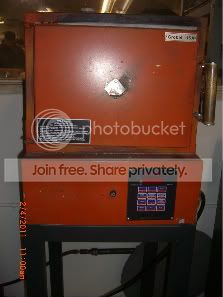
I have a Grobet USA

oven.jpg
 
Was the oven fully heat-soaked? In a heavy oven, it can take something like 45 minutes to an hour to bring the oven bricks fully up to temperature. Once that has been done, the variance in temperatures within the oven chamber will decrease. It's possible the oven floor wasn't to temp and acted as fastriot suggested. I also place blades edge up in a ceramic rack which puts the blades in the middle of the oven space.

--Nathan
 
Turns out my oven was around 100+F cooler on the bottom compared to the thermocouple
.

This is very common, and it's one of those "variables" that must be learned and taken into consideration. Heat ALWAYS travel UP...no matter the situation...that may seem overly simple, but realizing and understanding that will help you solve a lot of issues.

It's all about temp AND time....every change within steel requires a given temp, for a given amount of time. There in lies the "art" of what we do....figuring out the temp AND time required to achieve a desired result. I'm not a fan of long soaks at quenching temps, but feel it is a must when it comes to tempering temps.
In my experience, longer soak times at quenching temps creates more problems than it solves, while too little soak time during tempering does the same thing.
 
.

......... Heat ALWAYS travel UP...no matter the situation...
Ed, that is a common misconception, and is completely wrong. I understand what you were trying to say, though.
Actually heat radiates equally in all directions. It is warm air that rises over cooler air. This is called convection.
Heat is energy, and just like light, radiates until it is absorbed. It is not affected by gravity,while light, which is particle energy (photons) is minutely affected by gravity. Air, which is normal matter, is gravitationally affected, and thus warm air (less dense) rises over cool aid (more dense).
 
This is kind of homebrew and may or may not be helpful, but I've found that when tempering in a regular oven I get much more even heat distribution if I wrap the blades in foil. That way convection is less of a factor, or at least doesn't zap just one part of the blade.
 
So Hot Air travels up usually. On our peach orchard we use a big fan to blow out the cold air during freezes to raise the temperature just a little bit during blossom time. How did you get so smart Stacy? I am so happy I send away for heat treat. I guess the 135F brings up position in kiln, are the bricks heated to temp, lengthening soak times as well as secondary PID's. Hope you are able to solve this.
 
This is kind of homebrew and may or may not be helpful, but I've found that when tempering in a regular oven I get much more even heat distribution if I wrap the blades in foil. That way convection is less of a factor, or at least doesn't zap just one part of the blade.

You could take that one step further and add more thermal mass.

A cake pan full of sand allowed to heat up and stabilize, will even out temp variations with the element cycling on and off.
Big steel plates in the oven will also have a similar effect.
 
OK Where to begin

Soak your kiln at temperature with whatever brick your blade is sitting on in it for at least a half hour after the thermocouple indicates you have come up to temperature

That is a jewelry burnout kiln, it has a lot of thermal mass to bring up to temp,

Make a rack if you haven't already that holds your blade standing on its spine

Your soak time starts *once the blade is up to temperature* if you are putting a 5/16 thick blade (really over a quarter inch thick?) in for ten minutes you have only gotten the core of that blade up to maybe 500 or 600 degrees, with O1 you need a soak time of 20 minutes PER HALF INCH OF THICKNESS once the piece has reached an indicated surface temperature of what the spec sheet calls for if I remember correctly. Respectfully Mr. Caffrey, I realize that you have an MS stamp and get paid to write column inches in magazines, but having worked as a metallurgical associate engineer in an aerospace metals plant looking at metal under a microscope for a living, and evaluating the effects of heat treatment, as well as troubleshooting metallurgical furnace inaccuracies, I have to disagree with you on several counts. First, yes convection will cause warm air to rise, but in an electric kiln environment radiant energy is much more of an issue, you will not find convective thermal stratification causing a 200 plus degree difference in that small a chamber, also typically in an electric jewelery burnout kiln the thermocouple is mounted in the center of the back side, not at the top, secondly if you are doing an extremely short soak of a complex alloy like O-1 you are not bringing things into proper solid solution to get the most possible out of the alloy. Test results of extended soak times of O-1 shown at Ashokan a couple years ago AT THE CORRECT TEMPERATURES WITH CONSISTANT TEMPERATURE CONTROL showed no appreciable grain growth and a more uniform carbide distribution compared to short soaks. The art in your work should be the forging and grinding and assembling, science has shown that a uniform metallurgically correct heat treat will give consistant superior results, and that is what makes good blades.

preheat the kiln at least a half hour from the time it indicates you are at the correct temp to let it stabilize,

put your blade in and when it appears to be the same color as the kiln around it start your soak timer

In my kiln in order to minimize decarb I have blocked the vent, and I put a couple pieces of lump (wood) charcoal in just before I put the blade in to create a reducing atmosphere (carbon monoxide) which has sucessfully reduced my decarb layer thickness

Always have your blade standing, never lying flat, and minimize contact between the blade and anything else

-Page
 
Back
Top