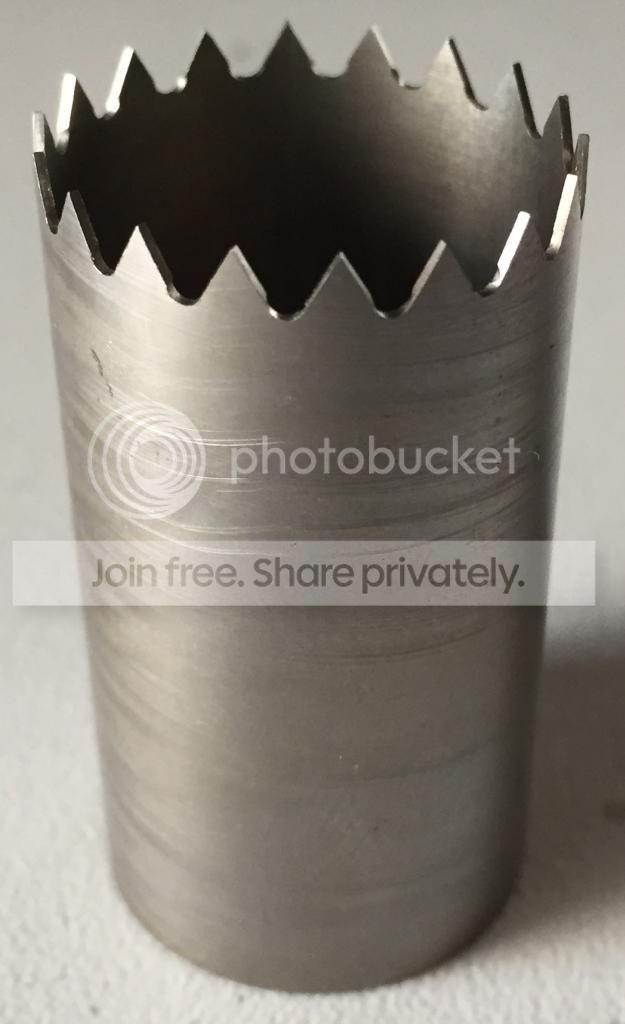
Heat Treated Stainless 440C Hole Saw Shattering. HELP!

Jesse, It is true that I am two days older than dirt. I have to take a nap now. Happy New Year to all the blade forum guys! Larry
 
There have been some good comments here. When I asked about finish I wondered if any surface defects had been removed . The " cold finished " doesn't tell me much. Use of one year ? How many holes ? Fracture surface here can tell a lot [fatigue vs sudden failure ]. Thicker wall would help [watch out for those girls LOL ]. Set teeth are normally used even for thin wood.Proper shape of the teeth would also help.Shape should be cut like a cross cut saw. Polish the bottom of the V of the teeth.Always temper for at least two hours. Raise the tempering temperature for more toughness.Set up cutting operation to help maintain cut perpendicular to wood .
Give those things a try.
 
If you only have to max at quarter inch material, how about making the tool, just long enough to do the job = less twisting stress.


if the purpose the hole, or do you have to keep the washer cut out intact ?

If you need the washers, how about some sort of clicker punch dies ?


If the T handle is how I imagine it to be, I'd ditch it and use a brace style handle.
It's easier to turn and keep straight.


I notice your saw has no teeth set, that makes it hard to clear chips and wet wood will surely bind.


Considering your intended use, I'd try to make it as rugged as possible and thicker


If you don't have to have perfect stainless surfaces for lab / heath / food prep hygine then I woudn't spend any time or money on stainless
If the tool gets used daily, and clean it will be shiny.
Plus as you know, stainless costs more in basic materials and in manufacture.


financially feasible ?
commercially available tools are as feasible as possible.
HSS teeth electrically bonded to carbon steel bodies in strips and wound into circles, powder coated.


unless you just go back further in the past to simple blacksmith made spade drills.


The cut out does not need to be intact. This tool is designed to be very portable, so I don’t think the clicker punch dies would suffice, based on ones I have seen.

You are correct, the chips do bind especially when the wood is wet. Halfway through cutting I always have to clear the chips, and then it cuts well again. I think I will set the teeth now.

I never did much testing with powder coating, which I will do now. In the past, I used paint stripper on a Home Depot hole saw. I had one coated with Titanium Nitride, and the other coated with Chromium Nitride. I believe they had HSS teeth bonded to carbon steel bodies as you described. They rusted almost immediately in the tropical conditions, which is why I switched to stainless.

Thanks again.
 
!have you co sidered differentially heat treating the hole saw? How about manually grinding between the teeth to eliminate stress risers before you do the heat treat?

I didn't realize you could differentially treat the hole saw. Our material science department referred to the Machinist Handbook for the heat treatment. I'll ask about it when I see them.

I think I will machine the teeth with an endmill instead of a v-cutter to get a radius in the root. This should eliminate stress risers.

Thanks.
 
Kenshin,
One comment you made about your hole saw not rusting isn't really correct if I read it correctly?

Just like your friend was able to break your tool with a little neglect Stainless will rust! Its Stain, Less.

If it has carbon in it? It can rust if not taken care of.
 
I do not know why you are trying to reinvent the wheel. If it is a project for school then you have passed. It worked for a year and now has broke. There are many hole saws for sale out there that work well enough for the task at hand. Use your machine talent to make something beautiful like a knife! Making holes in wood is not very interesting in the long run. I do not want to hurt anyone's feelings but making a hole saw is BORING (get it). You obviously have good machine shop skills...get creative and make something new. Just my opinion. I am sorry if I come off as a bitter old ugly grouchy old guy. I am not bitter. Larry

I understand where you are coming from. I've tested many traditional hole saws, but for my application, the asymmetrical teeth profile cuts wood chips faster. I honestly don't know why, nor does my professors. The two main issues that I am trying to address are fracturing, and chip clearing.

Perhaps the traditional gullet teeth hole saws in Home Depot didn't work well because they are rolled and welded. They are not perfectly circular. I think I may be able to recreate gullet teeth on tubing now.

This hole saw will benefit many people without electricity, making much more than just a project for school. I will be creating a specialty knife for this region fairly soon, so I am excited to be a part of bladeforums!
 
The valleys on the teeth should include a generous radius to reduce stresses and surface cracking due to repetitive stress/stain. Surface cracks are notorious for forming in sharp corners and will easily propagate.

Also, don't loan tools to girls. :D

The cutting edges of the teeth should be hard, the body probably should be softer to allow some strain without fracture.

Your professors should be able to figure this out, but they probably want you to do so on your own.

With that said, unless you require stainless steel for the application then other steels are probably better suited.

What are the design requirements?


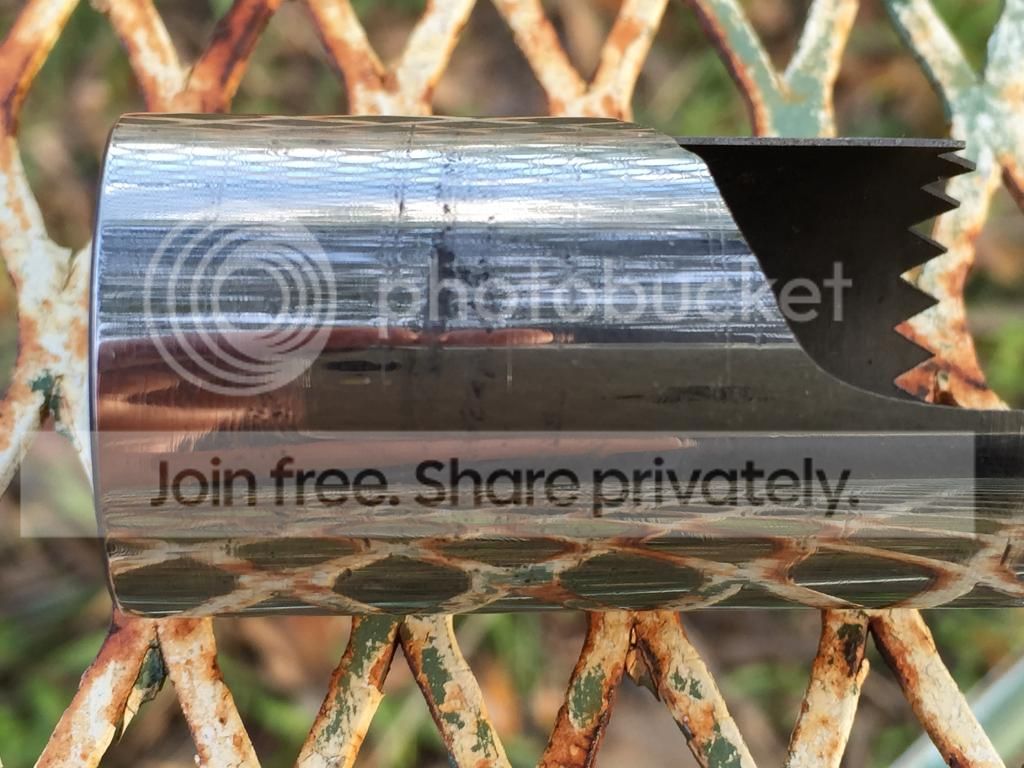
Below are images of a hole saw I created with a 1/16” TiAlN endmill. On the mill, I used an indexing head and rotated the vice 60 degrees clockwise, and then 60 degrees counterclockwise to machine the teeth. When it was quenched in oil, it warped, so I never really used it (I only air quench now).

I will go back to this machining procedure using a smaller diameter endmill allowing me to add more teeth. To make the cutting teeth hard, with a soft body, is induction heating on the hole saw a good solution?

https://www.youtube.com/watch?v=1u1K1WGZL3k

It would take seconds compared to hours with a traditional hear treatment. Any info on stainless steel induction hardening would be greatly appreciated. I don't mind building this setup.

The requirements are a rust resistant hole saw that will keep an edge for at least 1000 cuts through 1/4" hardwood or 3 years (I estimate 50 Rockwell C or above). If it is to be coated, the coating must not scratch easily during use. It must be easy to manufacture for mass production, using a widely available material, preferring in long tubing.

Thanks

IMG_4118_zpsc9cdd0f9.jpg

IMG_4121_zps66a449f7.jpg
 
There have been some good comments here. When I asked about finish I wondered if any surface defects had been removed . The " cold finished " doesn't tell me much. Use of one year ? How many holes ? Fracture surface here can tell a lot [fatigue vs sudden failure ]. Thicker wall would help [watch out for those girls LOL ]. Set teeth are normally used even for thin wood.Proper shape of the teeth would also help.Shape should be cut like a cross cut saw. Polish the bottom of the V of the teeth.Always temper for at least two hours. Raise the tempering temperature for more toughness.Set up cutting operation to help maintain cut perpendicular to wood .
Give those things a try.


I really never did try to remove any of the surface defects until after I heat treated the hole saw (when I was polishing it). I did notice some pitting that occurred after the heat treatment (see image below). I couldn’t really polish it out unless I removed much of the material.

I cut a little over 100 times in hardwood, ranging from 1/8” to 1/4” thickness.

I will try a small set once I return to college this semester. If I can’t, I may try machining a bit off the body ID and OD, leaving a thicker teeth profile.

So is it okay to keep the original heat treatment procedure I posted, with the exception of tempering at 500 degrees C for 2 hours?

When using the endmill to machine the teeth, I can easily machine the teeth to cut perpendicular. This was not the case for the V-cutter.

I’ll let you know how it turns out in the next few weeks. Thanks again.

IMG_4123_zps9a8a7c8e.jpg
 
You are correct. What I should have said is rust-resistant, not something rust-proof. I bet titanium hole saws are really expensive.

best regards
 
I hadn't mentioned induction heating as I thought you wanted things very simple. IF you have the equipment induction is fine. Industrial equipment can be adjusted easily , frequency , etc. Without adjustment you may have to experiment more.
Warp -At any time did you stress relieve the cutter ? A subcritical anneal , 1200 F for two hours after cutting teeth , might solve that problem.
 
I hadn't mentioned induction heating as I thought you wanted things very simple. IF you have the equipment induction is fine. Industrial equipment can be adjusted easily , frequency , etc. Without adjustment you may have to experiment more.
Warp -At any time did you stress relieve the cutter ? A subcritical anneal , 1200 F for two hours after cutting teeth , might solve that problem.

For the warped hole saw above, we didn't do any other stress relief besides the hour long temper I mentioned. I believe it warped because it was dipped in oil on it's side instead of being dipped strait-down equally. Not sure if this is relevant, but it was also in a small stainless steel envelope I created to decrease oxidization.

For the subcritical anneal, do I modify my original heat treatment procedure by heating to 1900F (1038C) for 30mins, air quench, then heat to 1200F (649C) for 2 hours? Or do I just heat to 1200F (649C) for 2 hours only?

Also, could you please point me in the right direction for info on stainless 440C induction heat treatment?

Thanks again.
 
Back
Top