If I find that axe, I'll let you know!Point by point F Falcata , I can't respond to everything, but here we go.
Yes it may look messy but this image can help to understand it a bit.

What you see here as a whole is Euskal Herria, the land of the Basques.
The 'Spanish Basque Country' is what is officially known as the 'Basque Country.'
Biscay is the region where Bilbao is located.
I didn't tell you the Basque axe tradition is dead, in fact, I'm writing about it right here.
What I wanted to tell you is that the Vascongadas pattern (hacha modelo Vascongadas) died out a long time ago.

Yes, I’m aware that Jauregi axes do exist, and no, they transitioned from forge welding to casting the heads and forging the bit decades ago.
Jose Ramon indeed owns one of the very, very few Vascongadas pattern axes I have ever seen. It’s an old one, much older than the axe we see in the image and quite interesting too. The eye has been made in an unnecessarily complicated way. If you ever visit him, ask him to show it to you. If he has any reservations, tell him you know me, I think he’ll be able to figure out who I am by my username.
I have seen another in a public place, you can have it in hand but it has been welded to the base of the exibition because it's their last piece and the anterior pieces have been stolen.
Regards

-
The BladeForums.com 2024 Traditional Knife is available! Price is $250 ea (shipped within CONUS).
Order here: https://www.bladeforums.com/help/2024-traditional/
You are using an out of date browser. It may not display this or other websites correctly.
You should upgrade or use an alternative browser.
You should upgrade or use an alternative browser.
Photos Hello, newcomer from Barcelona
- Thread starter Falcata
- Start date

Ugaldie
Gold Member
- Joined
- Feb 27, 2013
- Messages
- 407
...
The Jauregi family can custom-make this model for you using traditional methods. I don't think it would be a problem, and I've found their prices to be quite reasonable; they've been in this trade for generations.
...
Yes, Jose Ramon is a very pleasant person. He has reproduced axes for museums but I doubt he would proceed in the same way for non public or research related entities. If I’m wrong, please correct me.
...
Unfortunately, this type of metallurgy isn't properly valued in the rest of Spain. ...
I agree absolutely
I found it.If I find that axe, I'll let you know!
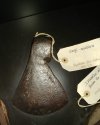
This is part of a collection of the regional government of Gipuzkoa, not in display nowadays. As you can see it's named in Basque language as 'Moon axe', it's close to an old charcoal maker axe (an early Basque axe we can say), it's a pity I didn't take any photo of this last one. This axe was similar to the Basque axe we know today but more blocky, with slightly straighter bit and little or no cheeks. Some sources name it as the Navarrese pattern.

Two different designs existed prior to the Basque axe we know today and dissappeared, or more correctly developed to the Basque axe we know today. Very few examples of those earlier axes exist these days. Basque and Biscayne axes took over all the other patterns in the Spanish side of the Basque Country. The French side of the Basque Country did have all French axe patterns at their hand but there Basque and Biscayne axes have also been prevalent at least as till the end of the 20th century.
Eusko Ikaskuntza is an institution dedicated to promoting and preserving Basque culture, language, heritage, and research in various academic fields, all type of academic people work or have work there. The following information comes from an unverified historical source (which is unfortunate), but it provides a clear view of the period before the development of the Basque axe. Below is an AI-generated translation.
"Navarrese axes are characterized by their greater robustness and weight at the back, with the back being as high or similar in height to the blade. These axes are used by "aizkolaris" in timber cutting contests and are also preferred by farmers. The so-called Biscayan axes are less robust and have a lower back. Their general shape is angular, in contrast to the round-edged Navarrese axes. This type of axe is used for smaller tasks, such as firewood cutting, and is also mass-produced by the industry. The "Illargi-aizkora" (moon axe), which is no longer used today due to the decline of charcoal production in the mountains, has a rounded edge, a wide blade that narrows towards the back, and a point of attachment for the handle."
Source
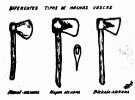
I discussed with one of the makers the incorrect and incomplete information regarding axe usage. For example the Navarrese axe was indeed another charcoal maker's pattern and there was a significant weight variation in Biscayne axes and these Biscayne axes were the most preferred by factory woodworkers. Additionally the Basque axe is not the same as the Navarrese axe, it is a fusion of both the Basque and Navarrese designs. He agreed with me but they didn’t update the information.
Nevertheless, F Falcata or anyone reading these words, if you come across any information, images or tools related to these I would be very grateful to hear about it.
Regards.
A Stunning piece! So lucky to have it at your colletcionYes, Jose Ramon is a very pleasant person. He has reproduced axes for museums but I doubt he would proceed in the same way for non public or research related entities. If I’m wrong, please correct me.
I agree absolutely
I found it.
View attachment 3133265
This is part of a collection of the regional government of Gipuzkoa, not in display nowadays. As you can see it's named in Basque language as 'Moon axe', it's close to an old charcoal maker axe (an early Basque axe we can say), it's a pity I didn't take any photo of this last one. This axe was similar to the Basque axe we know today but more blocky, with slightly straighter bit and little or no cheeks. Some sources name it as the Navarrese pattern.
Two different designs existed prior to the Basque axe we know today and dissappeared, or more correctly developed to the Basque axe we know today. Very few examples of those earlier axes exist these days. Basque and Biscayne axes took over all the other patterns in the Spanish side of the Basque Country. The French side of the Basque Country did have all French axe patterns at their hand but there Basque and Biscayne axes have also been prevalent at least as till the end of the 20th century.
Eusko Ikaskuntza is an institution dedicated to promoting and preserving Basque culture, language, heritage, and research in various academic fields, all type of academic people work or have work there. The following information comes from an unverified historical source (which is unfortunate), but it provides a clear view of the period before the development of the Basque axe. Below is an AI-generated translation.
"Navarrese axes are characterized by their greater robustness and weight at the back, with the back being as high or similar in height to the blade. These axes are used by "aizkolaris" in timber cutting contests and are also preferred by farmers. The so-called Biscayan axes are less robust and have a lower back. Their general shape is angular, in contrast to the round-edged Navarrese axes. This type of axe is used for smaller tasks, such as firewood cutting, and is also mass-produced by the industry. The "Illargi-aizkora" (moon axe), which is no longer used today due to the decline of charcoal production in the mountains, has a rounded edge, a wide blade that narrows towards the back, and a point of attachment for the handle."
Source
View attachment 3133284
I discussed with one of the makers the incorrect and incomplete information regarding axe usage. For example the Navarrese axe was indeed another charcoal maker's pattern and there was a significant weight variation in Biscayne axes and these Biscayne axes were the most preferred by factory woodworkers. Additionally the Basque axe is not the same as the Navarrese axe, it is a fusion of both the Basque and Navarrese designs. He agreed with me but they didn’t update the information.
Nevertheless, F Falcata or anyone reading these words, if you come across any information, images or tools related to these I would be very grateful to hear about it.
Regards.

 ja, ja, ja (que cagada) I'm sorry!