
Help designing my new work shop

Robert Erickson

Knifemaker / Craftsman / Service Provider
Joined
Feb 2, 2014
Messages
2,899
Hey guys,
I'd like some help with a work shop that I'm going to have built on the property we just bought. I've looked at some of the old threads regarding design and as such have some idea what I want to do. However, I'd like advice and guidance on my specific build so I do it right the first time.
In our current home I'm in a basement room that's 10' x 10' and has been sufficient for stock removal but I'd like to delve into the world of forging and possibly heat treating and so the new space is going to be a larger and a detached structure.

I've contacted the city for all their requirements and am starting to work with an architect.

The yard space will allow a 25' x 25' building of which part of will need to be storage as our new house is smaller than our current one.
The other two rooms will be divided into dirty/grinding spaces and clean/finishing space.
Here is a crude drawing of the space: (It's shown as a 20x25 but will be 25x25)
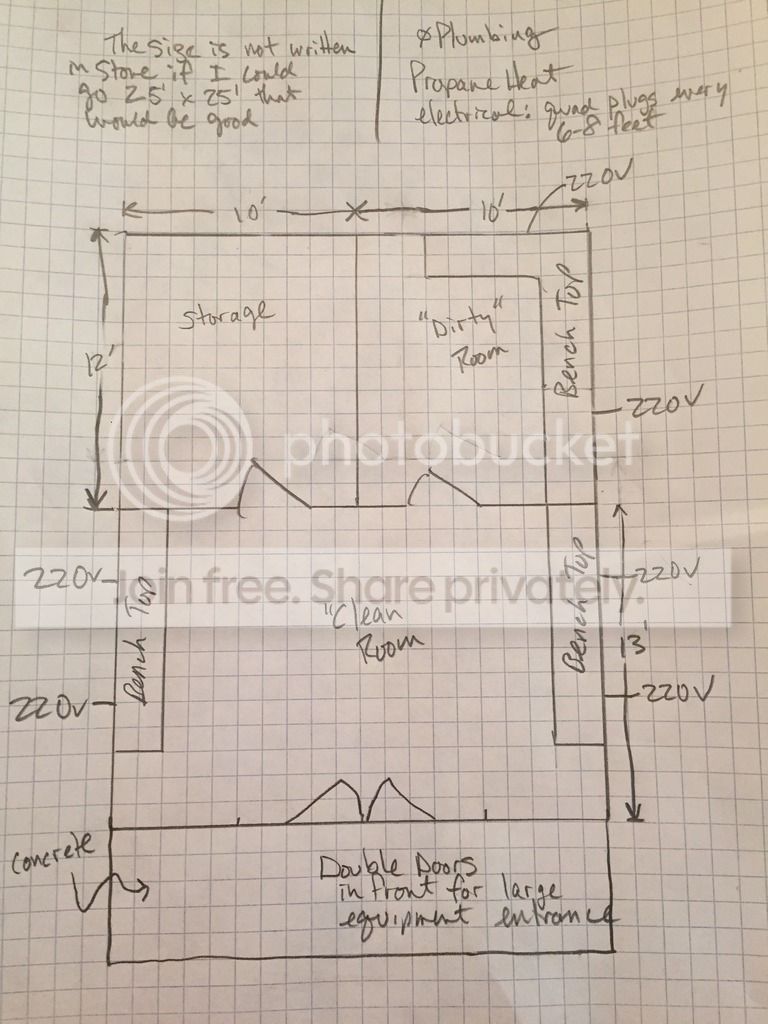


The right hand side of the picture is facing SW.
Electrical: quad plugs every 6' (each set of 2 plugs going to a different breaker) with 6 x 220v spread throughout the dirty and clean rooms.
HVAC: Propane fired forced air furnace. (No natural gas possible, the house is geo-thermal)
Plumbing: The house is on a well system and so I initially wasn't planning on plumbing it. I'm not yet sure how expensive it would be to plumb the structure. I'm now leaning towards plumbing as long as it's not cost prohibitive.
Windows: 3 on each side and 2 on the far end.
9 foot ceilings.
Barn doors in front and a side entry door.
I'm planning on having my KMG and disc sander in the dirty room. The plan is to some day have another grinder.
The clean room will have one wall where steel and wood will be stored, blanks cut with the portaband etc. On the other wall I would have the finishing station.

What do you guys think? Are the room proportions correct? When I begin forging I would imagine it will be in the clean room or is that a mistake? How thick should the concrete be? How critical is it to have it plumbed?
What I'm I missing?
Thanks!
 
If you're going to get into smithing, I'd say make the dirty room the larger of the two so that grinding as well as forging can take place in there. I used to have a small grinding room, and a large smithing/machines/finishing room- the forging area got everything else pretty dirty over time. Plus, a propane forge isn't the best thing to try to run in a cramped space. I like to have plenty of space between it and the wall, and then plenty of space in front of both doors so I can work without getting cooked.

As for storing stuff on the wall, my feelings are mixed. It's convenient, but not when space is at a premium. I recently pulled my remaining shelves off of the wall to make room for another machine. When machines, heat treat apparatus, welding gear and the like crop up, shelving becomes to me a nuisance. I have one freestanding shelf for small stock, more shelving built in under the workbenches in my clean room, as well as drawers under the grinder bench, and some remaining shelving outside under a shed-roof lean-to.

If you will have a lathe and mill at any time, consider keeping them in the clean room away from all the grit and dust from smithing and grinding. It will be good for the precision surfaces, over time. Put a surface grinder in the dirty room!

Why the concrete pad outside the double doors? I say if there's slab poured, maximize it with a roof and walls to make your entire footprint usable shop space. Also, since you are having a slab poured, and maybe plumbing the shop, have you considered heating the building with hot water through the slab? If I was going to build a shop from the ground up around here, that's what I'd likely go for.

The abundance of 220V outlets is good, and your thought to separate clean and dirty areas is spot-on.
 
One thing I'd like different in my current shop is a large window facing north so there is constant daylight without direct sunlight

I'd orient your building so that the clean room has a large north facing window.

Will it have a flat roof?
You may use over head space for storage as well
 
Thank you Salem and Hengelo. I wondered about the best place for the forge in the future. My concern was having the forge in the same room with the wood and metal dust of the grinders. If the room is big enough is that less of a concern?
Good point about maximizing internal space and I'll check with the architect and contractor regarding heating the slab.
There will be windows on both sides of the building. There are trees on the north side of the building and yard space to the south. The tree and lot line are dictating the orientation of the building somewhat. We'll have a pull down staircase with some storage above in the attic as well.
The other issue is lighting. I remember a thread a little while ago, I think started by Nick Wheeler, that discussed this. I'll probably do fluorescent lighting. Do I look for high K lighting? T8 bulbs?
 
I'd go with LED lighting from the get-go. Fixtures that emulate the size/shape of 4 ft. fluorescents. They are more expensive (although less every day) but they last WAY longer, are much brighter, more efficient, and are no problem in the cold. I HATE waiting for an old fluorescent bulb to warm up on a winter morning.
 
I'd go with LED lighting from the get-go. Fixtures that emulate the size/shape of 4 ft. fluorescents. They are more expensive (although less every day) but they last WAY longer, are much brighter, more efficient, and are no problem in the cold. I HATE waiting for an old fluorescent bulb to warm up on a winter morning.

It looks like LED's have come down in price, I'll have to check into them. I found some old threads on lighting and it looks like 5000ish K, high CRI 85+ bulbs are best?

I'll probably keep the configuration the same but make the smaller room the clean room and the larger one the dirty room.

How thick should the concrete be?
 
I'm with Salem on the LED, even if just over you main work areas to start. Windows will be nice too.
I'd consider access to the "dirty room" from the outside, think it might come in handy for access and ventilation.
I don't know how much 220V you need in the clean room? But more is better they say, especially for receptacles. :-o)
Perhaps a couple of 110 plugs up high for fans in the corner or additional lighting if it should be needed.
Concrete is hard on the body too, so a gravel forging area might be good? Please defer to a real smith on that though. (Salem?) Have fun. Dozier
 
Hey guys,
I'd like some help with a work shop that I'm going to have built on the property we just bought. I've looked at some of the old threads regarding design and as such have some idea what I want to do. However, I'd like advice and guidance on my specific build so I do it right the first time.
In our current home I'm in a basement room that's 10' x 10' and has been sufficient for stock removal but I'd like to delve into the world of forging and possibly heat treating and so the new space is going to be a larger and a detached structure.

I've contacted the city for all their requirements and am starting to work with an architect.

The yard space will allow a 25' x 25' building of which part of will need to be storage as our new house is smaller than our current one.
The other two rooms will be divided into dirty/grinding spaces and clean/finishing space.
Here is a crude drawing of the space: (It's shown as a 20x25 but will be 25x25)


The right hand side of the picture is facing SW.
Electrical: quad plugs every 6' (each set of 2 plugs going to a different breaker) with 6 x 220v spread throughout the dirty and clean rooms.
HVAC: Propane fired forced air furnace. (No natural gas possible, the house is geo-thermal)
Plumbing: The house is on a well system and so I initially wasn't planning on plumbing it. I'm not yet sure how expensive it would be to plumb the structure. I'm now leaning towards plumbing as long as it's not cost prohibitive.
Windows: 3 on each side and 2 on the far end.
9 foot ceilings.
Barn doors in front and a side entry door.
I'm planning on having my KMG and disc sander in the dirty room. The plan is to some day have another grinder.
The clean room will have one wall where steel and wood will be stored, blanks cut with the portaband etc. On the other wall I would have the finishing station.

What do you guys think? Are the room proportions correct? When I begin forging I would imagine it will be in the clean room or is that a mistake? How thick should the concrete be? How critical is it to have it plumbed?
What I'm I missing?
Thanks!

If you're going to get into smithing, I'd say make the dirty room the larger of the two so that grinding as well as forging can take place in there. I used to have a small grinding room, and a large smithing/machines/finishing room- the forging area got everything else pretty dirty over time. Plus, a propane forge isn't the best thing to try to run in a cramped space. I like to have plenty of space between it and the wall, and then plenty of space in front of both doors so I can work without getting cooked.

As for storing stuff on the wall, my feelings are mixed. It's convenient, but not when space is at a premium. I recently pulled my remaining shelves off of the wall to make room for another machine. When machines, heat treat apparatus, welding gear and the like crop up, shelving becomes to me a nuisance. I have one freestanding shelf for small stock, more shelving built in under the workbenches in my clean room, as well as drawers under the grinder bench, and some remaining shelving outside under a shed-roof lean-to.

If you will have a lathe and mill at any time, consider keeping them in the clean room away from all the grit and dust from smithing and grinding. It will be good for the precision surfaces, over time. Put a surface grinder in the dirty room!

Why the concrete pad outside the double doors? I say if there's slab poured, maximize it with a roof and walls to make your entire footprint usable shop space. Also, since you are having a slab poured, and maybe plumbing the shop, have you considered heating the building with hot water through the slab? If I was going to build a shop from the ground up around here, that's what I'd likely go for.

The abundance of 220V outlets is good, and your thought to separate clean and dirty areas is spot-on.


I would love in the floor heating.
Nice even heat with no worries about dusty air flow.

If you plumb with water, it's nice to have a little washroom maybe shower to hose off before you go in the house.
Let it doulble as a safety shower.
A sink for washing rinsing / especially ferric chloride and such is really nice.
However in Michigan, ,you will have to keep it unfrozen.
A small washroom is easier to keep closed and heated.

I'm with Salem, make it absolutely as large as possible.
I do see the sense in some covered roof and slab, but not if you have to give up inside space.
It makes moving big stuff easy if you can work over a concrete slab before you go in.


I' don't care for lining the walls with pegboard and tools. I like drawers like tool chests - it's clean and it's away.

I've read that North lighting is even, but I have south facing windows and I do like them best.

New T8 Fluorescent work well and start up pretty quick.
I like 6500K light, very daylight.

I know that everyone tells you to go overboard on power.
I have a different opinion.
Especially if you use externally mounted power like conduit not built into the walls

Plan what you want, put the power there and have plenty of room in the breaker panel and capacity in the service.
The machine can have a 6 or 10 foot cord on it which gives you 12 or 20 feet of latitude in placing it.

If you have to move a circuit or install a new one it's cheap and easy.
Take the difference of $ you would have spent up front and increase the square footage.

Consider the pro applied spray on foam insulation.
It seals cracks and drafts
The fiberglass goes damp and mealy, mousy and buggy- not as insulative in the long run.

Consider a translucent plastic garage door instead of barn doors
It's like a whole wall of windows and they are insulative.


Don't let household storage into this shop.
It will take over.
Just slap together a simple little garden shed for the crap.
 
if there is a Habitat for Humanity or architectural salvage store nearby, go look for used cabinets, countertops and shelving. when i furnished my new shop, I found several used kitchen cabinets with drawers and some shallow(12") upper cabinets and a shelving unit(6'x3'x1'). just the materials would have been double or triple what i spent. get some HardieBacker for worktop where you are going to be heat treating. get a couple of 2'x2' pieces of 1/2" HDPE, put these on your bench top before using glue or epoxy or finish. at both ends, put up at least a 4' deep loft. metal file cabinets are good places for power tools and larger hand tools.
just some thoughts.
scott
 
Last edited:
Yeah, the hardy board is a good idea for near your oven. Two other sentiments I gotta echo, file cabinets being handy for tools etc., and nixing household storage in the building. Since you are downsizing your living space, no doubt it will be helpful to have that storage as a buffer for a while as you adjust, but if it was me I'd try to reclaim that shop space asap by finding new homes for domestic items I didn't need.

Not that I'm any good at getting rid of stuff. Storage is always a problem. I'm going to have to build a bigger shop if I can ever afford it. My shop is 24x36' and crowded!
 
if you are currently working with your stuff in a 10x10 now, and are devoting 10x12 just for storage, i think later on you may wish you had made the storage area smaller and the other areas larger. a 6x10 storage area is pretty good sized.
 
Remember- lumber comes in 8 ft. lengths. 24 X 24 is much more practical than 25 x 25.
Build your shop exactly twice the size you think you'll need.
 
Lots of great ideas and advice here, thanks a lot!
Count, The translucent garage door idea is cool and I'm really hoping that plumbing this thing is in the budget.
The storage area is for my hunting, fishing and camping stuff so it should be at home in the shop/man cave :D But John you're right it could be scaled down.
Scott, HDPE and Hardie boards sound like a great idea and Bill you're right about 25 being an odd length, I'll have to re think that.
 
I took a lot of time deciding the hight of my work benches. I enden up three different hights build around me.
An inch or less to high or low can mean back pain.

Screw cheap thin multiplex board on you worksurfaces. Replace them when needed and have bright new work benches.
 
make at least one work area that can be worked sitting down. saves wear on the legs and it real good for intricate work. if your floor is concrete, get or make some anti-fatigue mats. working on steel or concrete floors for a long time will wear your legs out, i had to get a new knee a year ago.
scott
 
, if your cement slab extends from inside the building to the porch, and you're in Winter country in the winter the cold will conduct into the building from the outside porch
 
Lots of good input here. Can't wait to see your work when finished. Was messing with the knife I got from you today and it's Way Good. Dozier. (WDL III)


Sent from my iPad using Tapatalk
 
, if your cement slab extends from inside the building to the porch, and you're in Winter country in the winter the cold will conduct into the building from the outside porch

Here's where I'm at right now. I've got the floor plan so now I'm waiting for the construction elevations. (The slab in front is now gone) Bill, I checked with the architect and commercial lumber can be purchased in different lengths so going with the odd lengths won't increase waste.
Heating method is still up in the air. I'll be getting quotes from the contractor for in floor vs furnace heat once we get construction plans done. Either way there needs to be a small furnace room for that plus I'll probably put a small point of service hot water heater in there. If I go with forced air heat it would leave open the possibility of air conditioning in the future.

 
Back
Top