HELP! Lathe questions!

Joined
Jul 20, 2007
Messages
3,121
Ive run into some more snags in my grinder building process.
-I have to turn the wheels.
-key the shaft.
I also have to attach the tracking mounts and idler wheel mount, attach the tracking arm support, the tracking arm handle, the spring, make the motor mount and make some sort of platen or contact wheel

Wheels:

I understand how to turn the drive wheel from Rob's cnc video on his site, although I do not have the means to cut a keyway yet.

The idler wheel, on the other hand, Is more challenging. I do not know I should make it.

First off, I am not sure if the lathes we have are all running true. How can I check and adjust them?

Second, I am not sure on how I should go about cutting the bearing bores, I was told here on how a few ways to machine them. I was told by a local machinist that he would cut one bearing bore, flip it, cut the other one, then turn between centres to do the face but Nathan's mandrel way sounds easier but with more work involved to turn the mandrel. One issue was keeping it in the setup, I can do this by leaving a threatening note on it and put some sort of cover over the lathe.

Third, I was told by ib2v4u that there is a spacer holding the centre races apart, so how wide will the bore be to accept this?

Fourth, how deep are the bearing bores? I looked at a picture on Rob's site, and it looked like the bearings were not flush with the wheel.

Fifth, What is the angle of the crown on the wheels? I have heard 1 degree and I have heard 5.

Sixth, today I ordered cheap sealed bearings for it, I was going to buy the cheap ones with metal seals, but decided on the rubber ones, should I have bought the ones with metal seals instead? There was also high end bearings there, over $13 each, should I have gotten those?

Thank you in advance! I know it was a long winded post, and I have some other questions on the tracking mounts and the drive shaft, but those can wait.

oh and I took some photos.

One of the lathes
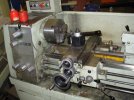
DSCN2697_800x600.jpg

The milling machine, notice the vertical, horizontal combo.
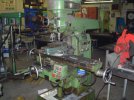
DSCN2699_800x600.jpg

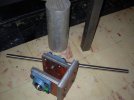
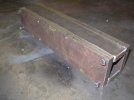
Some parts
DSCN2703_800x600.jpg

my troublesome receiver
DSCN2692_800x600.jpg

This is the tracking mount. I have other parts but I didn't take photos
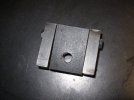
DSCN2695_800x600.jpg
 
I can answer 3 and 4

I will answer them backwards and you will get it.


I cut the bearing bores till the outside of the bearing is flush with the outside of the wheel.

The spacers I cut maybe 1/64th longer than the bore by trimming and fitting. Just enough so you could barely see the bearing not flush.

This is not the "ONLY" way to do it of course, it is just what worked for me. Hopefully I will have pics up on Sunday of the finished grinder. final assembly this weekend.

EDIT...

#2... I trued up the OD maybe 90%, cut a bearing bore, flipped it, cut the other, then trued up the OD 100%. I felt that starting off with a fairly trued OD first would help me get concentricity with the bearing bores. Maybe it did not matter, but the wheels are straight.
 
Last edited:
On the spacer take the thickness of your hub and subtract the thickness of 2 bearings, then add about .02 the will make the spacer long enough to hold the centers of the bearings apart. When you tighten the bolt that holds the wheel to the arm it will hold the bearings centers tight to the spacer. The outer races OD should be a slight press fit to the wheel and should allow for a flush fit. With the spacer they should be about .01 out from flush. As long as your lathe has no slop in the bearings it should turn true. Your chuck might not center true. But, if you put a piece of round stock in the chuck and turn it to a tapered point similar to a dead center and then DON'T remove it, the taper and point will be true. Turning the OD on this center and a live center will make it true. If you use a mandrill you need to check it for centered by turning the lathe by hand with something in the tool holder to check it for centered. Mess with the chuck to see if you can true it up. You can adjust with a 4 jaw chuck.You could laso mount the mandrill on a tail stock center and a turned center like I described above. You will need a lathe dog to transfer power from the chuck to the mandrill.
The proper way to cut a key way is with a press and a broach. You can poor boy it by using a milling machine and a small square file. Set up the piece so you can run a end mill down the edge of your hub cutting not quite a half circle. Down feed slowly so the mill does not defect, if you want a 3/16 keyway use a long 3/16 mill. Then use a file to square up the corners of the cut and take the slot to 3/16 wide and 3/32 deep. It works if you have some time and patents. I have done it. Maybe there is an easier way. I am a hack machinist. When I put bearings in a 10" Grizzly contact wheel, I had to make sure the OD was centered and square to the tool before I cut the bearing holes on each side as my OD was already set. This is simply a matter of patents and a lot of small taps and adjusting on a 4 jaw chuck.
 
Last edited:
To check Lathe run out:

First find yourself a piece of drill stock (before it has been fluted etc.) whatever you use needs to be at least 1/2" diameter judging on the size of the lathe chuck.

Second get a dial indicator with a base, set the indicator to have a zero reading when pressing against the drill rod stock at about 3" out of the chuck if possible. (Most any dial indicator can be zeroed by simply rotating the bezel, while it's not necessary to zero you just want to make sure the dial doesn't read more than a few thousands off. .001 inches) rotate the chuck slowly by hand and watch the reading of the indicator. With a 3 jaw self centering run out is hard to fix easily, and I wouldn't recommend messing around with it for a idle wheel. If you have a 4 jaw indipendent chuck use that, if the run out of the chuck itself is reasonably small and it doesn't vibrate it's just a matter of centering the piece.

As for the bearings for grinding with steel and metal dust or any dust for that matter rubber sealed bearings are the way to go, I might have gone for higher quality than the cheapest, but it shouldn't make a huge difference unless you use the machine daily for hours on end.

I think it may just be a better bet to go with the pre made wheels and just mount them up. If you go your own route be safe, but I'm not sure school shop equipment will get you the desired results.

Good luck either way.
 
Thanks, guys, my teacher often teases me about being a perfectionist and wanting everything square and straight, as opposed to just banging it out faster.
I'm glad that the auto shop had a dial indicator, I "liberated" it from there :)

So my bore going through should be just larger than my spacer?
 
The bore can be anything smaller than the OD of the bearing. You need a bit of a shoulder to hold the outer race from moving in. The spacer will not move around if it has an ID just over .500 and you use a 1/2" bolt or shaft to mount the wheel.
 
Thanks, guys.

Yep. What is the size of the stock you are using? diameterxlength

and What size wheel are you making? diameterxlength.

I am using 4" round stock, and the wheel is 3.5" OD and 2.5" wide.
The drive wheel is 4 OD and 2.5" wide.

I think I will turn between centres. Is there any tips for doing so? How steep of an angle should the drive centre be turned at?
 
The bore can be anything smaller than the OD of the bearing. You need a bit of a shoulder to hold the outer race from moving in. The spacer will not move around if it has an ID just over .500 and you use a 1/2" bolt or shaft to mount the wheel.

What I've highlighted in bold font is not actually accurate. Bearings come with a certain amount of radial internal clearance built into them. The amount of tight fit on the shaft and/or in the housing will remove some of this clearance. If you have it too tight it will remove to much clearance and cause the bearing to run hot and burn up. If you don't remove enough clearance, it will cause the bearing to run too loose and will spall out eventually from the load being carried over too small of a portion of the non-rotating race.

If you give me the bearing part number and manufacturer, and which part of the bearing (outer race or inner race, but I'm thinking it's an outer race rotation, but want verification) is actually rotating in service, I'll be able to give you shaft dimensions and housing dimensions, plus the tolerances of each that you'd need to hold to get the longest possible life out of the bearings.
 
So, you mean to say that the shoulder should clear the inner race?
Once I get them, I will defiantly check that out. Thanks, Scott.
 
I had to cut a keyway a couple of years ago and I found the easiest way was to use a chisel. It took me about 20 min to cut 1 3/16" keyway through 1" of steel. A broach sounds even easier, But I couldn't make a broch.
Del
 
Did you do it by hand or with a lathe or mill? I forgot to mention about jim's advise with the cutter, being that we do not have 1/8" end mills and no collets for them either. The only thing that we use the milling machine for now is facing with the 3/4" 4 flute that I put in 3 months ago.
 
If you are cutting a key in the bores of the wheels use either a key cutter or a broach. The broach is used in combination with a bushing and press. Put the bushing into the bored hole and use the corresponding broach to cut the keyway. If you are cutting a key in the shaft, use the appropriate size endmill, center the cutter over the shaft. is is best to try and cut this in one pass, it will give you the most accurate cut. Or you can use a woodruff key cutter and go from the side. Looking at your last post you may want to invest in an inexpensive collet and endmill set. This can be invaluable and will be needed. Enco has an R-8 collet set for $25. 1/8-3/4 by 1/8ths
 
our school does not have the right vertical cutters, but I did see a horizontal 1/8" cutter, but it wasn't super sharp and had blue-purple discolouration on it. I could buy the collet and the cutter, but the horizontal might have better chip clearance anyway.
 
The 2 options I see here are, 1 buy the tooling and have it for the next time you need it. I would say it would cost $50 to buy and assortment of collets and endmills. or 2 get all the pieces ready for assembly minus the keyways and seats, then take them all to a machine shop and have them cut them all with one or 2 set-ups. Either way it will cost about the same. At least that is what i would have charged at my shop.
 
Yes, I will probably end up bringing the drive wheel to a machine shop to get keyed.
I still think that I can do the bearings myself, though.

I have another question, What are the advantages of turning it on a mandrel over just turning it on centres?
 
Did you do it by hand or with a lathe or mill? I forgot to mention about jim's advise with the cutter, being that we do not have 1/8" end mills and no collets for them either. The only thing that we use the milling machine for now is facing with the 3/4" 4 flute that I put in 3 months ago.

Keith,
I cut the keyway entirely by hand with a hammer and a chisel that I made for the purpose. I do not have a milling machine, and it was really the only way I could do it. I had to have a 1" diameter piece of keyed shaft. I had some L-6, so I used that. I am accustomed to finding unusual answers to problems that come up when I am making new tools.
Thanks,
Del
 
Turning it on a mandrel, one side is normally chucked up and the other is supported by a center. Turning between centers requires a lathe dog and 2 centers. One in the chuck and one on the tailstock. One advantage is you can turn the center in the chuck and it will be perfectly aligned. This is as long as it is not removed until the job is complete. Now if you are going to bore the bearing seats then neither of these methods will work. Both require you to have a shaft running through the workpiece. You will need to bore the bearing seats in a chuck. If the machine has a 4 jaw chuck you can dial the work in. By the looks of your lathe it does not look like an adjustable 3 jaw. If you turn the bearing bore then turn the OD between centers this can remove much of the run-out. There are a few ways to go about this. You could almost do the whole wheel in the chuck if you cut the bore then turn the OD without removing from the chuck. The only problem with this is you need a large enough piece of stock to hold and turn without removing it.
 
Scott, I did not mean the OD that the outside of the race presses into. I know that has to be the correct size. I was referring to the OD of the rest of the hole. Does it matter if the shoulder the side of the bearing sets against is .10 or .05? The bore thru the center on mine is .875 and the cut for the bearing OD is 1.1248 or 1.249 (can't remember but a slight press fit) for a shoulder of almost .125. If my center bore OD was 1.00 and it made the shoulder .0625 what would it matter as long as the OD and depth were correct?
 
Back
Top