Help me understand patinas please. CV Case knife on the way

Joined
Mar 6, 2012
Messages
3,530
Hello there!
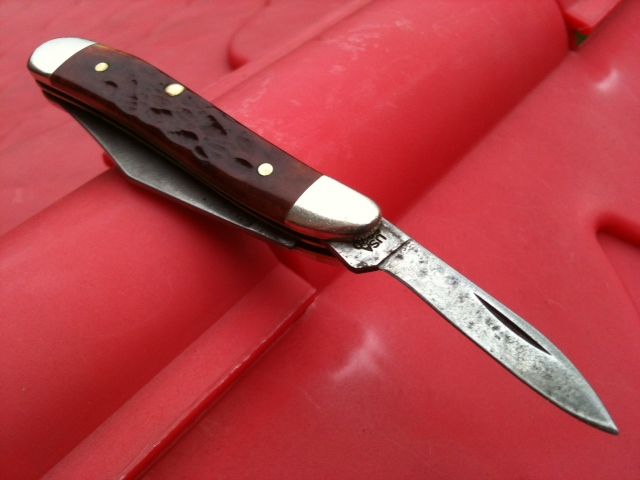
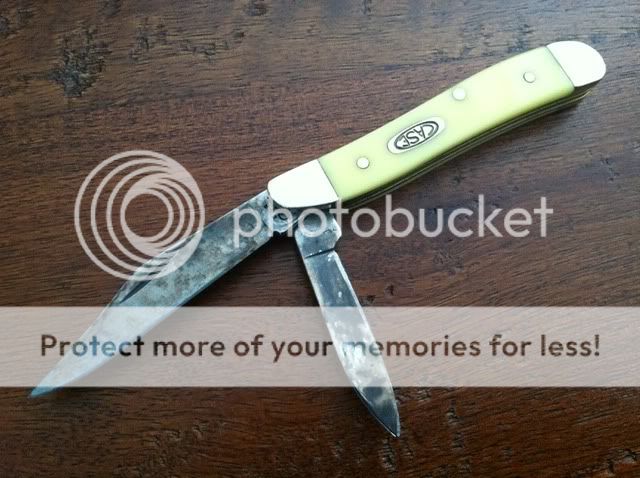
I have ordered a Chrome Vanadium Case Peanut with yellow handle scales.
I had to get something made of CV, and I didn't have a Peanut, so it added up nicely!
I love looking at patinas, and it makes "old" knives look so much better.
So, when my knife gets here, I plan on EDC-ing it all the time.
I like the idea of natural patina, and I'm not going to force one.
How long will it take, and do I need to oil it for a nice even patina with no dots? What care is required so that deep rust doesn't take over the patina?

Thank you for the help.
Bladeboss
 
I just wipe the blade down with some mineral oil or 3-in-1 after I'm done with it. I wash it before food prep, but don't worry about other stuff. If you don't protect the steel it will rust and pit. Food is the preferred method of developing a natural (non-forced) patina. Apples work well and potatoes. Oranges are quite agressive. Mustard will move a patina right along. There are lots of threads concerning the subject; and lots of differing opinions on what to do and how to get a patina built up on your blade.
Ed J
 
Make a couple of gin and tonics and a couple of rounds of hashbrowns, wipe it down immediately after cutting food and oil it with mineral oil shortly there after...in a couple of months you should have a nice little patina going
 
In My Opinion

Don't worry about even patina if you want a natural patina. Use the knife, wash it and then all will come eventually. I've had patinas form in a week, over a day- all depends on how, what and how often you use it. To naturally accelerate it I suggest BBQ sauce on steak and lots of Mangoes- gives a nice blue finish to the blade. Do kitchen prep with it to learn its strengths and weaknesses. If you normally oil the blade then do so. Worry about rust as much as you regularly would, don't leave it wet or in salty conditions.

I just let them happen and they seem to turn out well.
 
I have knives that I have had for 30+ years that I've done very little in preventative maintenance and have never had a carbon knife rust. In recent years when I get a new knife I wash it with dish soap and water or rubbing alcohol before use on raw food to be consumed, if cooking heat will kill any bacteria. I don't force a patina I encourage or persuade it by use, I eat a lot of fresh fruit and tend to use my knife to prepare, I eat a lot of mangos, peaches, plums, tomatoe salads, and make fresh squeezed orange juice everyday, never had a problem with oranges, gut fish, etc.After use I tend to wash and use alcohol in the joints to displace any h2o, and oil the bone scales, and in the joint with high grade mineral oil which is safe to consume, it's actually a digestive aid, some transfers to the blade but I usually wipe clean. Hope this was somewhat helpful. Enjoy your new peanut I carry and use one daily, check out last months traditional of the month it was the peanut you can see some of the things the mighty nut can do.
-Pete
 
Don't oil the blades at all for a nice patina. I don't oil any blade of mine, just keep it dry. Wipe it down with a clean dry bandana in the morning, and just carry and use it during the day. When you use it on something like food, just wipe it off with a paper towel or rinse in plain water and dry with a bandana or paper towel, and drop back in pocket. The patina will form, just be patient and let nature take it's inevitable course.

Carl.
 
It's just rust of a different color. Don't worry. Don't oil the blade and it'll happen.
 
Forced patinas in my opinion are for young people only. Take care of your knife, use the piss out of it, but use it if it is a user. Keep it oiled, wipe your blades when you think of it. That is pretty much it for a natural patina to occur. Users, are just that, and will develop a patina over time. Anything else does not make sense if traditionals are your thing. A 19 year old may want to stick his carbon blade in an apple to appear old school. Let them have at it an enjoy it as it is there knife. They paid for it and can burn it if they wish. No harm, no foul. Rust=neglect. You will not have a rusty knife if it's an EDC that is cared for. A forced patnina reduces the price of a knife around 40% in the secondary market. However, if that is your thing and you paid for it have at it. As to your question, the above mentioned will hold true.
 
I just use my knives and it comes. Some it takes a little longer, depending on their use. I find whittling slows down a patina as it kind of rubs it off. Being a student with a minimist kitchen I sometimes use my knives for food prep if they are large enough. The knives that get kitchen duty get a patina pretty quick.

As for oil, I just throw mineral oil on them every once in a while and give them a good clean up to. Other than that they just cut stuff :)
 
I figured I would chime in hear and agree with most everything that has been said.
When I use my peanut, I use my peanut, no job is too big or too small, too dirty or too fancy for the little nut. It will get that nice patina, but it will take a little time.
I've used mine for food prep and had it real dark, then I've tore down some boxes and lightened it up.

As far as forcing a patina goes, sometimes it's a blade safe. Some will disagree with the technique of sticking a blade in an apple, but even Jackknife will tell you, when you live in a humid environment it pays to have a blade with a nice patina.
I've had even well oiled carbon blades rust in my pocket while sweating under the hot sun.
 
Forced patinas in my opinion are for young people only. --- A forced patnina reduces the price of a knife around 40% in the secondary market.

Not sure I agree with you there :) Anyway...welcome to the traditional forum nice to have you along.

article-0-1384F79A000005DC-594_964x721.jpg


http://i.dailymail.co.uk/i/pix/2012/06/09/article-0-1384F79A000005DC-594_964x721.jpg
 
Last edited:
Me either Carl, I've had too many old timers tell me to stick it in a potato. :)

One thing about natural patinas is that they will be much more robust. A patina formed over years will be bonded to the steel in a way that a one day old mustard patina won't. The patina is going to need to breath over a period of time to bond right and it won't do it if you drown it in oil... mof if the oil has detergent in it you will end up stripping part of the patina away.

Here is the knife that I have chosen to be my EDC less than 2 months ago. Is the patina natural or forced? I just use it but the things I do cause a patina to form. And I stripped it once to leave only the well bonded part of the patina and then slowly built it back. Now it is strong enough not to rub off when I've used it to cut some zip ties or green wood or whatever needs a good cutting. You be the judge but you can hold it up to the light and you can't 'see through it'.

Will

cigar_01A.jpg
 
Forced patinas in my opinion are for young people only.

Can't say I agree with you here. My grandad was no spring chicken when he told me about sticking a knife blade in a potato.

To the OP's question about patinas, though, this thread about my cv peanut might help.

I'd just keep the knife blades dry. Wipe 'em off from time to time; that's it. A wee drop of oil on the joints from time to time is a good idea.

-- Mark
 
> do I need to oil it for a nice even patina with no dots?

I would say yes, others will disagree:

> Don't oil the blades at all for a nice patina

> Don't oil the blade and it'll happen.

> The patina is going to need to breath over a period of time to bond right and it won't do it if you drown it in oil

here is someone who did not oil and got dots (at first I thought the dots were caused by oil, but I no longer do. I like oil, and do not think it interferes with patina.)

Nut1-2.jpg


I do oil my blades, and I do have a very nice even patina on my Slimline Trapper, so I disagree with my belief, gleaned from others here, that oil interferes. In fact, my opinion today is, I think oil makes for a smoother patina.

65abfbb7.jpg
 
Last edited:
I know there's different opinions on forced vs natural patine, but the two are not incompatible, but one augments the other one.

I know my granddad's folks, rough old cobs that they were, always took a brand new pocket knife and stuck the blade in a potato overnight. They cleaned the blade well, getting all oil off, then let it sit. In the morning, it had some level of protection. These were working watermen on the Chesapeake, and it was a dirty wet job. In summer, the heat and humidity would rival the Georga low country coast. A new knife with no protection would rust quickly, and it's just impractical to have oil smeared on a pocketknife blade. Pocket lint and dirt would stick to an oiled blade that may be called on to slice an apple or plug of tobacco. .

Once the new overnight patina was formed, the new knife in question was dropped into the pocket and started out it's hard working life. The patina would continue to darken over a period of months, and many old knives had dark gray blades. The overnight potato patina was like a first layer of primer to protect the steel, until over time a deep natural patina built up like a final paint job. The knife was exposed to salt water, seat, salted bull lips or eel, quail breast, plug tobacco, tarred rope, and pipe bowl carbon, or slice a piece of apple for an old waterman who has dentures. All in one day. I don't think the owners worried over resale or collector value, since these knives were destined to be used down to sharpened toothpicks then replaced.

If it's going to be a real edc using knife, I'd go ahead and get a patina started with the potato and use the heck out of the knife and just let it keep building. Just wipe it off att he end of the day with a clean dry cloth or bandana and let it go.

Carl.
 
> stuck the blade in a potato overnight.

I agree that works well to protect a new blade, although I don't always do it, sometimes I just let food do the job

> it's just impractical to have oil smeared on a pocketknife blade.

True, smearing and not wiping is excessive :-)
After I use my Peanut and wipe the food off, I sometimes rub my fingers on my forehead or cheeks, then rub the blade with my oily fingers :-)

> The overnight potato patina was like a first layer of primer to protect the steel,

I really like how you write, total agreement that the potato patina is protective. I find Olive Oil also helps..

and fwiw, I have used a Tuff Cloth on some of my blades and noticed that it seems to reduce patina formation

I also notice that patina rubs off onto food sometimes, and I can taste it.. not my favorite thing.. I find stropping on leather or cardboard helps remove excess patina.. if the blade is used infrequently

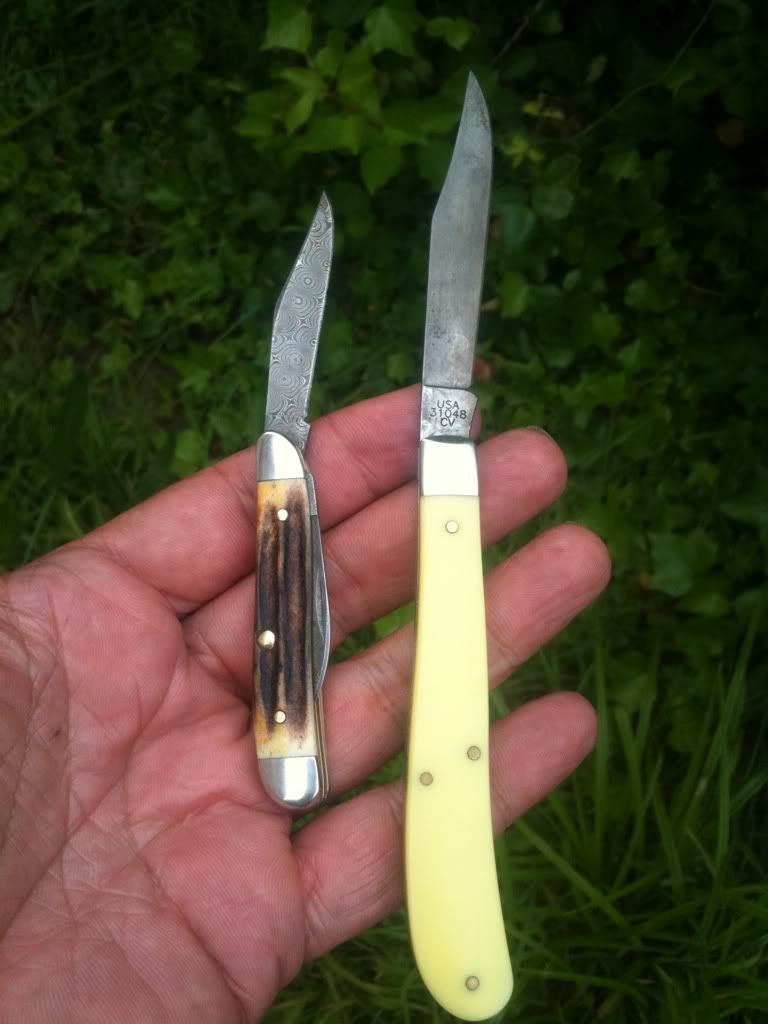
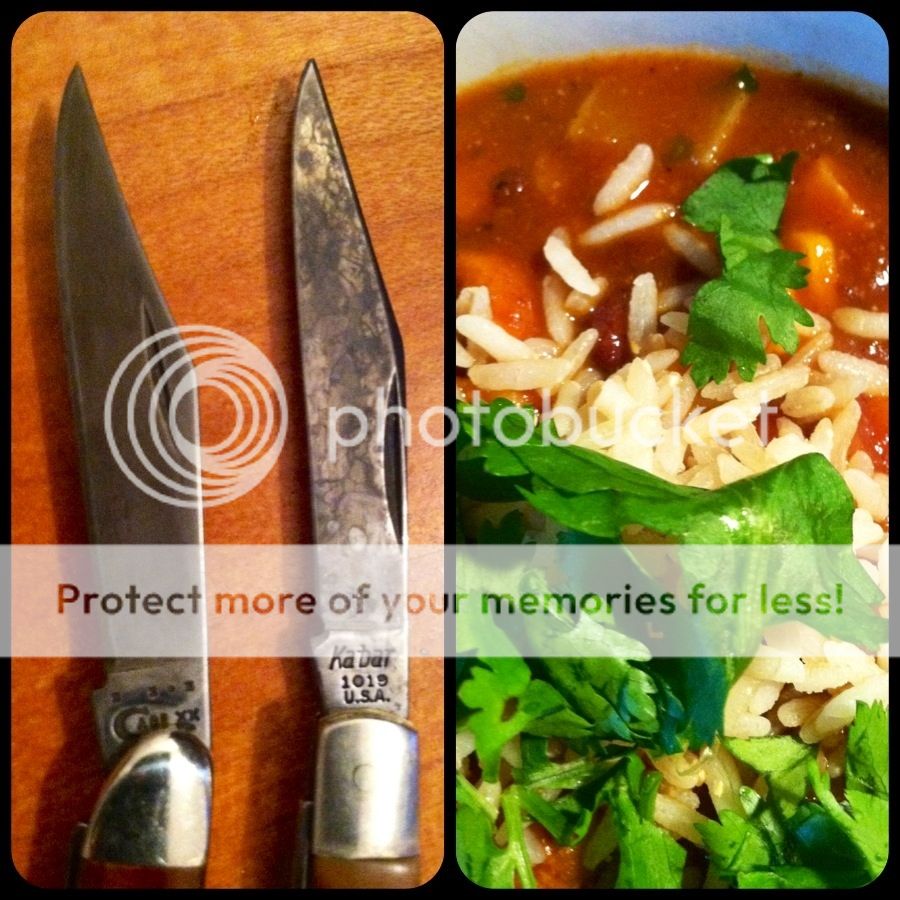
since I love pictures, here are some patina examples
this one made salsa and guacamole
c63a688b.jpg


the blade on the right is new patina partly from slicing oranges
e25912ab.jpg


both pics from this thread
http://www.bladeforums.com/forums/showthread.php/952279-Traditional-of-the-month-Peanut/
 
I know there's different opinions on forced vs natural patine, but the two are not incompatible, but one augments the other one.

Carl.

+1 It's the same chemical reaction in the steel however you do it at the end of the day. Once you get a few months of use on the blade I think you'd be hard pressed to tell the difference.
 
My favorite method of making a patina is to start with a CLEAN blade, and cut up a bunch of raw meat. Chicken, beef, pork, venison... any will do. Not only will a patina start to form, but it will be very interesting. Nothing else I have tried will give what I call the "rainbow" patina like raw meat. I have had some spectacular results on 52-100 and related steels with this method.
 
> stuck the blade in a potato overnight.

I agree that works well to protect a new blade, although I don't always do it, sometimes I just let food do the job

> it's just impractical to have oil smeared on a pocketknife blade.

True, smearing and not wiping is excessive :-)
After I use my Peanut and wipe the food off, I sometimes rub my fingers on my forehead or cheeks, then rub the blade with my oily fingers :-)

> The overnight potato patina was like a first layer of primer to protect the steel,

I really like how you write, total agreement that the potato patina is protective. I find Olive Oil also helps..

and fwiw, I have used a Tuff Cloth on some of my blades and noticed that it seems to reduce patina formation

I also notice that patina rubs off onto food sometimes, and I can taste it.. not my favorite thing.. I find stropping on leather or cardboard helps remove excess patina.. if the blade is used infrequently

since I love pictures, here are some patina examples
this one made salsa and guacamole
c63a688b.jpg


the blade on the right is new patina partly from slicing oranges
e25912ab.jpg


both pics from this thread
http://www.bladeforums.com/forums/showthread.php/952279-Traditional-of-the-month-Peanut/

Hey, I know those fellas, my case nut on the left has made orange juice everyday for about six months, if you check out the thread you see I don't baby my peanut and have used it for everything, I am most impressed with Cases CV edge retention.
The Kabar nut on the right I had picked up cheap at a flea market and the previous owner never developed a patina and there were little pit marks on the blade, so after a good cleaning I put the little guy into service. Since the juice the little guy has gutted some fish, I like the Kabar, but the case feels more solid.
 
Back
Top