
-
The BladeForums.com 2024 Traditional Knife is available! Price is $250 ea (shipped within CONUS).
Order here: https://www.bladeforums.com/help/2024-traditional/
You are using an out of date browser. It may not display this or other websites correctly.
You should upgrade or use an alternative browser.
You should upgrade or use an alternative browser.
Help me understand patinas please. CV Case knife on the way
- Thread starter bladeboss
- Start date

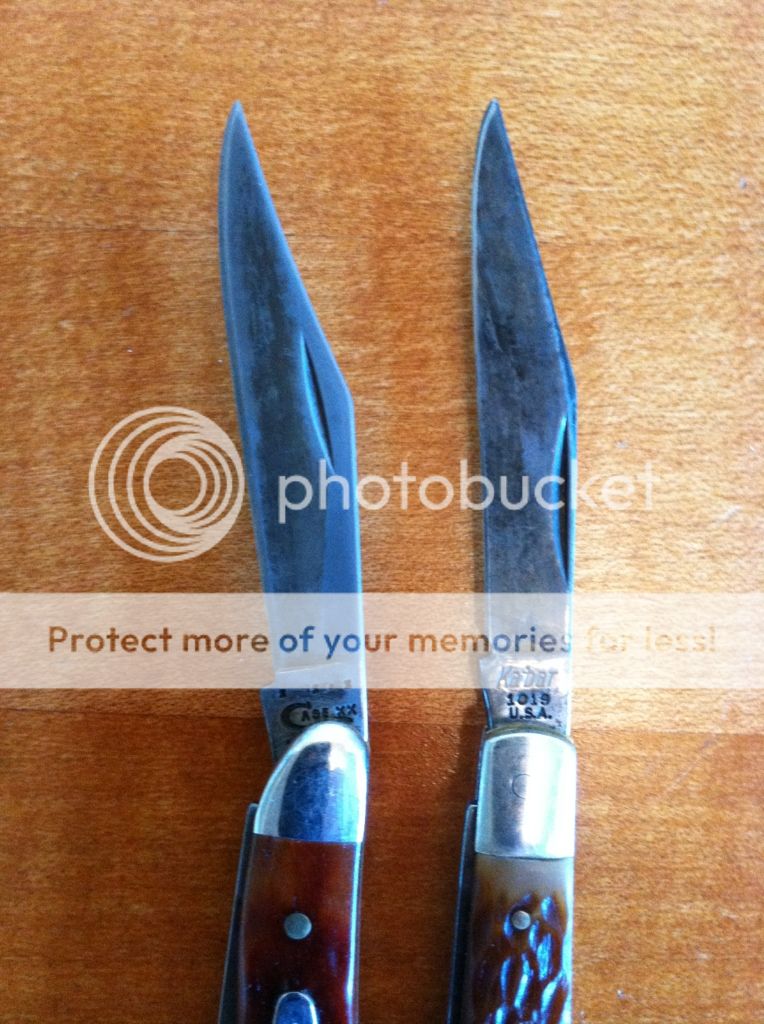
All patina is forced no matter how you do it. If you want an even patina to start with coat the blade evenly. If you let a patina happen it will change over time no matter if you let it form by sticking it in a apple over night or cutting up an apple instead. Both methods can be called natural and or forced.
- Joined
- Aug 24, 2010
- Messages
- 1,447
> if you let it form by sticking it in a apple over night or cutting up an apple instead. Both methods can be called natural and or forced.
lets define natural and forced, here is my attempt at a working definition
natural would be using the knife to cut apples for the purpose of using the apples
forced would be sticking the knife in an apple overnight for the purpose of forming patina
so natural would be slicing a sandwich that has mustard in it, for the purpose of eating the sandwich
forced would be coating the blade with mustard overnight for the purpose of forming patina
I agree, forced patina uses the same products, apples or mustard in these examples, as natural patina. The difference in natural is the blade is being used to prepare food to eat, whereas in forced patina, the food is being used to create patina by leaving the food in contact with the blade for several hours, such as overnight, with no intention of using the food for eating, only for creating a patina on the blade.
I find cutting a lime with a new CV blade very quickly results in some nice colors, including blues, on the blade. Irregular patinas will even out over time as more patina forms over the previous layers of patina.
Does anyone else have a negative reaction to patina that comes off on food, like I do. Does anyone else hate the taste of patina that rubs off on food, like I do?
lets define natural and forced, here is my attempt at a working definition
natural would be using the knife to cut apples for the purpose of using the apples
forced would be sticking the knife in an apple overnight for the purpose of forming patina
so natural would be slicing a sandwich that has mustard in it, for the purpose of eating the sandwich
forced would be coating the blade with mustard overnight for the purpose of forming patina
I agree, forced patina uses the same products, apples or mustard in these examples, as natural patina. The difference in natural is the blade is being used to prepare food to eat, whereas in forced patina, the food is being used to create patina by leaving the food in contact with the blade for several hours, such as overnight, with no intention of using the food for eating, only for creating a patina on the blade.
I find cutting a lime with a new CV blade very quickly results in some nice colors, including blues, on the blade. Irregular patinas will even out over time as more patina forms over the previous layers of patina.
Does anyone else have a negative reaction to patina that comes off on food, like I do. Does anyone else hate the taste of patina that rubs off on food, like I do?
I enjoy the patina on the blade to me the blade looks more alive and you can see that it has been used, this is one reason to why I actually preferr carbon steel to stainless.
As far as I understand it the patina is part of the oxidisation process of the metal used in the blade, basically a form of controlled rust. The oxygen molecule in the metal is "used" by the patina and makes it harder for the rust to set. Now the blade will rust eventually but the patina helps to keep it under controll, therby giving us longer time to clean it up.
As far as I understand it the patina is part of the oxidisation process of the metal used in the blade, basically a form of controlled rust. The oxygen molecule in the metal is "used" by the patina and makes it harder for the rust to set. Now the blade will rust eventually but the patina helps to keep it under controll, therby giving us longer time to clean it up.
I say go ahead and define it any way you like. Tomato tamoto to me. I'll give you my favorite forced patina method. Cut up fresh limes have some friends over. Squeez limes for juice, and make.
Margarita
2 parts tequila
1 part Cointreau or triple sec
1 part lime juice
1/2 part lemon juice
1/2 part simple syrup
Shake with ice. Serve in Margarita glass. My secret is 1 dash of Angostura bitters. Repete all night long. The next morning or later that day remember you forgot to wash off your favorite pocket knife. Tada a nice patina. .
Margarita
2 parts tequila
1 part Cointreau or triple sec
1 part lime juice
1/2 part lemon juice
1/2 part simple syrup
Shake with ice. Serve in Margarita glass. My secret is 1 dash of Angostura bitters. Repete all night long. The next morning or later that day remember you forgot to wash off your favorite pocket knife. Tada a nice patina. .

- Joined
- Feb 1, 2012
- Messages
- 11,784
shake with ice. Serve in margarita glass. My secret is 1 dash of angostura bitters. Repeat all night long. the next morning or later that day remember you forgot to wash off your favorite pocket knife. tada a nice patina. .

~ p.

- Joined
- Feb 7, 2000
- Messages
- 6,693
Does anyone else have a negative reaction to patina that comes off on food, like I do. Does anyone else hate the taste of patina that rubs off on food, like I do?
That's not permanent. In time it'll stop giving off a taste.
-- Mark

oldschool45
Gold Member
- Joined
- Oct 15, 2007
- Messages
- 1,242
Oil the joints... where have we heard that before
On carbon steel just keep it clean & dry. I've gone to almost all carbon steel blades in the kitchen. They next to never get oiled and sometimes stand in soapy water for a bit. They get dried after being cleaned. I have patinas but no rust. On the newer Case CV knives I believe that the springs are stainless so they likely won't take a patina.
On carbon steel just keep it clean & dry. I've gone to almost all carbon steel blades in the kitchen. They next to never get oiled and sometimes stand in soapy water for a bit. They get dried after being cleaned. I have patinas but no rust. On the newer Case CV knives I believe that the springs are stainless so they likely won't take a patina.


- Joined
- Feb 22, 2007
- Messages
- 9,008
Sigh. you have black rust, but no red rust.
Hi Frank,
I know we both have read these threads, but I still can't get a technical handle on the difference between rust and patina. Just saying one is red and one is monochrome makes sense but there has to be more. I was hoping since you have the technical knowledge that you could explain it once and for all. For example, firearms are hot blued to protect from rust. We can force patinas or let natural patinas occur to block rust. So, I did some searching, the best I could find was the following,
The difference is what the iron element reacts with. In the case of water, it's with oxygen to form FeO2 or FeO3, iron oxides, which give a reddish color. You can actually buy lab quality cans of the stuff, it's a rust red powder.
When you are applying any kind of acid etch or bluing formula you are controlling what the iron particles react to. With the mild acids you will turn the steel gray, with bluing solutions (bluing "salts" suspended in a liquid) you can turn them blue-gray to black. Hence the old term, "rust bluing" as it applies to the hand finish technique on old firearms.
The acid etch or bluing oxidation protects the steel from bad oxidization (rust) by getting iron to bond to something good before it has a chance to bond to something bad.
Could you explain the difference to me (us) in a more technical way that still might not go right over my head?
Thanks,
Kevin

There is also an oxide layer on stainless steel. I think we call that clear rust. I much prefer both clear rust and black rust over red rust.Hi Frank,
I know we both have read these threads, but I still can't get a technical handle on the difference between rust and patina. Just saying one is red and one is monochrome makes sense but there has to be more. I was hoping since you have the technical knowledge that you could explain it once and for all. For example, firearms are hot blued to protect from rust. We can force patinas or let natural patinas occur to block rust. So, I did some searching, the best I could find was the following,
Could you explain the difference to me (us) in a more technical way that still might not go right over my head?
Thanks,
Kevin
Last edited:
Thank you all.
So I think the final question is....
Should I oil it, or not?
Im feeling........no. But, I've never had carbon steel/CV blades (as you know now)
Well I am glad to hear that you are getting it settled in your head. TBH carbon blades are kind of utilitarian, they are hard to screw up and that is why they were so popular for decades.
Patina is a hard subject to discuss. The actual patina is something that pictures are almost incapable of showing accurately. Oil on a patina makes it look better that it is. What angle the light hits is will make it look different. The setting and lighting will make it look deeper or more shallow... it's tough.
Just get one and use it. Don't like where it's at? Rub it down with a Miracle Cloth or Blue Magic and start from scratch. Have fun with it. Believe me when I tell you it ain't as complex as we knife nerds make it seem.
Carl said that a quickly forced patina was like a first coat of paint. I'll agree and go one further and say it is like a coat of primer and won't give you much protection. When you start seeing grey on the blade turn it into the light. Does it turn pretty colors and allow you to see 'through it'? That means you just have your primer coat on. Keep putting it into action and soon it will have enough depth to where you can't see through it and it will not show fingerprints or whatnot. At least in my limited experience this is where the real protection is.
Good luck,
Will
- Joined
- Feb 7, 2000
- Messages
- 6,693
I like the idea of natural patina, and I'm not going to force one.
How long will it take, and do I need to oil it for a nice even patina with no dots? What care is required so that deep rust doesn't take over the patina?
Is the patina natural or forced?
Could you explain the difference to me (us) in a more technical way that still might not go right over my head?
I called this guy to get some answers ....

He just shook his head and went back to workin.'

-- Mark
oldschool45
Gold Member
- Joined
- Oct 15, 2007
- Messages
- 1,242
Thanks for the reminder Frank. I've had to explain to a few people what a patina is and I have used the term "good rust" for it to make sense.