Help with cutting burl??

Joined
Jun 5, 2009
Messages
80
Hey Everyone.. I got myself a nice piece of Manitoba Maple Burl on the weekend.. I am not sure as to where to start to cut it up and such.. I want to use it for my knife handles...

What is the best way to start with it?? Which way to cut it up? How long and thick (I want to make bookmatch sets), stabilizing? Etc..

Thanks everyone!!!

Dezi
 
Hello Dezi
Cutting burl? More of an art from then a science so hard to know your situation without a picture of burl. ‘But’ If it is round and was cut off or out of a tree you should have one flat side. (?) If so this is a good beginning point to lay this flat side on a table or band saw to make a 90 side cut. Sometimes it is good to square it up and then look to see what sides you want showing – to know what will be your length and what will be your thickness. Is it dry or still wet? This is important. If still wet or damp it can be cut but should be sealed so when drying it does not crack. Before being stabilized or worked it needs to be dry to at least 10%. Once you have it cut and dry you can take your time on the rest of the stages. ‘Tips’ are hard to give without knowing your skill level and equipment and what standards you want to meet. You may already know more then I do! Lots of info on internet with videos to look up and watch or buy or books on the subject with pictures. Mostly letting you know what you posted is getting read and well hang in there nd have fun and hope it works out!


These are the 2 pics of it.. It's a nice size... Around 18" in dia..

I have access to a cnc bandsaw so I should be able to clamp it and cut it up... It is wet still as I only cut it off on Saturday.. I brought it home and into the house where we have central air so it's not outside in the humid weather.. What would be best to seal it with while it dries???

Let me know what you think
 
Just a note: it could take two years for that to dry out. You may want to cut it up into blocks that are a bit over-sized for the handles you'll be making. Leave some allowance in the size for any warping that might occur as it dries. The more surface area, the faster it will dry. Seal them as recommended.
 
There's a wood seal called anchorseal that I use. Just about anything water based will work though; I've used latex house paint in a pinch.

A good rule of thumb is 1 year per inch of thickness to dry. If it's outside or higher humidity, it will take much longer.

If you seal wet "maple", the sugars in the wood harbor bacterial which will discolor it before it dries. A dunk in denatured alcohol for an hour or so, then air dry to touch before sealing will prevent this.

The wood you have we call Box Elder in the states. It's very soft and should be stabilized before using it on a knife. Also, if you expose it to sunlight (UV light), the red streak will turn dull brown.

Just cut it about 20-30% oversize, seal it and forget about it for a couple years.
 
anchorseal is the stuff to get, it is a clear wax sealer, cleans up easier than latex.

Also get a moisture meter so you will know when you get dry enough.
 
So having it custom kiln dried is a no no???? I was going to check that route out as well...

Thanks for all the advice guys!!!
 
Kiln drying is ok as far as I know, there is always some risk of cracking. I have never had a burl kiln dried, only boards, so others are likely more knowledgeable about it.
 
Kiln drying is ok but you then have to seal it or bag it right away or it will absorb moisture again. If you are going to stabilize the wood then the normal 10-14% moisture content of "air dry" wood will be a problem. The moisture still in the wood will boil under vacuum and push some of the resin out of the wood giving incomplete penetration. Oven dried wood which is then sealed to prevent reintroduction of moisture will have more room in the wood fibers to drink up the resin, resulting in a complete stabilization.
 
good to know i4Marc. So if I was to have it kiln dried, then cut it up into blocks right away and then either stabilize it or bag it, I should be ok?

Also should it be a slow dry in the kiln?? I just want to have the best results without having to wait years to use it :)

Thanks again guys for all the help

Dezi
 
Has anyone tried drying their blocks of burl (after you cut them down) in the microwave? I would love to see a couple pieces dried and shaped...

Dezi
 
Dezmond,

I would say cut them up before you kiln dry them. Remember, make your blocks over-sized for the handle dimensions. I think you should be ok if you stabilize right after you kiln dry. I don't know the ins and outs of kilns or drying speeds but slow dry sounds like there would be less chance of cracking or warping the blocks. I could be wrong. As far as the moisture info, I'm just passing along the information as it was explained to me by my resin supplier. Take it for what it's worth. Also, I wouldn't think that the microwave oven is the way to go for drying woods.
 
Has anyone tried drying their blocks of burl (after you cut them down) in the microwave? I would love to see a couple pieces dried and shaped...

Dezi

Drying any wood period in the microwave will not work, anyone that tells you it does is a liar. Drying burl or crotch cuts in a microwave will split best case and very rapidly spilt worst case. Microwave ovens rapidly vibrate the water molecules in things to create heat which cooks the food. At best you will make steam pockets in the wood which will redistribute uneavenly causing major warping and still be wet wood. Worst case... see above.... please don't kill this nice burl. It will be worth the wait. And until then buy some that is already prepared if you just gotta have burl.
 
In my experience with cherry burl (massive) the "eyes"or swirls will be radial to the trunk of the tree , in other words facing out from the tree.
 
Drying any wood period in the microwave will not work, anyone that tells you it does is a liar. Drying burl or crotch cuts in a microwave will split best case and very rapidly spilt worst case. Microwave ovens rapidly vibrate the water molecules in things to create heat which cooks the food. At best you will make steam pockets in the wood which will redistribute uneavenly causing major warping and still be wet wood. Worst case... see above.... please don't kill this nice burl. It will be worth the wait. And until then buy some that is already prepared if you just gotta have burl.

Yeah... Steam production inside wouldn't be a good thing. When trees explode after a lightning strike it is due to steam produced in the wood from the heat of the arc.

I could see using a desiccant to speed things along, but using heat or vacuum would probably result in splitting. Wouldn't mess with the nicer sections but there would be little to loose in sticking odd ends into a zip lock with some desiccant. You can weigh it before and then track its weight loss. When it evens out, it is dry. If it doesn't cause splitting you may end up with an approach that shaves years off of the drying time.

We use this stuff in my lab all the time. Just cook it in the oven when it saturates and turns pink and you can reuse it forever.
http://www.amazon.com/Advanced-Desi...iccant/dp/B000OUXA2Q/ref=cm_cr_pr_product_top

-Sandow
 
Last edited:
You don't want any good wood, and especially a burl, to dry FAST. It is slow that will get the quality needed for a select handle block..... the slower the better.
No desiccants, heat, microwaves, kilns, etc.

Coat all cut surfaces with Anchorseal or latex house paint and put in a reasonably even temp place for several years ( garage or basement works well). Cut it up then and let dry for a year or two more.
1 year per inch thickness isn't unusual for dense wood.
 
I am not sure if you have cut this yet or not.
First, maple is one of the easiest hardwoods to dry.
If you haven't cut it up, I would just paint the cut surface and put it somewhere dark and dry for a couple years.
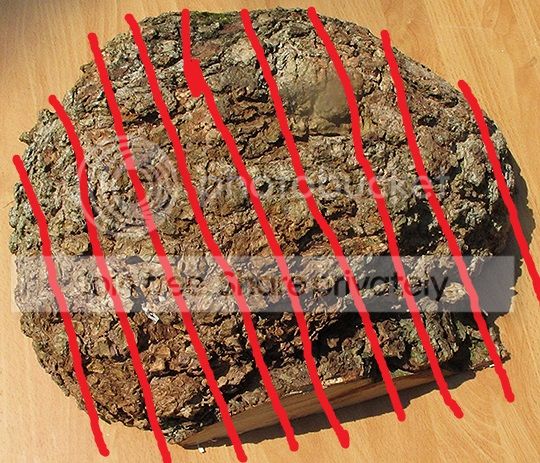
If you really want to cut it now I would cut like the red lines in the photo.
IMG_3004_zps5daeb589.jpg

Cut the strips 1&1/4 to 1&1/2 inches wide. This allows the wood to move a bit while drying and when you flatten the dry pieces they should still be thick enough.
The lines are following the length of the burl the way it grew on the tree.
Then stack the strips in a cool dark place with spacers in between each piece.
They will probably be dry enough this time next year. Maybe a few months longer.
If you leave it in strips instead of cutting into blocks you will be able to cut blocks from areas that did not crack while drying.

From the photo it looks like a bunion instead of a pin burl.
The figure will probably be kind of a crushed velvet look instead of eyes.
 
Back
Top