
-
The BladeForums.com 2024 Traditional Knife is available! Price is $250 ea (shipped within CONUS).
Order here: https://www.bladeforums.com/help/2024-traditional/
You are using an out of date browser. It may not display this or other websites correctly.
You should upgrade or use an alternative browser.
You should upgrade or use an alternative browser.
Hogs, what is your go to outdoor knife? Need help picking one!
- Thread starter Huntsman Knife Co. LLC.
- Start date
- Status
- Not open for further replies.

Last Visible Canary
actively parsing hurf durf
- Joined
- Nov 28, 2006
- Messages
- 4,577
The BOSS Jack is what I ended up on because it fits what I want. It doesn't the grip your looking for though, it sacrifices tortional control for the sake of slim efficiency and small foot print. The same is true of the BOSS jack le in choiless. It's thinner, but that grip is going to be to round and to slim for what you've said you like. It also feels just a bit long in it's thinner rendition (to me). The 1/4" version makes sense in a 6" blade,the 1/8 or 3/16" version seems to my hand like it should be 5"-5.5".
The CABS is small. More importantly it's small with a lot of belly. I came to realize over time and a lot of different knives that I don't like models with a lot of belly because I have no use for it over a much straighter edge. The curve is important, but the closer you get to round the harder it is to use for daily chores like cardboard and food prep. That belly effectively reduces your straight edge to about 3" which I found constantly frustrating. With less belly, and a straighter shot to the tip, you can successfully utilize the curve as part of the overall edge, but with that belly your cutting media will slide right past it once it dulls up bit. I've been told that the belly is excellent for skinning, but that just isn't part of the spectrum of use for my knives.
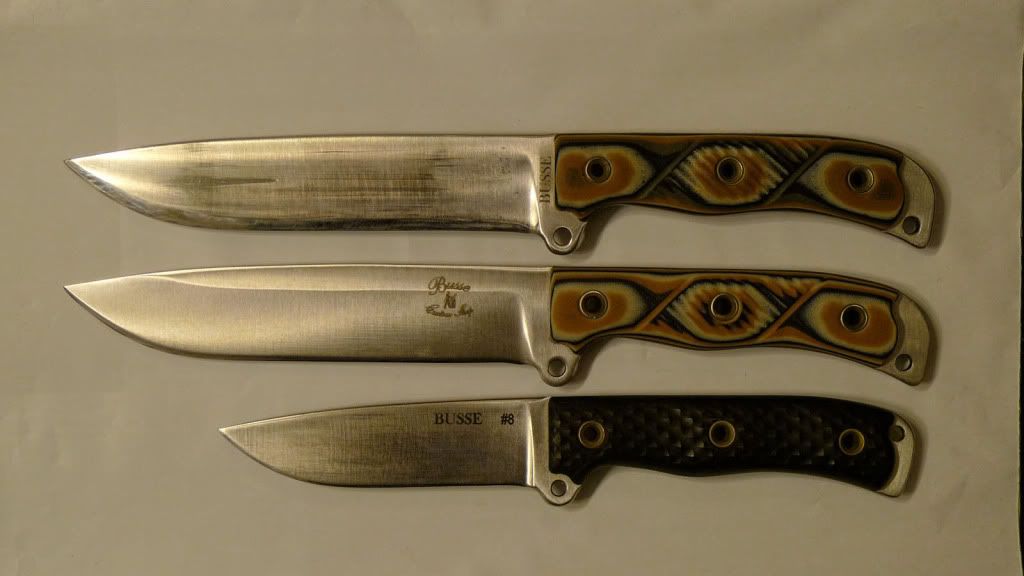
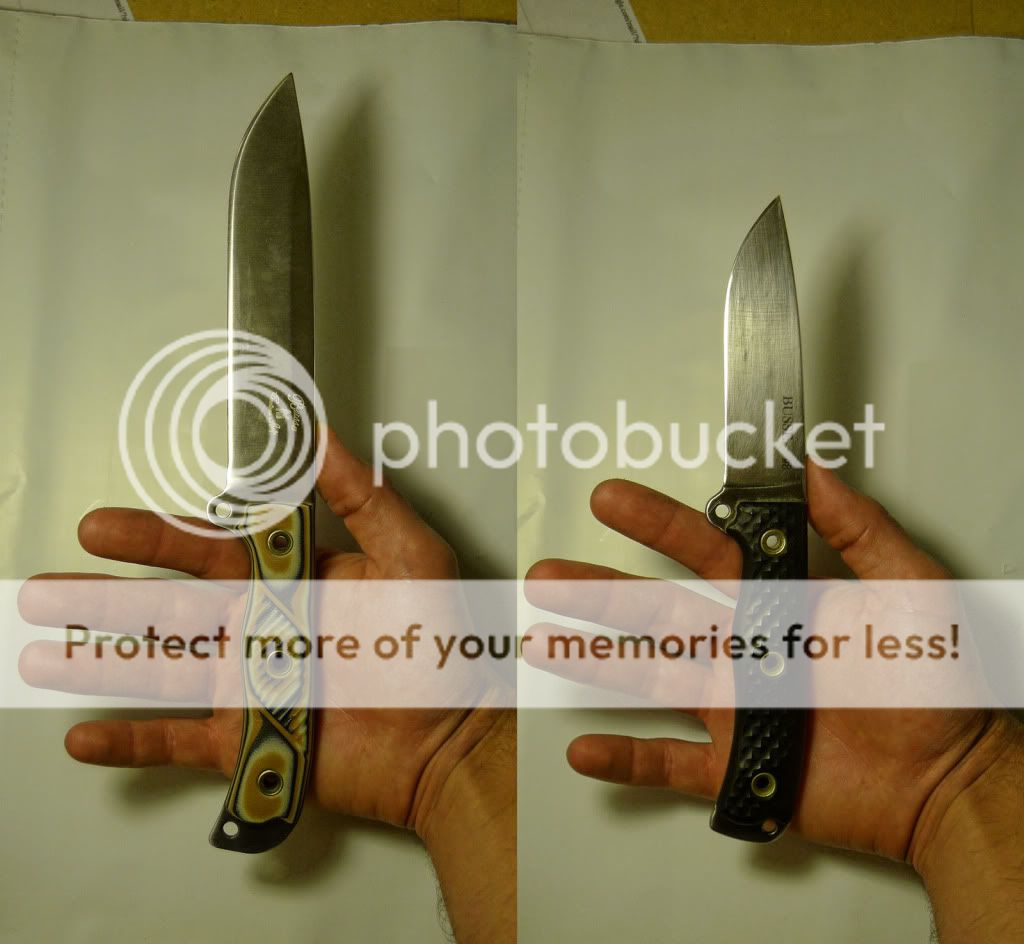
Sadly, aside from a few gaurdless options that each have their individual problems (grip, length, blade profile etc) Busse just doesn't make 5-5.5" choiless knives.
I've been out of the game and too poor for too long to know to to suggest production or custom wise. If I ordered something custom now I'd go with phil wilson if only for his handling of high end steels, but I don't know if he's accepting new orders or now.
The CABS is small. More importantly it's small with a lot of belly. I came to realize over time and a lot of different knives that I don't like models with a lot of belly because I have no use for it over a much straighter edge. The curve is important, but the closer you get to round the harder it is to use for daily chores like cardboard and food prep. That belly effectively reduces your straight edge to about 3" which I found constantly frustrating. With less belly, and a straighter shot to the tip, you can successfully utilize the curve as part of the overall edge, but with that belly your cutting media will slide right past it once it dulls up bit. I've been told that the belly is excellent for skinning, but that just isn't part of the spectrum of use for my knives.
Sadly, aside from a few gaurdless options that each have their individual problems (grip, length, blade profile etc) Busse just doesn't make 5-5.5" choiless knives.
I've been out of the game and too poor for too long to know to to suggest production or custom wise. If I ordered something custom now I'd go with phil wilson if only for his handling of high end steels, but I don't know if he's accepting new orders or now.
Last edited:

- Joined
- Dec 31, 2005
- Messages
- 2,984
I have to agree on your choice of Phil Wilson LVC ... I believe he is still accepting orders ... his handles are good for gloves and mitts ... they flare to the rear so that a drawing backward stroke enables you to retain control on the knife when lack of touch sensation occurs. His choice of steels and blade geometry provide you with a very sharp long lasting edge.
Personally though the most comfortable handle design for me is the Woodlore ... ideally in a large diameter grip ... again the birds head rear flare to the grip enables good control with mitts and gloves ... this design with a Phil Wilson blade with no choil and edge finishing close to the grip would be a great choice as a 4-5 inch blade.
You never get the perfect "amalgamation" of features though ... I am still wanting a 9 inch Basic Khukri with a Nuclear spine set of serrations and the grip modelled on the TTKZ ... with the edge being ASM and done by Jerry ... :thumbup:
Personally though the most comfortable handle design for me is the Woodlore ... ideally in a large diameter grip ... again the birds head rear flare to the grip enables good control with mitts and gloves ... this design with a Phil Wilson blade with no choil and edge finishing close to the grip would be a great choice as a 4-5 inch blade.
You never get the perfect "amalgamation" of features though ... I am still wanting a 9 inch Basic Khukri with a Nuclear spine set of serrations and the grip modelled on the TTKZ ... with the edge being ASM and done by Jerry ... :thumbup:

- Joined
- Dec 20, 2009
- Messages
- 2,314
This one is still one of my favorites, for as simple a handle as it is, it is unbelievably comfortable, no fancy swells or contours
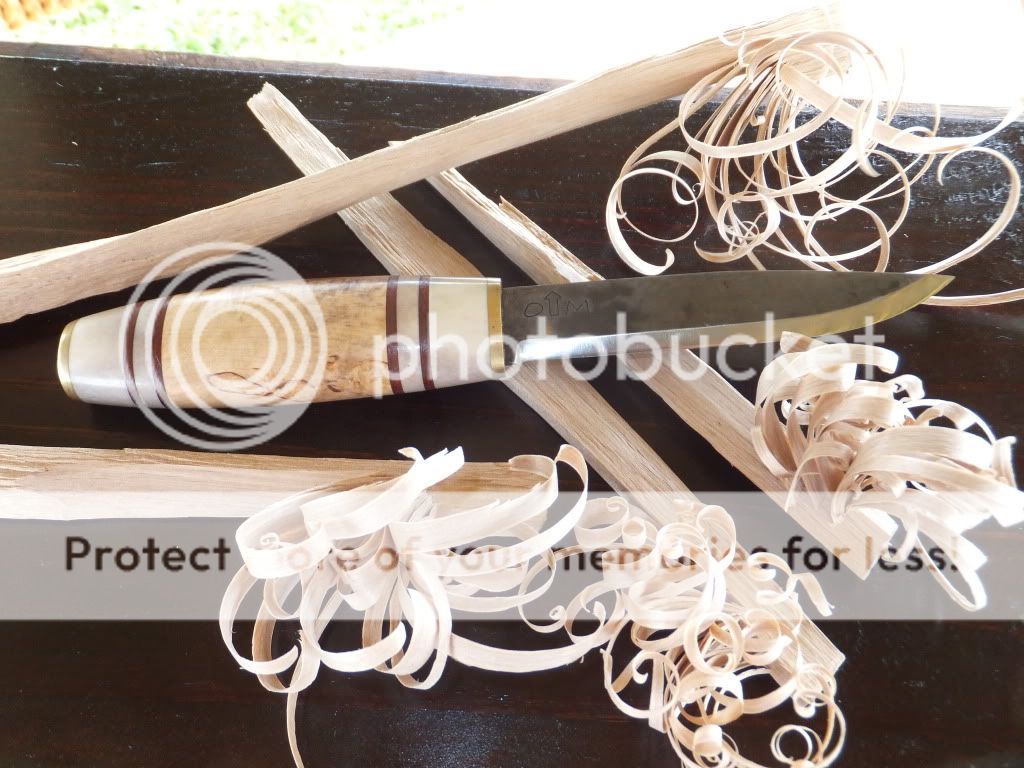
This is a new one what is just as comfy, blade by Big Chris ( M390 steel) handle is maple burl

This is a new one what is just as comfy, blade by Big Chris ( M390 steel) handle is maple burl

- Joined
- Dec 9, 2010
- Messages
- 47
I take a different approach to knives.
I don't seek out the perfect knife. I buy a good knife (like my GW), and I use it and use it and use it until I become accustom to its flaws and imperfections - which, as it turns out, are few.
I find that I'm more satisfied when I limit my options. There's something known as the "Paradox of Choice."
Check this out, if ya'll got time:
http://www.ted.com/talks/barry_schwartz_on_the_paradox_of_choice.html
An excellent point. Trying to decide which knives to get next is keeping me up at nights.
Last Visible Canary
actively parsing hurf durf
- Joined
- Nov 28, 2006
- Messages
- 4,577
I take a different approach to knives.
I don't seek out the perfect knife. I buy a good knife (like my GW), and I use it and use it and use it until I become accustom to its flaws and imperfections - which, as it turns out, are few.
I find that I'm more satisfied when I limit my options. There's something known as the "Paradox of Choice."
Check this out, if ya'll got time:
http://www.ted.com/talks/barry_schwartz_on_the_paradox_of_choice.html
I don't think you should be satisfied with a limited number of choices with known flaws where knives are concerned, especially if customs are within your price range. You should be capable of using a design that has features you don't like and be okay with it, those small issues shouldn't negatively impact your emotional, social or cognitive state, but you shouldn't necessarily settle for something with known easy fixes.
IF INFI is an absolute requirement in your knife then, yes, you have to accept that you have limited choices and be happy with what you have, and then lobby Jerry to make the design that you want. But in this case the ESEE series and the Ratmandu have been presented as awesome, but with individual flaws. If you take the essence of a design and remove the perceived flaws you have a better product, a better experience, a greater sense of satisfaction. Any custom maker could make you an equivalent design that was stylistically unique apart from the ratmandu but with the same modified feature set, some of them in very high end tough steels.
I think there's a note worthy difference separating the paradox of choice and being an educated consumer. You can limit your choices through selective filtering and active participation in a way that leads to much better products that are suited to your needs without having to settle for less than ideal products. In the case of 'I want a phone that does less', you can learn how to modify the desk top of your phone to only show a dial icon. Just because there are 10,000 knife choices within the category of 5" fixed blade, a very small number of those are within the filter set - you don't have to concern yourself with those that are outside of the filter. I agree that you should use knives that have perceived flaws in them, but not to become okay with those flaws, rather to isolate the features you don't like so that you can isolate your filter set and limit the number of options further. Doing so improves and limits the available options, instead of just limiting them.
This is all assuming you have the money to seek out high end consumer products. If not then I agree with you, you need to be able to be happy with what you have if you have no other options (or learn to make it yourself for very low cost)

Flatsman007
Gold Member
- Joined
- Apr 13, 2010
- Messages
- 2,801
Another vote for the CABS. I'm not much for a big knife when it comes to an all around blade. The Culti and the MUK are both great and I have a BT4 in 3v but the CABS is just awesome. It is compact and fairly light compared to the thicker Boss Streets. I have never held a Leaner Meaner and it is on my list but for now the CABS is very hard to beat.

- Joined
- Sep 10, 2010
- Messages
- 3,959
Ive been through so many knives since that post! Very cool to look back and see what Ive tried since then and how my tastes have changed.
I ended up designing my first outdoor knife about a year ago and have since then purchased a KMG and am making my first batch of blades soon.
To this day the best production knife I have used for general outdoor tasks when paired with a chopper is a Satin RMD. The Scrap Max 460 is a close second but its too thin for wood working.
With all knowlege and experince Ive gained from this forum and real world use, I think a great outdoor knife (to be paired with a chopper or saw) consists of the following
- ~5- 4.5 inch blade
- Thin but stout stock. .150 is my current favorite
- High wear resistance steel with good toughness
- comfy and full handle
- thin grind and edge
- functional sheath
I ended up designing my first outdoor knife about a year ago and have since then purchased a KMG and am making my first batch of blades soon.
To this day the best production knife I have used for general outdoor tasks when paired with a chopper is a Satin RMD. The Scrap Max 460 is a close second but its too thin for wood working.
With all knowlege and experince Ive gained from this forum and real world use, I think a great outdoor knife (to be paired with a chopper or saw) consists of the following
- ~5- 4.5 inch blade
- Thin but stout stock. .150 is my current favorite
- High wear resistance steel with good toughness
- comfy and full handle
- thin grind and edge
- functional sheath
Last edited:

- Joined
- Apr 9, 2011
- Messages
- 766
I would vote for my current combo of a Fiddleback Forge 12" Machete in a leather piggyback rig alongside a Fiddleback Forge Kephart. These are both AMAZING blades and way more comfortable than anything else I own. I do still like keeping my Ash-1 nearby though 
Last edited:
KalEl- you have described exactly what I am looking for. Now get busy and make one out Elmax:} I am waiting on mine from a maker found here. I'll post pics as soon as it arrives. If they made the 460 Scarpmax without a choil and .15 thick it would be perfect.
I am curious if you have figured out how to remove the Res C handles and reattach them? There was a mod here last year that asheath maker did to a Wardog that I contacted but never got a response. If you figure it out let me know. I may pick up a Wardog to let you mod by removing the choil.
I am curious if you have figured out how to remove the Res C handles and reattach them? There was a mod here last year that asheath maker did to a Wardog that I contacted but never got a response. If you figure it out let me know. I may pick up a Wardog to let you mod by removing the choil.
- Status
- Not open for further replies.