
-
The BladeForums.com 2024 Traditional Knife is available! Price is $250 ea (shipped within CONUS).
Order here: https://www.bladeforums.com/help/2024-traditional/
You are using an out of date browser. It may not display this or other websites correctly.
You should upgrade or use an alternative browser.
You should upgrade or use an alternative browser.
homebuilt power hammers
- Thread starter Joe Calton
- Start date


I can see that! I was originally wanting to build a smaller one that took up less space. but the more I looked at the ones on youtube, the more I noticed that the smaller hammers seemed to be unstable, and bounced all over the place. so I figured that the bigger and heavier I made it the nicer it would be to work with/on.
this is about as big/heavy as I can make it to fit in my shop! and I might use my big anvil part of it eventually to save the floor space as I hardly ever use it anyways and I should still be able to use the back half with the hardy hole by hand.
this is about as big/heavy as I can make it to fit in my shop! and I might use my big anvil part of it eventually to save the floor space as I hardly ever use it anyways and I should still be able to use the back half with the hardy hole by hand.

The "rusty" will defiantly be an improvement over just hand hammering. But, my experience with one and all the modifications I did trying to get more performance out of it was disappointing. A toggle link hammer just works faster, hits harder, and has a smoother operation, and takes up way less room, and it's not that hard to build. I have one of Clay's hammers, and had to make some modifications to it as well, but it runs like a top. Now understand, I primarily use it for drawing down stock and such, I do very little forming on it. If I was wanting a hammer to primarily form with, like say a blacksmith, the "rusty" style would probably interest me more as I'd use it as a powered treadle hammer. Or else I'd come up with a quick change die system for the tire hammer. One of the primary changes I made was to increase the baseplate, a 1/2" thick base plate is too thin, I welded it down to a 1" plate then bolted the whole thing to a thick concrete slab. Also ran some short weld from the motor to the motor mounting bracket as they tend to pop the spot welds loose. But then I tend to run the hammer hard and fast, but has plenty of control to run light taps and such. Wish clay would come up with a 100lbs. model.
I will say that the gunhilda hammer is one of the nicest "rusty" hammers I've seen, but it's still slow and chunky compared to a toggle link design. I really liked the way the tire and clutch was fabed, that would defiantly help improve control over the original rusty plans of a slack belt.
A lot of it comes down to what you want to do with it. A "rusty" is more suited as a powered treadle hammer, and a tire hammer is more suited to drawing out and general use. After using both, and a little giant, I think the best is a nice air hammer, but it's outside my money for that!
I will say that the gunhilda hammer is one of the nicest "rusty" hammers I've seen, but it's still slow and chunky compared to a toggle link design. I really liked the way the tire and clutch was fabed, that would defiantly help improve control over the original rusty plans of a slack belt.
A lot of it comes down to what you want to do with it. A "rusty" is more suited as a powered treadle hammer, and a tire hammer is more suited to drawing out and general use. After using both, and a little giant, I think the best is a nice air hammer, but it's outside my money for that!

Joe - Part of that stability comes from it being bolted to the ground.  I recently moved shop and had it sitting loose. I tried to do some forging that way, and it just was bouncing around too much to really get much done. I wouldn't expect to be able to run any mechanical power hammer that wasn't secured to the ground. I have seen some self-contained hammers that were transported to blacksmithing demonstrations that did fine sitting on the ground loose, but mechanical hammers tend to have rotating parts that rock things back and forth.
I wouldn't figure any part of the hammer as part of the anvil weight that wasn't directly under the anvil. The heavier the baseplate you use, the better it'll run. I have 1.5" plate on mine, and it was flexing until I added a couple more anchor points in front of the anvil to tie it to the slab. Nice and solid now.
Check out the Power Hammer page over at Anvilfire.com and the hammer subforum at Iforgeiron.com. Great resources. There's a fellow who goes by Ptree (Jeff Rheinhart) whose rendition of the Rusty design was very helpful when I was in the planning phase of mine. He's at both sites and his hammer is one of the ones displayed on the Anvilfire.com page.
Will5211 - Was this a Rusty that you built, or one that you took over from someone else and modified? I haven't run a Spencer-style hammer, but I have used a 50 lb. Little Giant a fair amount. The Little Giant hits faster, but is harder to control and hits a lot softer (of course mine has a heavier ram weight, but initially it was 88 lbs and not 100 and that was still the case). It's also a lot less adjustable.
I wouldn't say the Rusty is comparable to a treadle hammer. I can get single strikes out of mine, but it's not the easiest thing to do. I'm forging up to about 2" square with it, sometimes more complex shapes than a blade. It's built with blacksmithing in mind, with the capability of using tooling, but I end up forging blades the most.
I haven't heard anything bad about the Spencer hammers, but I don't think that they necessarily outperform the Rusty design. Each has its strengths and each has its weaknesses. I really like and take advantage of the flexibility of Gunnhilda in working with different tooling and adjustability, and she does just dandy drawing out. She hits at two or three beats a second.
JAWilder - If you're looking for portability, you might look at variations on the Depew hammer. It uses the acceleration part of F=ma to get a lot of work out of a small ram weight. Like 10 lbs or less.
One version built from junk is the lamentably late Grant Sarver's Original Junkyard Hammer.
[video=youtube;-tPTLwmxsWc]http://www.youtube.com/watch?v=-tPTLwmxsWc&feature=related[/video]
I like the idea of using the crankshaft as your eccentric, but I think that using the piston as the linkage complicated things unnecessarily. It'd make more sense to me to turn the crankshaft 90 degrees and then link directly from the crankshaft to the spring. A tire clutch would probably add better control, too. The results that they got out of this hammer is still quite impressive, and would be right dandy with the right dies for forging knives.
I recently moved shop and had it sitting loose. I tried to do some forging that way, and it just was bouncing around too much to really get much done. I wouldn't expect to be able to run any mechanical power hammer that wasn't secured to the ground. I have seen some self-contained hammers that were transported to blacksmithing demonstrations that did fine sitting on the ground loose, but mechanical hammers tend to have rotating parts that rock things back and forth.I wouldn't figure any part of the hammer as part of the anvil weight that wasn't directly under the anvil. The heavier the baseplate you use, the better it'll run. I have 1.5" plate on mine, and it was flexing until I added a couple more anchor points in front of the anvil to tie it to the slab. Nice and solid now.
Check out the Power Hammer page over at Anvilfire.com and the hammer subforum at Iforgeiron.com. Great resources. There's a fellow who goes by Ptree (Jeff Rheinhart) whose rendition of the Rusty design was very helpful when I was in the planning phase of mine. He's at both sites and his hammer is one of the ones displayed on the Anvilfire.com page.
Will5211 - Was this a Rusty that you built, or one that you took over from someone else and modified? I haven't run a Spencer-style hammer, but I have used a 50 lb. Little Giant a fair amount. The Little Giant hits faster, but is harder to control and hits a lot softer (of course mine has a heavier ram weight, but initially it was 88 lbs and not 100 and that was still the case). It's also a lot less adjustable.
I wouldn't say the Rusty is comparable to a treadle hammer. I can get single strikes out of mine, but it's not the easiest thing to do. I'm forging up to about 2" square with it, sometimes more complex shapes than a blade. It's built with blacksmithing in mind, with the capability of using tooling, but I end up forging blades the most.
I haven't heard anything bad about the Spencer hammers, but I don't think that they necessarily outperform the Rusty design. Each has its strengths and each has its weaknesses. I really like and take advantage of the flexibility of Gunnhilda in working with different tooling and adjustability, and she does just dandy drawing out. She hits at two or three beats a second.
JAWilder - If you're looking for portability, you might look at variations on the Depew hammer. It uses the acceleration part of F=ma to get a lot of work out of a small ram weight. Like 10 lbs or less.
One version built from junk is the lamentably late Grant Sarver's Original Junkyard Hammer.
[video=youtube;-tPTLwmxsWc]http://www.youtube.com/watch?v=-tPTLwmxsWc&feature=related[/video]
I like the idea of using the crankshaft as your eccentric, but I think that using the piston as the linkage complicated things unnecessarily. It'd make more sense to me to turn the crankshaft 90 degrees and then link directly from the crankshaft to the spring. A tire clutch would probably add better control, too. The results that they got out of this hammer is still quite impressive, and would be right dandy with the right dies for forging knives.
Air hammers undoubtedly give better control than a mechanical hammer, even if the parts run more money.
https://www.blacksmithsdepot.com/page.php?theLocation=/Resources/Product/Machinery/Air_Hammer_Parts
This one truly is a machine that not only is an out-and-out forging hamemr but also does treadle hammer duty:
[video=youtube;AKfIgWKx5cQ]http://www.youtube.com/watch?v=AKfIgWKx5cQ&feature=plcp[/video]
Someday I home to be making enough forging to warrant a nice air hammer or self-contained hammer.
https://www.blacksmithsdepot.com/page.php?theLocation=/Resources/Product/Machinery/Air_Hammer_Parts
This one truly is a machine that not only is an out-and-out forging hamemr but also does treadle hammer duty:
[video=youtube;AKfIgWKx5cQ]http://www.youtube.com/watch?v=AKfIgWKx5cQ&feature=plcp[/video]
Someday I home to be making enough forging to warrant a nice air hammer or self-contained hammer.
My "rusty" was built from plans I purchased. I never did get what I'd consider good control from the slack belt. If I was to do it again I'd build it like yours. I may eventually build another in the 100+ pound range, but even then I'd prefer the toggle link design. Mine had a 50 pound head, and comparing it to my tire hammer, control wise and moving metal there's no comparison, and it hits way harder than my rusty ever did. The only real draw back to the spencer hammer is that it's not really designed for tooling or quick die changes, but I am satisfied with slightly rounded flat dies. Of course tooling and a quick die change system could be designed for it. I have a hydraulic press for tooling and precision work though.
Last edited:

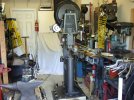 I fabricated a tire hammer about 2 years ago in my one bay garage at home from the plans sold by Ray. No real problems following the plans. I believe it took me about 5 months all told but a great deal of that time was spent scrounging parts and accumulating funds to complete the project. I couldn't be happier with the performance. Sorry about all the clutter in the picture. My space is limited. It was eventually moved to a spot against the wall where I saw cut the floor and poured a 2 ft. deep footer in the slab. Sure does save my old arm.
Will52100 - From what I've heard, the tire clutch does give better control than the slack belt clutch. If I was building a Spencer-style, I'd be tempted to put the tire on the back with a shaft going to an eccentric up front to avoid having to weld to the tire rim. That can cause problems. They seem like great little mechanical hammers in general.
KBamhi - That's a real neat-looking rendition of the Spencer hammer. Good work!
KBamhi - That's a real neat-looking rendition of the Spencer hammer. Good work!

I have a small design I am building over the next couple of weeks, just got to get a tire and some other stuffs.
I am planning on a tire clutch, i also want to put a brake on the lever so that when you release the foot lever the brake automatically engages.
I also just mailed a check to clay for a set of his tire hammer plans in case im not happy with this build, and its always fun to see how things work and are put together!
I also just mailed a check to clay for a set of his tire hammer plans in case im not happy with this build, and its always fun to see how things work and are put together!

Our 50# LG has a very nice brake on it and allows for one hits easy..Couldent do it without the break but with it its very controllable. Its based on a Clifton Ralph design..

Some good looking hammers here. I thought I would add a picture of mine as it is pretty unique. It has an old rear end on the top and when the treadel is engaged, it applies a brake to the rotating hub (non hammer side) which in turn causes the other hub (hammer side) to engage. The hammer is a 60lb. It ain't pretty, but it works and that is what matters. Total weight is a bit over 1600lbs. I did not build this hammer, but I was looking to build one when I found this one cheaper than the cost of materials.
-Mike


The brake:

-Mike
The brake:
Mike, that's an awesome hammer! I never thought about using the rear end of a car, and now I'm wondering what type of rear end to use! Brilliant!
How many RPM's are you turning? How many BPM does that translate to? Does it appear that you're losing a lot of energy from the motor because of the gearing in the diff? What size/type of rear-end is that? What's the Tup weight? Anvil weight? I'm wondering if a small car rear-end wouldn't be better geared for this application than a heavy-duty truck.....
I've got some serious thinking to do....
How many RPM's are you turning? How many BPM does that translate to? Does it appear that you're losing a lot of energy from the motor because of the gearing in the diff? What size/type of rear-end is that? What's the Tup weight? Anvil weight? I'm wondering if a small car rear-end wouldn't be better geared for this application than a heavy-duty truck.....
I've got some serious thinking to do....
Last edited:

Rounding up a good sized chunk (5"x36" for the tire hammer) of solid steel for the anvil has been a holdup for me.
Mike - That's one of the nicest homebuilt hammers I've seen. There's a hammer over on Anvilfire that uses a rear end like this, but I think this is better executed than that one.
Last edited:
Mike, that's an awesome hammer! I never thought about using the rear end of a car, and now I'm wondering what type of rear end to use! Brilliant!
How many RPM's are you turning? How many BPM does that translate to? Does it appear that you're losing a lot of energy from the motor because of the gearing in the diff? What size/type of rear-end is that? What's the Tup weight? Anvil weight? I'm wondering if a small car rear-end wouldn't be better geared for this application than a heavy-duty truck.....
I've got some serious thinking to do....
I believe the anvil is somewhere around 450lbs. The tup is around 60lbs. The hammer runs around 180 BPM. The motor is 1750 RPM. I had to replace the super old GE motor which was a bummer, but I still have it and may try to rebuild it someday. It actually ran for me for a while after I tore it apart and cleaned it up. I have no idea what the rear end is off from. The rear end has been chopped down and shortened considerably. The nice thing about the brake engaging the hammer is that I can let the brake slip to get softer or slower hits. This hammer was built in the 50's, so it is from something old as I assume the hammer builder didn't use a new rear end, but who knows. It doesn't seem like the hammer loses a lot of energy due to the rear end, but this is the only hammer I have ever used.
I would be pretty excited to see someone build a hammer using this idea. As far as posting a video of it running, I will see what I can do, but it probably won't be too terribly soon. Thanks for the interest.
-Mike
hey guys, just an update.........ITS ALIVE!!!!!
no pics or videos yet, but I have the thing running! It still needs alot of work: new upper pivot {a u-joint from a truck doesnt work so well} will be 1" pillow bearing blocks with a 1" bolt for a shaft, the ram guide attachment arm is too flimsy and needs to be stouter, it runs a bit fast, so ill have to turn down the drive wheel on the motor to a smaller diameter. the upright should be filled with sand, and it may need a heavier base plate. And I just tack welded the thing together to make sure all the parts worked smoothly with each other, so all my welds need redone.
but the basic operation is good. and the ram is at about 40 lbs right now as Im planning on adding dies and a permanent anvil later, right now its just the ram coming down on top of my 200lb anvil which is set in about 300 lbs of concrete, and it shakes that anvil like nobody's business! I have never seen that anvil bounce like that, not even with a helper holding steel and me hitting it with a 12 pound sledgehammer! and considering that its still not tuned up or even finished really, it runs pretty smooth.
I ended up using a mobile home axle and hub and tire for the drive, welded a plate onto the hub for the eccentric, used the same turnbuckle setup like gunhilda. I hope to have it in service by the end of this weekend and will get pics, and maybe a video as soon as I can.
no pics or videos yet, but I have the thing running! It still needs alot of work: new upper pivot {a u-joint from a truck doesnt work so well} will be 1" pillow bearing blocks with a 1" bolt for a shaft, the ram guide attachment arm is too flimsy and needs to be stouter, it runs a bit fast, so ill have to turn down the drive wheel on the motor to a smaller diameter. the upright should be filled with sand, and it may need a heavier base plate. And I just tack welded the thing together to make sure all the parts worked smoothly with each other, so all my welds need redone.
but the basic operation is good. and the ram is at about 40 lbs right now as Im planning on adding dies and a permanent anvil later, right now its just the ram coming down on top of my 200lb anvil which is set in about 300 lbs of concrete, and it shakes that anvil like nobody's business! I have never seen that anvil bounce like that, not even with a helper holding steel and me hitting it with a 12 pound sledgehammer! and considering that its still not tuned up or even finished really, it runs pretty smooth.
I ended up using a mobile home axle and hub and tire for the drive, welded a plate onto the hub for the eccentric, used the same turnbuckle setup like gunhilda. I hope to have it in service by the end of this weekend and will get pics, and maybe a video as soon as I can.