
-
The BladeForums.com 2024 Traditional Knife is available! Price is $250 ea (shipped within CONUS).
Order here: https://www.bladeforums.com/help/2024-traditional/
You are using an out of date browser. It may not display this or other websites correctly.
You should upgrade or use an alternative browser.
You should upgrade or use an alternative browser.
Honyaki Yanagiba claying up. Ugly picture added.
- Thread starter jdm61
- Start date

- Joined
- Oct 3, 2002
- Messages
- 12,297
Better do both sides, or big warp time.

Stacy E. Apelt - Bladesmith
ilmarinen - MODERATOR
Moderator
Knifemaker / Craftsman / Service Provider
- Joined
- Aug 20, 2004
- Messages
- 38,572
Yes, even though the omote is the polished side, the ura has to be clayed as well.

jdm61
itinerant metal pounder
- Joined
- Aug 12, 2005
- Messages
- 47,357

- Joined
- Dec 13, 2008
- Messages
- 2,986
Ive been meaning to pick up a radius to fit a bader/esteem style tool arm or adapt one. Never have gotten around too looking.72 inch Nathan platen, baby!!!
Ill probably end up making one myself
jdm61
itinerant metal pounder
- Joined
- Aug 12, 2005
- Messages
- 47,357
I have a 36 and 72 and I wish I had a 48 and a 120 (which he never made as far as I know) The 72 is perfect for clips on big bowies and a 48 would be perfect for fighters in the 7inch range. I do the curve of the clip on the 72 and then lay the blade over to do the swedges. Makes life much easier.
Ive been meaning to pick up a radius to fit a bader/esteem style tool arm or adapt one. Never have gotten around too looking.
Ill probably end up making one myself

- Joined
- Dec 6, 2004
- Messages
- 6,212
keep in mind there are "bend sticks" for straighting the soft spined single bevels
Stacy E. Apelt - Bladesmith
ilmarinen - MODERATOR
Moderator
Knifemaker / Craftsman / Service Provider
- Joined
- Aug 20, 2004
- Messages
- 38,572
A way to get Urasuki without a radiused platen is to hold your blade at an angle to a large contact wheel (10" to 16") and draw the blade across that grinder along the heel to tip axis. It only takes a little angle to greatly increase the width of the hollow. Try it on a scrap piece of 2" bar to get the feel of it.
jdm61
itinerant metal pounder
- Joined
- Aug 12, 2005
- Messages
- 47,357
Butch, I am contemplating HT'ing the blade "flat" with just the taper and then beveling and convexing post HT.
keep in mind there are "bend sticks" for straighting the soft spined single bevels
jdm61
itinerant metal pounder
- Joined
- Aug 12, 2005
- Messages
- 47,357
Yeah, even with the platens. I am going to do some test runs with both the 36 and 72. My biggest wheel is an 8 incher.
A way to get Urasuki without a radiused platen is to hold your blade at an angle to a large contact wheel (10" to 16") and draw the blade across that grinder along the heel to tip axis. It only takes a little angle to greatly increase the width of the hollow. Try it on a scrap piece of 2" bar to get the feel of it.
- Joined
- Dec 6, 2004
- Messages
- 6,212
befor i got nates platen i mocked one up out of wood. lasted for the knife and let me know i liked that radius hollow
jdm61
itinerant metal pounder
- Joined
- Aug 12, 2005
- Messages
- 47,357
I would like to have a 120 or maybe even a 144 for the bottom curve and facets on “dropped wa” kitchen knife handles, the spine of curved blades, etc. I use my 36 and 72 for about everything other than hollow grinding blades.befor i got nates platen i mocked one up out of wood. lasted for the knife and let me know i liked that radius hollow
Stacy E. Apelt - Bladesmith
ilmarinen - MODERATOR
Moderator
Knifemaker / Craftsman / Service Provider
- Joined
- Aug 20, 2004
- Messages
- 38,572
If you make wooden curved platens use something really hard, like lignum vitae, and put a graphite platen liner on it.
One technique it is to clay the blade keeping the edge axis as reference of symmetry. Thus you end the clay line a bit higher on the ura side and get the same height of uncovered area on both sides. Or play with this principle until you find the correct balance trick to control the movement.
The transformation will balance its effects both sides, preventing distortion.
The transformation will balance its effects both sides, preventing distortion.
jdm61
itinerant metal pounder
- Joined
- Aug 12, 2005
- Messages
- 47,357
Well, forging a yanagiba with a slight bit of bevel because the billet wasn't quite as wide as you wanted is not, in fact, the toughest knife to forge. That would still be an integral or a WIDE kitchen knife that starts off as a not very wide piece of steel. But it still was fairly time consuming. A small power hammer would be VERY good for forging pretty much ANY type of kitchen knife. The blade portion started off at like 140mm by 30mm by around 9mm and the blade ended up being almost 270mm by 35-36MM, After removing the scale and dents, I suspect that the blade will be over 4mm thick at the heel, possibly 4.5mm and about 33-34mm wide
But it still was fairly time consuming. A small power hammer would be VERY good for forging pretty much ANY type of kitchen knife. The blade portion started off at like 140mm by 30mm by around 9mm and the blade ended up being almost 270mm by 35-36MM, After removing the scale and dents, I suspect that the blade will be over 4mm thick at the heel, possibly 4.5mm and about 33-34mm wide
jdm61
itinerant metal pounder
- Joined
- Aug 12, 2005
- Messages
- 47,357
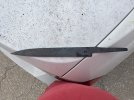
I did a rough profile of the forged blade shaped object. It will probably go back under the hammer for some final tuneup. it ended up being like 275mm from heel to tip and about 33mm tall with spine and edge ground to clean, straight steel. It is still quite thick, almost 6mm at the spine most of the way out the blade and not much in the way of big dents, so I have material to play with. Is it too pointy?
Last edited:
- Joined
- Jul 1, 2013
- Messages
- 32,479
Joe!, Not sure if its too pointy? But your Vehicle is dirtier than mine!I did a rough profile of the forged blade shaped object. It will probably go back under the hammer for some final tuneup. it ended up being like 275mm from heel to tip and about 33mm tall with spine and edge ground to clean, straight steel. It is still quite thick, almost 6mm at the spine most of the way out the blade and not much in the way of big dents, so I have material to play with. Is it too pointy?
View attachment 817243

Really, I don't forge, but I like to start out with way pointy in my first profile because grinding will always round it out some!
jdm61
itinerant metal pounder
- Joined
- Aug 12, 2005
- Messages
- 47,357
Its only that dirty on the trunk and part of the roof because I park under a dirty palm tree every night and it rained the night before. That is palm sap mud. As for my project, I am just "muddling" along with this knife because I have no yanagiba in hand and am working from pictures on the interwebz. My previous kitchen knives were copied and modified from a couple of mid prices Japanese blades that I bought because I liked their blade profile.
As for my project, I am just "muddling" along with this knife because I have no yanagiba in hand and am working from pictures on the interwebz. My previous kitchen knives were copied and modified from a couple of mid prices Japanese blades that I bought because I liked their blade profile. Joe!, Not sure if its too pointy? But your Vehicle is dirtier than mine!
Really, I don't forge, but I like to start out with way pointy in my first profile because grinding will always round it out some!