How Can a Novice Tell?

Joined
Mar 22, 2016
Messages
17
given the cheap Damascus knives on our favorite auction site, how does one confirm (or is it possible) that said blade is 15N20 and 1005HC , 512 layers, with a blade hardness of 58-60 HRC?
Some of the sellers undoubtedly have sold thousands of knives with near nonexistent negative feedback.
Are all the buyers clueless? Could the knives really be a bargain at $50-100 dollars? Haven't bought one yet, but I would much prefer losing one of these than a $500 knife made by a board member.
 
You can't tell. That's the simple answer. You simply can't.

Even if it were...you would have no garantee that the heat treat was any good. So Like the poster above me stated....just buy from reputable dealers and you'll be good.
 
I'd say Damascus blades are for the most part non users, so how would anyone know if the metal was soft and not the stated 58-60?
 
You can get a Fantastic knife for $150-$200. Especially likely when it was made from one if the members here.

Check out the custom makers section. While it may not be a pattern welded knife, it will live up to your expectations and cause you to not want for production knives.
 
given the cheap Damascus knives on our favorite auction site, how does one confirm (or is it possible) that said blade is 15N20 and 1005HC , 512 layers, with a blade hardness of 58-60 HRC?
Some of the sellers undoubtedly have sold thousands of knives with near nonexistent negative feedback.
Are all the buyers clueless? Could the knives really be a bargain at $50-100 dollars? Haven't bought one yet, but I would much prefer losing one of these than a $500 knife made by a board member.

Those are more than likely made in Pakistan. They have some tell tale craftsmanship that makes them stick out like a sore thumb.
 
You can get a Fantastic knife for $150-$200. Especially likely when it was made from one if the members here.

Check out the custom makers section. While it may not be a pattern welded knife, it will live up to your expectations and cause you to not want for production knives.
Depending on the size you're looking for...you might well find something in damascus for under $200.
 
My intent is to use if not abuse the knife and see what happens. Worst case, $28 in the bin.
I will look in the custom makers section. I want a folder with a four inch pattern welded blade.
Not as concerned about case craftmanship or composition as long as the blade is sound. In fact, if any members have some
early prototypes that could be had for under $200, I'd be interested.
 
I would be VERY surprised if you can find a 4 inch folder with damascus on the makers market here.

Folders are more expensive.
Well done folders are even more expensive.
Well done Damascus folders...generally start at around $500 and that's you getting one CHEAP.

Now a small damascus fixed blade for under $200 can well be done.

But large folders (a 4" folder is a LARGE folder) for that price.....unless you have a VERY good friend who makes em and is willing to sell to you at material cost.....doubt you're gonna find one.
 
Regarding folders, the most economical choice would be a friction folder. While it may not be what you are looking for, it will probably be the easiest on the wallet.
 
If you want a decent Damascus knife, the best thing to do is 1. shell out some decent $$ 2. but from a reputable dealer.
 
You can't tell the composition.

But you can tell (by using) whether the heat treat is any good.


Look at my posts/reactions in context and you'll see that's what I meant.
 
Those are more than likely made in Pakistan. They have some tell tale craftsmanship that makes them stick out like a sore thumb.

Pretty much this in my experience too. You can learn to spot them pretty quickly if you look around enough.

That, and if you happen to own a mass spectrometer, then you're good to go. That's realistically the only way to make sure that the steel is correct, but that's also true of much nicer knives to a certain extent.
You kind of have to trust that the manufacturer is telling the truth when they mark what steel they're using to a certain extent. I know that I have talked to a couple of people who have had BRKT knives that were accidentally marked 3V when they were actually A2 steel, and the only way they knew was because of the way the steel reacted to patina, which wasn't what they expected from 3V.

That being said, if it's quality steel, then most people might not be able to tell the difference even with somewhat heavy use.

You can generally tell with the cheap damascus though. It will fall apart pretty quickly under use.
 
My intent is to use if not abuse the knife and see what happens. Worst case, $28 in the bin.
I will look in the custom makers section. I want a folder with a four inch pattern welded blade.
Not as concerned about case craftmanship or composition as long as the blade is sound. In fact, if any members have some
early prototypes that could be had for under $200, I'd be interested.

LX_Emergency's post #10 was on point IMO.

If you want a damascus folder and don't mind sacrificing custom for production and a little bit in blade length, then the Spyderco Damascus Endura or the Kershaw Damascus Shallot are probably worth a look.
 
Best thing to do is to stay away from that site.

I am not saying that everything is fake, but unless you know more than most, why take that chance?

There are wonderful makers on the exchange in this forum that sell Damascus blades for very reasonable prices...
 
I'd say Damascus blades are for the most part non users, so how would anyone know if the metal was soft and not the stated 58-60?

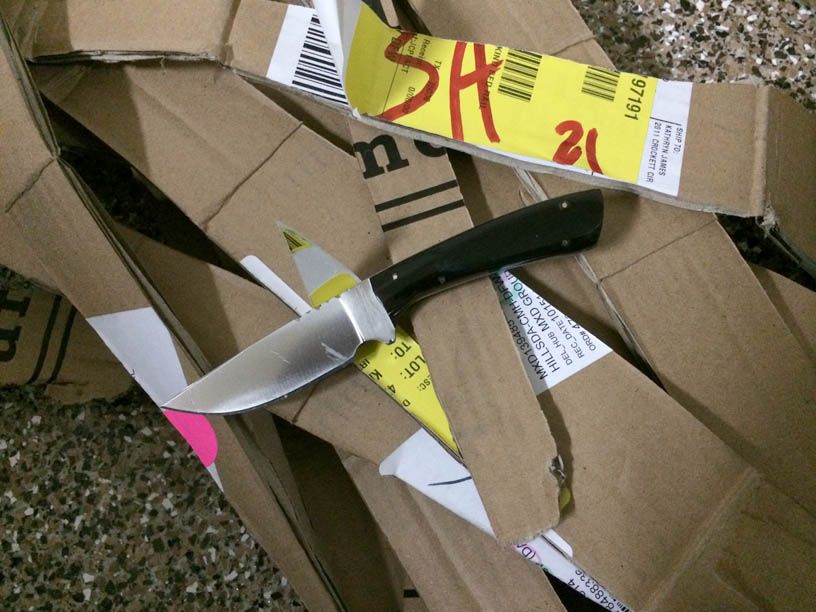
I think properly made Damascus would be OK, but you can't tell about what you find on an auction site if it isn't from a reputable maker. I used to buy a lot of custom knives, and one time I bought a small custom knife that was very cheap, cheap enough to be suspicious of it. It could be sharpened and under light use it seemed to be OK, but I wondered about its steel and heat treat. More recently reading threads about people testing knives by cutting large amounts of cardboard, I wondered how the little knife would do. I had previously tested my Manix 2 M4 against my Manix 2 S110V, so I did a similar cutting test with the little knife. It didn't do nearly as well as the M4 or S110V, but didn't do badly. So this is proof to me that the knife was made with reasonable steel and heat treat.

photo2014-11-16b_zps57cd6b4d.jpg
 
If you want a damascus folder and don't mind sacrificing custom for production and a little bit in blade length, then the Spyderco Damascus Endura or the Kershaw Damascus Shallot are probably worth a look.

I was just going to ask what people thought of those; my experience with Spyderco is that you get what is advertised in materials and heat treat.

Also I would say you can tell when you sharpen the edge after it gets pretty dull. Takes some one used to doing real sharpeniing on hand stones though.
 
Back
Top