
-
The BladeForums.com 2024 Traditional Knife is available! Price is $250 ea (shipped within CONUS).
Order here: https://www.bladeforums.com/help/2024-traditional/
You are using an out of date browser. It may not display this or other websites correctly.
You should upgrade or use an alternative browser.
You should upgrade or use an alternative browser.
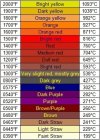
how can you make a knife without this ?
- Thread starter Virgilio
- Start date

- Joined
- Oct 2, 2006
- Messages
- 3,238
Easy, I have a PID controlled kiln to do my heat treating with. Color chart interpretation is subjective at best, and minor illuminant changes of the surrounding area can throw you off by hundreds of degrees. Not picking a fight with all of the old schoolers who swear by it, but having spent 26 years of my professional life dealing with color and color perception issues, it is a ballpark, nothing more.
-Page
-Page

- Joined
- Aug 25, 2010
- Messages
- 50
if your machine hasn't been "Laboratory" tested and calibrated each year, there is no way to tell if it is right or wrong, if it is high or low.
I ask this question sir, How do you know....?
"I" have been an engineer since 1985 and know a little about technologies, electronic and other wise..
not trying to pic a fight or anything, "just say'n"
virgilio palmer
I ask this question sir, How do you know....?
"I" have been an engineer since 1985 and know a little about technologies, electronic and other wise..
not trying to pic a fight or anything, "just say'n"
virgilio palmer
Last edited:

- Joined
- Jun 2, 2009
- Messages
- 1,564
I'll bet his controller is more accurate than your chart.

- Joined
- Mar 10, 2009
- Messages
- 92
Meanwhile, Busta puts his popcorn in the microwave...

gga357
Gold Member
- Joined
- Dec 3, 2007
- Messages
- 2,338
Well I am color blind (red-green) so as I have been reading and learning here and through several books I have to wonder before PID or technology I guess guys like me just had poor HTs. I have only just begun this as a hobby. So I figure until I can justify an controlled oven I will have to send everything out for heat treat.
Or maybe like with my clothes I could just ask my wife to verify color every time I need to use a color chart.
Or maybe like with my clothes I could just ask my wife to verify color every time I need to use a color chart.
- Joined
- Aug 25, 2010
- Messages
- 50
I don't know how long you have had your pid controller, but it aint been26 years and if you have been making knives for 26 years then , what you are actually saying is this..
" all my knives prior to my acquiring my pid controller are junk"
and you should then get ahold of all of your prior customers and acknowledge this and return their money or supply them with another knife. one made with your super duper pid controller...
nit trying to start a fight, Just say'n....
palmer
" all my knives prior to my acquiring my pid controller are junk"
and you should then get ahold of all of your prior customers and acknowledge this and return their money or supply them with another knife. one made with your super duper pid controller...
nit trying to start a fight, Just say'n....
palmer
- Joined
- Jan 1, 2009
- Messages
- 676
Nomatter how interesting bait looks - it still smells like bait. 
Rob!
Rob!
- Joined
- Jan 2, 2006
- Messages
- 564
I thought I caught a fleeting glimpse of a Troll.
- Joined
- Oct 2, 2006
- Messages
- 3,238
I'll bet his controller is more accurate than your chart.
Disregarding observer metameric failure and illuminant metameric failure at the forge (printing output is typically proofed for 6500 K illuminant which I guarantee your forge isn't or you would have a hard time seeing your colors) the difference in spectral energy distribution between blackbody radiation and reflected energy will mean any visual (tristimulus) interpretation is suspect.
On the other hand, I actually do calibrate the offsets on my kiln using the melting temperature of .999 fine silver and the Curie point of steel. Both of those are fixed known standards. In my day job I calibrate thermal test equipment used on aerospace alloys in a NADCAP accredited lab, before that I was a professional photographer doing high end color work, I learned color at RIT while working on my bachelors and Masters from Doctors Miller, Fairchild, and Grainger in the Munsell Color Science Laboratory, Center for Imaging Science.
-Page

- Joined
- Aug 13, 2002
- Messages
- 5,703
...nit trying to start a fight, Just say'n....
Wow, I would hate to see what you write when you WANT to start one.

- Joined
- May 25, 2007
- Messages
- 968
And how the hell do you get to town without a horse and buggy. You know those damed horseless carriages are unreliable!
Pass the salt. :yawn:
Mike
Maker
The Loveless Connection Knives
Pass the salt. :yawn:
Mike
Maker
The Loveless Connection Knives

- Joined
- Oct 30, 2002
- Messages
- 3,974
Disregarding observer metameric failure and illuminant metameric failure at the forge (printing output is typically proofed for 6500 K illuminant which I guarantee your forge isn't or you would have a hard time seeing your colors) the difference in spectral energy distribution between blackbody radiation and reflected energy will mean any visual (tristimulus) interpretation is suspect.
On the other hand, I actually do calibrate the offsets on my kiln using the melting temperature of .999 fine silver and the Curie point of steel. Both of those are fixed known standards. In my day job I calibrate thermal test equipment used on aerospace alloys in a NADCAP accredited lab, before that I was a professional photographer doing high end color work, I learned color at RIT while working on my bachelors and Masters from Doctors Miller, Fairchild, and Grainger in the Munsell Color Science Laboratory, Center for Imaging Science.
-Page
I read this and just went
.--nathan
- Joined
- Oct 2, 2006
- Messages
- 3,238
I read this and just went
--nathan
Yeah, I'm a geek.
I can be really boring at parties.
-Page
- Joined
- May 25, 2007
- Messages
- 968
if your machine hasn't been "Laboratory" tested and calibrated each year, there is no way to tell if it is right or wrong, if it is high or low.
I ask this question sir, How do you know....?
"I" have been an engineer since 1985 and know a little about technologies, electronic and other wise..
not trying to pic a fight or anything, "just say'n"
virgilio palmer
Must be Choo-Choo train en-ga-near!
Ya done started one. Just say'n!:jerkit:
- Joined
- Dec 20, 2008
- Messages
- 1,937
Page stop feeding this troll. he's obviously here to pick a fight But wow heckuva comeback man!


- Joined
- Jun 2, 2009
- Messages
- 1,564
Disregarding observer metameric failure and illuminant metameric failure at the forge (printing output is typically proofed for 6500 K illuminant which I guarantee your forge isn't or you would have a hard time seeing your colors) the difference in spectral energy distribution between blackbody radiation and reflected energy will mean any visual (tristimulus) interpretation is suspect.
On the other hand, I actually do calibrate the offsets on my kiln using the melting temperature of .999 fine silver and the Curie point of steel. Both of those are fixed known standards. In my day job I calibrate thermal test equipment used on aerospace alloys in a NADCAP accredited lab, before that I was a professional photographer doing high end color work, I learned color at RIT while working on my bachelors and Masters from Doctors Miller, Fairchild, and Grainger in the Munsell Color Science Laboratory, Center for Imaging Science.
-Page
Page - YOU ROCK!:thumbup::thumbup:
Disregarding observer metameric failure and illuminant metameric failure at the forge (printing output is typically proofed for 6500 K illuminant which I guarantee your forge isn't or you would have a hard time seeing your colors) the difference in spectral energy distribution between blackbody radiation and reflected energy will mean any visual (tristimulus) interpretation is suspect.
On the other hand, I actually do calibrate the offsets on my kiln using the melting temperature of .999 fine silver and the Curie point of steel. Both of those are fixed known standards. In my day job I calibrate thermal test equipment used on aerospace alloys in a NADCAP accredited lab, before that I was a professional photographer doing high end color work, I learned color at RIT while working on my bachelors and Masters from Doctors Miller, Fairchild, and Grainger in the Munsell Color Science Laboratory, Center for Imaging Science.
-Page
lmao !
Well, that's the most complicated "neener neener you big doodiehead" post I've ever seen.
I think you slayed it !

- Joined
- Feb 28, 2006
- Messages
- 3,494
Disregarding observer metameric failure and illuminant metameric failure at the forge (printing output is typically proofed for 6500 K illuminant which I guarantee your forge isn't or you would have a hard time seeing your colors) the difference in spectral energy distribution between blackbody radiation and reflected energy will mean any visual (tristimulus) interpretation is suspect.
On the other hand, I actually do calibrate the offsets on my kiln using the melting temperature of .999 fine silver and the Curie point of steel. Both of those are fixed known standards. In my day job I calibrate thermal test equipment used on aerospace alloys in a NADCAP accredited lab, before that I was a professional photographer doing high end color work, I learned color at RIT while working on my bachelors and Masters from Doctors Miller, Fairchild, and Grainger in the Munsell Color Science Laboratory, Center for Imaging Science.
-Page
I think I'm in love....either that or I just had a harmonic response to a quasi-metric imbalance of a psychosomatic hormonal misconception.
I can't remember when I've been so impressed by someone's experience, education, credentials and articulations. Page, dude, you kick butt. I mean, the unique manifestation of infinitude we know as Page knocked one out of the goshdarn park!!!

- Joined
- Jan 6, 2005
- Messages
- 9,680
Disregarding observer metameric failure... blah blah blah... in the Munsell Color Science Laboratory, Center for Imaging Science.
Yeah... but did you ever stay at a Holiday Inn Select?

I judge by colour, sound, and yes... a magnet
 I enjoy doing it this way and use the best equipment and materials I can, to suit my method. I would never compare my results to PID controllers, salt pots and cryo rigs. Metalography would surely show the downside to my ways, which I accept. Remaining honest to the craft and customer is paramount to me. I like to think my knives are judged upon performance, craftsmanship and asthetics... by those simple criteria, I have the utmost confidence in my work.
That being said, if anyone has a 36" Evenheat laying around.....
 :thumbup:
Rick