
-
The BladeForums.com 2024 Traditional Knife is available! Price is $250 ea (shipped within CONUS).
Order here: https://www.bladeforums.com/help/2024-traditional/
You are using an out of date browser. It may not display this or other websites correctly.
You should upgrade or use an alternative browser.
You should upgrade or use an alternative browser.
how can you make a knife without this ?
- Thread starter Virgilio
- Start date

- Joined
- Aug 25, 2010
- Messages
- 50
I use a mix of that (or a very similar) color chart and the magnet. I bring the metal up to temp and as I get close I'm keeping an eye on the colors (it's never 100% consistent as it comes up for me) and use the magnet to check. Once an area goes non magnetic I have a reference point that I can match a temp to color in current conditions and I go from there. I'm not so much saying "I want this color off the chart" as I am using the chart as a sliding scale that I peg to the magnet test as I go in order to match the actual situation.
This is not to say I wouldn't LOVE to use a fully temp controlled or at least monitored forge with regularly calibrated instrumentation, but I took the advice given here and use a fairly forgiving steel with a simple HT that lets my relatively coarse temp control give reliable results.
Oh, and as a fellow RIT geek I have to agree, trying to work straight off a color chart is no more reliable than the calibration used start to finish in creating, displaying, printing and viewing that color chart and matching it to the viewing conditions during the comparison. Even with high end equipment and a lot of care you can get two very different looking charts from the same source.
Here's one that'll mess with your mind. Imagine we had Pantone color calibration for this. If you somehow had one inside the forge you'd have to have it adjusted for the color temp inside your particular forge AND the light being given off by the blade once heated. If you use it outside the forge you'd still have to deal with light mixing from whatever light sources are around plus the changing color temp being given off by the blade. A white sheet of paper is not going to show as white when placed next to a glowing hot blade, even before factoring in the actual heat turning the paper into a fire hazard.
I only touched on the science of this stuff at school as it applied to my work, more a "how do I" rather than "why", when I needed more I tracked down folks like Page and let them explain it to me or just figure it out and tell me what I needed to change.
On a more humorous note. I'm going to see if I can dig up a pic of a friend of mine that shows just how deceptive light can be to the human eye. You guys will like it, sexy red head in a short dress....

If you want a larger file - http://www.wolfweb.us/images/sarahwhip.jpg
This had a white background with two different gels over the lights being used to light the background with some spill over onto her. In person the eye compensated so much you really couldn't see the colors on the background, they were very faint. On film....

I think I see what you are saying about the way light is effected by the shading. and how the dress looks almost black on one side and bright red on the other
palmer...

- Joined
- Jan 6, 2005
- Messages
- 9,680
I'm just wondering how you cool down the entire knife from 1500F by edge quenching for only 2 seconds. You don't submerge the entire blade, after the initial quench?
- Joined
- Aug 25, 2010
- Messages
- 50
no..
I do it just like Charlie Ochs, at www.oxforge.com ... he does it very much like the Japanese do, quick quench in water , after reaching the proper hardening temperature ..
palmer..
edit: I might not be explaining this right, but after reaching the required temperature for hardening, 1475-1525, you simply quench entire blade in water for 1 to 2 seconds, the time will depend on the thickness of the blade. thin blades are about 1 to 1.5 seconds, thicker blades 1.5 to 2.5 seconds. the hamon is produced that quickly, the edge temperature is dropped very fast while the body of the blade is still cooling slowly, making it softer...I hope that helps.
palmer..
edit: again: your quench curve is in your "Machinery's Handbook".somewhere around page 469, cooling and quenching section..look it up there, all steel info is in their..
palmer..
I do it just like Charlie Ochs, at www.oxforge.com ... he does it very much like the Japanese do, quick quench in water , after reaching the proper hardening temperature ..
palmer..
edit: I might not be explaining this right, but after reaching the required temperature for hardening, 1475-1525, you simply quench entire blade in water for 1 to 2 seconds, the time will depend on the thickness of the blade. thin blades are about 1 to 1.5 seconds, thicker blades 1.5 to 2.5 seconds. the hamon is produced that quickly, the edge temperature is dropped very fast while the body of the blade is still cooling slowly, making it softer...I hope that helps.
palmer..
edit: again: your quench curve is in your "Machinery's Handbook".somewhere around page 469, cooling and quenching section..look it up there, all steel info is in their..
palmer..
Last edited:
yes, and by saying that you are implying a person can't make a knife without that "color chart"
you were told how, you questioned it's validity- and were promptly told the shortcomings because of variables affecting the color chart, along with how he knew his oven was accurate.
you obviously are taking it a bit too personal
I think I am being much misunderstood.
I feel that both gentlemen make valid points. After 26 years of experience I'll bet that Mr Palmer sees, hears, even smells things about heat treating that most of us can not perceive because we haven't learned to do so and we might even doubt that it is possible because we ourselves can't do it. Acquiring such skill takes a long time.
On the other hand... I majored in Psychology about a thousand years ago and know from my experimental psych classes that a person's perception can certainly be influenced by his/her environment. Having accurate, regularly calibrated temperature control is an excellent way to assure quality and repeatable results.
With my own very meager skills in metal working I would not dream of telling ANYONE what they should or should not do when making a knife. I am under no illusions of grandeur that I will become the next Bob Loveless. My primary goal with this whole endeavor is for me to have fun learning to make knives.
So, I'm not taking a stand for or against color charts but was merely sharing experiences I have had when people have to make objective observations without training or awareness of the issues that effecting their perceptions. It is possible for perceptions to be influenced by things going on around us. It is also possible to learn to deal with those things and perceive accurately.
LonePine
AKA Paul Meske, Wisconsin

Tai Goo
BANNED
- Joined
- Apr 7, 2006
- Messages
- 3,806
I heat treat by eye, but never have felt that the color chart was intended as an accurate heat treating reference guide,... but rather as just a rough illustration of the color spectrum that steel goes through as it heats up or cools down.
When judging temperature by color/eye, in essence, first you have to “calibrate your eye“. Keeping the ambient light constant is an important factor in this, and at first it either takes a lot of experimenting and/or the use of other temperature indicators or devises. Using a steel muffle in can be very helpful in keeping the ambient light constant, as it blocks out most of the outside light and produces it’s own radiant light within the muffle. However, it is also important, even with the muffle, to do the heat treating in the same type of room or outside lighting.
So... in my opinion the question should be, "How can you make a knife with this?"
The tempering colors are a different matter entirely.
When judging temperature by color/eye, in essence, first you have to “calibrate your eye“. Keeping the ambient light constant is an important factor in this, and at first it either takes a lot of experimenting and/or the use of other temperature indicators or devises. Using a steel muffle in can be very helpful in keeping the ambient light constant, as it blocks out most of the outside light and produces it’s own radiant light within the muffle. However, it is also important, even with the muffle, to do the heat treating in the same type of room or outside lighting.
So... in my opinion the question should be, "How can you make a knife with this?"
The tempering colors are a different matter entirely.
Last edited:

- Joined
- Feb 17, 2007
- Messages
- 3,375
if your machine hasn't been "Laboratory" tested and calibrated each year, there is no way to tell if it is right or wrong, if it is high or low.
I ask this question sir, How do you know....?
"I" have been an engineer since 1985 and know a little about technologies, electronic and other wise..
not trying to pic a fight or anything, "just say'n"
virgilio palmer
Here is how I check my pid thermocouple so I know its right
I cut a small piece off a 99.99 pure siver coin I have for this purpose. I set the piece in 3 sided ss foil enclosure with the open end towards the door of oven and the silver and end of the thermocouple inside shielded from the elements by the ss foil walls. Then I start at 1745 and go up 10f at a time waiting 10 minutes at temp and see where the piece of silver slumps. It should melt at 1761f. So if it doesn't melt at 1755f and is slumped at 1765 I know I am very close. Closer than any color chart anyway.
I thought you were supposed to use taste to get the most accurate temperature readings?
Yea, I think that's right, but you only get one chance to do it. ;-)
LonePine
AKA Paul Meske
- Joined
- Aug 25, 2010
- Messages
- 50
Here is how I check my pid thermocouple so I know its right
I cut a small piece off a 99.99 pure siver coin I have for this purpose. I set the piece in 3 sided ss foil enclosure with the open end towards the door of oven and the silver and end of the thermocouple inside shielded from the elements by the ss foil walls. Then I start at 1745 and go up 10f at a time waiting 10 minutes at temp and see where the piece of silver slumps. It should melt at 1761f. So if it doesn't melt at 1755f and is slumped at 1765 I know I am very close. Closer than any color chart anyway.
sounds like a good test.

- Joined
- Aug 30, 2007
- Messages
- 5,483
if your machine hasn't been "Laboratory" tested and calibrated each year, there is no way to tell if it is right or wrong, if it is high or low.
I ask this question sir, How do you know....?
"I" have been an engineer since 1985 and know a little about technologies, electronic and other wise..
not trying to pic a fight or anything, "just say'n"
virgilio palmer
Why did you put 'I' in rabbit ears? Just curious.
Edit: I decided to change this post. Seemed unneccessary.
By the way, thank you for joining our community. Enjoy the camaraderie!
Last edited:
- Joined
- Jun 20, 2007
- Messages
- 1,361
OOOOh I have been such a baaaaaaaaaad boy, please give me another chance teacher. I promise to do better at judging colors for HT or anything else you want!


Sorry guys just couldn't help myself.
 I too have a problem with color identification. I am not totally colorblind but I see shades of colors differently than others. For instance a light pink looks white to me. I have learned to verify my temp and then remember that color associated with that temp!
- Joined
- Jan 6, 2005
- Messages
- 9,680
Yes, Tai is spot on. (I'm French/Canadian... but feel free to read that in a British accent.)
One of the first things I did was set my shop up in such a way that I could get repeatable lighting, anytime of the day. I used (and still do) Tempilstiks to calibrate my eye when reading heat by colour, shadow and sound. I say "sound" because when my LP forge is set for a certain PSI, it has a gentle "whisper" to it and that noise tells me everything is running well and ready to go.
I also have to point out that Tai's muffle pipe makes everything that much easier and more consistant.
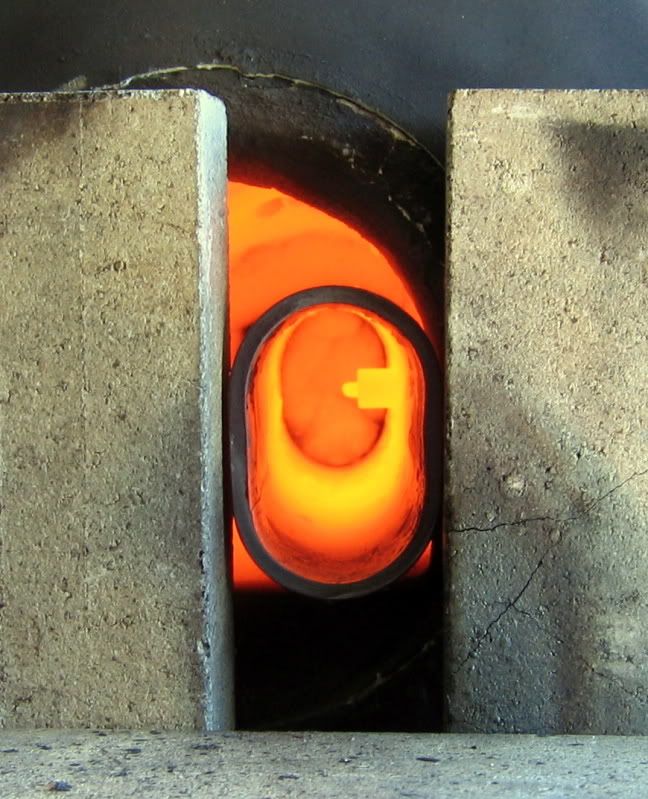
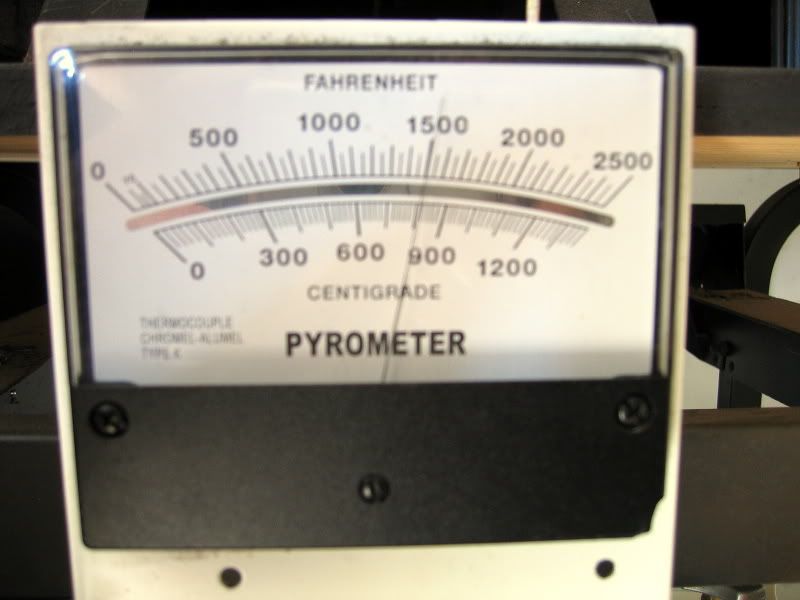
One of the first things I did was set my shop up in such a way that I could get repeatable lighting, anytime of the day. I used (and still do) Tempilstiks to calibrate my eye when reading heat by colour, shadow and sound. I say "sound" because when my LP forge is set for a certain PSI, it has a gentle "whisper" to it and that noise tells me everything is running well and ready to go.
I also have to point out that Tai's muffle pipe makes everything that much easier and more consistant.
- Joined
- Aug 28, 2009
- Messages
- 7,951
See I look at that picture and the chart side by side and the color chart and pyrometer don't match up. Being new to this whole knife making thing (1 year this month) I think I would put my money on the PID for me to get consistent results. Just thought I would give this thread the point of view from a newbie.
George
George
- Joined
- Jan 6, 2005
- Messages
- 9,680
That picture is aweful for colour. With my crumby camera, I had to use a flash to see the thermocouple.... it was to show the forge setup.
Rick
Rick
- Joined
- Aug 28, 2009
- Messages
- 7,951
But it does prove just how much lighting affects the perception of colour, even the settings on my monitor can throw off the colour. I think that to be able to use the chart correctly that I would need years of practice to get consistent results.
I would never say that the chart doesn't work, I just don't think it would work well for me without tons of supervision
I would never say that the chart doesn't work, I just don't think it would work well for me without tons of supervision

- Joined
- Dec 13, 2008
- Messages
- 2,986
I dont have a temp controlled oven myself so Ive had to make due. Ive learned to get pretty close over the years.
I do honestly know a guy personally who can get within a rockwell point of his intended hardness pretty much every time using his eye only. He is very meticulous about his heat treat though. He dosnt use a oven and he forges and heat treats in coal(tempers in a regular cooking oven). He does have access to a Rc tester so his results are unquestionalble. BUT hes been doing it this way for 30+ years.
Id love to have a oven to heat treat with but I dont. So we try to do the best with what we have to work with.
I do honestly know a guy personally who can get within a rockwell point of his intended hardness pretty much every time using his eye only. He is very meticulous about his heat treat though. He dosnt use a oven and he forges and heat treats in coal(tempers in a regular cooking oven). He does have access to a Rc tester so his results are unquestionalble. BUT hes been doing it this way for 30+ years.
Id love to have a oven to heat treat with but I dont. So we try to do the best with what we have to work with.
- Joined
- Aug 25, 2010
- Messages
- 50
Here is how I check my pid thermocouple so I know its right
I cut a small piece off a 99.99 pure siver coin I have for this purpose. I set the piece in 3 sided ss foil enclosure with the open end towards the door of oven and the silver and end of the thermocouple inside shielded from the elements by the ss foil walls. Then I start at 1745 and go up 10f at a time waiting 10 minutes at temp and see where the piece of silver slumps. It should melt at 1761f. So if it doesn't melt at 1755f and is slumped at 1765 I know I am very close. Closer than any color chart anyway.
This actually sounds pretty good, in the field of science the individual that develops a test procedure, usually gets it named after him. you could call it the "ib2v4u" calibration test. You could write it in better detail and a moderator could make a sticky about it. Then in the future, anyone that needed to calibrate their oven could reference your material..
thanks..

- Joined
- Sep 29, 2009
- Messages
- 1,614
I'm a little late to this party and will say that the knives I have made we all farmed out to a professional HT company. Although I'm still not sure as to what purpose this thread serves. Is it supposed to be educational or informative, though provoking, or a pissing match? I have yet to see how it can be the first though because there has been no real discussion by OP as to what makes this chart so critical that a knife seemingly can't be made without it.
Since this discussion has been going on for a few pages. Would you care to share your feelings about this particular subject? I for one am intrigued as to your thoughts on this subject and am eager to learn.
Since this discussion has been going on for a few pages. Would you care to share your feelings about this particular subject? I for one am intrigued as to your thoughts on this subject and am eager to learn.