How close to "full" hardness from quench w/ canola and 1084?

Status
Not open for further replies.
Good thing about Canola, is it works fine for 1084 and you can fry fish in it. Win Win ...

Park's 50 makes a hell of a hamon on W2, but not so good for fish. Just sayin.
 
Good thing about Canola, is it works fine for 1084 and you can fry fish in it. Win Win ...

Park's 50 makes a hell of a hamon on W2, but not so good for fish. Just sayin.


Haha! The bad thing about canola is the constant cooling rate. For 1080/1084 I don't think you will really notice a difference. Canola will get you full Ms conversion. It just doesn't have the slower cooling properties on the lower temp scale.
 
Theoretically, the blade quench in canola would be superior to the one quenched in the engineered fluid, because of the more uniform cooling mechanism… It would be 101% vs. 100%. :)

So vegetable oil is better than Parks AAA, a quench oil specifically engineered for carbon steels? :)
 
Last edited:
To add to the question if I may. If quenching 1080/1084 in Parks 50 I assume I will get full transformation from As to Ms. But, does the faster quench w/ Parks 50 add stress or a higher risk of warp? I know Parks 50 is faster than needed for 1080/1084....My question assumes proper heat control, normalizing, and uniform grind, sanding etc? Not trying to add/start a Canola/Parks debate.
All I have is Parks 50 and no canola.....w/40' of 1080 and 1084......

Excellent Post/question Pete... I too love the metallurgical art/science of bladesmithing...

Yes, a higher risk of warping and worse than that, an excessive amount of micro fractures.

As a side note,… “typically or conventionally” the steel is pushed to full hardness then tempered. However, this is not “always” the “best” in every situation. With difficult to harden high carbon steels, like 1095, pushing them to their absolute limit results in a very stressed out blade. In some cases, sacrificing a point or two of hardness may be a more prudent way to go. Excessive micro fracturing is more likely to result in catastrophic failure than a few grains of pearlite.
 
Last edited:
Haha! The bad thing about canola is the constant cooling rate. For 1080/1084 I don't think you will really notice a difference. Canola will get you full Ms conversion. It just doesn't have the slower cooling properties on the lower temp scale.

No.

It starts fast and ends slow.
 
IMG_1314.jpg


Canola and my paragon work well together.
 
Last edited:
Hey, all.

I know that 1084 with a quench in canola is the generally prescribed HT recipe for newbies/those w/o HT oven.

I'm curious to find out about how close to the full hardness one can get straight from a canola quench, assuming the steel was at the proper austenitizing temperature, canola was heated to 130, proper agitation -- essentially, if the HT were as perfect as is could be from a primitive setup, how close to the full hardness of 65 (HT'ers guide states 65 is full hard, although their formulation doesn't have the manganese Aldo's does) would one be able to get vs. using a HT oven and say Parks or other formulated quench oil? A point or two off, or a larger gap than that? Or is the hardness roughly the same but the structure is a larger percentage Ms/lower RA likely with proper quench oil because of the faster cooling rate?

Also, using Aldo's 1084, does anyone have an approximate table of tempering temps and corresponding HRC values? I've seen several -- some with 1080, some 1084, and even just the ones pertaining to 1084 varied quite a bit.

Naturally a Rockwell tester would be ideal, but I can't seem to find any machine shops or commercial heat treaters in the area who have one.

Thanks!

Pete, you asked a legitimate question and deserve legitimate answers, if your want some real information on the topic feel free to e-mail me (kevin@cashenblades.com), because you obviously aren't going to get it here. If you wonder who this Cashen guy is offering input, ask around for some references as to my ability to answer.

P.S. Stacy I am glad to see that whole pointless picture rule is working out so well:rolleyes: Seriously Pete, a private e-mail will get you a bit more ahead.
 
Pete, you asked a legitimate question and deserve legitimate answers, if your want some real information on the topic feel free to e-mail me , because you obviously aren't going to get it here.

Seriously Pete, a private e-mail will get you a bit more ahead.
Or, if you posted it here, we WOULD get the answer here.

Seriously don't let the good contributions get chased away.
 
Kevin, if you have something constructive to add to the discussion, I'm sure we'd all like to hear it.

It's not some big secret is it?
 
Pete, you asked a legitimate question and deserve legitimate answers, if your want some real information on the topic feel free to e-mail me (kevin@cashenblades.com), because you obviously aren't going to get it here. If you wonder who this Cashen guy is offering input, ask around for some references as to my ability to answer.

Pete, that's a high honor -- Kevin is a Master Smith, a member of the ABS Board, and teaches the ABS metallurgy class.

Kevin's metallurgy DVD is superb, if you get a chance.
 
Pete, you will do well taking Kevin up on his offer, his metallurgy is good and well researched. I have seen the direction this thread is likely to go about a month ago and will have no further part of it. Sadly I no longer have access to a good microscope and a met lab to run a side by side comparison to demonstrate for those who would actually accept actual metallurgical data what the actual results are.

-Page

Former Metallurgical Associate Engineer, Special Metals Corporation Aerospace Division (New Hartford)
Current President Mohawk Valley Chapter ASM International
 
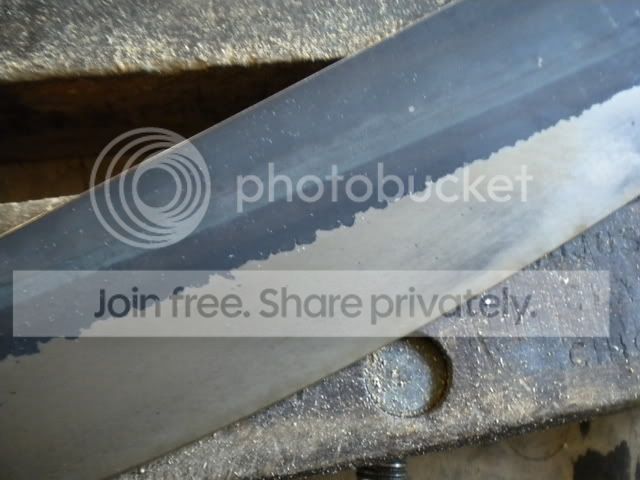
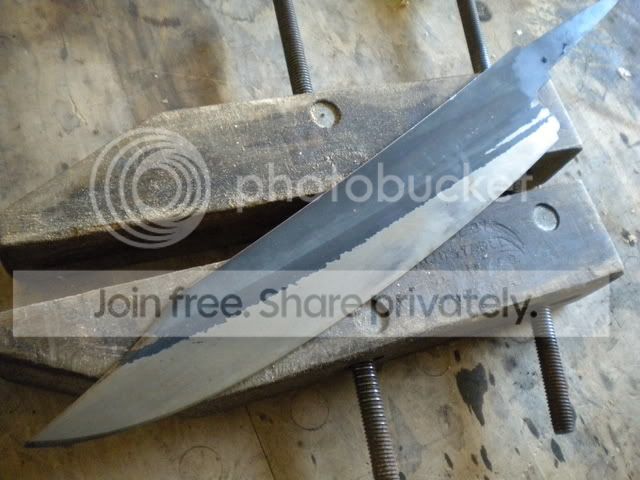
Here's one that came out of the quench real pretty,... 1095 in canola. I was shooting for a relaxed subtle "rainbow" above the primary quench line and to get the primary quench line to fall just under the grind line. I took the pics to see how closely the quench line follows the detail where the "black oxide" (not hard fire scale, just a thick heat patina) popped off.

Judging by the way it popped the oxide film off, and a quick hardness test,... it quenched the pee out of it! :)

DSCN2674.jpg


DSCN2670.jpg
 
Last edited:
Good lookin blade, Tai.


Folks, there's no reason we can't have a little fun here. And still get or provide good info. ;)
 
Don, I don't know how "good" the info is, just depends what you mean by “good“... but we for sure can have fun.

If it's fun, it's good. :)

I think this is a fun post:

We should get the references we discussed in past thread here on Canola in the stickies. I think we know more about Canola oil used as a quenchent then Parks 50. Trying to find out all the details and studies on Parks 50 has proven to be not so easy.

If anyone has studies and research on the use of Parks 50 please post the information so we can add to the database :)
 
Tai,

Being prudent by striking a balance between hardness and the micro-integrity of the steel is a sensible approach that has merit. "Absolutes" are usually attained through sacrifice and the result is usually an unbalanced one. In the final analysis, there is much more to a sound and functional blade than professing to squeak out it's absolute hardness.

Jeff

Yes, a higher risk of warping and worse than that, an excessive amount of micro fractures.

As a side note,… “typically or conventionally” the steel is pushed to full hardness then tempered. However, this is not “always” the “best” in every situation. With difficult to harden high carbon steels, like 1095, pushing them to their absolute limit results in a very stressed out blade. In some cases, sacrificing a point or two of hardness may be a more prudent way to go. Excessive micro fracturing is more likely to result in catastrophic failure than a few grains of pearlite.
 
Last edited:
Jeff, Sadly the industry seems to be geared more towards showy short term performance than sound HT and long term performance. I think the reason is obvious,... the parts work great for a while, then break, die an early death,... and you have to buy a new one. Industry and conventionality seem to love that.

It’s the way of the world $$$.
 
The most recent Reno Air Race s a good example of what happens when you push the edge of the design and/or material envelope too far.
 
There have been a number of studies on vegetable oil quenchants including canola. In every study I've read the oils used were aquired randomly from a local grocery store and showed identical results.

Tai, I am interested in learning more. Can you please point me to published studies on vegetable oil quenchants for knifemaking?
 
Last edited:
Don, I don't know how "good" the info is, just depends what you mean by “good“... but we for sure can have fun.

If it's fun, it's good. :)

I think this is a fun post:

Tai, I'm always having fun, man. Just too busy makin knives and cookin fish... :D
 
Status
Not open for further replies.
Back
Top