I have been a knifemaker for a few years, and I specialize in japanese blades. In all these years of making knives I have put a few bo-hi or fuller groove in quite a few pieces . today It is easily done with modern machinery (milling machine) Does anyone know how the japanese did it by hand ????? was it done with files or what seems it would be extremely labor intensive ?? JIM

-
The BladeForums.com 2024 Traditional Knife is available! Price is $250 ea (shipped within CONUS).
Order here: https://www.bladeforums.com/help/2024-traditional/
You are using an out of date browser. It may not display this or other websites correctly.
You should upgrade or use an alternative browser.
You should upgrade or use an alternative browser.
How did the japanese do it ??
- Thread starter artcreek
- Start date

- Joined
- Feb 15, 1999
- Messages
- 11,566
Checkout Don Fogg's site, I believe he has a tutorial on it.
- Joined
- Feb 12, 2007
- Messages
- 155
There is a tool called a fuller tool. It's a pulling tool with a hardened metel insert. You pull it along the blade much like a draw file, and eventually, you cut the fuller into the blade.
As IG said, there is a section on Don Fogg's website about the technique.
As IG said, there is a section on Don Fogg's website about the technique.


Stacy E. Apelt - Bladesmith
ilmarinen - MODERATOR
Moderator
Knifemaker / Craftsman / Service Provider
- Joined
- Aug 20, 2004
- Messages
- 38,668
You use a fuller scraper. See Don Fogg's site. It is surprisingly fast to draw one (the motion is a draw, or pull). Forging one in requires allowing for the spread of the steel and can really mess things up if not done right.
Stacy
Stacy


- Joined
- Apr 14, 2006
- Messages
- 3,816
Flux they used was a clay slurry with rice straw ash mixed in. if you are looking for a good general book get "The Craft of the Japanese Sword" with Yoshindo Yoshihara and others. Explains much of the process but does leave out some details.
Chuck
Chuck
- Joined
- May 22, 2007
- Messages
- 273
i agree, thats odd. and i find push cuts awkward for most things also. i have made many of my tools so they can be used for a pull. iv been planning on making a sen and fuller scraper for a while. oh where does the time go...
-Lou
-Lou

- Joined
- Jul 27, 2003
- Messages
- 5,703
Know what that groove is for?
Think of this, back in the "day", the people creating things out of steel with the forging method, or any method for that matter, didn't have Admiral Steel, or Fastenal, or Crucible, etc. just down the road or a day away with UPS! All they had, was what they had.
Steel was VALUABLE!!
Imagine what it took to build a furnace and make your own wootz.
Anyway, you have this piece of steel and you're forging along and realize you either want it a little longer or a little wider! You don't grab another piece of flat bar stock out of the corner - you only have what you have.
So you can push that edge down, but you need to get the steel FROM somewhere.
You smoosh down that groove up by the spine, and it moves your edge down. What was "in" that groove is now usable steel somewhere else.
It was just a matter of availability and stock resources.
Think of this, back in the "day", the people creating things out of steel with the forging method, or any method for that matter, didn't have Admiral Steel, or Fastenal, or Crucible, etc. just down the road or a day away with UPS! All they had, was what they had.
Steel was VALUABLE!!
Imagine what it took to build a furnace and make your own wootz.
Anyway, you have this piece of steel and you're forging along and realize you either want it a little longer or a little wider! You don't grab another piece of flat bar stock out of the corner - you only have what you have.
So you can push that edge down, but you need to get the steel FROM somewhere.
You smoosh down that groove up by the spine, and it moves your edge down. What was "in" that groove is now usable steel somewhere else.
It was just a matter of availability and stock resources.

- Joined
- Jan 5, 2005
- Messages
- 2,531
Here's a link to a thread that shows an excellent version of a fullering tool.
It was made by one of our very own ShopTalk phenoms, B Finnigan :thumbup:http://www.bladeforums.com/forums/showthread.php?t=522813
Not only a pic of the tool but a video showing it in use too. Excellent tool finny
It was made by one of our very own ShopTalk phenoms, B Finnigan :thumbup:http://www.bladeforums.com/forums/showthread.php?t=522813
Not only a pic of the tool but a video showing it in use too. Excellent tool finny
- Joined
- Jan 5, 2005
- Messages
- 2,531

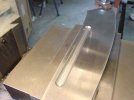
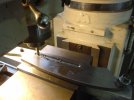

- Joined
- Jun 17, 2001
- Messages
- 5,705
Now to get back to your question: How did the japanese do it ?? Sameway as us.
Karl, I just bowered the book that Woodchuck mentioned. Don't recall seeing the groove being fullered but then I may have missed it. What you said sure makes sense to me.
Karl, I just bowered the book that Woodchuck mentioned. Don't recall seeing the groove being fullered but then I may have missed it. What you said sure makes sense to me.
- Joined
- Apr 14, 2006
- Messages
- 3,816
Yoshindo shows the cutting/fullering tool he uses. He does not forge it in but cuts it in. He has a handle he puts various chisels or gouges in to cut the groove desired. Page 96..
Chuck
Chuck

- Joined
- Mar 18, 2001
- Messages
- 588
bobby.t
^ That's odd, since pretty much any American tool that involves a push is done with a pull in its Japanese form (saws, planes, etc).
If you look on page 84 in the craft of the japanese sword you will see two pictures of Yoshihara San pushing his sen away from himself while cutting. Additionally on page 97 you can see him cutting the groove in a sword with a push cut.
- Joined
- Apr 14, 2006
- Messages
- 3,816
I use a sen in both directions. Works great for removing a lot of steel. I do not feel it is at all dangerous in the draw method. However pulling one of those chisels or gouges toward your body would be an accident waiting to happen. Fullering or forging the groove was done for the reasons mentioned above and also to lighten and strengthen the blade. At least this is what some who have much more insight than I have indicated.
Chuck
Chuck