
-
The BladeForums.com 2024 Traditional Knife is available! Price is $250 ea (shipped within CONUS).
Order here: https://www.bladeforums.com/help/2024-traditional/
You are using an out of date browser. It may not display this or other websites correctly.
You should upgrade or use an alternative browser.
You should upgrade or use an alternative browser.
How do I pin this?
- Thread starter kuraki
- Start date





- Joined
- Feb 27, 2006
- Messages
- 5,191
i agree with the domed pins, especially on horns and antler. i have seen antique knives on which the horn/antler was wavy and warped at the edges. if the pins had not been domed, the handle material would have popped off. nice quality of horn you have there !


Bill DeShivs
Knifemaker / Craftsman / Service Provider
- Joined
- Jun 6, 2000
- Messages
- 12,933
All I can add is to be careful. Ram's horn seems to be relatively fragile and can break when pinning.
It also shrinks if not aged.
It also shrinks if not aged.

- Joined
- Dec 1, 2016
- Messages
- 474
That looks killer!

- Joined
- Oct 17, 2010
- Messages
- 2,424
No cup punch necessary, just dome the pins by peening. It takes a little practice, I recommend drilling 5 or 6 holes in some scrap material first, pin each hole, by the time you get to the last one you'll probably be pretty confident. It's not rocket science. Only time I ever use a punch is when I have a pin deep in a tight recess, usually, that's with stag. None of your pins should necessitate that, the rear, right side will be a little trickier, I'd set one head in a "pin heading vise" (make one, it takes 10 minutes), and put that head on the opposite side, then peen the tricky side, once you get a good dome all around, you can smack that side of the dome down into the low spot easily. Just focus on getting it good and even, regardless of the fact that it wont be tight in the valley, and once the high side is flush with the handle material, evenly smack that side of the pi a few more whacks and push it down in.
Another option, is to take a small cone wheel on a foredom/dremel, and remove a little bit of material around the pin hole, on the high part of the handle material there, so you have a reasonably level seat for the pin. Blend it carefully, and it will look natural.
I put domed pins in nearly every knife I make, and I joke with most of my friends that I can make domed pins quicker than they can screw together a corby in the handle material, it may be a slight exaggeration but not by much. Once you get the hang of it, it's easy as pie.
With fragile material, like real old fossil ivory, pearl, mammoth tooth, etc, the most important thing is knowing how far you can push it, and being comfortable with your pin stock. If you're concerned, select a pin material that's softer and peens easier, gold and silver (buy it in "dead soft" state) peen super easy, nickel silver isn't bad, and 410 stainless will peen all day, but it's a bit tougher. 416 will work harden and splinter if you peen it too long, and you've gotta be quick and aggressive with it before that, which encourages the pin to "upset" and swell in thickness, which is usually what causes a crack.
When making domed pins, you don't need to swell the pin internally, the domed head creates a mechanical fastener, so don't treat it like a "peened" pin that you strike off (grind flush), where you need to swell the pin inside the chamfered hole. All you need for a domed pin is to chamfer (countersink) the corner of the hole.
Make sure you chamfer the pin head before you start doming also, just take the sharp corner off, but leave the face flat, this helps keep it from splitting from excessive peening.
IMO a cup punch is only used when necessary, and it typically requires three hands when it is. You have to support the back side of the pin, preferably in another cup punch so it doesnt deform the dome, hold the knife level, hold the top punch, and smack it with a hammer, all the while, if one of these components moves or get misaligned, you're liable to put rings in, or flatten one of your pins, or worse, the handle material.
Another option, is to take a small cone wheel on a foredom/dremel, and remove a little bit of material around the pin hole, on the high part of the handle material there, so you have a reasonably level seat for the pin. Blend it carefully, and it will look natural.
I put domed pins in nearly every knife I make, and I joke with most of my friends that I can make domed pins quicker than they can screw together a corby in the handle material, it may be a slight exaggeration but not by much. Once you get the hang of it, it's easy as pie.
With fragile material, like real old fossil ivory, pearl, mammoth tooth, etc, the most important thing is knowing how far you can push it, and being comfortable with your pin stock. If you're concerned, select a pin material that's softer and peens easier, gold and silver (buy it in "dead soft" state) peen super easy, nickel silver isn't bad, and 410 stainless will peen all day, but it's a bit tougher. 416 will work harden and splinter if you peen it too long, and you've gotta be quick and aggressive with it before that, which encourages the pin to "upset" and swell in thickness, which is usually what causes a crack.
When making domed pins, you don't need to swell the pin internally, the domed head creates a mechanical fastener, so don't treat it like a "peened" pin that you strike off (grind flush), where you need to swell the pin inside the chamfered hole. All you need for a domed pin is to chamfer (countersink) the corner of the hole.
Make sure you chamfer the pin head before you start doming also, just take the sharp corner off, but leave the face flat, this helps keep it from splitting from excessive peening.
IMO a cup punch is only used when necessary, and it typically requires three hands when it is. You have to support the back side of the pin, preferably in another cup punch so it doesnt deform the dome, hold the knife level, hold the top punch, and smack it with a hammer, all the while, if one of these components moves or get misaligned, you're liable to put rings in, or flatten one of your pins, or worse, the handle material.

kuraki
Fimbulvetr Knifeworks
- Joined
- Jun 17, 2016
- Messages
- 4,679
I don't have anything to add except I really like the knife! What's the steel?
Thank you, it's 1095.

- Joined
- Aug 24, 2014
- Messages
- 765
I really like the design and grind you got goin on there!!


- Joined
- Dec 24, 2005
- Messages
- 881
Nice looking package. Have you considered the method used by Puma knives, using small washers to spread the load of the pin head. No need to worry about splitting your material.
kuraki
Fimbulvetr Knifeworks
- Joined
- Jun 17, 2016
- Messages
- 4,679
They all wrote to you, I add one advice: when you grind it do not heat the material. Use belts in good condition. It's a wonderful material with extraordinary colors.
You're not kidding. I didn't yet realize when I posted this, but I've since finished and buffed the fronts of the scales and the marbling is beautiful. Is that what interior horn looks like? I need to get more if so.
Great set of scales you got there! I know how rare is to find such a pairing match.
I don't agree with all the concern about going easy with that ram, i don't think you can split those scales easily.
On the contrary you could also heat it and bend it like thermoforming plastic, although you won't need it for this project
Gread advices as always from Javand!
I don't agree with all the concern about going easy with that ram, i don't think you can split those scales easily.
On the contrary you could also heat it and bend it like thermoforming plastic, although you won't need it for this project
Gread advices as always from Javand!

KnuckleDownKnives
Time to make the doughnuts..
- Joined
- Feb 12, 2015
- Messages
- 1,715
Great looking knife John. Looking forward to seeing the end product.

Horsewright
Knifemaker / Craftsman / Service Provider
- Joined
- Oct 4, 2011
- Messages
- 14,141
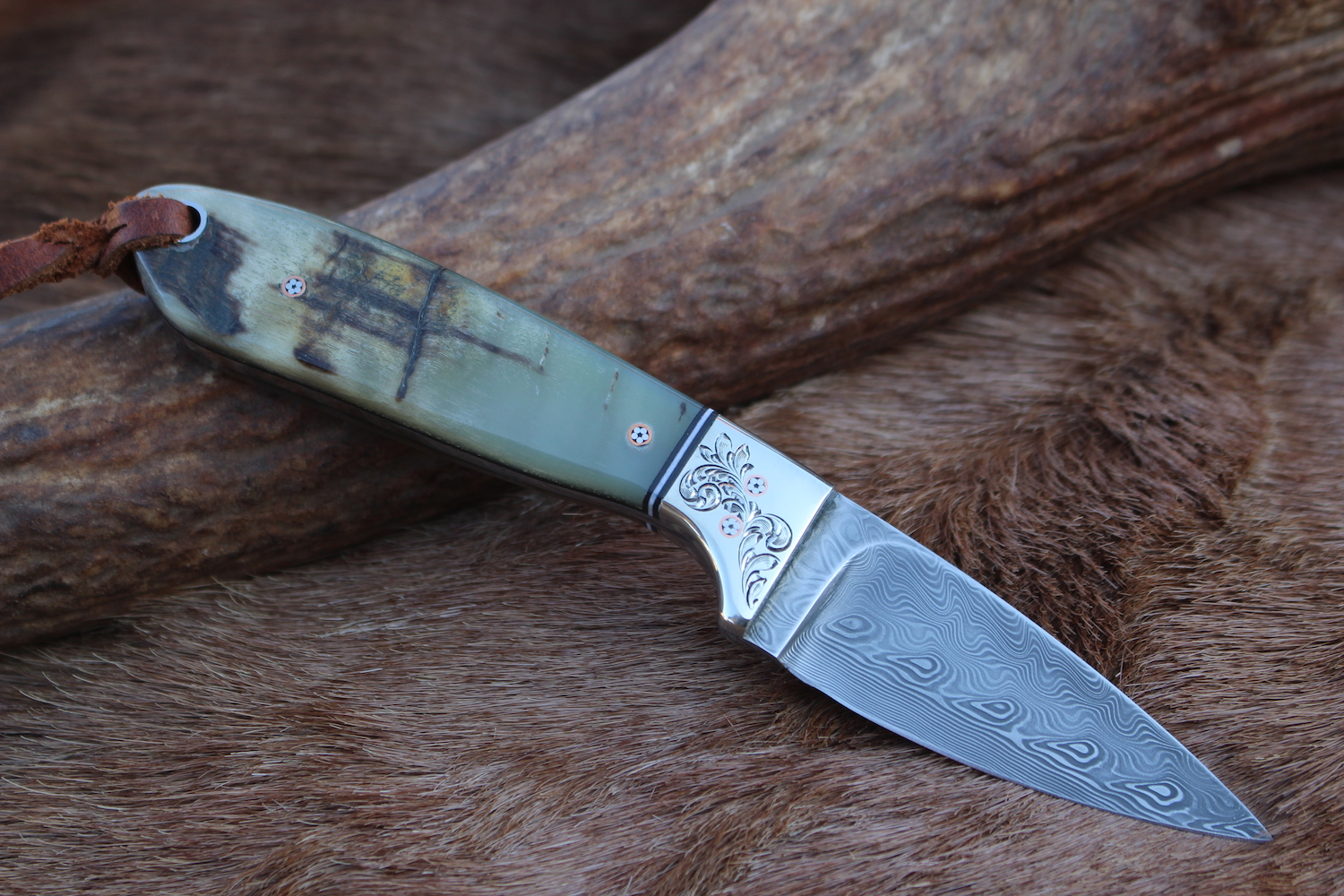
If your design criteria ever involves grinding and sanding smooth be aware that the different sheep horns can kind of go translucent on ya. Not a deal on this project but just future info. I use to dye the inside of the scale but then went to using colored liners on all sheep horn handles. Little disconcerting if you can start seeing the tang lightening holes or if like me ya sometimes write notes on the tang. I have sawed off more than one set before starting to do this. The aforementioned colors can actually be accented with the right color choice.
Black:
Red:
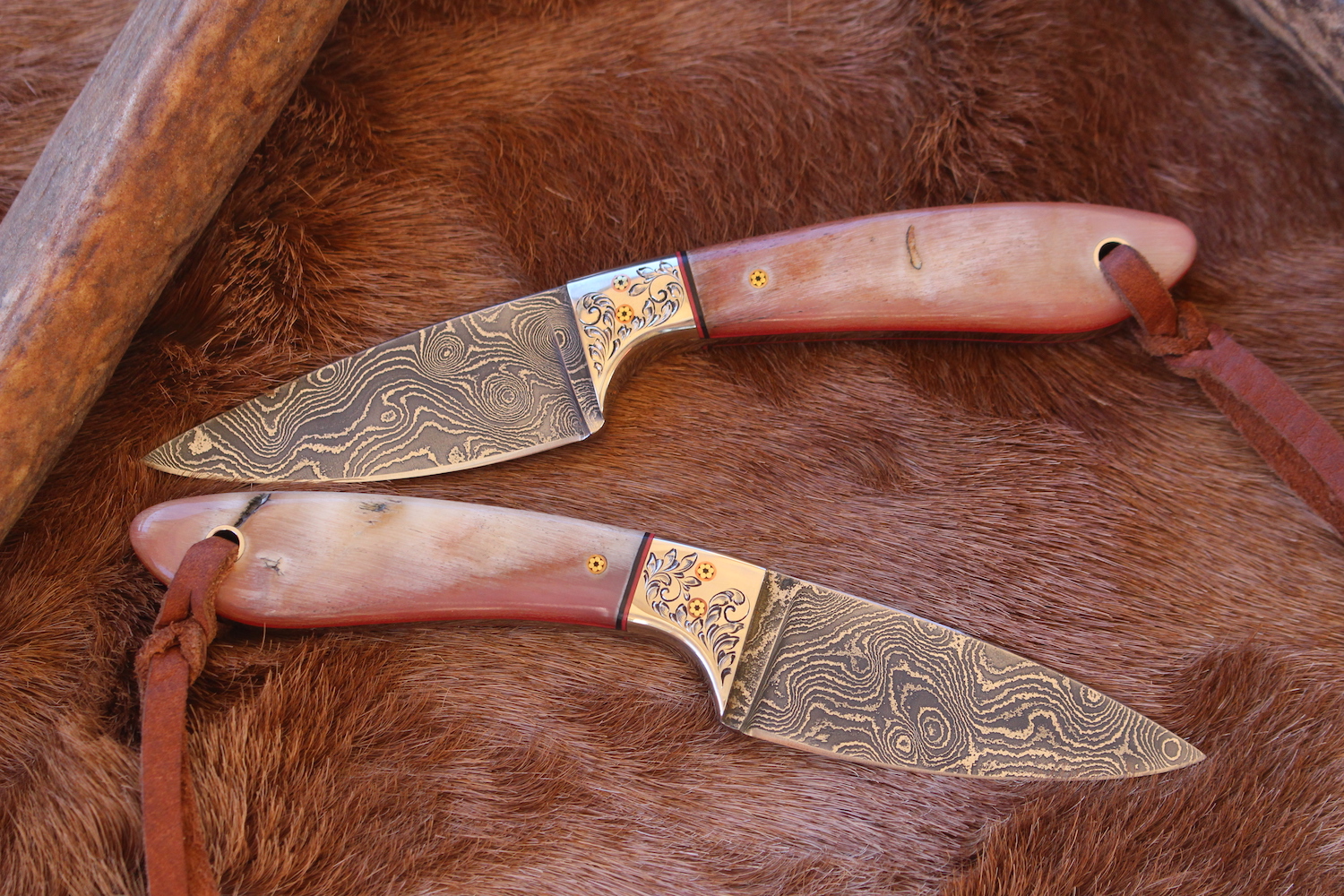
While I don't have any decent pics, green has been widely popular. Again just for future info on a another project, since you're not grinding your pins flush on this one. Nice work so far and a nice set of horn!
Black:
Red:
While I don't have any decent pics, green has been widely popular. Again just for future info on a another project, since you're not grinding your pins flush on this one. Nice work so far and a nice set of horn!
Horsewright
Knifemaker / Craftsman / Service Provider
- Joined
- Oct 4, 2011
- Messages
- 14,141
Ya bet buddy.
- Joined
- Feb 27, 2006
- Messages
- 5,191
i have read in the past it is good to wipe mineral oil on rams horn gun grips and knife handles once or twice a year and let it soak in.. the natural oils will eventually evaporate and thats when it twists/shrinks.

DEllis
Part Time Steel Basher
- Joined
- Oct 17, 2007
- Messages
- 966
That knife will be awesome!
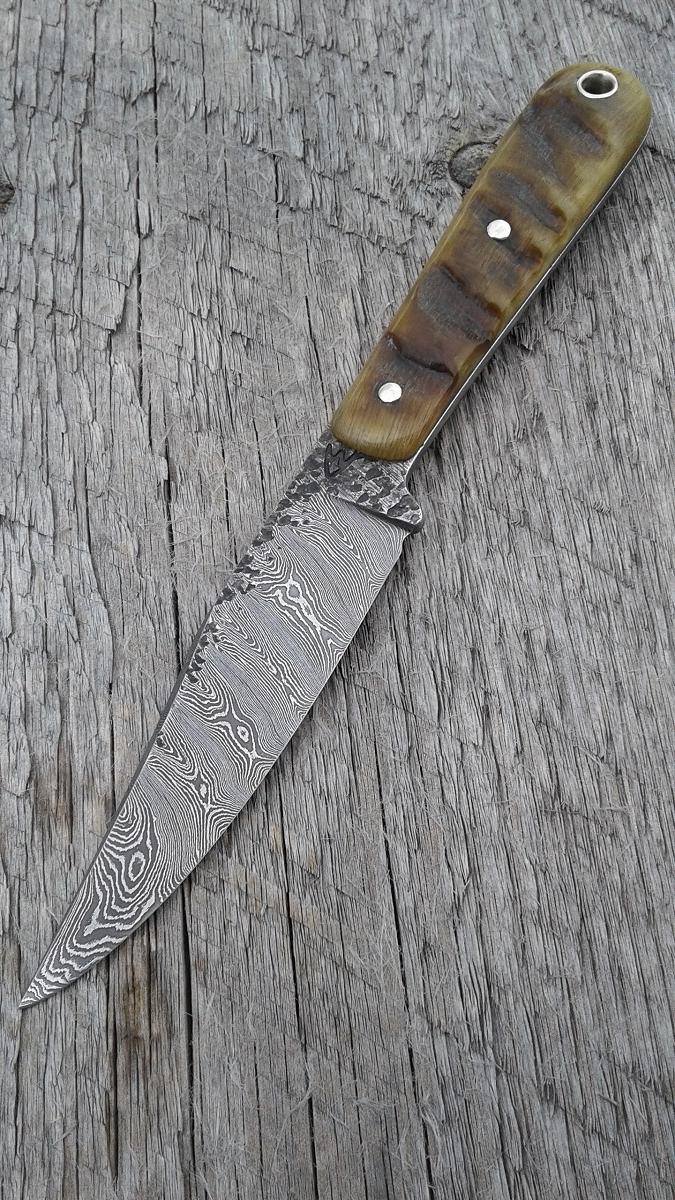
Domed(peened) and polished works well. To polish the pins, add a couple layers of masking tape with a hole punched thru it over each pin and buff the pin head from all directions. Take it slow to keep from overheating the pin and cooking the horn around them. The tape will keep the buffing compound from staining the horn.
Here's one of mine. I did a bit more sanding on the surface of the horn than you want to I think.
Darcy
Domed(peened) and polished works well. To polish the pins, add a couple layers of masking tape with a hole punched thru it over each pin and buff the pin head from all directions. Take it slow to keep from overheating the pin and cooking the horn around them. The tape will keep the buffing compound from staining the horn.
Here's one of mine. I did a bit more sanding on the surface of the horn than you want to I think.
Darcy