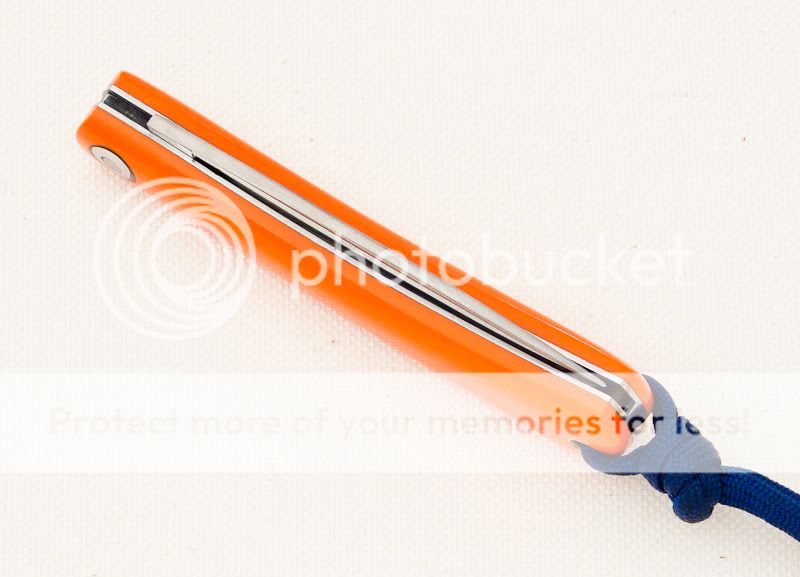
How do you all feel about steel bolsters/liners?

Most of the custom traditional knives (and the Case/Bose collaborations) have stainless steel bolsters and liners. I much prefer the look of stainless steel over the brass.


Kevin's grandpa certainly knew knives and obviously did a good job passing that knowledge on. Iron/steel was used on less expensive knives.

Here's some info from BRL on the subject.

Jake, thank you for passing that info along to me. I was probably close to ten when he told me that. It wasn't until after he died that I really had a passion for traditional knives. I was never able to go back and ask him exactly what he meant. I appreciate it.

Kevin
 
Thanks for the opinions and input guys. I might make one with steel all around just to see how I like the looks of it. Steel and ebony. Hmmm.....hard working knife material for sure!
 
Thanks for the opinions and input guys. I might make one with steel all around just to see how I like the looks of it. Steel and ebony. Hmmm.....hard working knife material for sure!

Sounds like a great combo to me :thumbup:
 
My very first GEC happened to be an all steel 73. I had no idea at the time other than I liked the pattern. It was only after hanging around here for awhile that I found out. It snaps like crazy but I don't know if that's because it's steel or just because it's a GEC Scout.

gecgreenscout.jpg


Then I picked up an all steel Barlow, I knew it was all steel but I bought it for the clip and green handles

gecbarlow.jpg


Love 'em!
 
That is a nice 73! One question though, what steel does GEC use? The only steel I have is the bullnose and it definately does not patina like carbon steel.
 
Given the choice, I'd like all my knives to have nickel silver or stainless liners. Brass liners have never really done it for me and on a work knife, I'm not sure I want the up keep of an all carbon steel knife.
 
L1020594.jpg


Trial run:
-O1 Tool Steel
-57-59 Hardness
-Orange Delrin
-***Updated 125 low carbon cold rolled steel liners
-***Updated "Pivot is 125 low carbon steel with bite washer pressed on pin design"
-3.75" Closed Length
~1/2" handle thickness measured with ruler
~6 13/16" Overall length measured with ruler
~Measured Spine thickness 0.094"
~Measured thickness just above the edge bevel 0.014"
 
50 years ago an elegant knife of the highest quality, had liners as well as bolsters of nickel silver. The cost was higher. Only Kurt Guttman ordered Hen & Rooster knives with brass liners, the Guttman marked Hen & Rooster knives were the cheapest H&R knives made in the 1950s and 60s. Very desirable today.

Today, brass cost more than 410 staainless, but takes a lot less labor to make it work. Stainless takes much less upkeep over the years. Brass is still used in this country because the makers think that the contrast of steel, brass, and nickel silver is attractive to the American buyer of traditional knives. (and they like the cost savings involved)

100 years ago the cheapest barlows and jack knives were made the vow carbon liners and bolsters. They were called iron bukt were lowest cost steel, except those that were cast.
 
That is a nice 73! One question though, what steel does GEC use? The only steel I have is the bullnose and it definately does not patina like carbon steel.

It does not patina as quickly or aggressively as the 1095, that is for sure. Low carbon steel I believe.

But Mine are still taking on a nice greyish color.
 
Thanks for that info on the GEC Farm Tool. I may have to run to the local steel yard and grab some 22 gauge 1018 cold roll.
 
Thanks Guys and A. G.
I know, and I think A. G. will agree, for a basic EDC folder, a linerless folder is more than adequate. There is beauty in simplicity too.
 
To this day, I still don't know what '125 low carbon' steel is. By itself, and disregarding the mysterious '125' designation, 'low carbon' can mean anything (either stainless or not, just minimal carbon content). I've never found any documentation anywhere, for a steel named as such.
 
To this day, I still don't know what '125 low carbon' steel is. By itself, and disregarding the mysterious '125' designation, 'low carbon' can mean anything (either stainless or not, just minimal carbon content). I've never found any documentation anywhere, for a steel named as such.

I remember when you and I tried to figure it out before. Still stumped myself. All I can tell you is my bullnose got covered in corrosive materials and the liners are still shiny. Thats why I was wondering if GEC used it across the board.

And the info was from Mike, quoting GEC factory.
 
I remember when you and I tried to figure it out before. Still stumped myself. All I can tell you is my bullnose got covered in corrosive materials and the liners are still shiny. Thats why I was wondering if GEC used it across the board.

And the info was from Mike, quoting GEC factory.

And that's what I'd normally expect of most 'low carbon' stainless bolster/liner material, when such are used in knives. Oftentimes, it's something like the 410 stainless A.G. Russell mentioned, which is indeed very low carbon, but high in chromium content. I think some other similar varieties have been used as such (304, 316 come to mind; extremely low carbon, but high chromium; maybe nickel too). But the '125' designation of this particular steel really throws me. I'd bet with certainty, based on lack of patina as you mentioned, that it is stainless, but I wish I knew more about it.
 
Back
Top