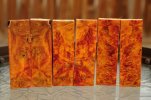
How Do You Like Your Curly Maple?

I have only made one knife with maple, but have a bit of it in stock, as I found a e-bay dealer who says his is kiln stabilized that gives it a good color and more stability.
I have a couple of sheets of it plus these blocks.
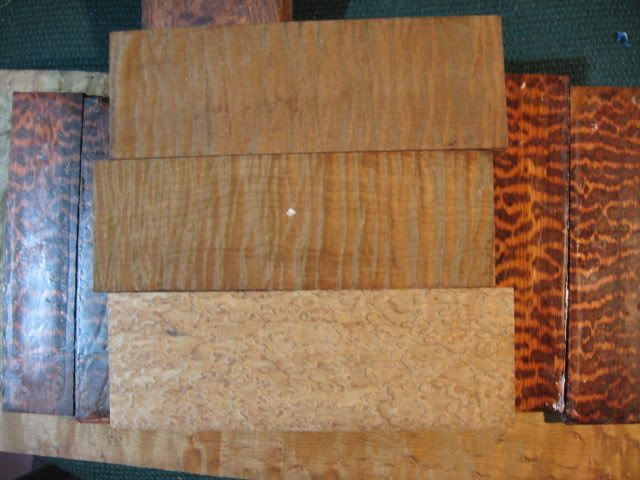
IMG_3608.jpg


Here it is profiled before contouring
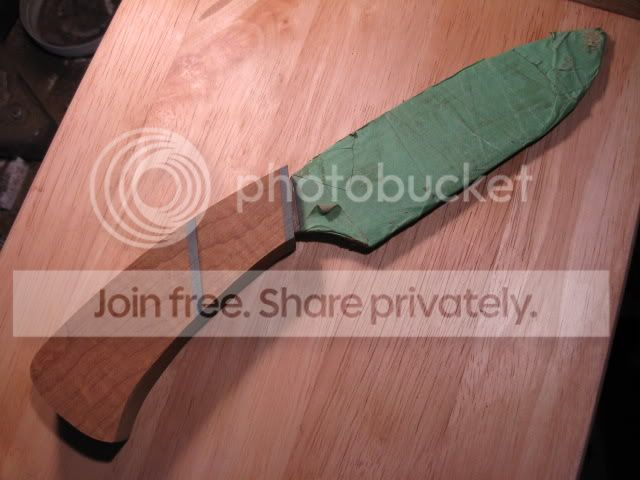
IMG_4870.jpg


And after taking to 600 grit finish with only tung oil. I was amazed with the color and chattoyancy (sp?) that it showed, and then understood why it was so desireable of a material.
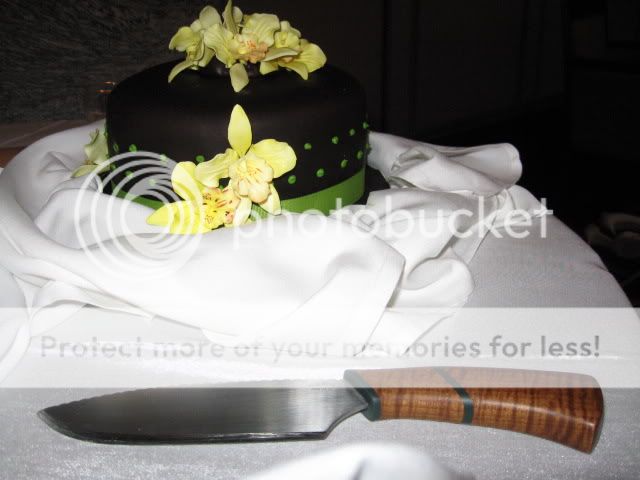
IMG_5081.jpg
 
Do you use aqua fortis (I have no idea what this is - need to Google it!) before stabilizing?

Dennis

The auqu fortis can be as simple as steel wool in vinegar - and the result is gorgeous - but I'm not sure the penetration is deep enough to make blocks, stabilize them and then make handles.

Don't knock stabilization guys. Knives used to be made of stone or bone - bronze - steel - and now advanced alloys and more. Handles are the same. It's part of the evolution of the craft. There is much to be said for the history and ancestry of the craft - but I'm not taking knapped obsidian into the field for my field dressing knife. I'm also not going to send out an unstabilized handle to anyone except a very special customer - the kind who appreciates the patina on an old leather saddle, and is willing to treat his knife as good as he treats his rifle. That's a rare breed these days.

By the way, I kind of like this:

maple.JPG


even if it is dyed :-)

Rob!
 
The following picture is of a knife dated from 1862 made with a spiral walnut grip. I hope that 200 years or so from now my knives look this good....patina and all...

DSCN6612_19_40_55_149453419.JPG
 
Last edited:
Up here in Vermont I am literally surrounded by sugar maple. It's one of my favorite woods. Tight grain, hard, stable, and beautiful... Finishes real nice too, even without stain.
 
The auqu fortis can be as simple as steel wool in vinegar
Actually no that's not aqua fortis which is iron dissolved in nitric acid aka ferric nitrate whereas iron dissolved in vinegar is ferric acetate.
While they give a similar look they are not the same end effect and are not used the same - AQ requires the piece be blushed with heat and then neutralized whereas the vinegar solution does not, but then the vinegar does not in my experience give the same "depth" of grain that AQ does.

For those wanting to try AQ here's where to get it:
1) WAHKON BAY AQUAFORTIS
Continental U.S. ground shipping only.
MICHAEL LEA AND DAUGHTER, 2109 Summit Street, Columbus OH 43201. Telephone 614-291-4757, email <oldguns2109@sbcglobal.net>
2) Ferric Nitrate Crystals - mix 3 or 5 to one distilled water and crystals
http://secure.sciencecompany.com/Ferric-Nitrate-125g-P6384C670.aspx

As for stabilization, yes it has it's place and if that is what rings your chimes than use it, but the idea that a knife is no good without a stabilized grip is pure balderdash, stabilization has been around for maybe 40 years - unstabilized knife handles several thousand.........
This curly maple one is 150 + years old and BTW - the guard and ferrule are cast pewter.....it was made by one of the Gillespies, well known Tennessee gunsmiths..
gillespie-knife-1.jpg
 
While maple does not require stabilization....and stabilization is a process that will not normally mix with aqua fortis coloring....there are unique effects that sometimes will be displayed by stabilizing maple. The sugar content reacts with the chemicals and the heat during the process and creates great colors and chatoyances that were not visible before. The block Rob posted is a good example. I have quilted maple stabilized for this reason.
 
There is much to be said for the history and ancestry of the craft - but I'm not taking knapped obsidian into the field for my field dressing knife.

I would absolutely love to be able to do this. To learn the ancient art of flintknapping and actually be able to hunt and survive using such primitive methods...that would be such an awesome experience, to do things like they did thousands of years ago....providing it were actually legal to do so.:D
 
Something has been missed here and I'm sorry Dennis for the thread drift. Stabilizing is important for me as I make a lot of kitchen knives - I know that a lot of guys don't like the feel of a stabilized handle, but for food service it is the cat's @$$. No open pores in the wood means no place for bacteria to fester, and if it accidentally get's tossed in the dishwasher, it will probably be ok (although not recommended).

As far as the curly maple goes, I like it blond - I appreciate the nice darkened look, but I prefer to leave it a nice golden honey color and accent it with either a darker wood or pins/guard. I pretty much despise dyed maple, it just ain't natural. Personal preference is what it is I guess.

Have a good one,

Nathan
 
I like the nice darkened look the best, but I have used just the natural honey color too. I've tried dying it before, but found that I didn't really like it...partly because I can't stand messing with dyes...same when it comes to my leather sheaths. I recently found the iron and vinegar trick and I think I'm really going to like using it. It is natural, historical, and it is something that I can use on both my knife handles and my leather sheaths. I would like to try the aqua fortis someday as well...maybe there's a way I can make the stuff myself? I don't know. Anyways, I totally can see someone wanting to use stabilized wood on a knife for the kitchen because keeping bacteria out and so forth is a reasonable concern. I just like to keep things traditional and natural that's all.
 
ORANGE, like orange aniline dye mixed with tung oil.........

sorry cant find the pics, but it is stunning
 
Dennis I see how your thread went way off course. I like my curly maple tight grain lots of waves and a light brown dye to enrich the hidden beauty of the grain that gets missed if not dye. I hear the some of the guys love the old traditional way of doing things and 2 each his own. I want my handles stabilized because I want them to last under the worst conditions you can immagine. Thats why I am a believer in stabilization. Kellyw
 
ORANGE, like orange aniline dye mixed with tung oil.........

This is not curly maple, but I did a large batch of maple burl. Is this a similar color you were referencing too?

Dennis
 

Attachments

  • DSC_2672 - Edited.jpg
    DSC_2672 - Edited.jpg
    62 KB · Views: 35
Back
Top