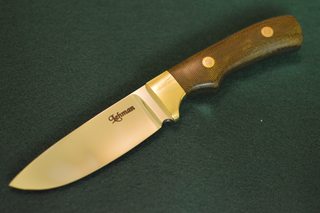
How do you peen pins or what else

Joined
Jan 5, 2014
Messages
1,495
I am a fan of thinner pin stock for my pins, and I do what I call old school peening for them- I cut them slightly proud of the scales and slightly countersink the through holes for them and then I put them on an anvil of sorts and hammer the pins until the have mushroomed slightly--then I sand them with the rest of the scales--I also put a little texture on the body of the pins to help them grab a little more epoxy when gluing up the scales. I am just curious what others do, I have considered using some standoffs and torx head screws and doing some scales that are screw mounted, and have thought about using some corby bolts--what is ya'lls methodology for the Corby's, do you drill a hole that will fit the body of the screw part through the scale and blade and then countersink a small bit on the top side of your scale, or what.


Just looking to learn what approach others use--all input and methodology is welcomed
 
I am a fan of thinner pin stock for my pins, and I do what I call old school peening for them- I cut them slightly proud of the scales and slightly countersink the through holes for them and then I put them on an anvil of sorts and hammer the pins until the have mushroomed slightly--then I sand them with the rest of the scales--I also put a little texture on the body of the pins to help them grab a little more epoxy when gluing up the scales. I am just curious what others do, I have considered using some standoffs and torx head screws and doing some scales that are screw mounted, and have thought about using some corby bolts--what is ya'lls methodology for the Corby's, do you drill a hole that will fit the body of the screw part through the scale and blade and then countersink a small bit on the top side of your scale, or what.


Just looking to learn what approach others use--all input and methodology is welcomed

I currently use corbys. There's a bit of a learning curve but the best use is a step bit. I made my own on the 2x72 and a dremel. It works for all intents and purposes. The idea is to have a "shelf" about half way through the handle material for the head of the corbys to catch on. I like that they hold the scales very securely.
 
Fochops, that sounds interesting, how exactly did you go about making the step bit? I have purchased a few, but haven't tried them yet.
 
Take your digital calipers and find the size of the smaller portion of the corby and the larger portion or "heads" of the corby. Select a bit that is as close as possible to the heads of the corby. Take that bit and drill a hole through a piece of wood. Use a collar stop so that a good inch or so is hanging out of the wood. Take to the grinder and while spinning the chuck side in your fingers run the cutting portion of the bit on a belt. Whittle it down to match the diameter of the smaller portion.
When that's done put the bit in a drill and clamp the drill in a vise and turn it on. Use a cutoff wheel on a dremel to clean up the shoulder you made on the grinder and get a crisp shoulder. Hope that makes sense?
 
I use corby's mostly as well. I get them along with the stepped bit from Pop's Knife Supply. When I use pins, I do the domed type, as shown in this Nick Wheeler video:

[video=youtube;ULWxdqEZqDg]https://www.youtube.com/watch?v=ULWxdqEZqDg[/video]

[video=youtube;X0A_63OwdVM]https://www.youtube.com/watch?v=X0A_63OwdVM[/video]
 
Here is a sketch showing how I do Corby's. There might be better ways, but this works for me.

corbybolt.png
 
I remember when Nick first posted this here on BF's and someone showed a much more simplistic way of doing this--can't remember who it was, but his method was much simpler to my way of remembering it. You can't go wrong if you copy Nick though!!
This is a lot different from what I do for a pin, and as to what I think is necessary.

Fochops, that makes total sense on how you came up with your step bit--think I will try that.
 
I remember when Nick first posted this here on BF's and someone showed a much more simplistic way of doing this--can't remember who it was, but his method was much simpler to my way of remembering it. You can't go wrong if you copy Nick though!!
This is a lot different from what I do for a pin, and as to what I think is necessary.

Fochops, that makes total sense on how you came up with your step bit--think I will try that.

It was Bill DeShivs. He has probably peened more pins than all of the rest of us put together.
 
I use Loveless bolts for all of my knives and have since I started.

I like the abilty to put longer bolts for thicker handles if I'm making a large Cleaver or Chopper with a hefty handle.

Loveless Bolts give a strong mechanical connection with G-Flex Epoxy for a water proof seal and I'm good to go!

Domed pins do look great on a Coffin handle or other period piece, but i rarely make those.

Stay safe & Have Fun!:thumbup:
 
I use essentially the same method as Nick. I find it takes that amount of care to ensure those type of results. I have fine tuned it a little in my own ways, but anyone does that after a while.
 
I have used torx screws and stand offs. I buy .250 od stand offs that are .312 long for .250 thick tangs, so that they'll be .031 proud on each side. I drill the tang and scales .250 through, then use a counter bore or counter sink depending on whether I'm using button head or flat head cap scews. This is an effective and economical method, I buy the screws and stabdoffs from McMaster Carr.

I also use corbys as posted above. I want to try domed pins soon.
 
My only recommendation that you buy the step drill for each size of Corby and Loveless bolts you use and keep the drill labeled with the bolts so 6 months later you don't use the wrong step drill for the fastener you choose. Larry
UCSi3IGm.jpg
BsamI5Gm.jpg
 
Larry, that's especially good advice for me in particular--I'm awful about not labeling parts properly early on, and getting them confused when I fetch them out at a later time!! I think I need to label the few step bits I own currently while I still have some idea what they are. I like the idea of using a step bit as a solution actually. But I really like the idea of making one yourself.

As to Loveless bolts, I don't see where there is an advantage to them over Corby's--am I missing something. And I do use epoxy also with all my pinning methods!
 
Larry, that's especially good advice for me in particular--I'm awful about not labeling parts properly early on, and getting them confused when I fetch them out at a later time!! I think I need to label the few step bits I own currently while I still have some idea what they are. I like the idea of using a step bit as a solution actually. But I really like the idea of making one yourself.

As to Loveless bolts, I don't see where there is an advantage to them over Corby's--am I missing something. And I do use epoxy also with all my pinning methods!

When I fist started using Corbys I made a knife and ground the scales down along with the bolsters to a pleasant shape and the handle got a fraction too thin. I ground through the bolt head on the front Corby bolt and was left with the shank. I quickly center punched and drilled it out and used a tungsten carbide drill to enlarge the hole to 1/4" through the tang and put in a stainless pin. I had to do the same to the rear pin. I saved the knife and used only Loveless bolts for a short time after that because they look the same even when ground thin. They adjust to pretty much any length and look kind of traditional as well. I now plan a little better and use Corbys all the time but sometimes grind the shanks shorter before assembly if I am making a knife with a slender handle. I use epoxy when using Corby's and Loveless bolts. I hope this helps you a bit. Larry
UCSi3IGm.jpg
 
I remember when Nick first posted this here on BF's and someone showed a much more simplistic way of doing this--can't remember who it was, but his method was much simpler to my way of remembering it. You can't go wrong if you copy Nick though!!
This is a lot different from what I do for a pin, and as to what I think is necessary.

Fochops, that makes total sense on how you came up with your step bit--think I will try that.

[video=youtube;LZjWkcHfYuE]https://www.youtube.com/watch?v=LZjWkcHfYuE[/video]
 
Thickness of the scale minus .075 to .125 depending on blade thickness and scale material, equals the depth you cbore.
 
How do you measure that while using a drill press? Sorry if this sounds ignorant I'm in now way shape or form a machinest or anything if the sort so it kinda sounds like a different language sometimes
 
Back
Top