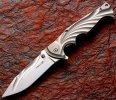
How do you think he made this?

Joined
Mar 27, 2009
Messages
122
Brian Tighe's knife looks great. How do you think he made the grooves? (what would you call them?). Do you think he used a CNC? Think they could be made without a CNC? I have my own design I'd like to try in a similar way. I've tried using my foredom with poor results. I have a miniature mill/lathe, but don't see how that would help. So what do you think?
Thanks.
 

Attachments

  • tighebreaker.jpg
    tighebreaker.jpg
    67.2 KB · Views: 486
CNC Mill with ball endmills. I'm sure you could do it without one, but it would sure make life way easier.
 
It is called a sculpted handle. The grooves are called flutes. It can be done by hand with ball burrs and a flex shaft, or programed in a CNC mill.
 
Dremel tool and cutoff wheel. Die Grinder, or normal size cutoff wheel. If you pull the cutoff wheel through at an angle instead of straight you will get a round bottom groove instead of a straight line. That's how grooved crown molding is made on a table saw.
 
You can do the handles with a CNC Mill and it still be a custom knife. The only thing required for it to me a custom is the blade has to ground by hand.

the word "Custom" has nothing to do with whether or not any part of it is done by hand, "Custom" implies that something about the design or construction is unusual, and was done specifically for the customer who ordered the knife. You can do a "Custom" piece that is full-on CNC machined, however that piece would not be "Hand Forged" or "Handmade"


-Page
 
Yes He is a tool and die maker in real life and uses CNC to do that.

You could use a manual rotary table for constant radius grooves, but he is doing variable radius arcs and variable depths on this.


Wolfgang Loerchner. does this with all hand tools
Gallery27b.jpg
 
It is called a sculpted handle. The grooves are called flutes. It can be done by hand with ball burrs and a flex shaft, or programed in a CNC mill.
Dremel tool and cutoff wheel. Die Grinder, or normal size cutoff wheel. If you pull the cutoff wheel through at an angle instead of straight you will get a round bottom groove instead of a straight line. That's how grooved crown molding is made on a table saw.
I understand the idea of how to use ball burrs and a flex shaft (foredom) with wood, and I understand the idea of how to take a cutoff wheel through at an angle (I've done this with wood projects and a saw), but I have been unable to control the foredom well enough to make it accurately follow an S curve in STEEL. How do you control it? What bits work? Do you have to go so slowly that you might as well hand carve it with files, or do I need a LOT MORE practice?
If it were wood, I would use the pin router jig I made. With it I use a pattern made of plywood cut to the shape I want to route out. The pattern is then attached to back of the wood to be routed with double side carpet tape. The wood and pattern are placed on the router table, wood to be routed face down with the pattern on top facing the rod/pin in an overhead arm, centered over the router bit. The wood is then cut by having the pin touch and follow the pattern. The router cuts the pattern from underneath. I then finish with hand work.

So how do you do it with a flex shaft? Is there a jig to purchase for this? Or would I need to make a pin router jig like my wood one? Or....?

Is it possible to follow a curved pattern with a manual Sherline miniature mill. Do you use some kind of jig to make it possible to follow the pattern with an X Y table. I picture trying to do it just with the X Y hand wheels and having it turn out like a wiggly line Etch A Sketch drawing. (Which is how my lousy hand held attempts have turned out with the Foredom). I don't have the X Y table yet, so I'd like to know if there is a way to do this before investing in an X Y.
Is the best way to grind it. Is there a link to someone doing this?
Thanks
 
This is the kind of thing that all sorts of people will gladly give you free advice regarding their THEORY... but there are only a handful of people in the WORLD that can do carving at that level with hand tools. Whether you rough it in with power tools or hand tools, it's going to require a ridiculous amount of hand finishing to make it smooth, symmetrical, and clean.

Like numbers posted... Wolfe is the first maker that comes to mind who could actually pull it off.
 
Like numbers posted... Wolfe is the first maker that comes to mind who could actually pull it off.

Elizabeth is doing a pretty good job herself these days. I'd love to be a fly on the wall while either one of them was working.
 
Brian's lovely work is very deep into automation but so what. His prices are kept reasonable, and he constanty is doing something new, and almost every one offers something special. Here, in my opinion, is where automation catches up and often passes hand work.
I have done a few with metal flutes and many with pearl. My way is very simplistic and as Nick said heavy on the hand work. I cut a very small groove with a dremel type tool except mine is air driven. The tip has a 3/32" ball on it. I do not go very far with this. It is to provide me with a general positioning on where I want to go and to overcome the starting problems of scateing files. I use course to start and then fine and then several sizes of sandpaper. To see one of my meteorite pearl "swallow tails" go to the customknifegallery.com and scroll down on the left hand sideto find me. Damascus and meteorite are kind of tough to do because of the changing direction of the metals. Frank
 
Brian's lovely work is very deep into automation but so what. His prices are kept reasonable, and he constanty is doing something new, and almost every one offers something special. Here, in my opinion, is where automation catches up and often passes hand work.
I have done a few with metal flutes and many with pearl. My way is very simplistic and as Nick said heavy on the hand work. I cut a very small groove with a dremel type tool except mine is air driven. The tip has a 3/32" ball on it. I do not go very far with this. It is to provide me with a general positioning on where I want to go and to overcome the starting problems of scateing files. I use course to start and then fine and then several sizes of sandpaper. To see one of my meteorite pearl "swallow tails" go to the customknifegallery.com and scroll down on the left hand sideto find me. Damascus and meteorite are kind of tough to do because of the changing direction of the metals. Frank

Thank you for the specifics. I started out with to large a ball and it just wandered.
 
Thank's much Count. I have an awfull lot of repect for your knowledge.
Edge, I was supposed to have written in to start with course files. Go with the 1/8" ones to start and then increase the size as needed. You may be surprised that they can get up to a pretty big size to do what you want. As well you some clean clay . Dux Seal, or even some white putty as a damper when working on the part with the grinder.
Can I help more? Please let me know with questions , if so. Frank
 
One thing I find interesting about this thread is the feeling I get that people shy away from this sort of thing because it requires a lot of hand work. Personally, this is precisely the sort of thing that excites me. If a knife can be cranked out in a day or two, it doesn't really draw my attention no matter how perfect the bevel or how pretty the handle material. What grabs my eye is custom detailing. All of the examples shown in this thread appeal to me at a very deep level, and like the base poster I appreciate any insights into how to do this sort of thing by hand.

Thanks to Frank for sharing the technique. I'll have to give it a try that way and see what I can make. Lord knows I have plenty of files of all shapes and sizes.

- Greg
 
Thank you for posting Frank!!! I was hoping somebody who has some solid carving experience would add their thoughts.

For those who misinterpreted my post, I was not discouraging anyone from carving. I was discouraging them from taking advice from people who don't really know how to actually do it.

As per design, fortunately we all have the right to like what we like and dislike what we don't. But I feel very different than tryppyr about it. Learning to make a "simple" knife that is clean, flowing, as close to flawless as possible (not possible, but you can strive for it), and learning to take elements and play them off each other in a manner that works with the human eye, takes years of dedication to make happen.

If a maker gets to that point, they can make a knife that is like a beautiful woman in a black dress. She doesn't need jewelry or a ton of make-up or fancy shoes.... it is her natural flowing lines, grace, and simple aesthetically pleasing presence that draws your eye to her. You can add some lip-stick, or a nice necklace, or some sexy shoes, and make her stand out a little more... but nothing gawdy. Your eye will be drawn to her in her entirety and won't get hung up on one area.


A maker trying to fumble together something fancy when he doesn't have a solid grasp on making a smooth, ripple free bevel, or a seamless transition from one material to the next, is going to end up with a fat, pimply, greasy, used car salesman wearing a pink and green paisley, polyester suit, with orange clown shoes, and a purple clip-on tie. Your eye will go nuts... it won't know whether to focus on his shoes, his suit, his tie, his horrible disgusting shape....

But some guys like that.... this is the interwebz after all. ;) :)

This is my version of a discussion I had with Tim Hancock and Larry Fuegen, two of THE BEST bladesmiths in the WORLD, at the ABS Expo show about 8 years ago.

 
I have tried this technique with hard stones which work a bit like metal. You can do most of the sculpting with just a flexshaft or dremel with a ball burr and finish with sandpaper, it just takes a LOT of practice. Draw your design and follow it with the ball tip then cut deeper where you need to. There is no easy way to do this by hand that I know of, it just takes loads of practice. I'm not any good at this yet, just passing along information. I picked this up from a guy who could carve just about anything in a matter of minutes! :D,
 
Guys i have a pretty good "Friend" named Bill Tuch who is a "Carver" of steel blades& handles and i can speak from watching him work Yes you can do all that without CNC.. it does take forever & the "Gear" is not cheap .lot's of specialty Files/stones,custom holders ,huge inventory of every grit sandpaper up to 8000.
Did i mention a shitload of time?? as in weeks minimum for something simple .
i'm sure he would tell ya "Anyone Can " do this most won't
 
A maker trying to fumble together something fancy when he doesn't have a solid grasp on making a smooth, ripple free bevel, or a seamless transition from one material to the next, is going to end up with a fat, pimply, greasy, used car salesman wearing a pink and green paisley, polyester suit, with orange clown shoes, and a purple clip-on tie. Your eye will go nuts... it won't know whether to focus on his shoes, his suit, his tie, his horrible disgusting shape....

We really need not talk of extremes, when in this very post there are examples of artistically carved handles that show how things can be done tastefully, even using mixed materials.

Those whose work we admire today almost certainly started in a less admirable place. They almost certainly didn't get where they are now by shrinking from the challenge. They might, however, have been put off by someone characterizing their work as you did. I can say I am not discouraged, and will start down that path, and if I end up in a clownish place, so be it. I take no offense. I am what I am, and I don't pretend to be more.

If my words about the perfect bevel and the pretty handle offended you, I apologize. I know many on this forum strive for that combination and do excellent work in that endeavor. I meant no denigration to them. I was simply stating an opinion, and one that I hoped would let those who do the more artistic work know that their efforts move me and are appreciated. And if in my naivete I attempt what they have executed expertly and my results are less expert, it is to be expected, as the first steps on any path are less steady and sure than the ones that follow.

- Greg
 
Back
Top