How hard is it to taper the tang really?

Joined
Jun 13, 2007
Messages
7,743
Am I most likely to trash the knife I've spent hours making?

I'd have to use the 6" disk grinder (freehand) mostly. On top of that, the tang is already shaped and the butt is not square, so that may make it a bit more challenging. The pin holes are already drilled.

Should I practice on scrap, or am I over thinking this?
 
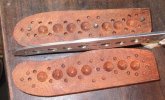
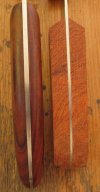
I tried to taper a tang and ran into trouble with the handle pins. When the scales where laid against the tang, they sat at an angle so the pin holes formed a V-shape.


Edit: Now that I think about it, if you wait to drill the pin holes in your scales until after you taper the tang, you should be fine.
 
Do you have the ability to hollow grind? If so, then it's not hard at all.
The main thing that helps me is to mark the end of the tang for the thickness you want, just like when doing a bevel, and make both sides look the same.
I probably wouldn't do it if I couldn't hollow grind a trough in it...it's just too hard to get right, for me.
 
Bob Loveless " How to make Knives" shows how, and if you have a good grinder and can hollow grind and have a flat platen, it's easy. I have heard some later printings of Bob Loveless book have dark hard to see pictures. If you can get a early copy with good pictures, the book is full of great information.
 
His video shows that part pretty clearly too.


Everything is easy once you know how, practice on scraps makes lots of sense to me.
 
In my last materials order from Jantz, I added a DVD of S.R. Johnson's "Making a Sub-Hilt Fighter". Wow, what a wealth of information! He marked the butt of the tang just like you would mark the edge of the blade, maybe .030" thick. He then hollow ground the tang until he reached his mark. Then he ground the taper on the flat platen and cleaned it up on the disc grinder. He made it look easy. I figure he produced an $8000 knife in about 4-1/2 hours.

Bob
 
Last edited:
In my last materials order from Jantz, I added a DVD of S.R. Johnson's "Making a Sub-Hilt Fighter". Wow, what a wealth of information! He marked the butt of the tang just like you would mark the edge of the blade, maybe .030" thick. He then hollow ground the tang until he reached his mark. Then he ground the bevel on the flat platen and cleaned it up on the disc grinder. He made it look easy. I figure he produced an $8000 knife in about 4-1/2 hours.

Bob

One of the best knifemaking videos ever.
 
I've seen the hollow made in youtube videos. I only have a 1x30, so very little (and not so flat) platen. The knife is only 1" tall so it would fit the belt, but again, the platen isn't really long enough to hold the knife vertically against the belt.

Since the hollow doesn't have to be pretty, I might be able to get away with using the idler wheel at the top.

As for scribing the butt... I could do that, but it's already shaped, meaning, it's more like a point, not a flat face.

I should mention that the main reason for doing it is because I flat ground into the spine when doing my bevels. Tapering would fix that if done right.

Honestly, I think I may just go ahead and finish this knife and start a new one. I really wanted it to be as close to perfect (or at least really good) as possible, but I think it may just be better to finish it and try applying what I learned on this one with the next. As it stands, it's just kinda sitting there in limbo and I'm feeling like I'm done with it.

Thanks for the tips on the dvds. I'll check on them the next time I order some materials which should be soon.
 
Not hard. It does make you have to be a little more careful fitting up the handle material though.
 
Here is the trick - fit the scales after the tapering.

Temporarily attach one scale in place with a dot or two of CA. Drill pilot holes where the pins/rivets will go with a drill bit smaller than the pins/rivets ( I like half the size). Since the scale is flat, and you are drilling from the tang side, there is no parallax at this point. Temporarily attach the second scale. Now the two sides are not parallel anymore. Place a shim under the scales at the spot where the tang ends. The shim should be the amount of metal you removed from the tang. If the blade is .125" stock, and you tapered to .004", make the shim .008" thick ( a drill bit close to that measurement works perfect for the shim). Now you can re-drill through the first holes as normal with the pilot bit, and then drill the clean holes in the proper size. The holes will perfectly align when the handle is assembled later.

Second trick - The scales you just drilled will not sit flat to each other with the pins/rivets in place without the tapered tang in between them. This makes shaping and sanding the front ends before assembly a bit of a problem. The trick is to stick that same drill bit you used as a shim between the scales at the back end. The pin/rivet holes will now align and allow the scales to be taped together - thus allowing the front to be easily shaped and polished.

Upon final assembly the handle will be a perfect fit.....and the only "special" jig/tool you used was a drill bit as a shim.
 
Would it be possible to taper a tang on a 4 x 36 or would the wheels get in the way?

I considered this, and, aside from irritating bogging, I believe it would work great. Nice big platen to work with. The only reason I'm not planning on using it, and I know that this is a half lame reason, is because I don't have a good belt. I have exactly 1 worn out and crappy belt, designed for wood. Even if it was fresh, the belt has an annoying bump at the seam.

I have looked for decent belts for the 4x36, and actually found some, but I'm not ordering anything atm. I'll, instead, be using the disk sander on the side. For some reason I must have tossed the work rests so I have to free hand everything, even on the 1x30. Must have thrown a fit years ago when I drank or something. :D

Stacy- you are brilliant. Plane and simple. I planned on tapering, then drilling holes in the handle material smaller than the holes in the tang so that they could fit through at a cockeyed angle. The holes in the scales would fit the pins, but not the holes in the tang. Doesn't seem like such a good idea now.

Okay, so I'm back in on the idea. How do you figure out how far up the tang to grind? Does the taper go all the way into the ricasso? All the way to the plunge?

I really do appreciate all of your advice guys.
 
However far you want to go. It's sort of like Nike says, Just Do It. You will see where you need to stop after you mess a couple up.
 
If you do a google image search for "tapered tang", you might just see a few examples to get an idea.

Bob
 
These threads never fail to amuse me. Tapered tangs are not "magical" or complex to grind, build or finish... although they do have a wonderful influence on the weight and balance of a good knife, and they really look cool. :)

The geometry and procedure is really quite simple... it's nothing more than a full-flat grind on a narrow, long piece of steel. Quite frankly, if a knifemaker cannot make a tapered tang, I would have serious reservations about him/her grinding a simple blade that actually cuts well.

Drill first, then taper, then drill/fit your scales with a couple degrees of taper in mind. Easy peasy.
 
Last edited:
Full grind ahead - that's the spirit, Strig! if it ain't broken, you're not trying (quote Red Green).

I simply do taper tang with my crappy 2x42 (crooked & grooves platen). Just grind until achieve straight gradual flat lengthwise bevel - I didn't hollow/channel nor used any jig. I post-ht grind, so it takes around about 30 minutes to an hour to taper a tang. Here is my wip experimental 52100 petty 5" w/ weight reduction(big holes) tang taper to 0.05...

52100 petty 5inch amboyna pre-epoxy.jpg52100 petty 5inch amboyna curing-epoxy.jpg
 
Here is the trick - fit the scales after the tapering.

Temporarily attach one scale in place with a dot or two of CA. Drill pilot holes where the pins/rivets will go with a drill bit smaller than the pins/rivets ( I like half the size). Since the scale is flat, and you are drilling from the tang side, there is no parallax at this point. Temporarily attach the second scale. Now the two sides are not parallel anymore. Place a shim under the scales at the spot where the tang ends. The shim should be the amount of metal you removed from the tang. If the blade is .125" stock, and you tapered to .004", make the shim .008" thick ( a drill bit close to that measurement works perfect for the shim). Now you can re-drill through the first holes as normal with the pilot bit, and then drill the clean holes in the proper size. The holes will perfectly align when the handle is assembled later.

Second trick - The scales you just drilled will not sit flat to each other with the pins/rivets in place without the tapered tang in between them. This makes shaping and sanding the front ends before assembly a bit of a problem. The trick is to stick that same drill bit you used as a shim between the scales at the back end. The pin/rivet holes will now align and allow the scales to be taped together - thus allowing the front to be easily shaped and polished.

Upon final assembly the handle will be a perfect fit.....and the only "special" jig/tool you used was a drill bit as a shim.

Can you explain that math, or draw a photo, I 'm not catching on.
 
Back
Top