How hard is it to taper the tang really?

Glad I can be of service James. ;)

So you're of the mind that I'm over thinking it. I agree. My biggest obstacle is equipment. Unfortunately that seems to be a recurring issue for me. Grinding into the spine was a symptom. Seems I'm likely going to continue to have little problems that I'll end up needing to fix, but as I understand it, that's a large part of knifemaking. Glad my pop taught me to work with what I've got.

I ask these questions because I know that some of you have had similar issues and are great about sharing knowledge. Your post would have been exactly what I needed except that I already went for it. :)

Bluntcut, thanks for your advice and help. I'm sure you already know that I really respect your methods and testing in all things having to do with making a sharp knife ridiculously sharp. I wish you frequented this forum more often. ;)
 
You guys would get a HUGE laugh if you could only see my "equipment". :D

VYbxx9C.jpg


Q0q0YXz.jpg


EQjr9LH.jpg


What is amazing to me is how much different the weight and balance are. I mean, the thing is made out of steel, you remove a bunch so of course it's lighter, but dang... It's much much lighter. Either that or my brain is fried from having been awake for so many hours.

Anyway, the answer to my own question is, not really that hard. I still have some cleaning up to do, but I think I can get it done right.

As always, thanks!
 
I drill out my relief/skeleton holes in the tang and them full flat grind the tang using a file handle with a piece of pin stock in it as a push stick or In my case an old culinary knife with the blade ground off with a little pin hole spot left in the blade pushing into the last pin hole of the tang. Then use my other hand to press lightly on the riccasio area until I get the tang tapered the way I want , then on to he other side. I go through a 36, 60, 120, belt then to whatever finish belt/s I want.

If you can bevel grind a knife you can taper the tang on that same knife.
 
Its funny when makers say its easy to do.. When they already know how to do them. I have learned to do them. And they are real easy to do once you do learn. But they are tricky in the beginning or if you have never done them. So there is nothing wrong with asking a question..Nothing really amusing .
 
Its funny when makers say its easy to do.. When they already know how to do them. I have learned to do them. And they are real easy to do once you do learn. But they are tricky in the beginning or if you have never done them. So there is nothing wrong with asking a question..Nothing really amusing .

Mark,
I have never heard a dumb question, but I've heard plenty of no so bright replies.

I don't think anyone said its EASY! Its just if you can make a FFG you can taper a tang. You may end up sacrificing one to the knife gods but thats the case in most knife making endeavors. Some people over think this stuff. There is no magic. I generally use my used belts for Tang tapering and profile grinding etc. You may want to use a new or almost new belt until you get the hang of it. I taper my tangs after the blade has been HTed and before I grind the bevels. You can taper before HT if you like. There are no rules here.
 
I have not tried it yet. Do you try and stop the taper at the end of the scales ? or grind past them and blend it in?
 
I have not tried it yet. Do you try and stop the taper at the end of the scales ? or grind past them and blend it in?

I went from the ricasso to the butt. The knife I have from another maker was a great example.

I agree that it would be pretty straight forward with a proper platen, or large disk grinder. The trouble comes with trying to do it with crap tools. I ended up using a combination of disk sander, 1x30 belt grinder, files and sandpaper. I still have a lot of hand sanding to do in order to get the tang flat and matching width between the top and bottom of tang. I'm going to guess that I could probably do it in an hour tops with a 2x72. I'll probably put a solid couple of hours into doing it this way.

On top of everything else, I may need to re-heat treat this knife because I used a magnet to hold the knife and didn't realize that it got fairly hot.
 
I use a 4"x 36" and have very little trouble tapering tangs .
Of course I "hollow grind "the tang first (using an angle grinder)
Ive found that a tapered tang need not be perfectly square to the rest of the blade (I.E. there can be a bit of taper from the spine to the edge , or vice versa )as long as its FLAT along its length and has a bit of hollow to prevent the scales from "rocking"on it .
 
Perhaps "easy" is the wrong word. It's simple. Whether or not a person can make it happen depends on their focus and skill.

Please accept my apologies for being amused by folks making a straightforward concept seem much more complicated than it really is.

:)
 
I accept your apology.

The question, as I stated at the top, wasn't about simply grinding some steel off a tang resulting in a flat surface. I already know I can do that. It had more to do with my limited equipment, and whether or not those that might know would recommend trying given the already shaped handle, inexperience, limited equipment and the desire to not destroy something I've spent a lot of time on already. Of course no one could say for certain. I understand that, but I'd never done it. I felt it was possible that someone might say, no, I've tried with a little disk sander and had poor results, or, I did something similar and it worked...

Doesn't matter now. The jobs 99% done and I'm very pleased with the results. ;)
 
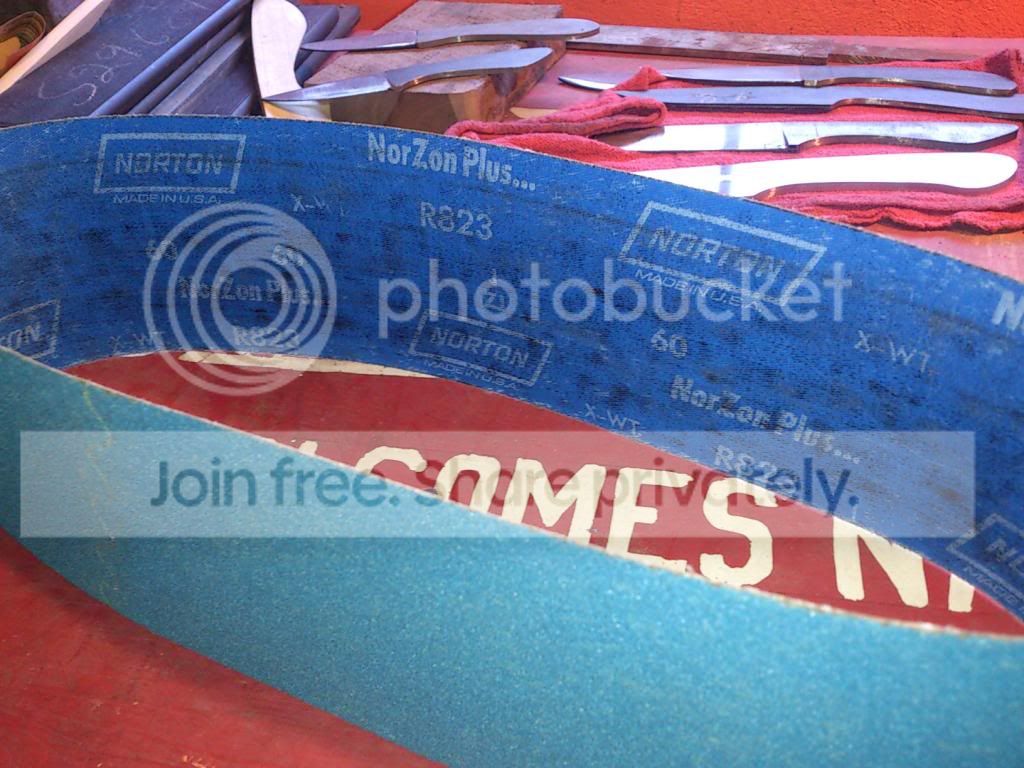
Hey Strig, I have been using a 4x36 with these belts.

norzonzirc_zpsa9df34f8.jpg


I think Truegrit stocks them and I have found them in 10 packs by searching for Norzon R823. These are 60 grit Zirc belts and last a long time. I have not bought them myself because I get them from a materials testing lab that uses them to prep samples before going to the spectrograph. Get this, they have to use these belts because they won't contaminate the samples and they can only use the belt on one sample. The sample is little lollipop shaped puck less than 2 inches diameter. They then have to toss the belt and put on a new one for the next sample. They don't do this test very often but one of the guys is putting back some of the belts for me so I plan to continue to use my 4x36 for profiling and flattening among other things even after my 2x72 is finished being built.
 
I was talking to Jimmy Fikes about some stuff that seemed like voodoo magic to me and he told me his process then said, "All of this is simple, none of it is easy." Seems fitting here.
 
Wow, that's awesome Perrin! Mind sharing that supplier? Just kidding. :)

I'll definitely look into these. I believe I saw them on truegrits website once before. I'll try to pick some up. :)

Thanks for sharing that Shaw. Indeed, that is well put and accurate.
 
Back
Top