How long does it take to get good at grinding bevels?

I started a couple of years ago. In my experience, as in everyone's, various things can affect your progress. I filed my first blade but that was pretty disappointing. So I bought a Grizzly grinder which was all I could afford. I ground maybe 60 blades on that. With practice my grinds improved. Almost all of those blades are in my junk jars. Some of the trouble was that I was trying to clean up forged blades. That has it's own set of challenges. Then I started doing stock removal. The ability to scribe the blade more accurately and establish a nice square ricasso led to much better results. And more practice meant more success. Then I took a deep breath and wrote a check for a TW-90. That improved my grinds quite a bit. But by that time I had already figured some things out through practice and by paying close attention to what was happening during the grinding process. Then I started grinding with one of Bruce B's file guides. Man, did that thing up my game! I don't have a background in metalworking but I am an artist by profession. That also helped my progress. Toward the beginning of my journey down the path of making knives I decided to invest in some classes. Thankfully I live only a couple of hours from a master smith here in NY. I took a few classes over the last couple of years. That cut years off my learning curve. And of course a little resource called the Blade Forums might have played a small part too. :) These days I'm pretty comfortable getting a blade ground. I still have a long way to go but I like what I'm turning out. My problem is in finishing the knives with handles and sheaths. I work at a painfully slow pace. Making sure I understand the next step and complete everything to my satisfaction before moving on. I'll never be able to support myself just by making knives. But attention to detail matters. Not making excuses and taking the time to do things right really forces you to improve. People don't keep looking to Mr. Wheeler for advice because he's a nice guy. They do so because he is driven to perfection [that last handle notwithstanding, just kidding Nick ;) ]. If you want a rough idea what kinds of milestones may bring noticeable improvement, I think you can safely say that with constant practice in one year or 50 blades your knives will be significantly better than where you are now.
 
Thank you all for your responses. Now I just feel inexperienced instead of totally inept. I try to keep in mind the phrase "practice makes perfect".

Fred's 'bubble jig' really cuts down on the learning curve. It's like training wheels on a bicycle.
 
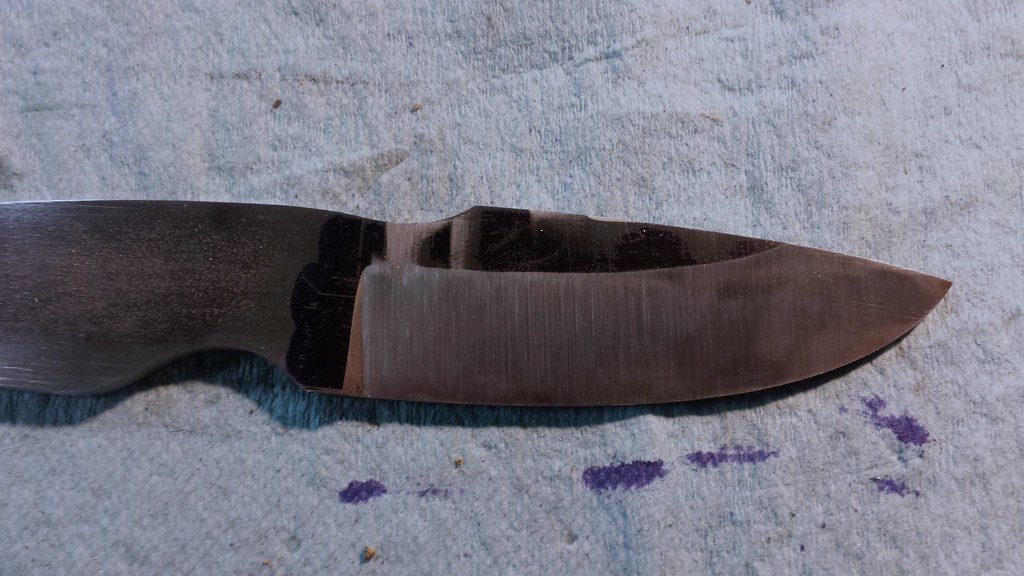
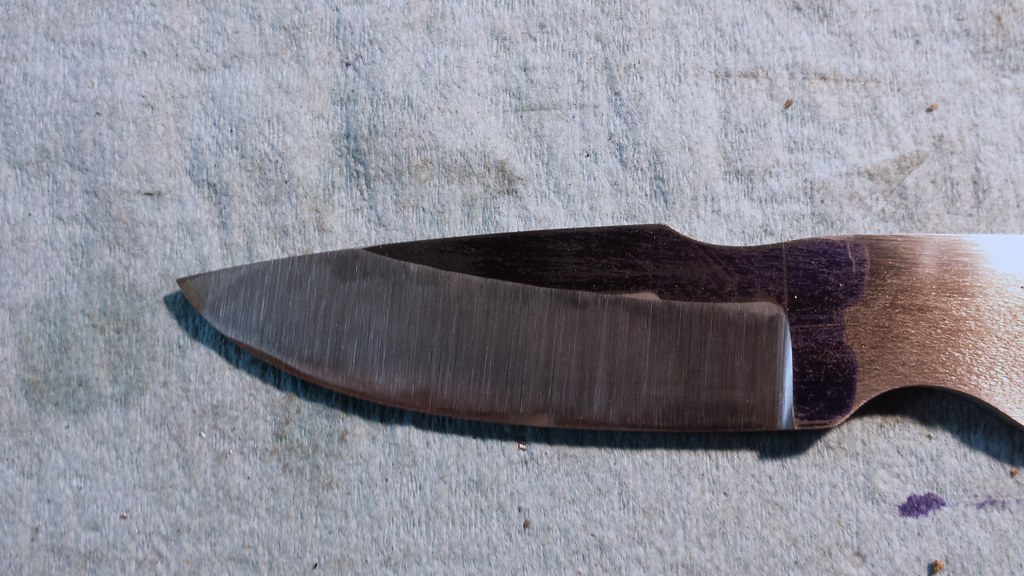
Today I ground blade number four. I am doing this freehand on the flat platen. I roughed it out with a semi worn 50 grit Blazer then went to a 120 grit Blazer. It was looking okay so I decided to try a 220 grit J-flex and things went downhill. The bump of the thin J-flex was giving me hell. After I had it looking pretty bad with the J-flex, I decided to try something new and threw on a A45 Trizact. The Trizact was real smooth and ran cooler allowing me to get the bevels back to half way straight again. By this time I was well past my scribed lines on the sides of the blades but I decided to keep experimenting to see what happened. I went back to a 220 AO belt this time that was a little stiffer than the J-flex. I felt like I was getting a feel for things with the Trizact but the AO belt kept chattering on me. I turned up the speed and did the best I could with it. Here are pictures for everyone to critique.

Bob


Untitled by Ranger_Bob, on Flickr


Untitled by Ranger_Bob, on Flickr
 
Looks pretty good, getting there. A nice sharp new belt is always a good thing. I know they cost money, but trying to push a warn belt especially when you haven't developed a feel yet will facilitate mistakes.

I can see where you are laying your edge down and rocking it onto the bevel. Using your body so that the hands stay constant helps this a bit. From there its just a matter of nice, smooth and even pressure all the way through. Reducing just enough as you come off the tip and making sure you follow through the stroke.
 
A nice sharp new belt is always a good thing. I know they cost money...

Truth.


It's a tired old saying, but because it's true.

USE BELTS LIKE THEY'RE FREE.

RJ Martin was kind enough to let me watch him work in his shop once - I was astonished at how many belts he used, and how quickly he replaced them. 30 seconds for some. Maybe less. Difference is, he was perfect in his pass and his finish. When the belt stopped cutting smoothly, it was gone. I started doing similar things and sure enough, my grinds improved - just like that.
 
Truth.


It's a tired old saying, but because it's true.

USE BELTS LIKE THEY'RE FREE.

RJ Martin was kind enough to let me watch him work in his shop once - I was astonished at how many belts he used, and how quickly he replaced them. 30 seconds for some. Maybe less. Difference is, he was perfect in his pass and his finish. When the belt stopped cutting smoothly, it was gone. I started doing similar things and sure enough, my grinds improved - just like that.

Burt Foster is my local resource/mentor/etc. Same there. Puts on a new belt, dresses the edge and dives right in. You can hear the pitch of the machine change when it starts dragging, and then it gets switched.

But keep em, don't just chuck em. Belts that won't work for precision work can still cut plenty of other stuff. Handle materials, just dressing up a profile lightly, etc. In the whole scheme of things, each knife deserves new belts from start to finish. It doesn't add much to the overall cost of materials...
 
I suggest a Bubble Jig as well.
Its my own invention and I do make money off them; but if you want to learn to grind free hand and in a very short amount of time, get one. Money back if you are not thrilled with the results you get.

I have not tossed a bad grind in 6 years :)

I would get the bubble jig. They work great. I'm right around 60 knives and still whip out the bubble jig on occasion.

BTW When are you going to do a video on distal tapers with the bubblejig?
 
I would get the bubble jig. They work great. I'm right around 60 knives and still whip out the bubble jig on occasion.

BTW When are you going to do a video on distal tapers with the bubblejig?

As soon as the shop gets warm enough to shoot; I'll make that happen. You are not the first to ask and so I will get that up on youtube.

Fred
 
Last edited:
I think that everyone has their own learning curve when it comes to grinding.

There are many factors in play, making it very difficult to estimate a timeframe for becoming competent at grinding.

I do think it's safe to say that the more you practice, the shorter this time will be.
 
Technique, and proper lighting will shorten your learning curve a LOT. I see that you are aware of both now- I just wanted to underscore those.

Here's some grinding tips of mine in case you've got a few perfectly good minutes to fritter away reading them...
https://sites.google.com/site/vorpalcustomknives/shop-techniques-3/grinding-tips

I have read your grinding tips page at least half a dozen times. I've also read most of your other pages multiple times. Thank you for a very helpful resource.

Bob
 
I use a piece of an angle iron and a push stick for the most part of my grind, at the end, if there are minor symmetry issues I even things out very carefully freehand. I tried doing everything freehand before and I struggled with keeping things consistent. I don't have much time for my hobby, so I need to make the most out of it.
 
For plunges
Buy good quality belts or spend hrs trying to clean up your grinds
Run your belt over the side of the Platen or Wheel about 1/4" and "Break" or bear down on that side. use scrap
Grind your bevel using that side of the belt
Flip the belt over Repeat
Do this especially on the initial pre HT grind and follow with a near finish grit to "Walk it in" pre HT
Much easier than post HT trying to true them um
 
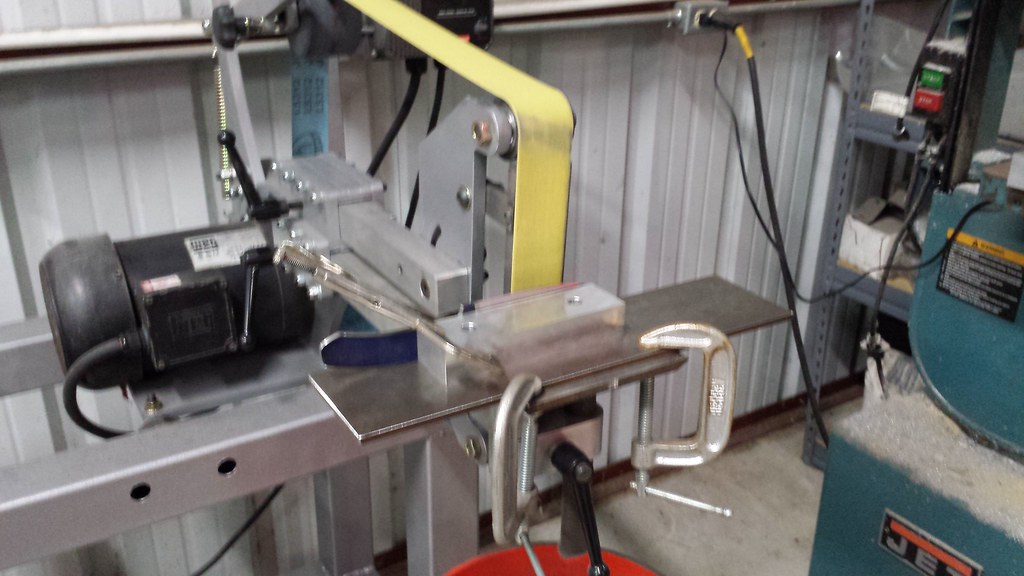
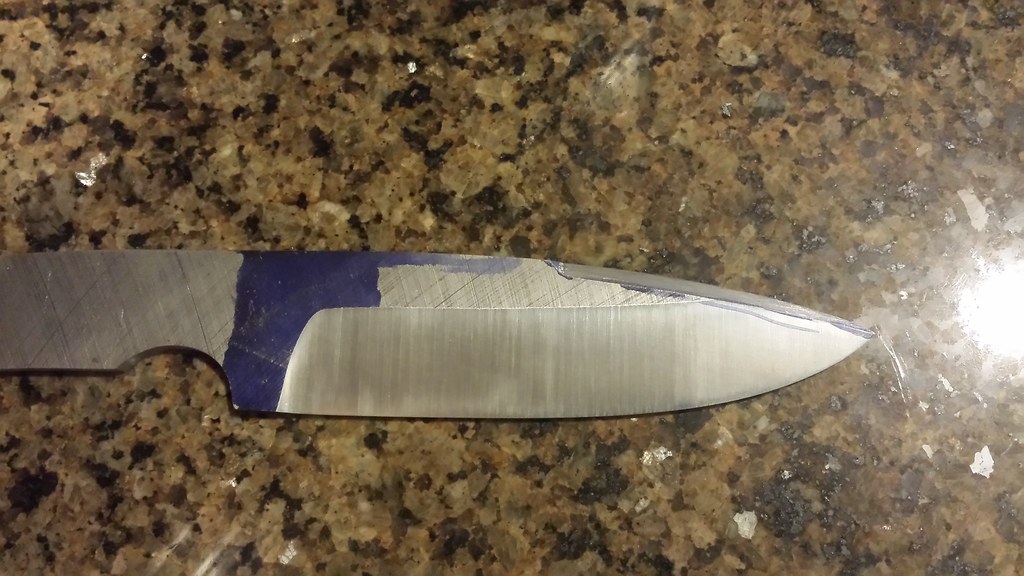
I was thinking about making a jig so I could produce something that I would feel was halfway decent. After a lot of thought on it I decided that I could just tilt the flat platen forward and clamp the blank to a square block. Below is a pic of how I set it up. The platen is set at 8 degrees. I knocked the edge off the bevels freehand with an old belt then clamped the blank and ground it with a new 60 grit Blaze. I'm really glad I did this because it taught me a lot about how the grinder works to produce the desired bevels. It really helped me to understand how you need to angle the tang back as you get to the tip. Obviously, that is just one way of doing it but it gives me a better reference to build from. It also showed me how careful you need to be when bringing the bevel back onto the belt. I found that the area just behind the belly was the best contact point for re-introducing the bevel to the grinder. The down side of using a jig setup like this is that you can't easily compare the two sides for symmetry. If I use this technique again, I would add some scribed lines on the side of the blade to give some reference for the top of the grind.

Bob


Untitled by Ranger_Bob, on Flickr


Untitled by Ranger_Bob, on Flickr
 
Lighting. I should know better.

I have to hook up another 110 outlet for the power feed on the mill anyway, might as well make it available for a grinder light.

I have had much more luck with the 16" disk grinder rolling in both directions now. :D

-Ron
 
Truth.


It's a tired old saying, but because it's true.

USE BELTS LIKE THEY'RE FREE.

RJ Martin was kind enough to let me watch him work in his shop once - I was astonished at how many belts he used, and how quickly he replaced them. 30 seconds for some. Maybe less. Difference is, he was perfect in his pass and his finish. When the belt stopped cutting smoothly, it was gone. I started doing similar things and sure enough, my grinds improved - just like that.

^This & variable speed & good belts.

30-50 blades to get decent at it. 100+ to get good.

My son has been working in the shop here for bout two years. He's at around 40 blades and is getting really good, but it was painful watch the first few!
 
As has already been stated numerous time, everyone has a different learning curve. That said, there are a couple of things to consider, which will make things all the more "easier" while you're learning:

#1: Make sure your grinder is up to snuff.
If you're using a work rest, make sure it's perfectly flat, and square to your platen.
Make sure your platen is FLAT. If you haven't already, think about instally a ceramic glass liner.
Make sure your belts are tracking properly.

#2: Start simple. Grind a few smaller blades and expand from there. Don't start with a 6ft long, double bevel broad sword. ;)

#3: Understand the consequences of your actions: What happens when you change angles? (front to back or side to side) What happens when you dwell to long on one spot, or go too fast on another?

#4: Use sharp belts, and understand the difference in belt types. IMO, a J-flex is harder to grind a consistent flat with than an x-weight belt, as it tends to roll and bunch up easier.

#5: Make sure your grinder is at a comfortable height.

Those are just a handful of things I can think of that helped me as I progressed. If you can watch another accomplished maker grind, that may help too.

Most of all: practice, practice, practice!
 
Back
Top