
-
The BladeForums.com 2024 Traditional Knife is available! Price is $250 ea (shipped within CONUS).
Order here: https://www.bladeforums.com/help/2024-traditional/
You are using an out of date browser. It may not display this or other websites correctly.
You should upgrade or use an alternative browser.
You should upgrade or use an alternative browser.
How many cuts with your knife?
- Thread starter 1984nitro
- Start date


- Joined
- Aug 6, 2007
- Messages
- 5,060
Swinging cuts on hanging rope or slicing cuts on held rope?
- Joined
- Jun 23, 2006
- Messages
- 2,418
I couldn't make it through that whole video. I haven't ever bothered to do a rope test with my knives, so I can't really comment on that.
- Joined
- Sep 23, 2006
- Messages
- 366
While I'll be the first to admit that I havn't been in this game for very long, nor made any really impressive strides towards pushing the quality envelope forward, I would nonetheless wager that after the first two hundred or so cuts, the exercise is pointless.
Once you have determined with some degree of solidarity that cutting manilla or sisal rope isn't having a noticeable impact on the edge geometry, why keep going? Sure, eventually, enough inclusions in the rope will abrade the edge (rope isn't known for its chemically pure construction, there's stuff in that there rope) to begin to form a dull spot that will grow with ever more cutting. However, at some point, you are testing the quality and cleanlieness of the rope more than you are the quality of the knife. Obviously, a dirty rope with grit of different compositions worn into it will make even a good knife dull fairly quickly, wheras a nice, new, clean rope likely won't.
What I'm trying to say is that if your knife made a couple hundred good cuts and you notice no change in the sharpness of the edge, continuing ad nauseum will likely not teach you anything new about the knife. On the other hand, if after only a couple of dozen cuts, your knife is getting dull, then your knife has issues that deed addressing. A magnifying glass or some other low power magnification device would probably be useful at that point to tell you how the edge is deforming, which would give you some pretty solid information to work with in fixing the production methods at fault.
Once you have determined with some degree of solidarity that cutting manilla or sisal rope isn't having a noticeable impact on the edge geometry, why keep going? Sure, eventually, enough inclusions in the rope will abrade the edge (rope isn't known for its chemically pure construction, there's stuff in that there rope) to begin to form a dull spot that will grow with ever more cutting. However, at some point, you are testing the quality and cleanlieness of the rope more than you are the quality of the knife. Obviously, a dirty rope with grit of different compositions worn into it will make even a good knife dull fairly quickly, wheras a nice, new, clean rope likely won't.
What I'm trying to say is that if your knife made a couple hundred good cuts and you notice no change in the sharpness of the edge, continuing ad nauseum will likely not teach you anything new about the knife. On the other hand, if after only a couple of dozen cuts, your knife is getting dull, then your knife has issues that deed addressing. A magnifying glass or some other low power magnification device would probably be useful at that point to tell you how the edge is deforming, which would give you some pretty solid information to work with in fixing the production methods at fault.

Tai Goo
BANNED
- Joined
- Apr 7, 2006
- Messages
- 3,806
It's not how many cuts you make ,... but how you make many cuts. 
Most of the rope cutting tests are done with "crunch cuts", crunching down through the rope with pressure from on top and supported on the bottom with a cutting board, similar to a push cut... pretty easy way to cut rope. If you use a baton, it's even easier.
Slice cutting rope is a different thing. By slice cutting I mean using a sawing or slicing motion with the full length of the edge, by hand. With this type of cut you can just raise a burr very quickly and cut the rope several times with the burr, basically sawing through. However, the burr won't last very long with this type of cut. The only other way is to get the knife super sharp with a polished surgical edge, which is very difficult to do and make the cut successfully . However, with the polished edge you will be able to make more cuts and everything else being equal, the edge will last longer.
How many cuts really depends on what type of knife it is, what it is intended for and personal preferences. There is no right or wrong answer as long as the blade does what it was intended to do...
...clear as mud, eh?
What you need to do is field test a variety of knives of known quality that were all designed for similar purposes... and do some comparisons...
Most of the rope cutting tests are done with "crunch cuts", crunching down through the rope with pressure from on top and supported on the bottom with a cutting board, similar to a push cut... pretty easy way to cut rope. If you use a baton, it's even easier.
Slice cutting rope is a different thing. By slice cutting I mean using a sawing or slicing motion with the full length of the edge, by hand. With this type of cut you can just raise a burr very quickly and cut the rope several times with the burr, basically sawing through. However, the burr won't last very long with this type of cut. The only other way is to get the knife super sharp with a polished surgical edge, which is very difficult to do and make the cut successfully . However, with the polished edge you will be able to make more cuts and everything else being equal, the edge will last longer.
How many cuts really depends on what type of knife it is, what it is intended for and personal preferences. There is no right or wrong answer as long as the blade does what it was intended to do...
...clear as mud, eh?
What you need to do is field test a variety of knives of known quality that were all designed for similar purposes... and do some comparisons...
Last edited:
Tai Goo
BANNED
- Joined
- Apr 7, 2006
- Messages
- 3,806
The free hanging 1 inch manila rope cutting test is generally more a test for degree of sharpness than edge holding, and is also an easy cut to make... looks and sounds impressive though.
As long as the edge is sharp enough to shave, (which really isn't very sharp), it should be able to make that cut. However, it is harder to do with a short blade than a long blade. In other words, doing it with a 6 inch blade would show a higher level of achievement and degree of sharpness than doing it with a 16 inch blade.
As long as the edge is sharp enough to shave, (which really isn't very sharp), it should be able to make that cut. However, it is harder to do with a short blade than a long blade. In other words, doing it with a 6 inch blade would show a higher level of achievement and degree of sharpness than doing it with a 16 inch blade.
- Joined
- Sep 23, 2006
- Messages
- 366
Alternatively, doing it with a 6 inch could show show a higher level of achievement and degree of skill in cutting than doing it with a 16 inch blade.

Larrin
Gold Member
- Joined
- Jan 17, 2004
- Messages
- 5,131
Cutting rope varies a lot from maker to maker, and greatly depends on technique, the rope, the type of cut, etc. Many fine makers with what I consider to be superior knives report wildly varying numbers. Does one makers knife really make 10 times as many cuts as the other? I don't believe so. The numbers are more valuable if the maker uses a baseline knife to compare to his values. That would eliminate several of the variables, at least technique, sharpening, and the rope. Of course, a butter knife wouldn't be much of a baseline. That does leave the personal aspect though. We're greatly affected by our imaginations when we're determining if our knife outcuts the factory model. However, most makers are more concerned with having a good story or a good show than truly demonstrating the superiority of their knives.
I think that Tai Goo pretty well described the needs and types of edges of most makers. I prefer the smooth edge because it does last longer.
A sharp knife will cut the 1" rope "IF" it has the right blade geometry. A fat edge will always leave part of it hanging.
A sharp knife will cut the 1" rope "IF" it has the right blade geometry. A fat edge will always leave part of it hanging.
- Joined
- Sep 9, 2003
- Messages
- 2,361
I am also with Ray that Tai and Larrin have the best points here. Time and time again I have been disappointed at the number of reasonably knowledgeable smiths who rely on cutting rope as any sort of objective baseline (in this I exclude the hordes of hype mongers who simply want a parlor trick to make their work look good). Rope cutting can give you a very wide and vague idea of where a knife is at but assigning hard numbers to it is inaccurate at best and irresponsible at worst. I believe that the fact that it is some sort of industry standard speaks very sadly of where we are at.
This is not to say that it is worthless, just as I always try to stress one really needs to know exactly what they are measuring with any test and Tai and Larrin have well pointed out just a few of the possibilities. I personally like tests that isolate out one feature or property in a measurable way, thus I waste little time cutting rope in my shop.
However to the cleaver salesman hidden variables can be a great tool in making their product or process look fantastic in a very graphic display for the public. I will repeat my standard line that testing for the purpose of learning or finding the shortcomings in your work or process in order to improve is indeed testing, testing for the purpose of making your work look good for the public is called marketing or advertising.
This is not to say that it is worthless, just as I always try to stress one really needs to know exactly what they are measuring with any test and Tai and Larrin have well pointed out just a few of the possibilities. I personally like tests that isolate out one feature or property in a measurable way, thus I waste little time cutting rope in my shop.
However to the cleaver salesman hidden variables can be a great tool in making their product or process look fantastic in a very graphic display for the public. I will repeat my standard line that testing for the purpose of learning or finding the shortcomings in your work or process in order to improve is indeed testing, testing for the purpose of making your work look good for the public is called marketing or advertising.

- Joined
- Jan 28, 2008
- Messages
- 1,876
I agree with Dan and Tai Goo , I also think that the type of steel has been overlooked. Its not fair to compare the edge retention of deferent steels, for example S7 and 10V will have total different results though neither is best, just different. The same can even be said of the same steels in different Rc ranges, for different kinds of knives.


- Joined
- May 23, 2006
- Messages
- 122
Cutting rope to compair knife ~ knife has some value.
For a maker, comparing your work to earlier knives, factory or other custom knives can give you a personal assessment of edge retention.
Pictured are a couple factory hunters, and a custom knife, I know how they stack up to each other. Maybe just me, but that has a personal importance.
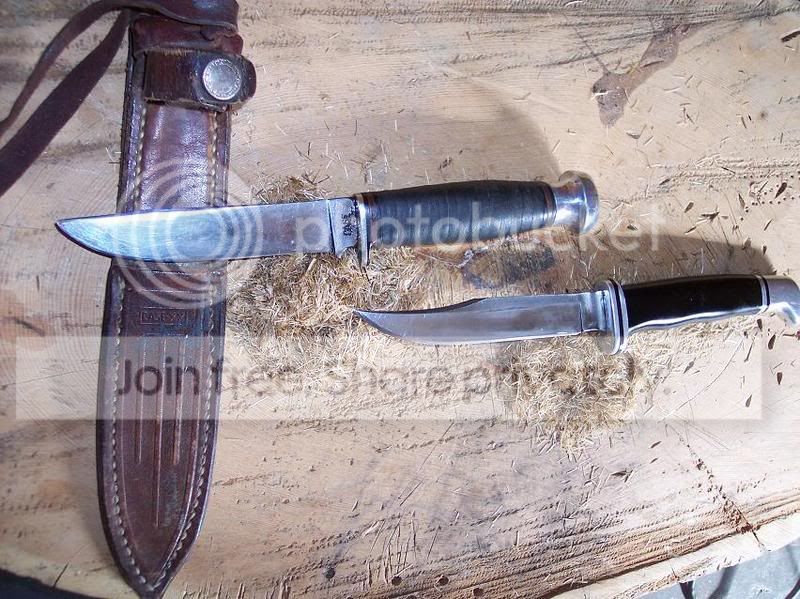
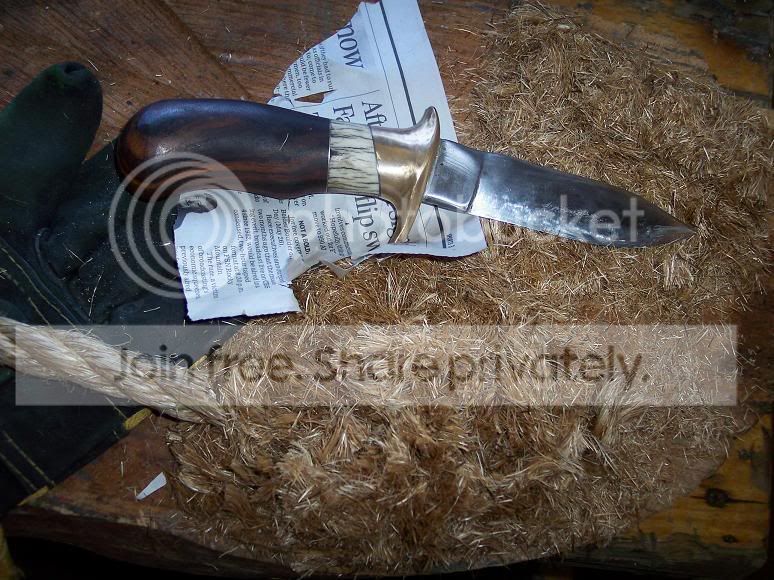
For a maker, comparing your work to earlier knives, factory or other custom knives can give you a personal assessment of edge retention.
Pictured are a couple factory hunters, and a custom knife, I know how they stack up to each other. Maybe just me, but that has a personal importance.
How accurate or reliable is the data from a CATRA test? You can see what it looks like about 4:12 into this video.
http://www.youtube.com/watch?v=zrhC0QS2H9E
http://www.youtube.com/watch?v=zrhC0QS2H9E