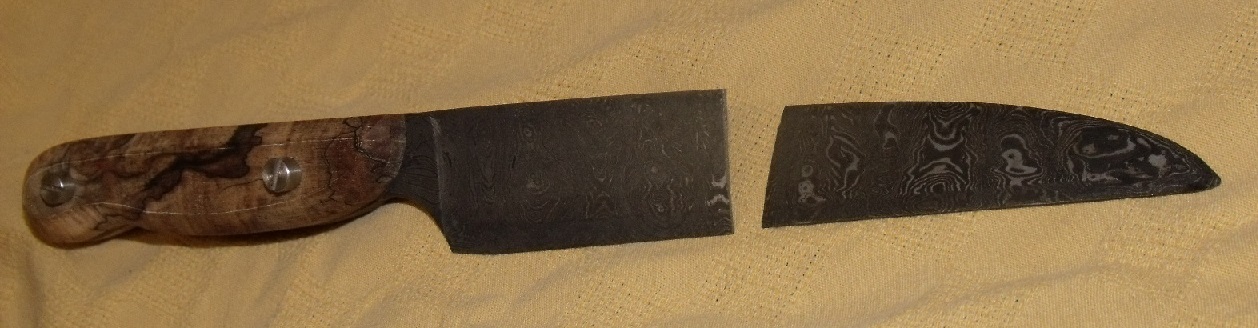
How straightening blades! A very easy method and A SHORT VIDEO by Eduardo Berardo JS!

HSC, would it be correct to say that straightening a laminated blade is done from the convex side, and is a very different operation due to the inherent flexibility of a blade made with a martensitic core and cladding that remains soft? A wooden surface would have just the right give for that. I routinely straighten mono blades of common alloys before they cool enough to become stiff, using the same "stump" technique but on my anvil (which has a remarkably flat face for a tool used since 1895).
I've seen Carter, somewhere in his youtube channel, demonstrate a technique very similar to Claudio's, using a cross pein hammer to spread soft cladding from the concave side.

straightening a laminated blade is much more free form and there is alot more give in the process, there is almost no concern of cracking a blade. So the straightening method is not restricted in the sense of concave or convex side. Frankly twists in the blade are quite common and represent the greatest challenge (for me). And yes, while it's a different operation, Eduardo's demonstration is simply something to add to the straightening toolkit. :-)

I'll look for that Carter video but if you have the link, pls post it

regards
Harbeer
 
straightening a laminated blade is much more free form and there is alot more give in the process, there is almost no concern of cracking a blade. So the straightening method is not restricted in the sense of concave or convex side. Frankly twists in the blade are quite common and represent the greatest challenge (for me). And yes, while it's a different operation, Eduardo's demonstration is simply something to add to the straightening toolkit. :-)

I'll look for that Carter video but if you have the link, pls post it

regards
Harbeer

I'm sorry, it was in his book- the autobiographical one, "Bladesmithing With..."
 
Further success. I heat treated, tempered and ground some on my blade today. Still straight! Thanks Mr Barardo. WDL III
 
Last edited:
Obrigado Eduardo! For sure I will learn this method. Thanks again for you're willingness to share your knowledge.
Is the pointed end of your hammer rounded or basically flat?
Where are you living in Brazil?

Hi Jonathans, the point of hammer is rounded. Yes, I live in Brazil. Hugs!
 
Eduardo,

I think we are all talking about the same thing. The names of the procedures are a little different here but we understand you fine. Here, the hardening in the oil, water, salt or air we call "quenching". The heat cycles afterwards to reduce stress and add toughness we call "tempering". The technique you describe is very interesting. Another member here once mentioned a similar technique someone taught him which involved sandblasting the warp to remove the bend. Same idea. Thanks for sharing.

Thanks for your explanation! All the best for you brother!
 
Quote Originally Posted by Eduardo Berardo "The blade is cold brother! After hardening!"

The peening on the inside of the curve spreads the steel there and forces the blade to bend in the opposite direction and (eventually) flatten out. The reheating (or re-tempering) of the blade helps to deal with the internal stresses caused by the peening.

Yes Chris, You are correct, no doubt left internal stresses caused by the peening! Thanks brother!
 
It would seem to be the same as a phenomenon observed in older machine tools. The table surface on a mill will often be slightly high in the center/low on the ends, by several thousandths of an inch after 50+ years in service. Not because of the steel of the table sagging at the ends, but because the sheer amount of work done on the surface and all the little taps and dings and marks it acquires over time begin to effectively peen or stretch the top surface out longer, causing the table to camber along its length...
As it turns out, I've got a blade with a little warp today, so I'm off to try it right now! Just gotta mod a hammer to work.

You will like Salem. Regards my brother!
 
Parabens e obrigado Eduardo, nao conhecia esa tecnica mais vou tentar aprenderla, poderia descrever o martelo?. Agora sou eu quem pide perdao pelo meu "portunhol" :D

Guys, in Brazil they speak portuguese and down here in Argentina Spanish.


Pablo

Legal que você gostou Peu. Forte abraço meu irmão!
 
Eduardo,

I'm curious. The hammering stretches the surface of the blade which causes the correction. What happens when you grind through that surface layer on your way to dialing in the final grind and finish on the blade? If you sand through the hammered layer will the blade want to return to its warped state?

No brother, after straightening you can grind and finish the knife because it not will move more! It's very interesting but is the truth. All the best brother!
 
Success, or at least a good start.
Have a forged 1084 kitchen knife, 8-9" blade, cold and annealed, soft state prior to HT.
Blade wavey, (couple of small curves) not bad, but couldn't get a good centerline mark. Got out my small ball peen, pulled a chair up to my anvil and went to tapping. Tried to mimic the video here. Very pleased with the results. Will HT and temper soon, we shall see.
Big thanks from South Louisiana.


Sent from my iPhone using Tapatalk

If you have problems after quenching and tempering, this method will work well too brother. Hugs from Brazil!
 
Eduardo,

as a bladesmith student using laminated steel blades, straightening blades is a requirement on every blade and is done at least twice in the process.
So I'm very interested. Traditional Japanese bladesmithing uses a brass hammer on a wooden stump after quenching, it's ok to straighten on the anvil in the annealed condition. I do struggle with getting a blade perfectly straight and it's hugely important to be straight in order to have the core centered when bevel grinding.

This method looks to be a very useful tool for me.
Would you be kind enough to show a closeup detail of the hammer you are using and indicate the weight of the hammer? Edited - Oh I see it now in post #54 of your other thread! :-)

2114A1BA-8F95-42D2-95B1-5B4A52C35A0A_zpsfvxjxoac.jpg


regards
Harbeer

Hi Harbeer. I have no assurance, but I thing the weight of my hummer is between 200 and 400 grams. The weight is not so important, because you will beat less force at the side of the blade!
 
Hi Harbeer. I have no assurance, but I thing the weight of my hummer is between 200 and 400 grams. The weight is not so important, because you will beat less force at the side of the blade!

i made one up yesterday, it works great, because you can focus on one small area

C8FCDB76-8B6B-44DC-920B-EAB6731C6028_zpslofqdfnt.jpg


EEA92726-95C9-412A-B8A0-C99A3DA266A1_zpsnmysmtze.jpg
 
This worked well for me. I used the ball on a very small ball peen hammer. The spine was softened after hardening/tempering. I imagine that is crucial...maybe not ?
 
This worked well for me. I used the ball on a very small ball peen hammer. The spine was softened after hardening/tempering. I imagine that is crucial...maybe not ?

Hi Shaw, it is not crucial, because it works well with the blade hard or soft. Regards!
 
Eduardo, today was O2 hardening day (Bohler K720) and now I have the opportunity to test your method as 3 blades came out slightly warped.

Tempered them for about 20 minutes and cooled. They are 2mm thick.

Since I didn't have a proper hammer to modify I hacked one out of 304 steel, made the head of about 4x8mm and hammered on the concave side of the warped blades, Im not having success so far, maybe its because 304 is not hard enough, do you have any additional advise?

[EDIT 24HS LATER] it was the hammer... I cannot believe how good this method is!!! I'll ask some of my FELLOW KNIFEMAKER friends who are going to the Salao Paulista to buy a beer for you!!! MANY MANY THANKS

ObrigadAO!!


Pablo
 
Last edited:
Eduardo, today was O2 hardening day (Bohler K720) and now I have the opportunity to test your method as 3 blades came out slightly warped.

Tempered them for about 20 minutes and cooled. They are 2mm thick.

Since I didn't have a proper hammer to modify I hacked one out of 304 steel, made the head of about 4x8mm and hammered on the concave side of the warped blades, Im not having success so far, maybe its because 304 is not hard enough, do you have any additional advise?

[EDIT 24HS LATER] it was the hammer... I cannot believe how good this method is!!! I'll ask some of my FELLOW KNIFEMAKER friends who are going to the Salao Paulista to buy a beer for you!!! MANY MANY THANKS

ObrigadAO!!


Pablo

Hello Pablo. This ,method is really easy, fast and efficient. It ever works good. I'm very happy to help and the BEER IS WELCOME!
God blesses brother!
 
Hope I'm not too late to the party, but I just watched the video and seriously wish that I had seen this last December.

Possibly could have avoided
pveelaA.jpg


Thank you for sharing, and I wish I could also buy you a beer or 2!
 
Back
Top