
I like Ugly Wood - Weird wood for the Pasadena Show

Joined
Dec 7, 2008
Messages
7,187
Maybe we can turn this into a strange wood thread.
If you have some really unusual pieces of wood, maybe you would post a photo.

I am getting a lot of blocks ready for the Pasadena, CA show this month. As I am picking out pieces to cut I find that I keep cutting the weird, ugly stuff.
Sure I'll bring some pretty pieces but I really like the ugly stuff.
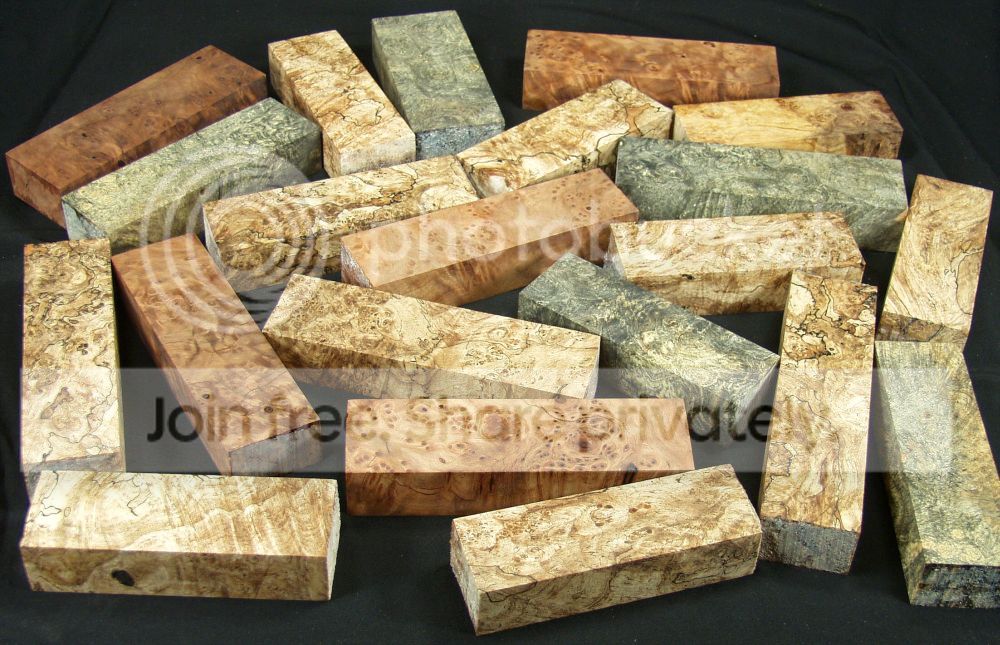
ugly001.jpg


These are some of the blocks I stabilized and just finished sanding. Redwood, buckeye and maple.
 
Last edited:
I like the green ones, which wood is that? Being as new to knife making as I am I cannot tell one from the other yet. I personally like stuff that is different, not the norm.
 
I like the green ones, which wood is that? Being as new to knife making as I am I cannot tell one from the other yet. I personally like stuff that is different, not the norm.

Those are buckeye burl. Colors are grey and blue with a little gold. At first glance they do look a little greenish.

The maple and the buckeye are both woods that have spalted (started to decompose). They both start out as a white/gold color when fresh cut. When they start to decompose different types of bacteria form colonies that cause the different colors and black lines. It can form some pretty unusual abstract patterns. Normally spalted woods are too soft for most uses but by stabilizing the wood is made hard and durable enough for hard use knife handles.
 
Last edited:
Those are buckeye burl. Colors are grey and blue with a little gold. At first glance they do look a little greenish.

The maple and the buckeye are both woods that have spalted (started to decompose). They both start out as a white/gold color when fresh cut. When they start to decompose different types of bacteria form colonies that cause the different colors and black lines. It can form some pretty unusual abstract patterns. Normally spalted woods are too soft for most uses but by stabilizing the wood is made hard and durable enough for hard use knife handles.

Thanks for the info, learn more everyday. I have two more blades (#'s 2 & 3) ready for the final forge weld tomorrow and I will need some handle material so I will be in touch with you soon to get some once I decide what I want.

Thanks
Ronnie
 
I'll be stopping by your table at the Pasadena Show to look at some of that "Ugly Stuff"
 
Yep, ugly is definitely in the eye of the beholder :)

Mark, why don't you just ship all that ugly junk to me so that you aren't disturbed by it:D
 
Actually, the weirdest piece of wood I've got is that piece of madrona burl you sold me a while back. I still haven't even decided if I like it, much less what I'm gonna do with it.
 
When they start to decompose different types of bacteria form colonies that cause the different colors and black lines.

Normally spalted woods are too soft for most uses but by stabilizing the wood is made hard and durable enough for hard use knife handles.

Spalting is caused by fungi and not bacteria.

"Spalting" is the technical incipient stage of decay and once wood fiber becomes soft it's passed thru the spalt phase and is technically no longer spalted but into the rot phase.
 
I have a few questions for you wood smart people. I still burn wood for my source of heat and this last time getting wood I fell a large fir with lots of real big branches on it. In cutting it up there where several places that looked really neat, the knots from the branches went all the way into the middle of the tree and then turned down towards the roots covering several feet. My 1st thought was when I saw a few of the cuts that they would make a real cool coffee table (tree is a little more than 3' in diameter). Some of the knots are 3-6" in diameter. A few of the cuts had 4-8 knots in them.

So my question is how well would these large knots work for a handle? The tree is still a little green, we left it whole to dry for this summers wood getting, cut it down a little more than a month ago. It is on our property so it should still be there (I hope). When does one want to take wood for handle material, when it is still green or dried out or in the middle? Is fir even worth the effort, will it make a good handle?

If it would make a good handle I will grab the chain saw and go get some of it and send it off to be stabilized as I have no idea what that entails.

Thanks
Ronnie
 
It has to be really dry before you stabilize it. Stick it somewhere cool and let it dry slowly, or have it dried by a pro.
 
Spalting is caused by fungi and not bacteria.

"Spalting" is the technical incipient stage of decay and once wood fiber becomes soft it's passed thru the spalt phase and is technically no longer spalted but into the rot phase.

OK, This is twice now that Larry has had to correct me about spalting being caused by fungi not bacteria. I must have some sort of mental block.

Here is a link to a wikipedia page that gives the technical info about spalting.
 
Mark, if you want to sell one of those pieces of spalted maple before you get to Pasadena, let me know.
 
OK, This is twice now that Larry has had to correct me about spalting being caused by fungi not bacteria. I must have some sort of mental block.

Here is a link to a wikipedia page that gives the technical info about spalting.

That's just age, Mark!! :) I find myself concentrating at stop lights..green is go..green is go...

Wikipedia is good if one has some knowledge going into it. For example, it states blue stain fungi is spalting, but it is not a decay fungi..it's..well...a stain fungi and does not destroy wood fiber. We find blue stains in buckeye and pine for example. Sapwood spalts, but generally not heartwood because sapwood does not have repelling extractives that form after sapwood becomes heartwood. Maple is mostly sapwood as is birch and beech. I have seen true spalted walnut and koa heartwood, however..only once each in 20 years.
 
Back
Top