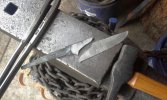
I should of went with 1084! :D

I have had 1084 ping on occasion. What did you quench in? If it was brine or water then that is likely the cause for the crack. Personally the w2 I had crack had that same rounded crack from the edge up and forward. It was brine quenched. Is there any gouge or anything that could have been a stress riser to start the crack? Also how long between the quench and temper cycle, and what was your heat treat process?
 
it pinged in the brine quench. Granted it was heated up in a homemade brick forge. I know I should have just sent it off to be done professionally but to be honest I did it to try it. The steel was 3/32nds (very thin) everything was smooth, except maybe on the very edge, when i looked at it afterwards it looked like a small file nick that i missed
 
a two-brick forge and warm canola produces a damn fine 1084 blade. I've had satisfactory results (for me) with 1095 in warm canola too.
 
If you're going by color in a brick forge, 1475 deg isn't that bright...it's so hard to keep the edge from going into the higher orange range, which is waaaay too hot.

That can contribute to the pinginess of simple steels.
 
When I water quench w2, hitachi white or 1095... On thinner knives I do all my grinding after I heat treat. The even thickness of the steel makes the PING a lot less common. Ime
 
If you quench in water/brine.....you will break blades......sometimes a lot of them in a row.

If you can't stand the heartbreak, use oil. I rarely use brine any more, fast oil does a great job on thin high carbon steel. Unless you are doing yaki-ire, I would recommend oil for all quenching of carbon steel.
 
Stacy, what do you think of doing the first 7 seconds in brine, then the remainder in fast oil? I have done a few like this and had nice hamons. I haven't broken a blade since getting my pyrometer. I broke two before getting it, which prompted the purchase.
 
Exactly.
When something that catastrophic occurs, there is normally a long list of things that were done incorrectly.

lol I am sure there is a list what was done wrong, but it is what it is and I did not spend much time at all on it, I was just trying to play around with brine quenching 1095. I followed some directions from youtube and some places on here for getting hamons with 1095. So it really wasnt a loss and no heartbreak. It's all education for me at this level of making things sharp. Trial and error is how I learn best.
 
If you quench in water/brine.....you will break blades......sometimes a lot of them in a row.

If you can't stand the heartbreak, use oil. I rarely use brine any more, fast oil does a great job on thin high carbon steel. Unless you are doing yaki-ire, I would recommend oil for all quenching of carbon steel.

Next time will use Parks #50 for it.
 
lol I am sure there is a list what was done wrong, but it is what it is and I did not spend much time at all on it, I was just trying to play around with brine quenching 1095. I followed some directions from youtube and some places on here for getting hamons with 1095. So it really wasnt a loss and no heartbreak. It's all education for me at this level of making things sharp. Trial and error is how I learn best.

There is so much really bad information ot there on youtube. Every noob with a camera seems to have a very authoritative looking video on youtube that is filled with bad ideas that sond great until you get even a basic understanding of metallurgy

-Page
 
Parks 50 will not prevent you from making excellent hamons if the steel will support. I cant remember exactly because I have not done a hamon in a little while but you just have to learn how it affects your hamon. For instance brine and parks each will change how your hamon appears with the amount of clay on your blade and where it is placed. If I remember correctly parks will follow the line of the clay and dip below it with the ashi (spelling ?) where as water will make more of the ashi at the clay line and carry the hard line of the hamon a tad higher into the clay region.

Now its been a while so this may be a little reversed. Either way the best hamon will come from nailing the temperature correctly, not so much the clay. If you can nail the temp exactly and have the proper thickness to the spine in relation to the edge you can get the no clay hamons but its alot harder to do that in a forge.

I go thru stages with my brine, I enjoy using it but some days Ill crack everything that goes into it, other days Ill have a 90 or 100% success rate. Just depends, ofcourse I probably missed something on the bad days.
 
Back
Top