I Tested the Edge Retention of 48 Steels

Geometry won't get very far on its own without a concomitant (appropriate) heat treat of the steel of any particular flavor.

By way of example, I had a paring knife from Victorinox with a thin blade and grind. However, it turned out to have had a bad heat treat because it would not take nor hold an edge like its siblings from Victorinox I owned, nor its cousins from Opinel or Tramontina by way of example.

So yes, geometry is certainly a huge factor...but I'll take geometry along WITH a decent steel and an appropriate heat treat for the win.

Perhaps we shouldn't couch our opinions as absolutes...there are many very experienced users, (and makers), hereabouts.
Geometry cuts. Steel determines for how long.

That’s like “mitochondria is the powerhouse of the cell” but knife wisdom. 😀
 
Larrin Larrin I wish the data could be updated to include some popular steels used primarily in Chinese budget knives. That would be 9Cr18MoV and the Artisan badly named RPM whatever it is. Might as well add AUS10a.
 
I think with the first big update only MagnaCut, MagnaMax en 3V or maybe one or two more will be the only relevant steels left from all the currently listed in dr. Larrins reports . 😂😂🫣. The rest is more or less obsolete and can be put in the metallurgy history books ….. we are getting into a new era of a few steels that make many others “redundant” in terms of properties and availability. Less nice for many hobbyists raving about specific steels but very real I am afraid….😌
 
Last edited:
Larrin Larrin I wish the data could be updated to include some popular steels used primarily in Chinese budget knives. That would be 9Cr18MoV and the Artisan badly named RPM whatever it is. Might as well add AUS10a.
Maybe this is of help to you:

Staal
C
Cr
Mo
V
Edge retention
440B
~0.9

17

0.75

-

medium

440C

~1.1

17

0.75

-
Higher

9Cr18MoV

~0.9

18

~1
Small amount
medium+

AUS10 is in that same ballpark of mediochosre steels that depending on heat treat can perform ok-ish…
 
Larrin Larrin I wish the data could be updated to include some popular steels used primarily in Chinese budget knives. That would be 9Cr18MoV and the Artisan badly named RPM whatever it is. Might as well add AUS10a.
I tested 8Cr13MoV but the grades you are requesting typically are only sold directly to knife companies in big batches, not small bars sold to custom knifemakers. So they are challenging to obtain despite how cheap and prevalent they appear. However, as noted there are similar grades I have tested with a little bit of extrapolating.
 
I think with the first big update only MagnaCut, MagnaMax en 3V or maybe one or two more will be the only relevant steels left from all the currently listed in dr. Larrins reports . 😂😂🫣. The rest is more or less obsolete and can be put in the metallurgy history books ….. we are getting into a new era of a few steels that make many others “redundant” in terms of properties and availability. Less nice for many hobbyists raving about specific steels but very real I am afraid….😌
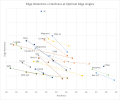
Here is an analysis I did based on choosing the correct geometry for each steel to reach the same toughness, so you can really compare apples to apples. 3V and MagnaCut are indeed at the top, but you're missing some great steels that reach higher hardness like 4V, K390 and Z-Max. 15V with the BBB heat treatment currently being used by Spyderco is also probably up there but there's no consistent data on it.

1000014157.png
 
Here is an analysis I did based on choosing the correct geometry for each steel to reach the same toughness, so you can really compare apples to apples. 3V and MagnaCut are indeed at the top, but you're missing some great steels that reach higher hardness like 4V, K390 and Z-Max. 15V with the BBB heat treatment currently being used by Spyderco is also probably up there but there's no consistent data on it.

View attachment 3107856
Unless I'm reading this incorrectly, this chart seems to say that edge retention goes down as hardness increases. That seems counterintuitive to me.
 
Unless I'm reading this incorrectly, this chart seems to say that edge retention goes down as hardness increases. That seems counterintuitive to me.
It does go down with hardness when you increase the edge angle to make toughness the same, since higher hardness decreases toughness. Yup kind of counter-intuitive.

Actually you could just replace toughness with edge retention in the chart if it helps since the geometry is essentially just trading one for the other. In other words, if we changed the geometry to keep edge retention the same and measured toughness instead that chart would look exactly the same.

I thought so at first as well, but I think he's showing what he believes to be the optimal Rockwell hardness for each particular steel to reach its own best potential for edge retention, as opposed to being compared to the other steels on the graph.

So, using MagnaCut as the example, its own edge retention would be superior at 62 HRC vs 63 and 64 HRC. (It's not a comparison with other steels.)
To clarify, I'm showing what happens if you choose a particular toughness and change the geometry of each steel to reach that toughness. So 3V would have a thinner geometry since it's very tough but Rex-121 would have a thicker geometry to reach the same toughness. And if you did that, you would see that the 3V blade would actually cut much longer than the Rex-121 blade, which is counter-intuitive but correct.
 
I thought so at first as well, but I think he's showing what he believes to be the optimal Rockwell hardness for each particular steel to reach its own best potential for edge retention, as opposed to being compared to the other steels on the graph.

So, using MagnaCut as the example, its own edge retention would be superior at 62 HRC vs 63 and 64 HRC. (It's not a comparison with other steels.)
It does go down with hardness when you increase the edge angle to make toughness the same, since higher hardness decreases toughness. Yup kind of counter-intuitive.

Actually you could just replace toughness with edge retention in the chart if it helps since the geometry is essentially just trading one for the other. In other words, if we changed the geometry to keep edge retention the same and measured toughness instead that chart would look exactly the same.
Thank you both.

For the above graph, I would like to see the lower hardness being graphed as well, then it would be more clear as to what is being shown. Edge retention increasing until optimal hardness is reached, then declining again once hardness goes beyond optimal.
 
Now you just need a chart for optimal angles for each steel...

Stop being so lazy. ☺️

(I removed my post above so as not to confuse the matter once Synov Synov replied again.)
The optimal edge angle changes based on what toughness you want. I guess I could give a list of formulas for each steel where you input a desired toughness and hardness and it gives you the correct edge angle. But most people don't think in terms of what toughness value they want. Maybe I could figure out some real world analogues.

Thank you both.

For the above graph, I would like to see the lower hardness being graphed as well, then it would be more clear as to what is being shown. Edge retention increasing until optimal hardness is reached, then declining again once hardness goes beyond optimal.
The chart actually shows all the hardness values I have data for, and the relationships are very linear so you can extrapolate to other hardness values as long as they are in the possible range for that steel. Edge retention will increase as you decrease the edge angle in order to keep toughness constant as hardness decreases.
 
Must be talking about the Shi Ba Zi Zou Cleavers, the 7.2 , 8 , and 9 with the 80cr13 steel are just incredible performing blades at any price...I work in a pro kitchen 30+ years, and these blades are just unreal....its all in the Heat treat of these , They have perfected it....If only they would make a set of western style mono steel bolsterless wooden or POM handle triple rivet full tang knives out of the same 80cr13. same heat treat...what a budget knife those would be for the pro kitchen, unreal how long they keep an edge and I have a lot of really nice japanese knives.
What about what I said made you think I wanted to advertise for some random cheap cleavers?
 
Sometimes.
Was just curious because I have found you can get away with much lower edge angles when using a slightly (maybe 5 degree steeper microbevel. Always been a good tradeoff for me.

What about what I said made you think I wanted to advertise for some random cheap cleavers?
Just admit it, the entire KnifeSteelNerds project over the years was just you playing the long game to sell cheap cleavers via commission. But in all seriousness I own Knife Engineering and saw you made some updates to it with another edition. Is there a way to see what parts were changed/updated?
 
Was just curious because I have found you can get away with much lower edge angles when using a slightly (maybe 5 degree steeper microbevel. Always been a good tradeoff for me.
If I was thinning the blade, I would, if I'm just sharpening, no need but for burr removal. I'm not going for hair splitting sharpness. I'm going for an edge that will perform the sorts of things I might do with a knife on any given day...and not get hung up in the material.
 
Back
Top