- Joined
- Sep 16, 2002
- Messages
- 1,577
I'm really bummed about my KITH knife this morning, and I just wanted to vent a little. Perhaps there are even some other guys/gals who's KITH knives are giving them troubles and/or are not living up to their expectations, and we can start a little pity party here!
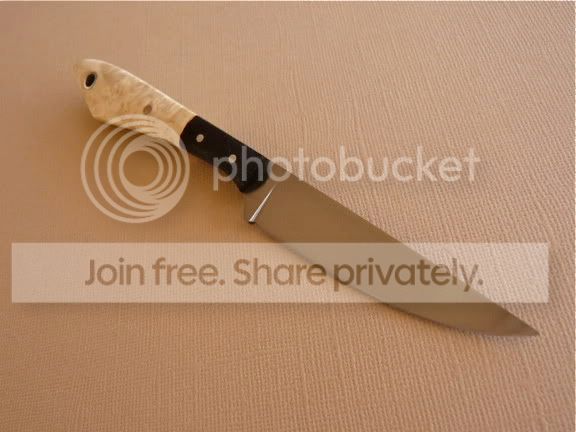
I've been working hard to get this knife done in time and to make it as nice as my current skill level allows. Aside from the plunges being a little uneven, I had high hopes for my KITH knife. I think this is my 7th knife to date and, up until now at least, each one has been better than the last. The bevels (aside from the aforementioned plunge) were my best grinds yet, and the hand-rubbed finish was (is) also the best I've been able to achieve so far. This would have been my first time doing a KITH, and I was quite excited about it. I've given most of my knives away to friends, but never to another maker before and I was really looking forward to the whole thing.
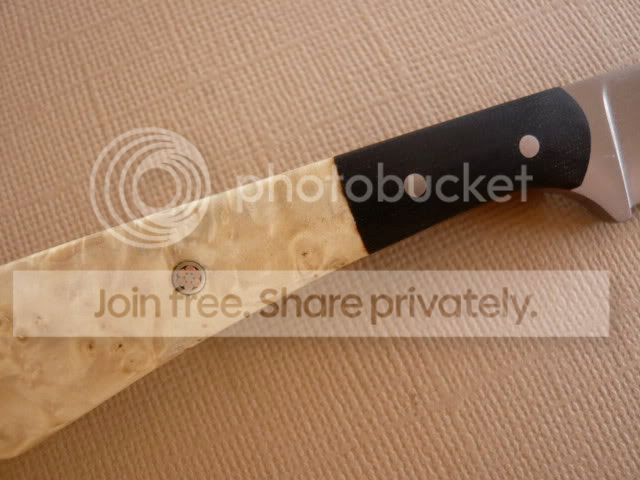
Then I decided to make a last minute change to the handle scales, and that's when things went south. I had these pretty little box elder burl scraps from a friend that were kinda warped and out of shape, but I told myself to clean them up and they would fit this little knife perfectly. So, I went with the change, cleaned them up, and epoxied them on.
As I started grinding the handle to shape, I felt a lump creep up into my throat. I have gaps between the scales and tang in several areas and also between the thong tube and scales, I have some scorching/burning in the wood at the bolster dovetail that is showing, and I also have staining in the light wood from the tang, pins, and/or belts and Si Carbide sandpaper. I think with some effort and fiddling, I could probably fix the staining problem, but the other problems I cannot do anything about. I've never had any of these problems with darker handle materials, so either I haven't had them previously and I just got 'lucky' on this one, or they just haven't been visible until now.
It's very disappointing and depressing to feel like I'm taking a step backwards on this one, but even worse to think I'm going to have to sit out another year until next Christmas season.
I've been working hard to get this knife done in time and to make it as nice as my current skill level allows. Aside from the plunges being a little uneven, I had high hopes for my KITH knife. I think this is my 7th knife to date and, up until now at least, each one has been better than the last. The bevels (aside from the aforementioned plunge) were my best grinds yet, and the hand-rubbed finish was (is) also the best I've been able to achieve so far. This would have been my first time doing a KITH, and I was quite excited about it. I've given most of my knives away to friends, but never to another maker before and I was really looking forward to the whole thing.
Then I decided to make a last minute change to the handle scales, and that's when things went south. I had these pretty little box elder burl scraps from a friend that were kinda warped and out of shape, but I told myself to clean them up and they would fit this little knife perfectly. So, I went with the change, cleaned them up, and epoxied them on.
As I started grinding the handle to shape, I felt a lump creep up into my throat. I have gaps between the scales and tang in several areas and also between the thong tube and scales, I have some scorching/burning in the wood at the bolster dovetail that is showing, and I also have staining in the light wood from the tang, pins, and/or belts and Si Carbide sandpaper. I think with some effort and fiddling, I could probably fix the staining problem, but the other problems I cannot do anything about. I've never had any of these problems with darker handle materials, so either I haven't had them previously and I just got 'lucky' on this one, or they just haven't been visible until now.
It's very disappointing and depressing to feel like I'm taking a step backwards on this one, but even worse to think I'm going to have to sit out another year until next Christmas season.


 Buh-bye $45 buckeye burl block. Now I am scrambling to find something else. I have other woods to choose from, but they are all a little short for this project. Not a good day.