
-
The BladeForums.com 2024 Traditional Knife is available! Price is $250 ea (shipped within CONUS).
Order here: https://www.bladeforums.com/help/2024-traditional/
You are using an out of date browser. It may not display this or other websites correctly.
You should upgrade or use an alternative browser.
You should upgrade or use an alternative browser.
I want to like 52100... but..
- Thread starter 69_knives
- Start date

- Joined
- Oct 2, 2006
- Messages
- 1,746
You can gain a couple of points Rockwell putting a quenched 52100 blade in the home freezer in a few hours.
Great! I will write that down in my notebook.

- Joined
- Nov 20, 2008
- Messages
- 1,855
Should be Cryo. isn't necessary. That is Cryo. in the method of slow cool to -300F range, hold, slow warm. Tool Steels, 3rd ed. has numerous mentions of "sub zero" treatment of tool steels to eliminate (nearly as possible, is my reading) retained austenite. Alcohol or acetone and dry ice will reach -100 +/- that Tool Steels means when they say "sub zero".
There is a question whether just reaching -100F transforms the austenite to martensite or whether the temp needs a hold. Mete says because martensite forms at the speed of sound, the logic is reaching -100F would take the transformation to MF, or as near to no-retained-austenite as can be reached for the alloy. He didn't say what industry practice is and neither does "Tool Steels", that I can find.
Mike
Should we all agree that "Cryo" means Liquid Nitrogen treatment to -276 roughly and that anything less than that is "Cold Treatment"?
- Joined
- Feb 4, 2005
- Messages
- 834
You can gain a couple of points Rockwell putting a quenched 52100 blade in the home freezer in a few hours.
What are the post quench and post freezer HRc readings you commonly get, Ed?
Have you put your 52100 blades in either -100F or -300F temps and noted how many HRc points you gained from that?
Mike
- Joined
- Feb 4, 2005
- Messages
- 834
Should we all agree that "Cryo" means Liquid Nitrogen treatment to -276 roughly and that anything less than that is "Cold Treatment"?
It would be more specific to actual process to do that...
My understanding is "sub zero" is older industry terminology but I haven't come across another term for the -100F "heat" treatment for retained austenite.
Mike
- Joined
- Oct 2, 2006
- Messages
- 1,746
It would be more specific to actual process to do that...
My understanding is "sub zero" is older industry terminology but I haven't come across another term for the -100F "heat" treatment for retained austenite.
Mike
Henckel's calls it the Friodur ice hardening process which uses dry ice.
- Joined
- Nov 20, 2008
- Messages
- 1,855
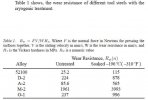
While it may not be necessary, in the particular data I'm referring to, in the un-treated state, they say O1 has 9.5 times the wear resistance of un treated 52100. and in the treated state O1 has 39.5 times the wear resistance of untreated 52100.
I'm just sayin, it may be worth checking out, but if you're an inside the box thinker, maybe not so.
I'm just sayin, it may be worth checking out, but if you're an inside the box thinker, maybe not so.
- Joined
- Nov 20, 2008
- Messages
- 1,855
It would be more specific to actual process to do that...
My understanding is "sub zero" is older industry terminology but I haven't come across another term for the -100F "heat" treatment for retained austenite.
Mike
I guess I should have said "anything MORE than -276 roughly"
- Joined
- Oct 2, 2006
- Messages
- 1,746
While it may not be necessary, in the particular data I'm referring to, in the un-treated state, they say O1 has 9.5 times the wear resistance of un treated 52100. and in the treated state O1 has 39.5 times the wear resistance of untreated 52100.
I somehow find this hard to believe!
Unless by untreated, they mean that the 52100 was not heat treated.
Last edited:
- Joined
- Feb 4, 2005
- Messages
- 834
hard to say.
When people say "carbide" as a generic term they are talking about tungsten carbide. Again, I'm just saying, tungsten carbide is pretty wear resistant.
Yes, and vanadium carbides harder, yet. Chromium carbides are relatively softer.
Mike
There are standandised repeatable tests the ASTM have defined that explore different wear types. I wonder if the tests were done to ASTM standards and what type of wear resistance the study is looking at.
It's known that converting more retained austenite will increase hardness. This can also be achieved through multiple quenches with the greater risk of cracking should the material be prone to it.
Personally I strive to reduce wear but moreso prevent breakage that comes from a lack of strength and or toughness. A worn blade can be sharpened a broken one has failed.
It's known that converting more retained austenite will increase hardness. This can also be achieved through multiple quenches with the greater risk of cracking should the material be prone to it.
Personally I strive to reduce wear but moreso prevent breakage that comes from a lack of strength and or toughness. A worn blade can be sharpened a broken one has failed.
I should add that while multiple quenched are an alternative to deep cryo for recovering retained austenite studies have shown deep cryo enhances the precipitation of carbides giving improved toughness wear resistance and fatigue resistance. Currently my personal tests are inconclusive as to if this has an observable effect on cutting tools beyond reducing RA as much as possible.
- Joined
- Nov 20, 2008
- Messages
- 1,855
I should add that while multiple quenched are an alternative to deep cryo for recovering retained austenite studies have shown deep cryo enhances the precipitation of carbides giving improved toughness wear resistance and fatigue resistance. Currently my personal tests are inconclusive as to if this has an observable effect on cutting tools beyond reducing RA as much as possible.
Here's a screen cap of the small amount of data from the paper:
If cryo is precipitating out tungsten and chromium carbides in O1, it makes sense to me that it could be significantly more wear resistant after treatment. But like I said earlier, it would be great if a knifemaker could do testing with actual knives.
http://www.ingvet.kau.se/material/fo/pub/itc/48_671_684.pdf


- Joined
- Jul 21, 2001
- Messages
- 2,869
Here is what I do:
3 post forging quenches, from critical inroom temp texaco type A oil, 35 seconds a quench.
2 flash and one full normalize - critical to room temp - 70 f. then to the freezer overnight.
3 annealing heats 988 f. for 2 hours, slow up in the Paragon - slow cool to room temp then to the freezer overninght.
Grind the blade oversize, polish to 220 grit.
Differentially harden harden 3 times - let the blades cool to room temp in the oil, then in the freezer overnight - 3 days.
Temper 3 times, in the Paragon cool, to 388 f, for 2 hours, cool to room temp in the Paragon, then back to the freezer over night each cycle.
Blades Rockwell 60 - 61, but will scratch a 62 Rockwell steel.
Photomicrographs reveal no measurable retained autenite in hardened zone.
Grain size 14 and finer.
For best results you have to set the table for this system to work, high rate of reduction by forging, low temp forging - 1625 f top temp. Many thermal cycles.
and the three post forging quenches are very significant - very uniform grain and no blade warp.
We have found that when blades crack in heat treat (52100 and 5160) it is usually due to forging too hot - overheating - or faults in the steel. I have not had a blade crack using quality steel for over 15 years.
We have found that while vanadium = fine grain it also reduces toughness significantly.
Troop - Joe knows what he is doing, a good man to listen to.
We have found that if Cryo. results in a significant difference in performance, you need to modify what went before to be more in harmony with your steel and make up the difference that way for the performance qualities we like to see in a blade.
3 post forging quenches, from critical inroom temp texaco type A oil, 35 seconds a quench.
2 flash and one full normalize - critical to room temp - 70 f. then to the freezer overnight.
3 annealing heats 988 f. for 2 hours, slow up in the Paragon - slow cool to room temp then to the freezer overninght.
Grind the blade oversize, polish to 220 grit.
Differentially harden harden 3 times - let the blades cool to room temp in the oil, then in the freezer overnight - 3 days.
Temper 3 times, in the Paragon cool, to 388 f, for 2 hours, cool to room temp in the Paragon, then back to the freezer over night each cycle.
Blades Rockwell 60 - 61, but will scratch a 62 Rockwell steel.
Photomicrographs reveal no measurable retained autenite in hardened zone.
Grain size 14 and finer.
For best results you have to set the table for this system to work, high rate of reduction by forging, low temp forging - 1625 f top temp. Many thermal cycles.
and the three post forging quenches are very significant - very uniform grain and no blade warp.
We have found that when blades crack in heat treat (52100 and 5160) it is usually due to forging too hot - overheating - or faults in the steel. I have not had a blade crack using quality steel for over 15 years.
We have found that while vanadium = fine grain it also reduces toughness significantly.
Troop - Joe knows what he is doing, a good man to listen to.
We have found that if Cryo. results in a significant difference in performance, you need to modify what went before to be more in harmony with your steel and make up the difference that way for the performance qualities we like to see in a blade.


- Joined
- Oct 26, 2006
- Messages
- 2,898
Here is what I do:
3 post forging quenches, from critical inroom temp texaco type A oil, 35 seconds a quench.
2 flash and one full normalize - critical to room temp - 70 f. then to the freezer overnight.
3 annealing heats 988 f. for 2 hours, slow up in the Paragon - slow cool to room temp then to the freezer overninght.
Grind the blade oversize, polish to 220 grit.
Differentially harden harden 3 times - let the blades cool to room temp in the oil, then in the freezer overnight - 3 days.
Temper 3 times, in the Paragon cool, to 388 f, for 2 hours, cool to room temp in the Paragon, then back to the freezer over night each cycle.
Blades Rockwell 60 - 61, but will scratch a 62 Rockwell steel.
Photomicrographs reveal no measurable retained autenite in hardened zone.
Grain size 14 and finer.
For best results you have to set the table for this system to work, high rate of reduction by forging, low temp forging - 1625 f top temp. Many thermal cycles.
and the three post forging quenches are very significant - very uniform grain and no blade warp.
We have found that when blades crack in heat treat (52100 and 5160) it is usually due to forging too hot - overheating - or faults in the steel. I have not had a blade crack using quality steel for over 15 years.
We have found that while vanadium = fine grain it also reduces toughness significantly.
Troop - Joe knows what he is doing, a good man to listen to.
We have found that if Cryo. results in a significant difference in performance, you need to modify what went before to be more in harmony with your steel and make up the difference that way for the performance qualities we like to see in a blade.
Ed, Thanks for the info. But, what is a "flash" normalization?
- Thanks
- Joined
- Jul 21, 2001
- Messages
- 2,869
Larrin: I agree!
Tai: thanks!
Troop: by flash normalize I mean, heat to just above critical in my forge, check with a magnet then hold the bade in a shadow and watch the color change from light to dark, then back to a light color, the blade has just passed down through the transformation zone and is magnetic, check with a magnet to be sure. Then put it back in the forge and again heat to non magnetic, repeat once more, then full normalize.
When we started our quest for our Excalibur Rex and I swore to use no big words in order that those interested could understand with out having to go to a metallurgical text book to understand what we meant.
Tai: thanks!
Troop: by flash normalize I mean, heat to just above critical in my forge, check with a magnet then hold the bade in a shadow and watch the color change from light to dark, then back to a light color, the blade has just passed down through the transformation zone and is magnetic, check with a magnet to be sure. Then put it back in the forge and again heat to non magnetic, repeat once more, then full normalize.
When we started our quest for our Excalibur Rex and I swore to use no big words in order that those interested could understand with out having to go to a metallurgical text book to understand what we meant.