Ideal wilderness skills/bush knife features?

Joined
Sep 11, 2007
Messages
1
This is my first post.

I also asked this question on another forum and received some great replies. I'm looking for a general-purpose bush/camp knife to do wilderness skills tasks. What are some features I should be looking for? Size? Steel? Grind? Thinkness? Handle Material? Fixed or Folder? Should it have any Special features? I'm not looking for names brands, just features.

Thank you
 
For me this is just my opinion now. It has to be fixed blade, full tang, carbon steel, 4-6 blade length, and convex or flat grind
 
Wabajack's description is pretty much spot on with mine.

I lean towards the 3.5" over the 4" direction, I think smaller is way better for control. I also vastly prefer carbon over a stainless steel, which is my only beef with the F1 (which I'd still love to get).

Full tang is a big plus, no guard is important. Drop point is probably the best bet for most tasks.

I seem to prefer convex grinds and find they get 'sharper' for me. A good scandi is a very close second.
 
After a lot of thought and questions about the same thing, I decided to splurge on the Bark River Northstar. It has a 4" A2 carbon blade with a sharp, easy to maintain convex grind and is about 8" overall. The blade comes to a fine point that is in line with the handle, which is useful for bushcraft, and the spine is notched to scrape with a firesteel. It has a full tang, no guard, and is thick enough at the spine to baton if necessary. I got mine with an aesthetically pleasing curly maple handle, but they are available in more rugged materials too.

The Northstar is expensive, but there are also many other quality knives with most of these features for less money.
 
Here is want I look for in a knife.

1. The knife should have a fixed blade, non-folding.
2. The blade should be made of good quality carbon steel. Carbon, unlike stainless steel can be used as the striker in the flint and steel method of fire lighting.
3. An overall length of 8-9 inches is ideal to perform intricate woodcraft duties, yet is large enough to present a good target for batoning. Batoning will assist a 4-inch blade in cutting down small trees, and splitting wood.
4. The knife should have a full tang; the metal of the knife blade should extend for the full length of the handle for strength.
5. The knife’s spine should be squared off to be able to spark a FireSteel/ferrocerium rod.
6. The knife needs a comfortable and easy to hold oval shaped handle, made of a water-resistant durable material, like micarta.
7. The preferred grind is a wide flat bevel that runs to the edge of the blade with no significant secondary bevel, usually the edge bevels only goes 1/3 way up the side of the knife. The result is a very keen edge. This grind gives excellent control in woodcarving. If you carve wood, you will probably find that the flat bevels give you better control of the cut. The wide bevel face lies flat against the wood like a plain and slices wood into fine curls. Working with wood is a must when practicing wilderness living skills. Another advantage is ease of field sharpening. There is no special tool kit or other gadget required to get a razors edge. All that is required is to lay the bevel flat to the stone, and work the entire surface of the bevel. The wide bevel forms its own guide.
 
Yeah, gonna get close to the same anwsure everytime, but here it goes.

Fixed blade
Carbon steel
Drop point
Full tang
Scandi,flat or best of all convex(I've redone most of my knives convex and I love them all)
Handle material isnt a huge deal to me, just as long as its grippy.
 
Here is want I look for in a knife.

1. The knife should have a fixed blade, non-folding.
2. The blade should be made of good quality carbon steel. Carbon, unlike stainless steel can be used as the striker in the flint and steel method of fire lighting.
3. An overall length of 8-9 inches is ideal to perform intricate woodcraft duties, yet is large enough to present a good target for batoning. Batoning will assist a 4-inch blade in cutting down small trees, and splitting wood.
4. The knife should have a full tang; the metal of the knife blade should extend for the full length of the handle for strength.
5. The knife’s spine should be squared off to be able to spark a FireSteel/ferrocerium rod.
6. The knife needs a comfortable and easy to hold oval shaped handle, made of a water-resistant durable material, like micarta.
7. The preferred grind is a wide flat bevel that runs to the edge of the blade with no significant secondary bevel, usually the edge bevels only goes 1/3 way up the side of the knife. The result is a very keen edge. This grind gives excellent control in woodcarving. If you carve wood, you will probably find that the flat bevels give you better control of the cut. The wide bevel face lies flat against the wood like a plain and slices wood into fine curls. Working with wood is a must when practicing wilderness living skills. Another advantage is ease of field sharpening. There is no special tool kit or other gadget required to get a razors edge. All that is required is to lay the bevel flat to the stone, and work the entire surface of the bevel. The wide bevel forms its own guide.

Hi Myakka-

Just wondering, do you feel that the Skookum Bush Tool is currently the blade that comes closest to approaching your ideal blade? Or, to your mind, what 'percent perfection' does it achieve?

If it's nowhere close to you, what's next in line?

Thanks-
 
Personally, I think I'd be more comfortable with a slightly larger blade than what a few have suggested, but I'll defer to the consensus and add a recommendation for something along the lines of a Busse Active Duty. These are very stout and fit the above descriptions fairly well. I'm planning on taking mine hunting in a couple of months when the season opens. -DT
 
You've definitely come to the right place when looking for expertise. This crew will give you plenty to ponder. They've cost me a bundle!

My scout just had me order an Al Mar SERE Operator to fix onto his backpack strap. He handled an assortment of fixed blades and did some research like you're doing. It seemed to fit a lot of the criteria listed here. Although he covets a Chris Reeve, this fit the budget better.

Good luck in finding a knife that will work for you.

GB
 
You can get them for between $85 and $100, and the steel they've switched to is VG-10 laminated between 420J. Very tough, ergonomic knife.
 
Hi Myakka-

Just wondering, do you feel that the Skookum Bush Tool is currently the blade that comes closest to approaching your ideal blade? Or, to your mind, what 'percent perfection' does it achieve?

If it's nowhere close to you, what's next in line?

Thanks-

So far The Skookum is my favorite "general bush blade" I like it better than my Linger, Steve Cox, and all of my Moras.

Ron
 
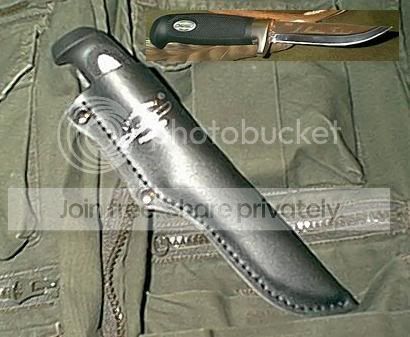
If you are indeed young and without much experience, the knife should probably be one designed for a young user. Finger guard, a non-slip handle, 3"-4" easy sharpen blade with scandi grind, fairly thin stock for good slicing capability and lite weight, good sheath and well known company.

You asked not to mention company names, so I'll just show you a pic.:D
martiini001.jpg
 
Nothing wrong with what has been posted before. What I like is 4-5" carbon steel, 3/16" wide, and with Micarta handle. I like having a guard and a palm swell in the middle of the handle. Lanyard hole to attach something bright to if it's dropped and I like my handles to have a slight forward rake to it. Making the knife slightly boomerang like if that makes sense.:D
 
Back
Top