Identifying unique trees for wood handle?

Joined
Aug 29, 2007
Messages
1,602
Hey guys, recently my cousin and I decided to honor our grandfather my making a knife out of the old maul he made in the 70-80's. We didn't even think this was possible until we visited a local guy who makes knives out of all kinds of scrap steels (saws, large cabled steels, etc). Anyways, to continue the theme, we would love to find a suitable tree to use on the camp that he started so many years ago to make a handle out of. It's located in Armstrong County, PA (near Pittsburgh) and has primarily cherry and ash. There is also a decent amount of oaks (several variety), maples, and hickory. My question is, what woods make the best handles? I would love to find some curly maple or ash but that may not be realistic. If they are, is there anything I should look for?

I appreciate any help you may have in helping me find the proper handle material for what will truly be an awesome knife.

Thanks,

B
 
I think all woods you mention (Cherry, ash, oak, maple & hockory) are usable for knife handles.

Oak, you don't see that much, but I quite like it (I have a folder with oak handles).

Kind regards,

Jos
 
You can get various types of figure in Hard Maple .It's my favorite. I get 'stabilized' wood so it's beautiful and practical. Hard maple is better than soft maple .The only ash I have is black ash burl which is very nice. As a fruit wood cherry can have some nice figure.
A freshly cut piece of woo has to be dried, either by oven commercially or air dried but that takes a long time !
 
You may be able to find some maple with interesting figure if you choose from appropriate areas of the tree. Towards the bottom of the trunk you may find some wood that has been compressed into a curl figure. If you choose an area near the fork of two branches you can obtain crotch figure.

Neither will be as stable on their own as straight and clear grained stock but if you dry it carefully (check different woodworking sites for help) and get it stabilized it could work nicely.
 
Look for wood that is twisty or misshapen. Bumpy bases on trees, twisted crotches, odd bends in a trunk or large branch.

Cut out the selected areas with about 6" extra wood on each side of the part you like. Take them home and paint the cut ends with white house paint ...and set them in a dry place above freezing to dry.

After a year, cut them into slabs about 2-3" thick, trim the ends off an inch or two....and set them in a dry place to continue drying.
The thing to remember is that this wood will not be ready for a knife handle for 2-5 years.

When it is below 10% moisture content (7% is better) the wood is dry. You can use it on a knife now.
It would be even better when the wood gets dry if you cut it into slightly oversized handle pieces and send off to be stabilized.
 
Thanks for the replies everyone!

@Jos-I like being different, so maybe Oak isn't a bad idea

@Mete, PB, bladsmth-I don't mind waiting a few years. I want to do it right and not take short cuts. Thanks for the suggestions on what to look for. I will go out within a few weeks to see if I can find anything cool. Maybe I'll take some pictures to see if you guys think they could amount to anything? I don't really think there is a lot of hard maple, though.
 
As bladsmth said, covering the ends of you fresh cut wood is critical. You can also use wood glue to do this as well, but whatever you use, coat both ends of the cut wood asap! Checking(cracks at the cut) can occur within minutes! There is lots of info out there on curing wood. One of the best sources if read was in a book called"the traditional bowyer's bible vol. 1"
 
Last edited:
Dogwood has a really cool striped look and it's hard as heck. But don't oil it, it ruins it. Just wax and buff. Try to find a dead tree or limb. I think you'll like it.
 
Red and White Oak is porous to the extreme! Walnut and BlacK Cherry are pretty as they age but are relatively soft. Sugar Maple ought to do it for you if you can find a 'curly' or a 'bird's eye' figured piece. If the handles are not big (ie you're looking to make scales only) perhaps you want to look around for a nice piece of Apple or Pear. That particular wood is hard and very durable (and becomes a lovely colour like cherry) and you don't see it very often only because the trees are never big nor do they grow straight.
Have fun!
 
Thanks bmilla for starting this thread. I was also curious as what types pieces to look for since we do a small bit of tree/brush removal and my boss will cut me almost anything I ask. He seems completely fascinated that I have such an interesting hobby! :D
 
[video=youtube;3-Ls9HxrjuM]http://www.youtube.com/watch?v=3-Ls9HxrjuM[/video]

This video gives a decent idea of what to look for to find burls.
 
I use a lot of osage orange for knife handles.............We call it hedge apple in Ohio..............carl
 
As I understand it, many burls are created from insect infestation. If that's true, might try looking for those.

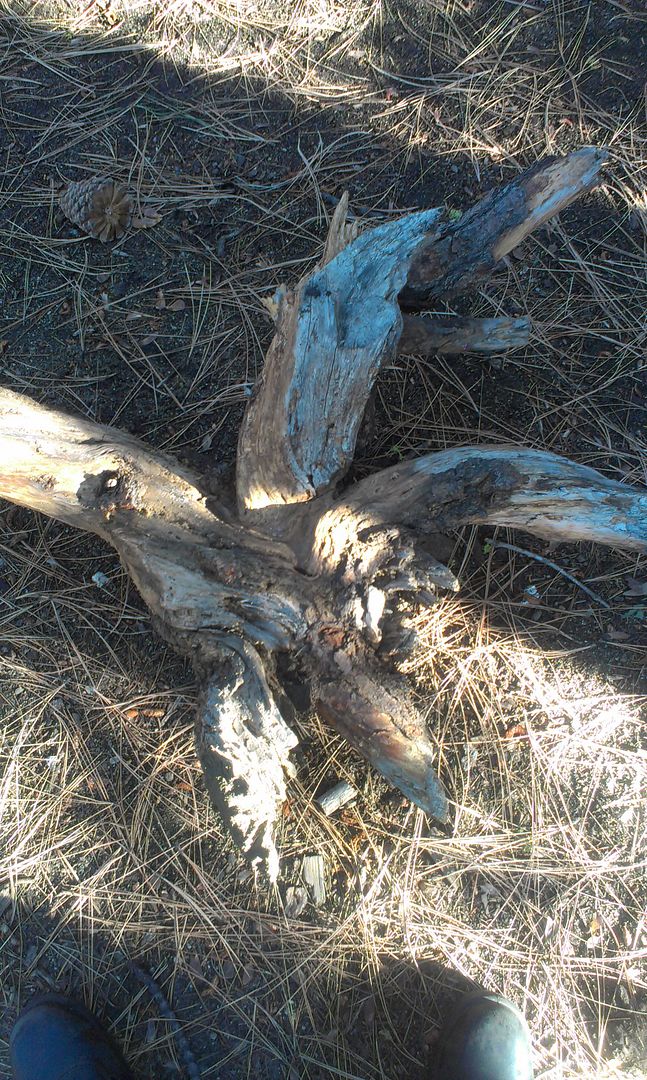
I saw this piece while out in the woods.

IMAG1724_zpsfdd80255.jpg


Not sure if it would have been worth taking and didn't have a saw.
 
While on the subject of odd wood choices, has anyone ever used "mountain mahogany" it's all over the place out here in high desert N.
Cali... kinda cool looking scraggly old trees, slow growing and relatively hard... or juniper for that matter?
 
I use a lot of osage orange for knife handles.............We call it hedge apple in Ohio..............carl
We call it Bois D' Arc or Horse Apple. It is hard and tends to split. It will last forever and has a beautiful yellow to it. I use very old fence posts for handle scales.
 
Wow. Thanks everyone for some truly excellent advice.

As bladsmth said, covering the ends of you fresh cut wood is critical. You can also use wood glue to do this as well, but whatever you use, coat both ends of the cut wood asap! Checking(cracks at the cut) can occur within minutes! There is lots of info out there on curing wood. One of the best sources if read was in a book called"the traditional bowyer's bible vol. 1"

Thanks for the book suggestion. I'll check that out.

Dogwood has a really cool striped look and it's hard as heck. But don't oil it, it ruins it. Just wax and buff. Try to find a dead tree or limb. I think you'll like it.

I'll have to check around to see if dogwood is around. I'm not certain it is. Thanks for the suggestion, though!

Red and White Oak is porous to the extreme! Walnut and BlacK Cherry are pretty as they age but are relatively soft. Sugar Maple ought to do it for you if you can find a 'curly' or a 'bird's eye' figured piece. If the handles are not big (ie you're looking to make scales only) perhaps you want to look around for a nice piece of Apple or Pear. That particular wood is hard and very durable (and becomes a lovely colour like cherry) and you don't see it very often only because the trees are never big nor do they grow straight.
Have fun!

Yeah a unique hard maple (like sugar) is what I initially planned on using if I could find a sample at my camp. The handles shouldn't be too big, but we haven't even designed the knife lol.

ETA: I like the apple idea a lot because my grandfather actually planted apple trees a when they bought the property way back when!

Thanks bmilla for starting this thread. I was also curious as what types pieces to look for since we do a small bit of tree/brush removal and my boss will cut me almost anything I ask. He seems completely fascinated that I have such an interesting hobby! :D

You're very welcome! Hopefully you too can find out what you were looking to learn about.

[video=youtube;3-Ls9HxrjuM]http://www.youtube.com/watch?v=3-Ls9HxrjuM[/video]

This video gives a decent idea of what to look for to find burls.

I never even thought of checking Youtube! I'll check that video out soon.

I use a lot of osage orange for knife handles.............We call it hedge apple in Ohio..............carl

I tried to find osage orange when attempting to make a bow and couldn't find one :/ It's some tough stuff..

As I understand it, many burls are created from insect infestation. If that's true, might try looking for those.

I saw this piece while out in the woods.

IMAG1724_zpsfdd80255.jpg


Not sure if it would have been worth taking and didn't have a saw.

Nice. I'll look. Too bad emerald ash borers don't count as an infestation. I know we have plenty of those! :grumpy::thumbdn:
 
Last edited:
We call it Bois D' Arc or Horse Apple. It is hard and tends to split. It will last forever and has a beautiful yellow to it. I use very old fence posts for handle scales.

I have used Hedge, as we call it, before. I had never thought to use the old posts though as they are so hard to cut. I have a HUGE pile of 60-80 year old posts I could sample from.

Chris
 
If you go for the oak, you´ll be amased how good it looks after filling the pores. (basicaly with a dust/oil mixture)
But if your father planted apple tries, I´d go for that!
 
I was also curious as what types pieces to look for since we do a small bit of tree/brush removal and my boss will cut me almost anything I ask.

for knife handle wood use parts of the tree that would be hard to bust with a maul. I love crotch wood . If you saw a piece of crotch you want to end up with boards that have a Y shape , thats where the feather figure is. Like others have said coat the ends of the piece as soon as possible with wax or paint to minimize the cracking. And keep it out of direct sunlight.
 
Back
Top