Info on performance of a convex edge???

Joined
Aug 28, 2003
Messages
1,574
Hey folks

I am just getting into convex edges on some of my knives. I did a convex grind on a small bushcrafter I made a while back and have been carrying since. I really like the performance(though it did take some time to warm up to it) this one was out of 1/8th O1. I decided to try another in 3/32 O1 thinking the thinner stock would improve cutting. It is a Kephart design and I am just waiting to glue the scales on but first wanted to check to see how the cutting performance was. It bites into wood, slices tomatoes/cucumber cleanly, paracord no problems and it will cut a potato, not split/break it.....I think I have it. I did not bring up the convex too high as I wanted to retain strength in the thin stock.
Any other tests I should check out before I glue this baby up tomorrow????

Thanks
Craig

P.S. I'll post a pic up in a bit
 
Just wanted to add, I sharpened this up on a rubber backed piece of 600 grit sandpaper....it won't shave hair off my arm cleanly but it starts to bite.

Should I switch over to a mousepad and higher grit sandpaper, strop it....? Still trying to figure out the finer points of the convex edge

Thanks
 
stropping it with some fine grit, around 2000 grit or something like green rouge should give you that extra bite.

make sure you have a burr raised along the whole edge before stropping though, or else stropping won't help.
 
Move up to 1000 and then 2000 grit and then hit it on a strop. Save your money and get buffing compound from sears. $2.50 each for green and white. Strop it and you will never regret switching to the convex edge.
 
Thanks everyone!

Gonna get some compound and try the 1000-2000 grit. Also, watch the videos this evening.
 
Just wanted to add, I sharpened this up on a rubber backed piece of 600 grit sandpaper....it won't shave hair off my arm cleanly but it starts to bite.

Should I switch over to a mousepad and higher grit sandpaper, strop it....? Still trying to figure out the finer points of the convex edge

Thanks

Graig, Maybe I'm missing or misunderstanding (easy for me to do) something here since you are a knifemaker, but - I go from start to finish on the belt grinder when I am grinding out a convexed blade. By the time I've gone from 180, 320, 500, 1200, 15 or 20 micron, to the honing belt, my convexed edges are as sharp and polished as they can possibly be made. From there I maintain them on a leather strop loaded with blade honing compound, or on the honing belt if in the shop.

At one time I liked the mouse pad affairs when used with little pressure. Now, I just prefer wet/dry over thick leather glued to a board. In a hurry, I might finish up at 600. If I have more time, I will stop at 1500 and finish it up on my strop. In the shops, here on the ranch, I have a HUGE variety of woods and materials to test the durability and performance of my edges and, thus far I am content with the results.

I might add: When I am in the wilderness for a long period hunting, camping, etc., with convexed blades, I don't carry strops and wet/dry. I carefully maintain the edges on something like the Fallkniven sharpeners (1 X 4) - fine diamond on one side, ceramic on the other. Most often just a brush across a ceramic rod or plate, waist belt will maintain the edge for a considerable period of time. Just remember to increase the angle of your blade when using stones, rods, etc, so only the very, very edge is addressed. I watch the edge, nothing else. :)

Got some photos of your convexed knives?
 
I put a convex edge on this blade using the video links I posted above.

Kabar001.jpg


TF
 
Dannyboy, sorry I kind of mislead with my post. I was asking a couple of Q's. I do all my grinding....on the grinder too:D I wanted to know of maintaining the edge. Also, I wanted to know, with the tests I had done, was the geometry sounding correct. I wanted to know if I needed to bring the convex bevel back further to the spine, without compromising strength. I am heading out to our local Sportsmans show and will snap some pics while I am out and post them later.

Thanks again for all the help:thumbup:
 
Dannyboy, sorry I kind of mislead with my post. I was asking a couple of Q's. I do all my grinding....on the grinder too:D I wanted to know of maintaining the edge. Also, I wanted to know, with the tests I had done, was the geometry sounding correct. I wanted to know if I needed to bring the convex bevel back further to the spine, without compromising strength. I am heading out to our local Sportsmans show and will snap some pics while I am out and post them later.

Thanks again for all the help:thumbup:

Understand. I should have had more caffeine this morning. :D

Personally, I like thinner convexed blades for much of what I do (a joy to sharpen). Chopping blades are another story, of course. I think your 1/8" and 3/32" blades should be about perfect for many of us.

I have had lots of folks in my classes ask me how old the convex profile is with regards to cutlery. Well, I also teach flintknapping, and most of my points and blades are very convexed. :D Once they inspect some of my ancient arrow and spear point collection, they have a pretty good idea why the convexed profile is superior and needful in many designs.

I also collect historical Early American (not necessarily made here) knives made or forged before there were grinders. All of these knives were forged and filed with a convex profile. Actually, historically speaking, the flat or hollow grind (and many others) is a fairly new invention. None of these early knives have the highly polished sides and edges that the current convexed knives have, but striations from the files and stones are clearly seen. These early convexed blades are best sharpened (without changing their appearance) on a freehand stone. One simply sharpens the edge like a "V" but dropping the angle every 4th or 5th stroke to get rid of the shoulder. The old edges are either fully-convexed or semi-convexed and serve utility purposes very well. Some of my early woodworking blades show more effort at polishing and stropping the convex edge.
 
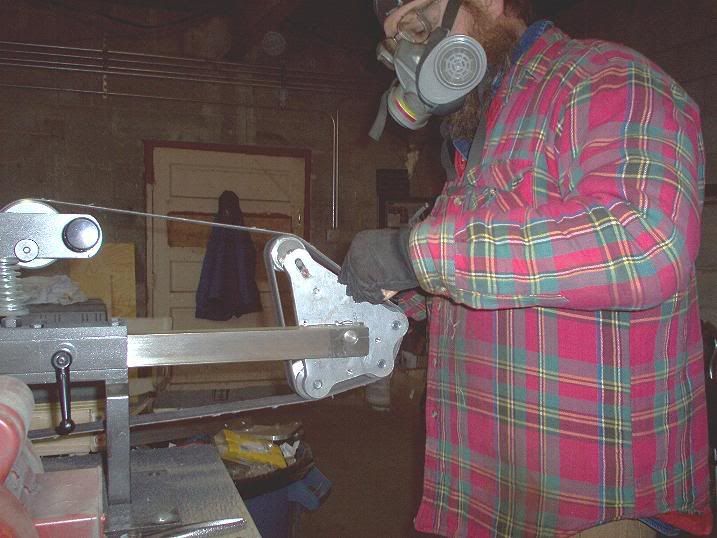
How are you grinding your convex grinds, slack belt? I use to do my convex grinding on the slack belt. Problem is for stock removal, you can't get the grind thin enough above the cutting edge to cut as well. It will cut, but will need more pressure to do so. If you forge your bevels, then slack belt only isn't a problem. With stock removal, I've found by flat grinding first, then switch to slack belt, you get a better geometry with your grind. I actually use the rotary platen to convex the grind. My convex edges are finished on the slack belt.
Scott
 
Scott...both of these(only done 2 so far) have been flat then convexed much like the way you said. I flat, then slightly slacked belted them and then finished with hand sanding to smooth everything out.

Scott, any chance you could post a pic of your slack belt set up(or email) which ever is better for you??? I have a Coote and just go above the platen for slack "belting" I have never seen slack belting done so I just assume this was the way to go.

Thanks
 
here's my slack belt attachment on the KMG.

shape.jpg


This is the rotary platen.


psk6.jpg


How much room do have above the platen on your Coote? I can remove my platen from the slack belt attachment.
Scott
 
Scott, I can take the platen off. Above the platen to the top idler wheel off hand is around 10 inches a bit more even. Thanks for the pics, those helped lots:thumbup:

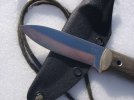
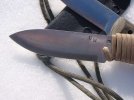
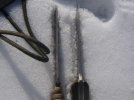
Here are some pics of the 2 convex knives I have done so far. I have posted the small Bushcrafter before and this is a Kephart style without scales but a really nice cord wrap:o Tomorrow it will get some cocobolo scales epoxied on with SS pins and a SS thong tube.
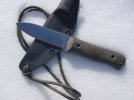
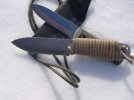
Thanks again for all the help:thumbup::thumbup:

Craig
 

Attachments

  • P2280467.JPG
    P2280467.JPG
    67 KB · Views: 20
  • P2280469.JPG
    P2280469.JPG
    59.8 KB · Views: 29
  • P2280468.JPG
    P2280468.JPG
    68.4 KB · Views: 26
  • P2280470.JPG
    P2280470.JPG
    62.5 KB · Views: 37
  • P2280472.JPG
    P2280472.JPG
    63.8 KB · Views: 17
CKE2, I have the coote grinder to and just go above the platen. I have the 2 x 72 and not the 2x 42. I am not sure if there would be a difference or not.

Bryan
 
It might be overkill but i often finish a convex (maintaining) with up to 10,000 grit and always at least 6000. In a pinch in the field, I might settle for 1500 grit to get a little more speed and still a pretty fine finish. I have con vexed quite a few of my knives but many have gone to siguy for the first convexing.
 
I use a diamond rod and strop on a belt loaded with 600 grit compound. That's all I do to maintain my blades. I found this to be the simplest way to hand sharpen knives. The knives I make for sale are finished with a medium scotchbrite then a fine scotchbrite loaded with the same 600 grit compound.

Craig, your knives look great. Nice work.

Scott
 
Thanks Scott:thumbup:

Besides beadblast, scotchbrite is my favourite finish.
 
http://www.knivesshipfree.com/p4/Sharpening-Videos/pages.html

Watch this video series - I have followed it to GREAT results. I have done three or four convex edges so far and all have been SHAVING in about 1/2 hour from double bevel to convex.

TF


This is an awesome video for proper convex sharpening whether a full or secondary convex bevel is used. People have a tendency to raise the angle as if they were still on a stone which is a "no-no".

The Japanese knew how efficient a convex edge was. They had a slightly higher standard of sharpness. You can take it further than the video. The cool thing about the Japanese was that they used a stone to create their convex edges... and they also ran the stone along the edge at times rather than perpendicular. I have switched to stones and learned a bit of the old way..... my edges have never been the same. My final strope is on a 8000+ grit surface.

Sorry to sound so arrogant... I try not to come off that way..... I just get excited because if I can do it, so can you!


Rick

Edit************

If you're thinking this wouldnt be as practical in the field, think again....... no mouse pad, no papers, less compound, two stones (1"x1"x2")

***************
 
Last edited:
Back
Top