Input on a first knife design?

Joined
Mar 13, 2013
Messages
74
I want to get into knife making starting off with stock removal, and have access to some 1095 so I plan to use that. If you think that is going to be way harder than 1084, please let me know. In fact, criticism is welcome. Let me outline what I expect from it, and then I'll explain my drawing (sorry I'm a terrible drawer, but better at shaping material! ).

Sorry for the essay!

Expectations/Use -

I want this to be an all around camping knife/survival knife. I do not own a fixed blade, and my last camping trip didn't go so hot with only my 3" folder. Let's just say stinging nettle doesn't go down with that... So I want to be able to do cooking with it, minor bushwhacking, possibly some bushcraft, and all the way up to splitting small-medium logs. I will have smaller knives for the smaller stuff, but don't want something huge.

Drawing-

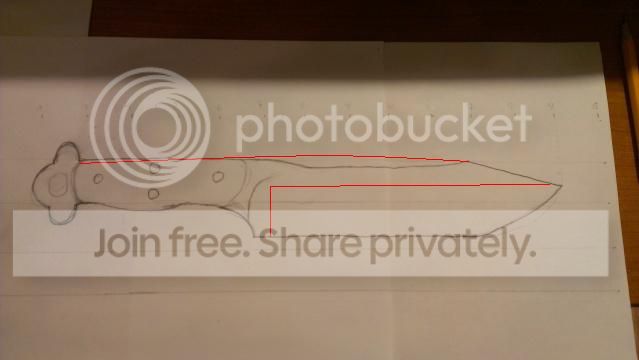
I am basing this off of inspiration from the camping knife challenge thread in the great outdoors. I took some qualities from each, and hope to come out with something useful. The 1095 is 3/16" in thickness, and 3" wide. In the drawing, you can see the horizontal lines that are each an inch apart, and the notches up top and if you can see on the side are also marking each inch. The blade comes out to be ~7" cutting edge, and about 1.75" wide. I decided to have the plunge start partially up the blade so as to have a full edge all the way.

The butt might be a bit too big/showy, but I want a decent bit of steel coming off to supply some form of hammering capability (I would need clay to harden this and not the tang/handle correct?). I plan a green canvas micarta for the handle material. I think the middle bulge might be a bit too pronounced too. I might need to lengthen the handle about 1/2" too. Not sure.

Comments welcome! Thanks !

zlx0e9.jpg


Link to bigger size: http://tinypic.com/view.php?pic=fyoa6v&s=6
 
My first thought is to get rid of the ears on the butt. They serve no use and will cause horrible blisters. Next, I'd go with 1084 or 5160 rather than 1095. 1084 if you plan to heat treat it yourself. Also, what is the purpose of dropping the spine? Leave it straight and you can get away with a smaller piece of steel. Starting off with 3" is quite a bit and I think you can accomplish everything you want with 1.5" For the swell in the handle, I'd say get rid of it too and just arch the butt of the handle down a bit so that the handle curves down. Finally, the tip seems awfully pointy for a bushwhacker. Maybe a gentle drop point would give you a stronger tip.

Just my $.02 worth.
 
It looks like a knife that would do all that you ask of it. I like the way you've identified the key tasks you want the knife to do.

I understand that you want to "hammer" with the butt of the handle, but it looks to me like the Micky-Mouse ears are going to get it the way. How are they supposed to be used?

Just my personal preference, but I'd move the plunge line forward so the index finger can't accidentally get cut if you push it too far forward.

If you have some doubt about the size of the handle make a full size copy out of cardboard and see how it feels.

Good luck,

- Paul Meske
 
Thanks for the input. Yeah the ears on the butt were just for fun, they don't have a real purpose. 1084 is that much easier than 1095 eh? I will go that route then, I figured if my friend had it I might as well go 1095, but yes we want to heat treat ourselves (to learn). I said 3" steel also because that is what he had.

The dropped spine just looked right, and doesn't serve any real purpose. I thought to try and do some structural analysis to see what shape would provide best support but I figure others have done so before me.

The handle I would leave flat on the bottom? Not just make the swell smaller?

The bushwhacker might also be a bushcrafter, so for drilling. Should I keep the rise in the blade on the bottom to the same height for the height and start the drop farther down the spine then?

I'll make some modifications. Thanks!
 
thanks for the LOL lonepine- mickey ears. Yeah I'll maybe just almost triangle that out instead? I will definitely be making a cardboard cutout- that will help me transfer the design to the steel.
 
Going off what others have suggested for starters maybe consider something along this to get you started.

zlx0e9.jpg
 
wow thanks, you even went out of your way to add lines! Thanks, much gratitude. I know the handle proportions are whacky from my drawing skills. I will definitely go for those changes. It does look tougher without that dip I made on the spine.
 
No problem took 2 seconds. Start with that then play around with some handle/butt designs. Once you make a cardboard cutout of it you'll know if it feels right almost immediately and what to change. Even if it feels right in your hand spend some time "using" it to see how you think it would perform.
 
Solid advice. I plan on doing quite a bit more work with the design, as I'm waiting until it warms up some around here before the garage is any decent to do work in. Until then, it's read read read, and modify my design. Really quite an amazing resource of information you guys have here.

Edit: would it make sense instead of moving the plunge up to elongate the handle some and leave a larger ricasso?
 
I think I may use this as a build thread with questions to avoid a totally new post. Will hopefully eventually put a final knife in here! I increased handle length, decreased the swell, and made a (hopefully) more ideal butt without the lanyard hole. Straightened the plunge/grind, and moved the handle away from the edge a bit for a larger ricasso to avoid accidental slicing! Also shortened the drop tip. Better? Again, criticism is welcome,

11qtvzk.jpg


~13.5" total length.
 
Belly of the handle? Yeah I guess it's too straight now. I think I may look around more at handles all of you have made to find what I might like as well as mocking up with some play-dough. Hopefully I can get something more comfortable handle wise.

Do all the other "improvements" seem better?

Thanks!
 
The first one looked pretty ambitious for a beginner. The updated one lacks some curves. I'm not a big fan of straight backed knives. Maybe try to put just a hit on curve on the top of handle and more in the belly.
 
Belly of the handle? Yeah I guess it's too straight now. I think I may look around more at handles all of you have made to find what I might like as well as mocking up with some play-dough. Hopefully I can get something more comfortable handle wise.

Do all the other "improvements" seem better?

Thanks!

I mean the edge, the way the tip meets the straight part of the blade, it could be a long sweeping curve instead of two straight lines that meet.

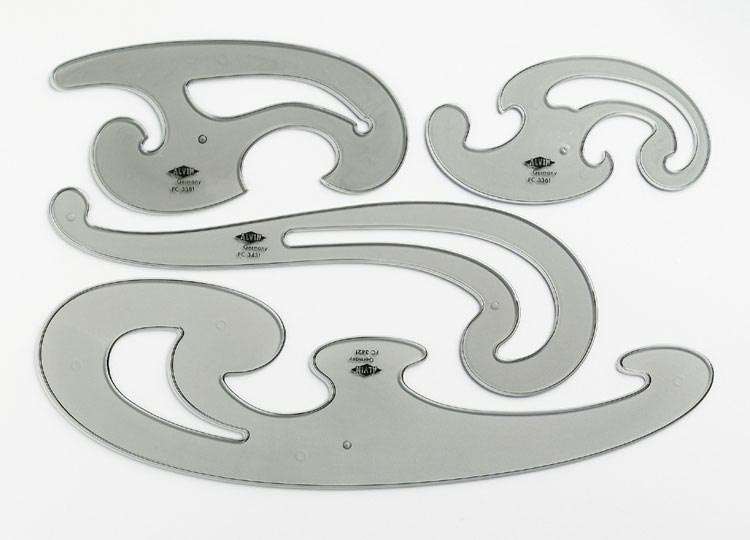
When you're drawing by hand, try these.
Called French Curve Templates = available in any art or stationary store fairly cheaply

3112.jpg
 
Last edited:
Just like in the fairer sex, curves are far better than angles and straight lines.

Make the blade edge curve evenly up to the point. Make the whole spine have a slight curve from butt to tip. Just an 1/8-1/4" total curve makes a big difference.
The hook at the butt needs to be make into a smooth rounded curve, and frankly is excessive. Look at some photos of camp knives in The Gallery or in The Exchange for ideas about how to clean up the shape. The slight palm swell on the lower side of the handle is OK. The smooth curve down to the blade edge from the handle is good, too.
 
Understood, I'll fix those things up after getting a French curve. Should help as I'm no artist. I will check those areas of the forum for more ideas, thanks.

When you say curve the spine, you mean so the back arches upwards, not arching towards the edge correct?
 
Yes, the spine should be a slight curve from tip to butt. The place where the handle meets the blade should be about 1/8" to 1/4" Higher than the tip or butt. Most folks just shape this tiny curve when profiling the spine until it seems right. It is very subtle, but adds a touch of fluidity to a blade. A totally straight blade is very stiff looking.

I also meant to suggest that you just use three rivets in a straight line. Any deviance from dead perfect as it is now will show poorly. Trust me on this one.
Corby bolts are a bit more work to install, but would be the very best for a heavy use chopper/camp knife.
 
I'll take your word and wait until I have more experience to get more creative with such things. I will go find some curves to try and make that slight curve on the spine. Might have to have my more artistic lady help a bit there. really appreciate your mention of 1/8 to 1/4, I like to be able to measure such things.

Corby bolts look like a great idea, again thanks for your suggestion.
 
Back
Top