Intro to Bladesmithing at NESM 3/2-3/13 WIP

Joined
Sep 16, 2012
Messages
33
I am an absolute novice in all aspects of making knives. I've spent at least 2 years lurking on this forum to read and watch all that I can in order to help me learn. I've read the stickies quite a few times, and I've checked off everything in the Count's Beginner post at least 3 times. I feel I have a grasp, but there is obviously far more to learn. One thing often recommended is to try to meet with a local maker for some guidance. That avenue for me has been less than fruitful despite emails and calls around. So I decided I would enroll for an ABS course. When I'd searched on here for information, there really wasn't a whole lot. It seemed like a few comments but nothing really detailed. So I emailed Stacey and asked if he thought it would be a good idea to do a daily post with pictures and a recap of my experiences, which he thought some folks on here might be interested. So here it goes......

I live in Orlando, FL. When choosing the school to attend, I had 3 options. One is in North Carolina, one in Maine, and another in Texas. I decided to attend the New England School of Metalwork in Auburn, ME mostly because of the fact that they have a very inexpensive dorm on the property (2nd reason is I have family in New England I could visit on my way up, the weekend between and my way back home). After a 21 hour drive up to stay with family Saturday night, I drove the last 3 hours today to keep ahead of the storm which was rolling up through Pennsylvania, New York, Massachusetts and then in to Maine. I arrived at 4:30pm. I'd been provided a way in to the dorm building by Dereck (the man in charge) and instructions for finding my key and he answered a few last minute questions I had. Once inside I found 2 classmates who had already arrived, and we chatted for quite a long time getting to know each other. After a few hours, I went back out to my vehicle, grabbed my gear and started migrating upstairs to locate my room. The dorm is upstairs and has 4 rooms with bunk beds in each, 2 full bathrooms and an instructors room. I'd been informed by my classmates that there were only 4 of us staying in the dorms, so we each have our own room, which is cool by me!

Here are pictures from the NESM website,
Sitting Area and main room
livingroom.JPG


Bedroom
bunkroom.JPG


One of the Bathrooms
Bathroom.JPG


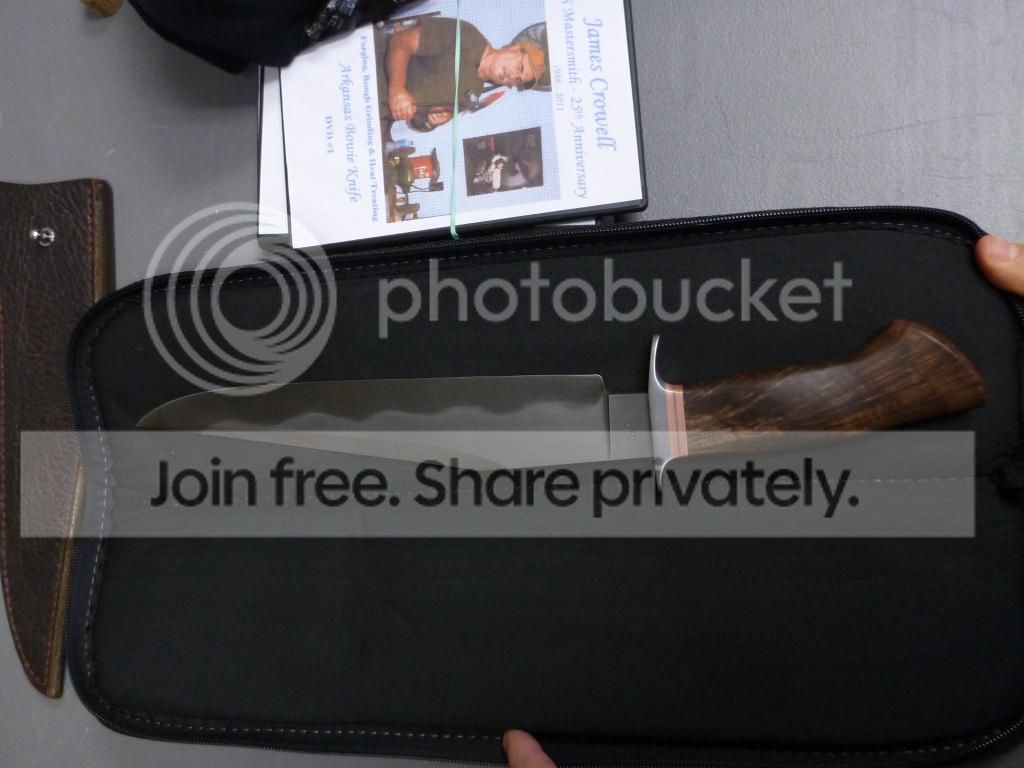
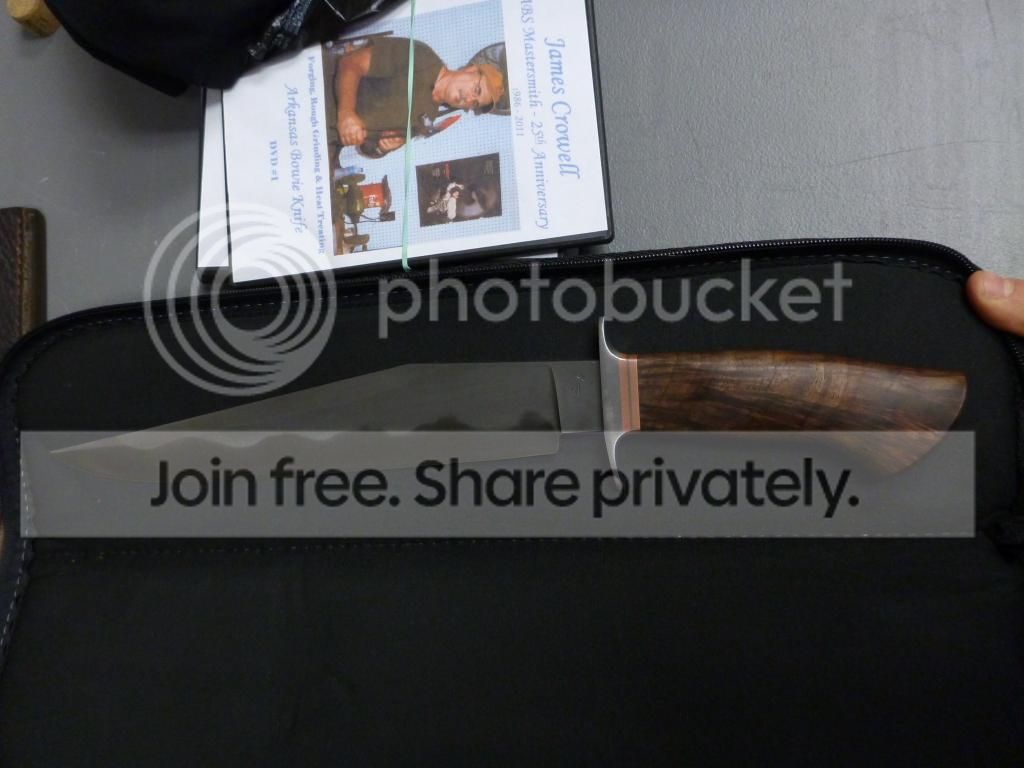
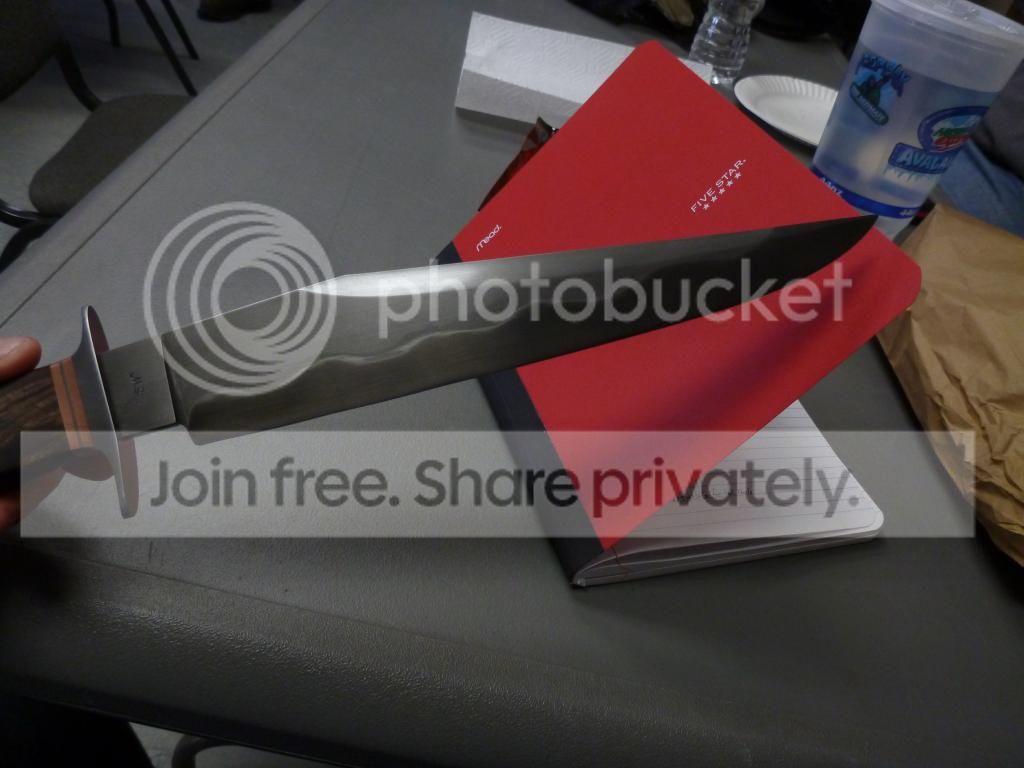
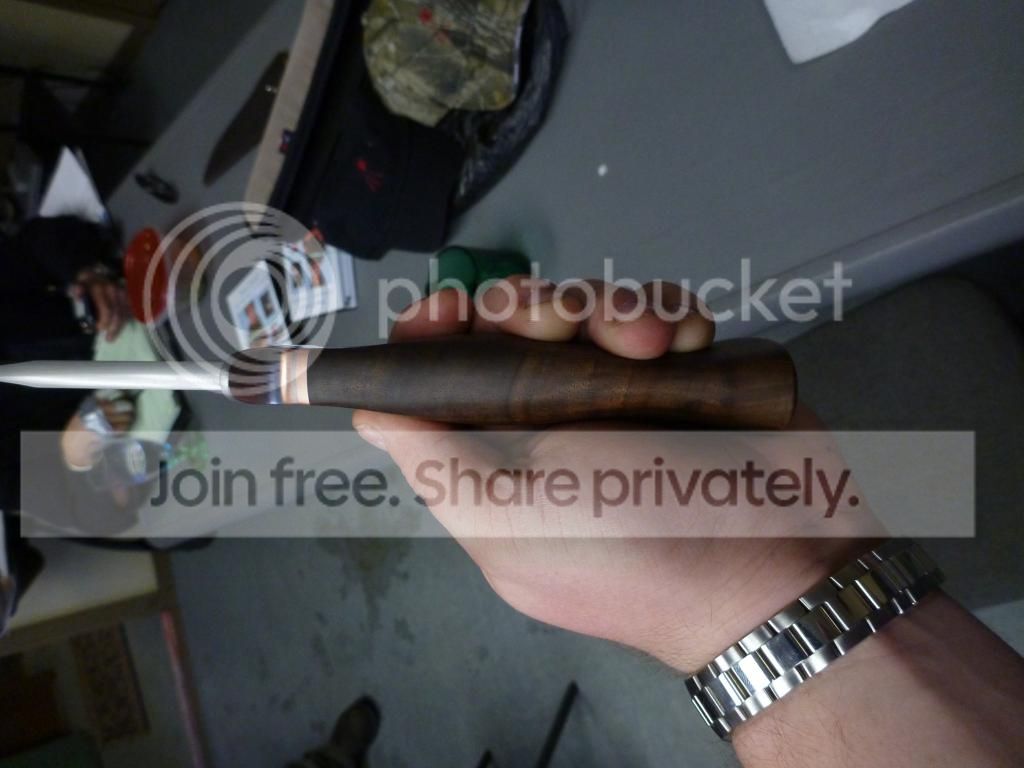
About the time I finished unloading my stuff and letting family know I'd made it alright, I heard a new voice. When I walked out of my room, I was met by Nick Rossi (please let me know if I spelled his name wrong) and right after him coming up the stairs was Jim Crowell, who is the instructor. I've never met either of them before, but because of the great pictures posted all the time on this forum, I knew who they were. Ok, confession, I KNEW Jim...I was only 95% sure Nick was Nick Rossi. Jim took his gear in to his room and Nick had a sheath he was admiring. Then Jim came back out with a fun toy! He had a padded protective carrier for a knife he'd made. He took out a very large Bowie for which the sheath was made. W2 steel, 416 shaped guard with 416 spacer and copper spacers as well. Black walnut handle with some amazing color and figure.

I know, I know....where is the picture??? I promise...I will take one tomorrow and post it if I get his permission!

It was a really gorgeous knife to hold. Solid piece of steel yet light in the hand and balanced so that it didn't seem nearly as long as it is. It seemed about 12 inches, but I'll ask tomorrow the exact length.

We sat around in the common area and talked for a while, and then Nick had to head back south, which I believe was to try to beat the storm that blew in. Jim, John, Isaac and myself stayed out shooting the breeze for a while and gradually all separated out to head to bed. Jim and Nick were both really nice guys to talk to. Tomorrow class begins at 8am and I am super excited yet nervous at the same time.

I'll be back tomorrow with a recap and pictures of the shop, as well as my 'starting point' so we all can compare to how I do on the final day. If anyone has questions, fire away!
 
Cant wait to see more pictures and to see how the experience goes for you, should be a fun time.
 
I did their basic bladesmithing course two summers ago (although with Greg Neely). I definitely had a blast! Great instruction, and not just from the instructor, Nick and Dereck had lots of great tips. I would go back there again if I had time & cash, but unfortunately I don't think that'll happen anytime soon.
Good luck and hope you enjoy yourself!
P.S. The burger place on the corner is pretty good
 
Sorry it is so late, but between dinner with Jim and John, then watching a documentary with everyone on the samurai sword, it took some time for photos to upload!! Thanks to the folks who were supportive and Jbaker, thanks for the tip on the eats! I've heard from a few folks that it is good and we've made plans for a venture later this week.

So as promised, here are a few of Jim's knife which is gorgeous......

P1080540_zpsq7yfsley.jpg


P1080541_zpssg4ai7nr.jpg


P1080538_zpsh5ktie5q.jpg


P1080539_zpsub4urvue.jpg


Amazing walnut!
P1080539_zpsub4urvue.jpg


So the class started off promptly at 8am with a quick classroom discussion. Terminology was discussed and explained, ideas behind techniques, drawings showing the techniques and so on. It only lasted an hour, but was very informative to a new person like myself and outlined what we would be doing for today. I found that the students were from all over the U.S., as well as 2 are from Canada...including one farrier!

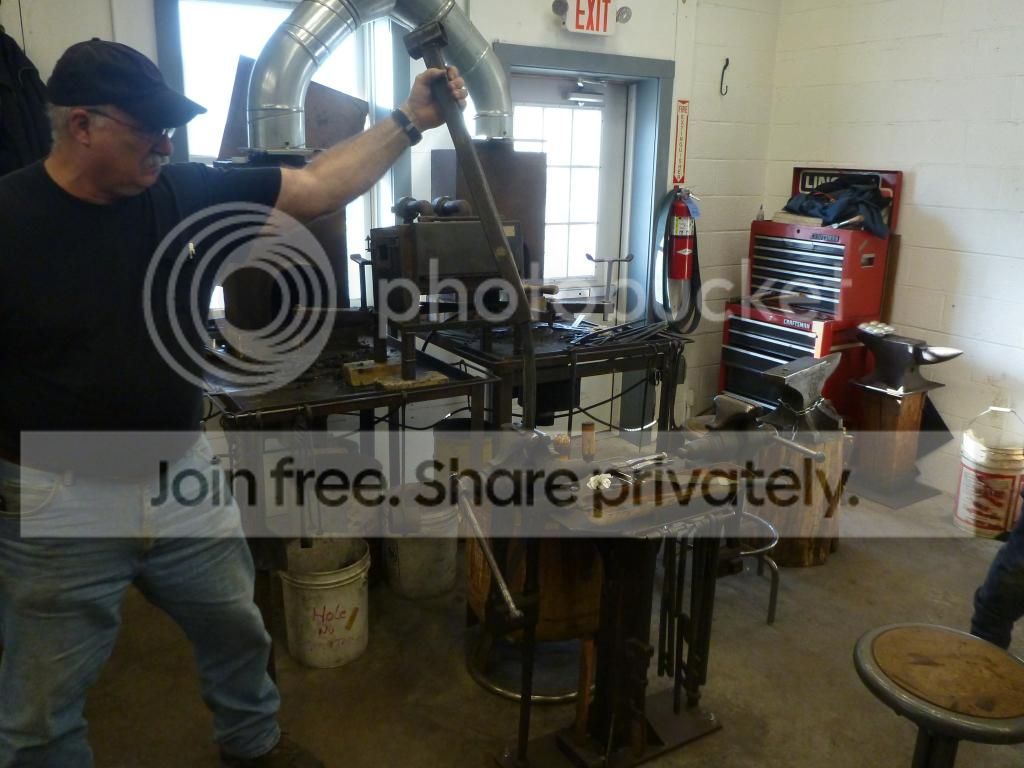
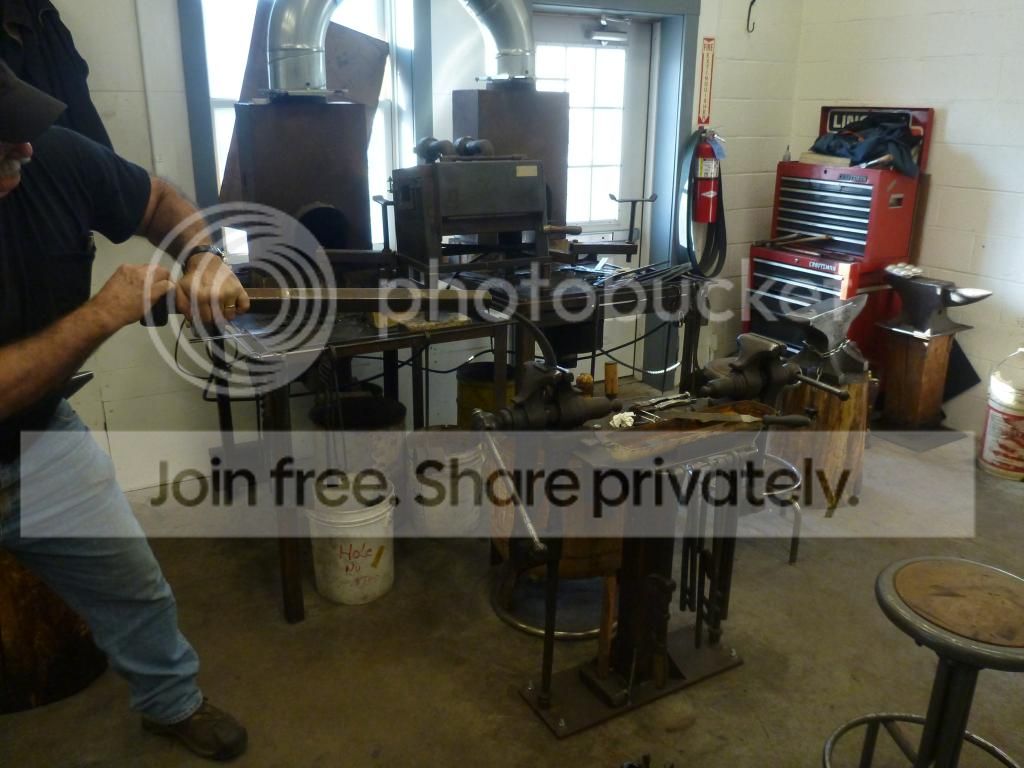
The stroll to the shop was quick and we went right to getting ready to work. Nick began setting up the forges as well as finding anvils that would fit the person at each station. I wound up needing to switch with Isaiah because he had a rather tall anvil and mine was short. The shop is set up really well with 8 stations, 4 forges between smiths which you share and while tons of equipment is in it, you don't feel cramped. I also really liked that since it was cool outside, it seemed to help cut down on how much heat we felt from the forges running constantly. Well the cool weather and the exhaust system helped too. it really seems like this facility is top notch. Jim began discussing again what we would be doing and demonstrated each step and then sent us on our way to perform it ourselves.

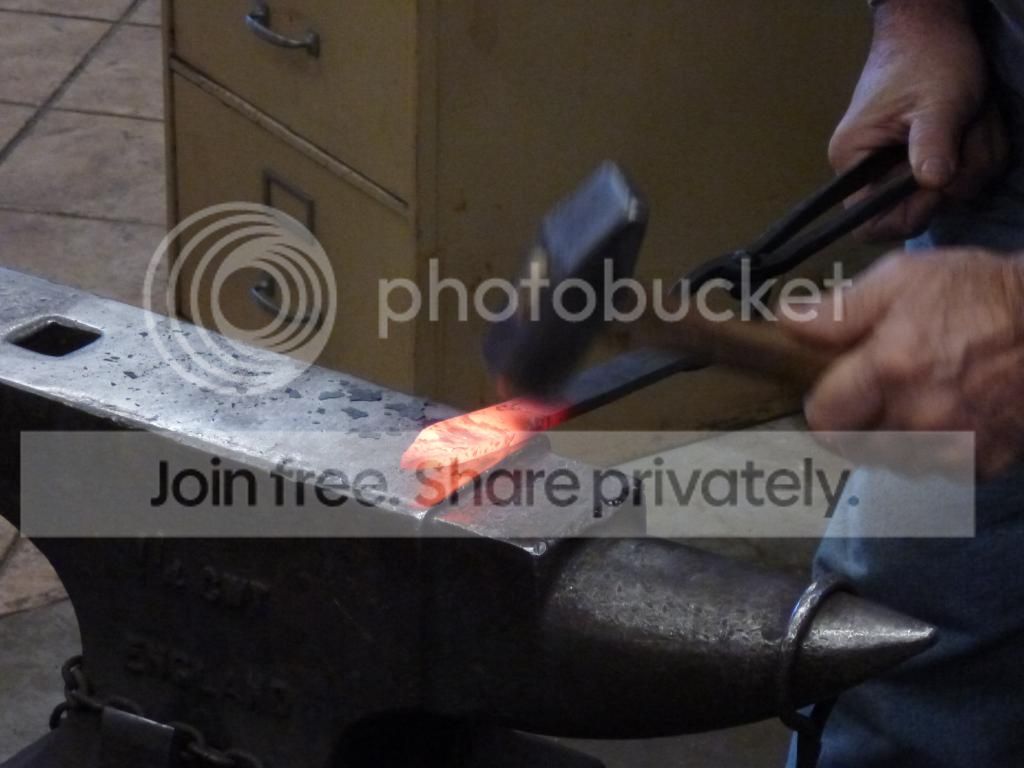
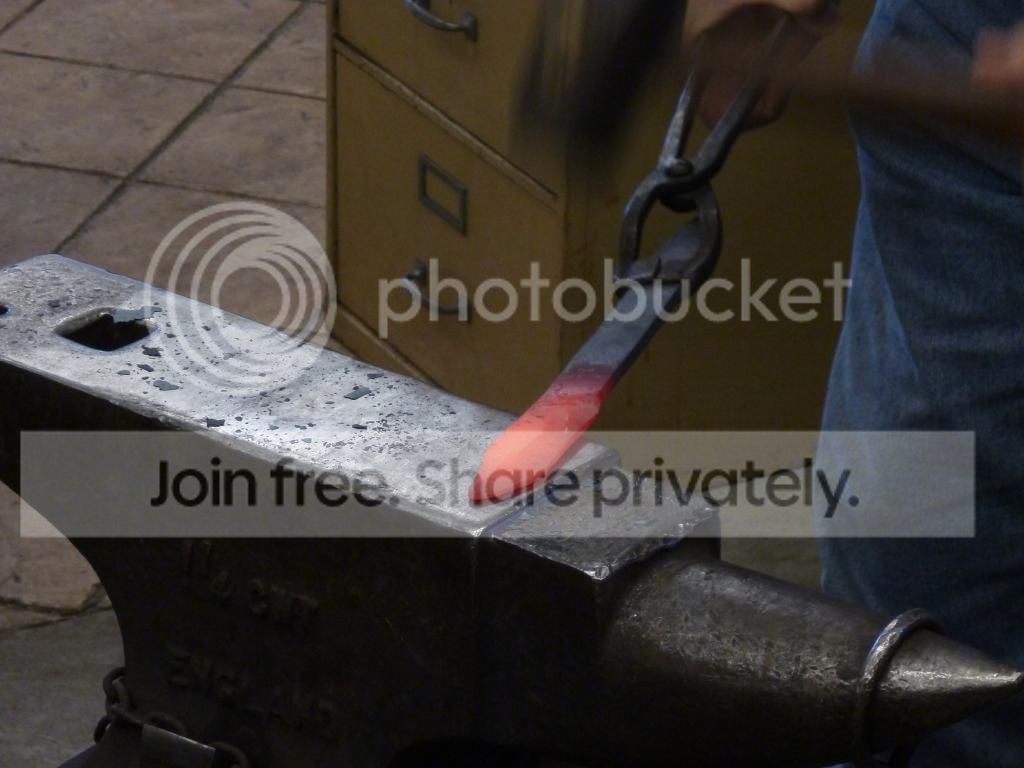
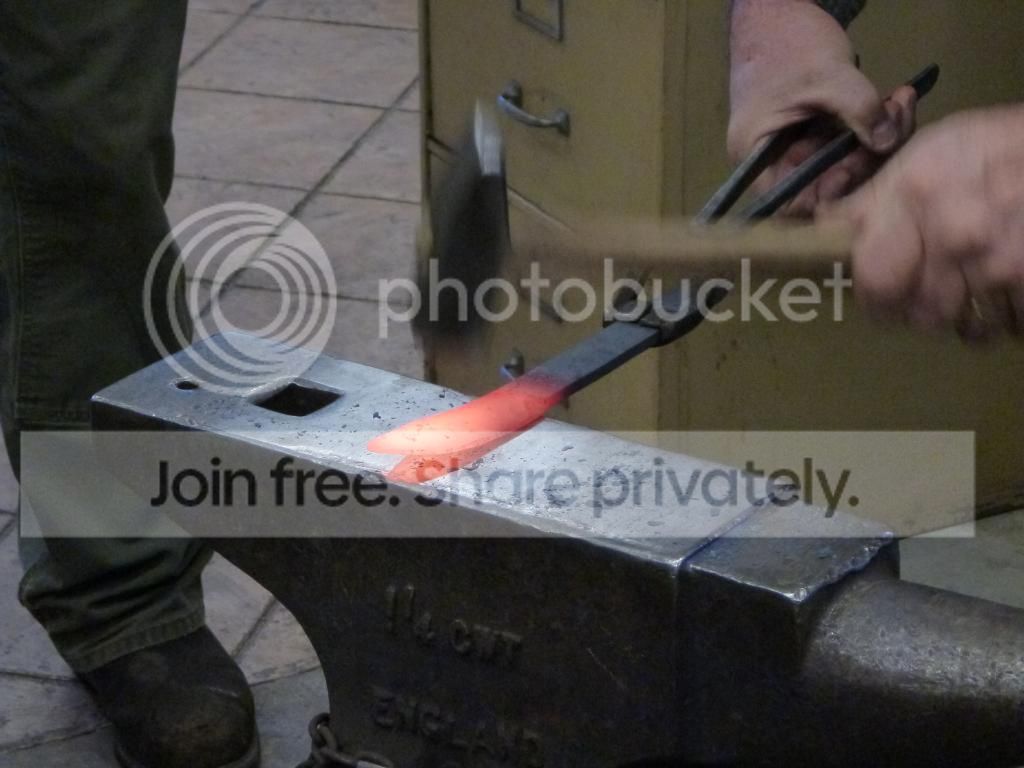
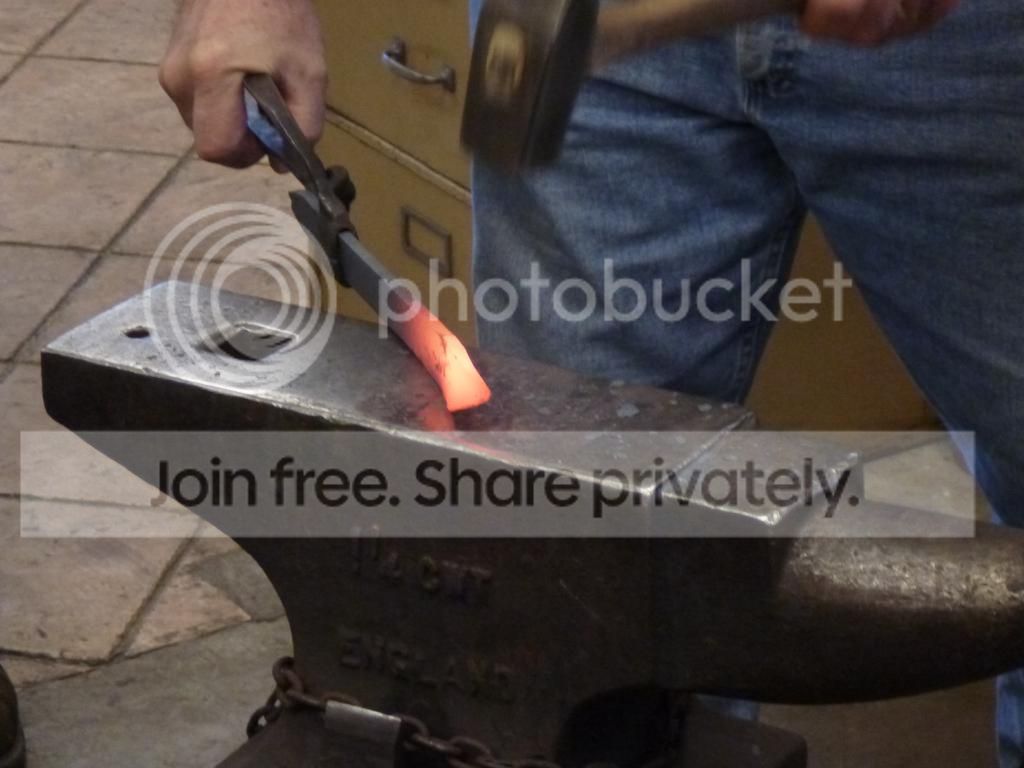
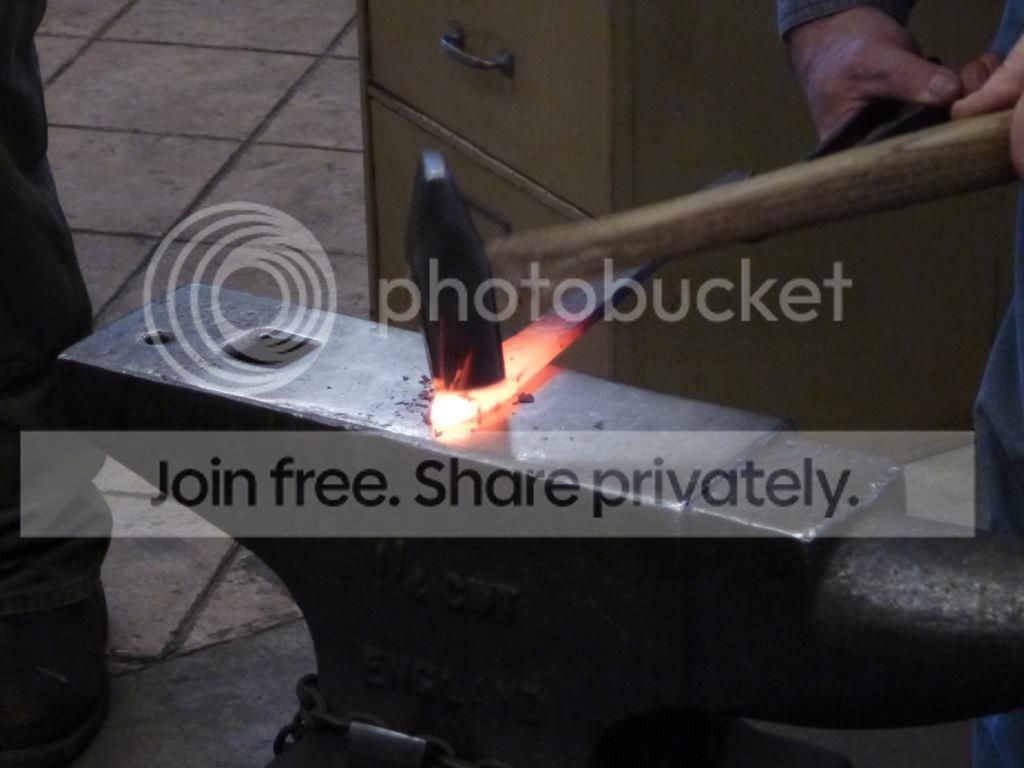
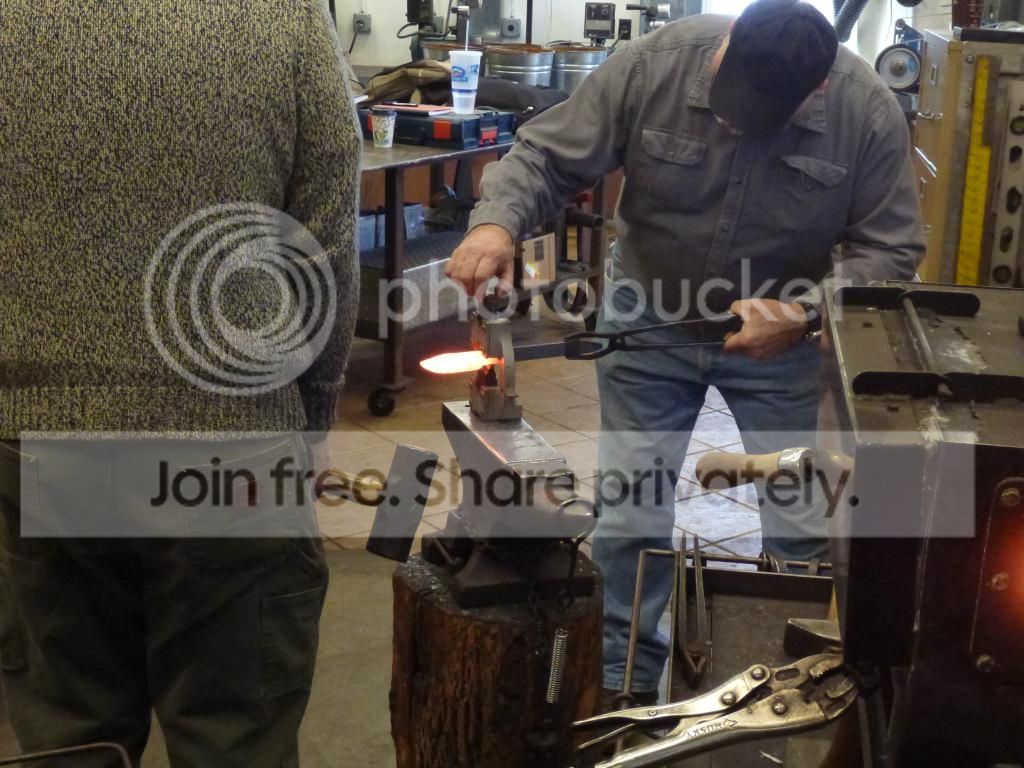
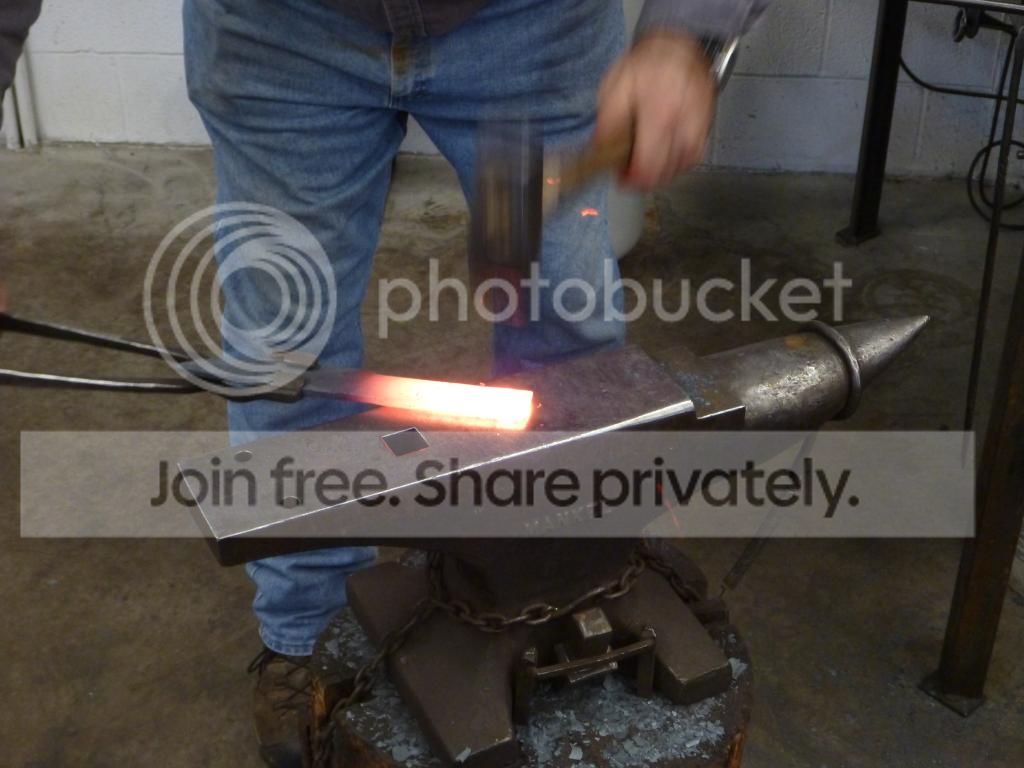
In order, forging the point (we started with bar stock), then adding the pinch, then forming the bevels, then dropping the tip, then straightening the blade, to using the guillotine to help start forming the tang, to using a cutoff hardy and then drawing out the tang and forging to shape. I took a lot of video of Jim performing his examples...not quite so many pictures which I realized after half the day was gone.

SORRY! I will try to do better in the future. But here is what I did catch.

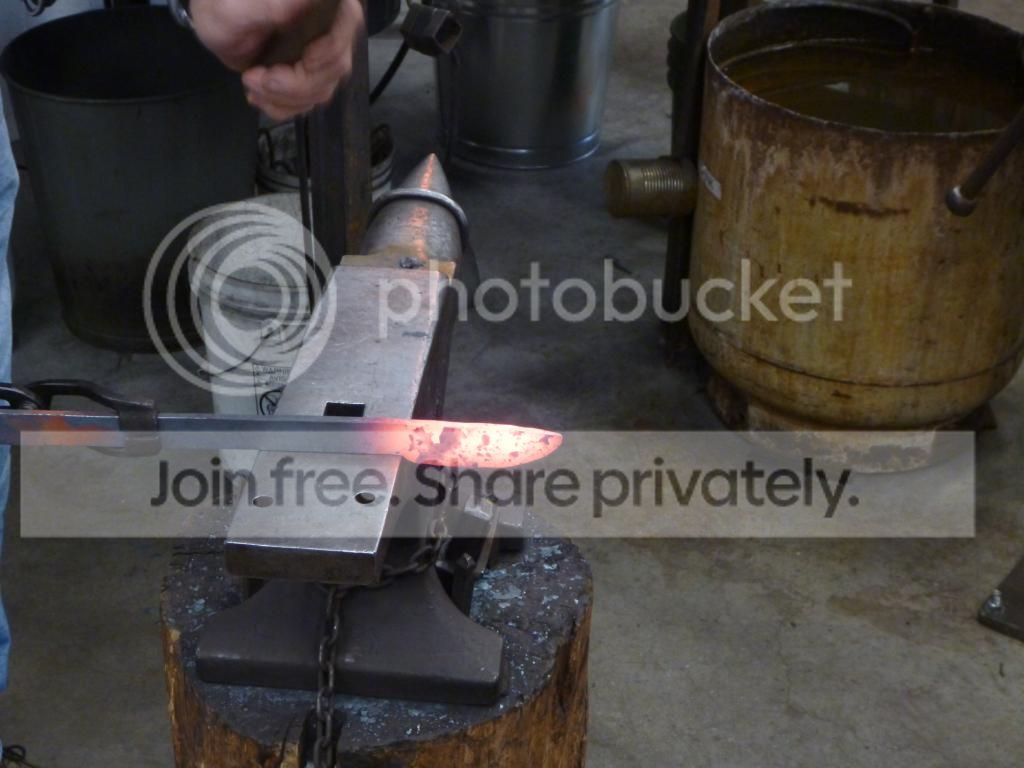
Here is the tip on my 2nd attempt, the first wound up with 'Fish lips' and we had to grind it off so I could continue. This started out much better!
P1080516_zpsm2i5gzls.jpg


I believe this was right before he started to heat the steel to add the pinch. Often times Jim would use the steel to demonstrate the technique visually before doing it for real, obviously so we knew what to look for while he was on the clock to forge while hot.
P1080521_zpsvdbk8alf.jpg


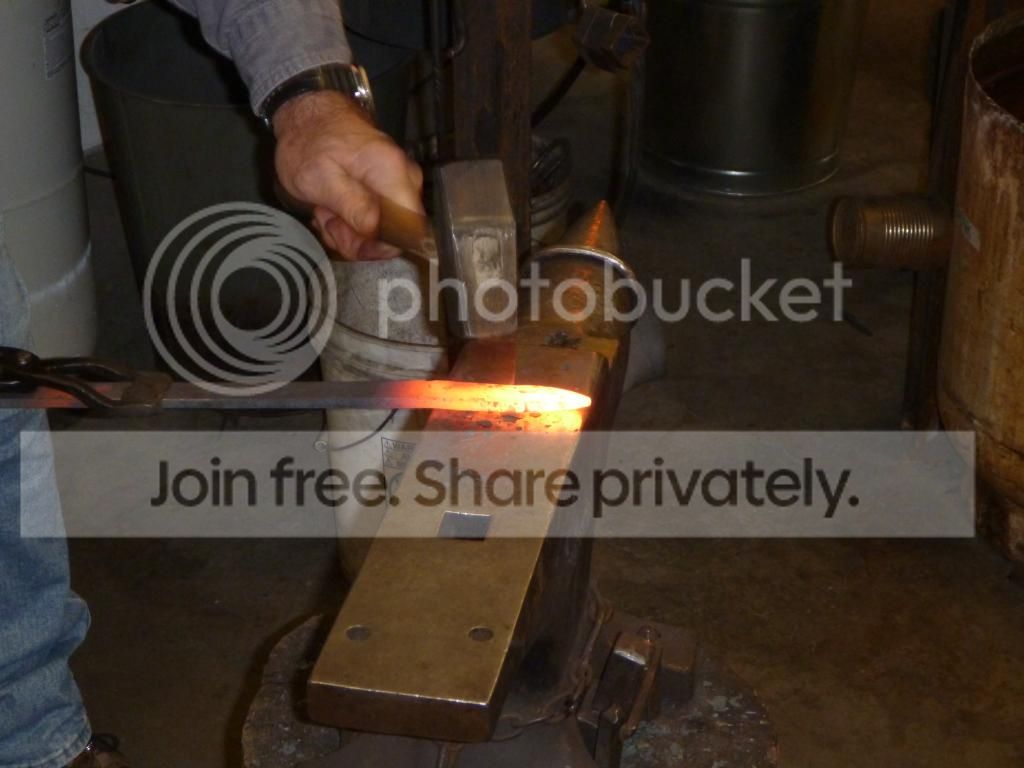
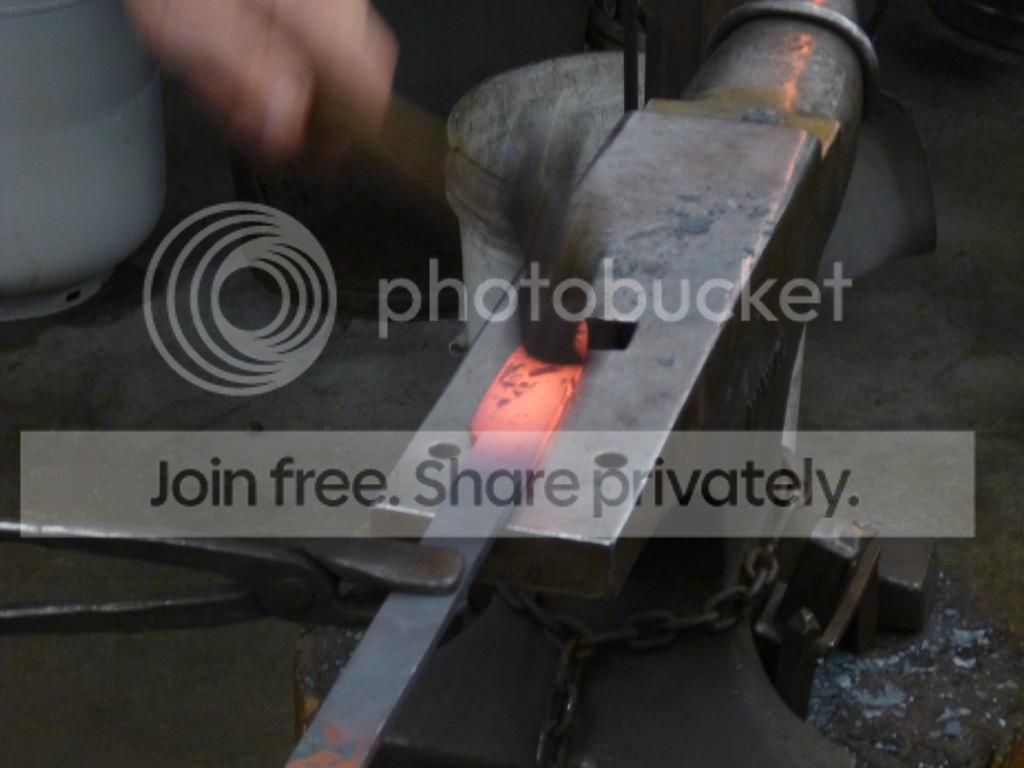
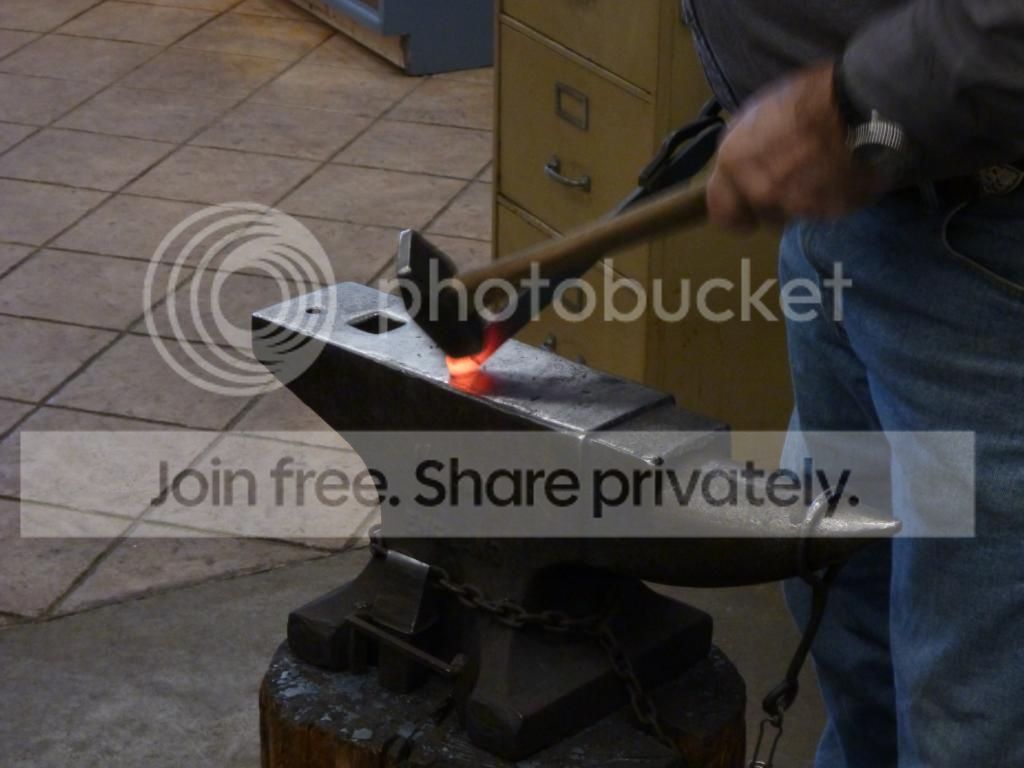
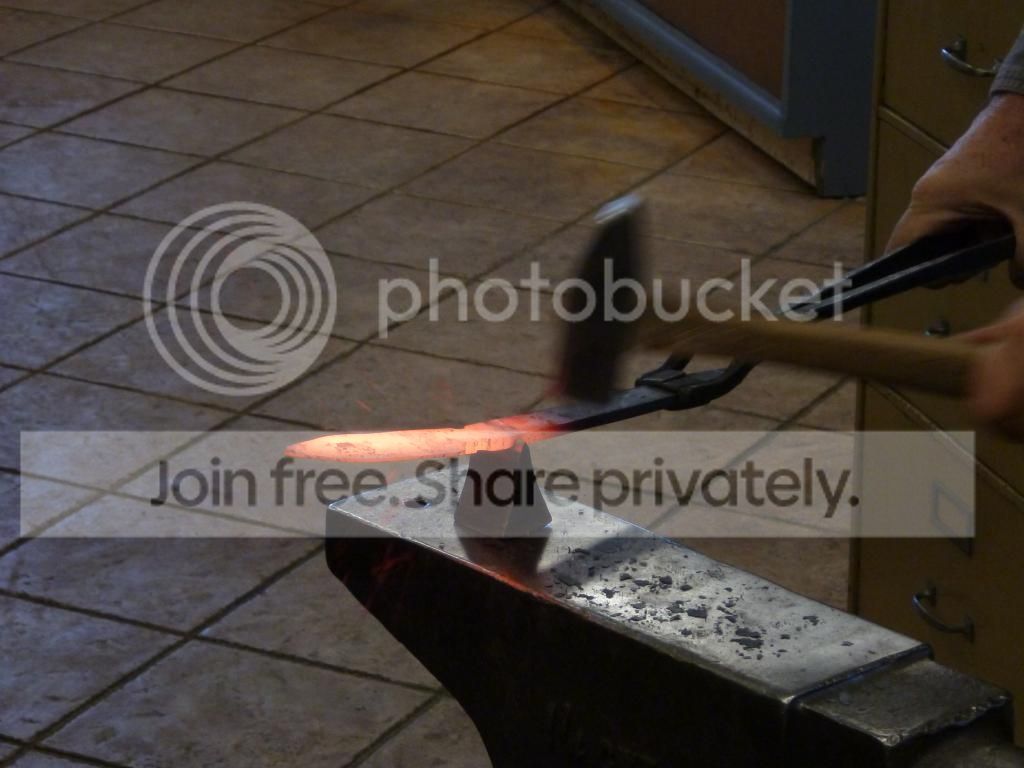
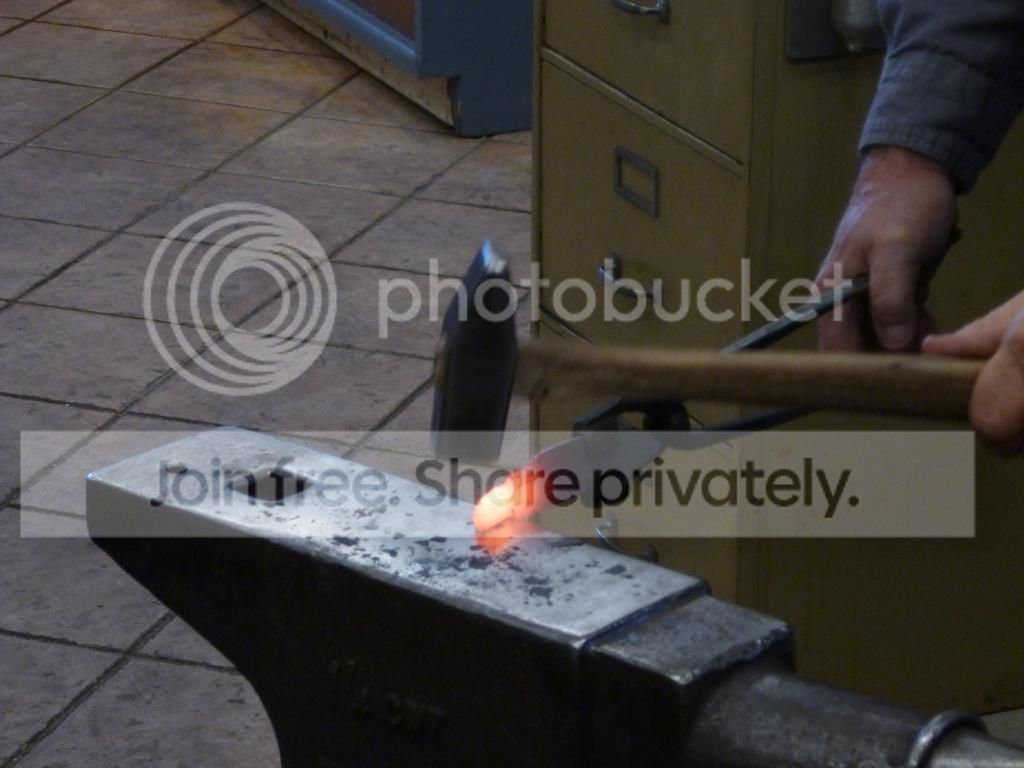
I got video of him adding the pinch, but here is Jim adding bevels.
P1080522_zpsmbj7ycqp.jpg


And more
http://i284.photobucket.com/albums/ll18/teter09/P1080523_zps4xnxewkx.jpg

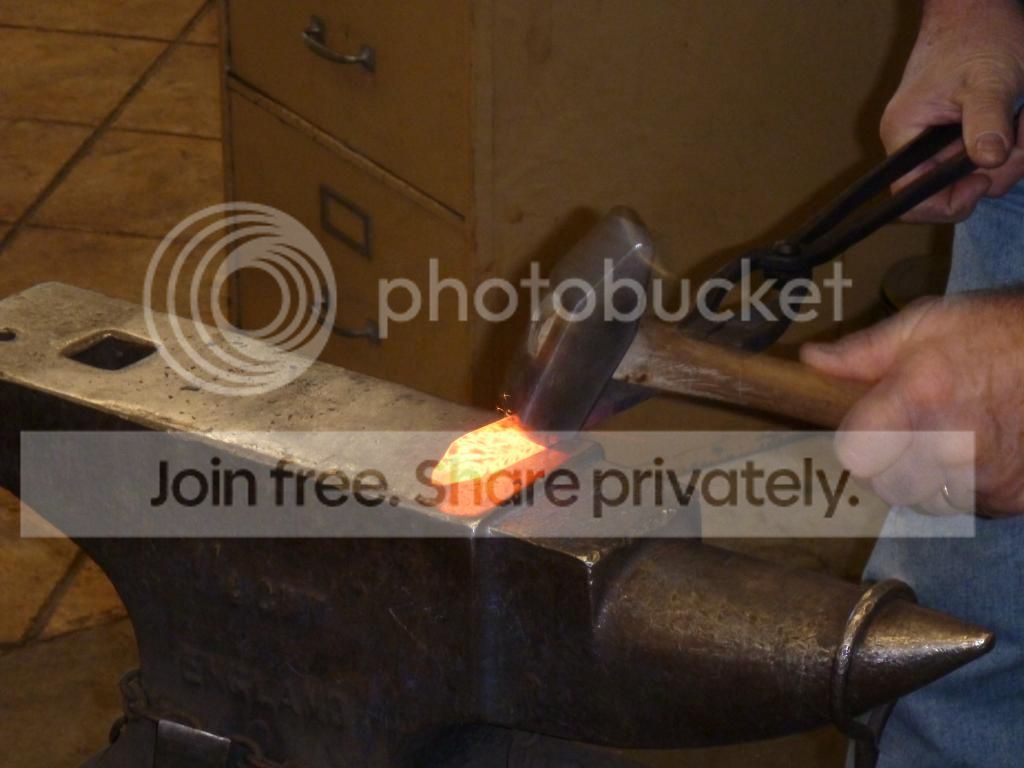
Here Jim had forged the 'banana' from adding the bevels back to being a drop point.
P1080533_zpsqb7nkcdm.jpg


another
P1080532_zpstqav2j3u.jpg


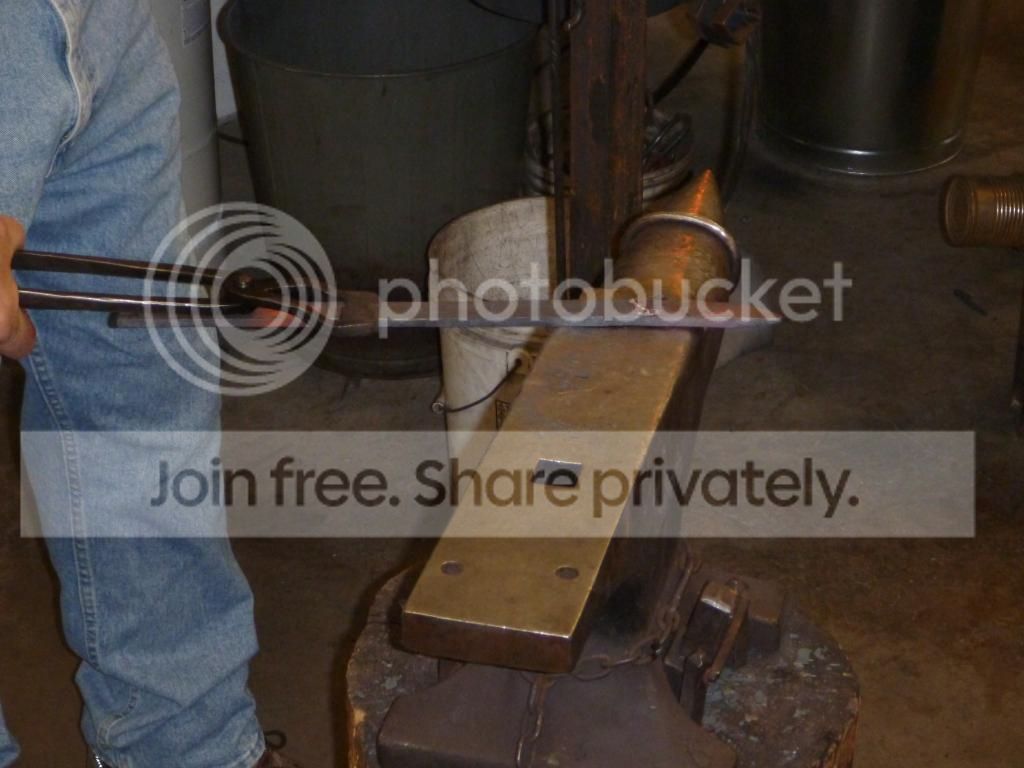
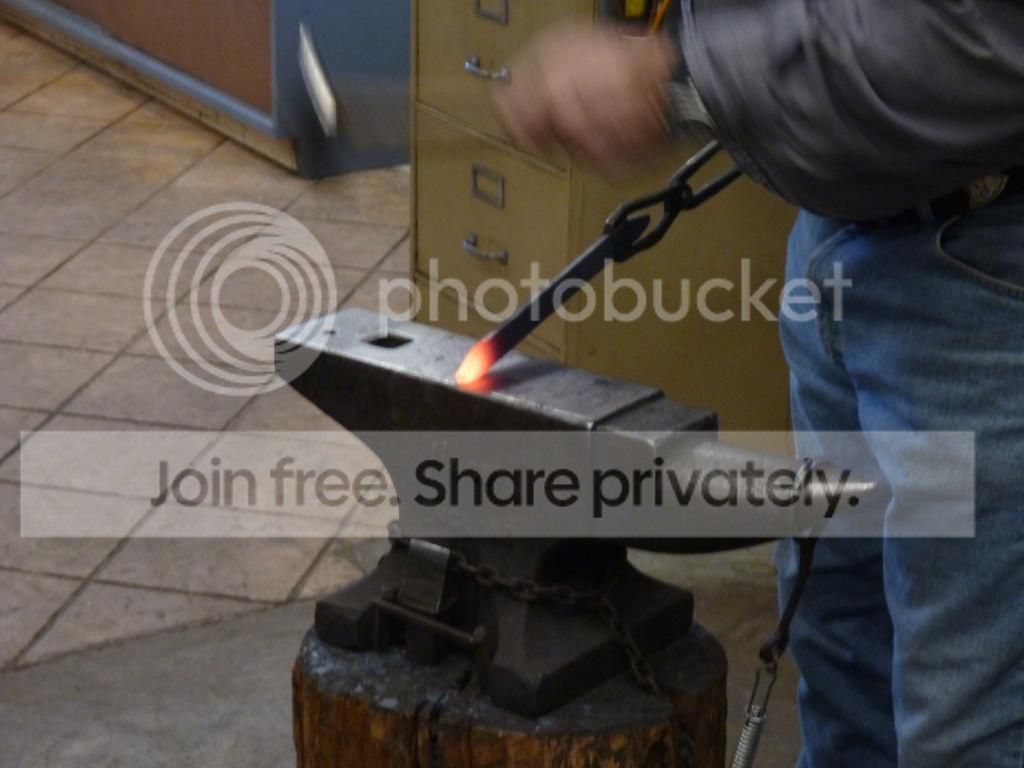
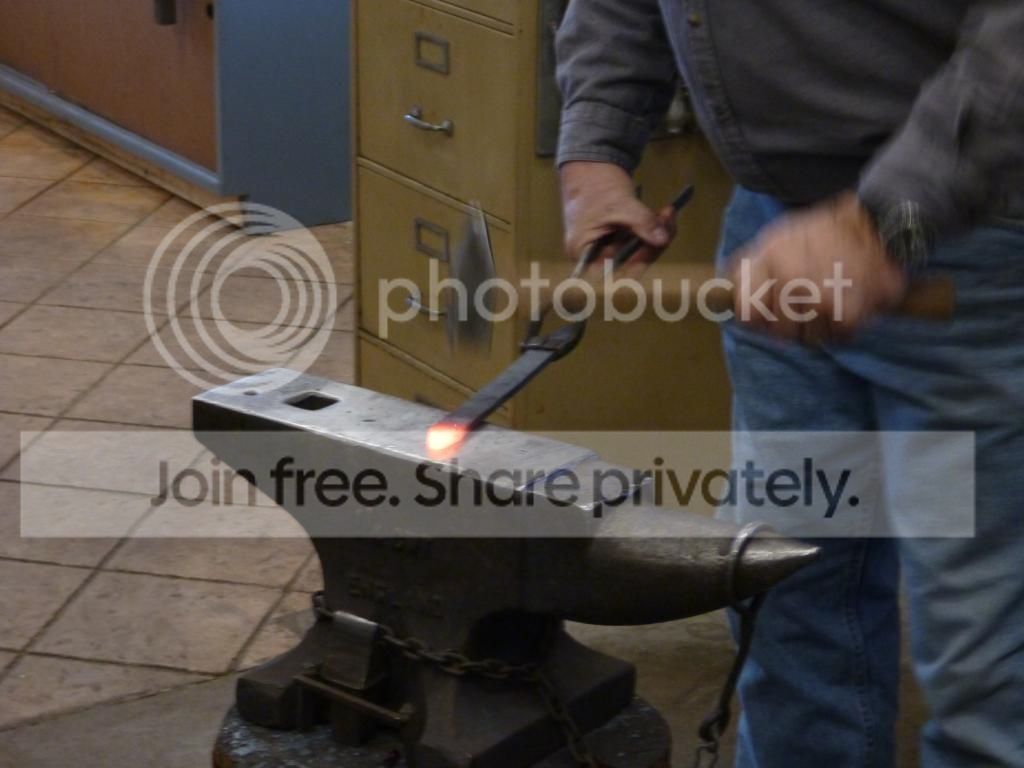
Here he is straightening the blade.
P1080536_zpsutgjubco.jpg


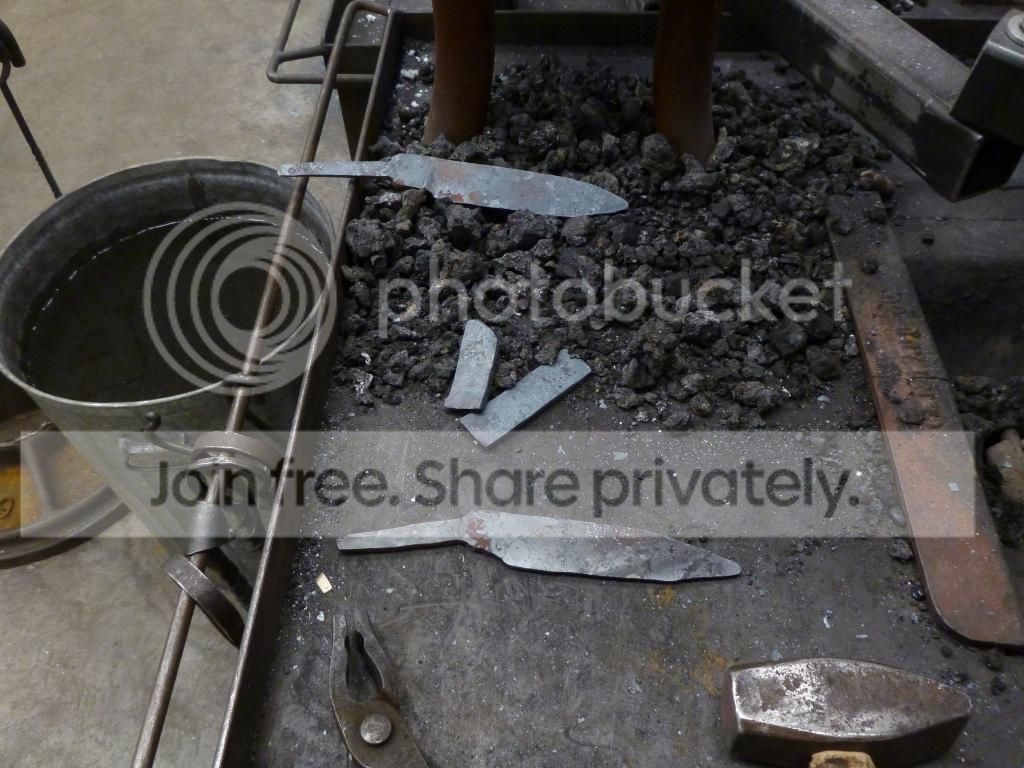
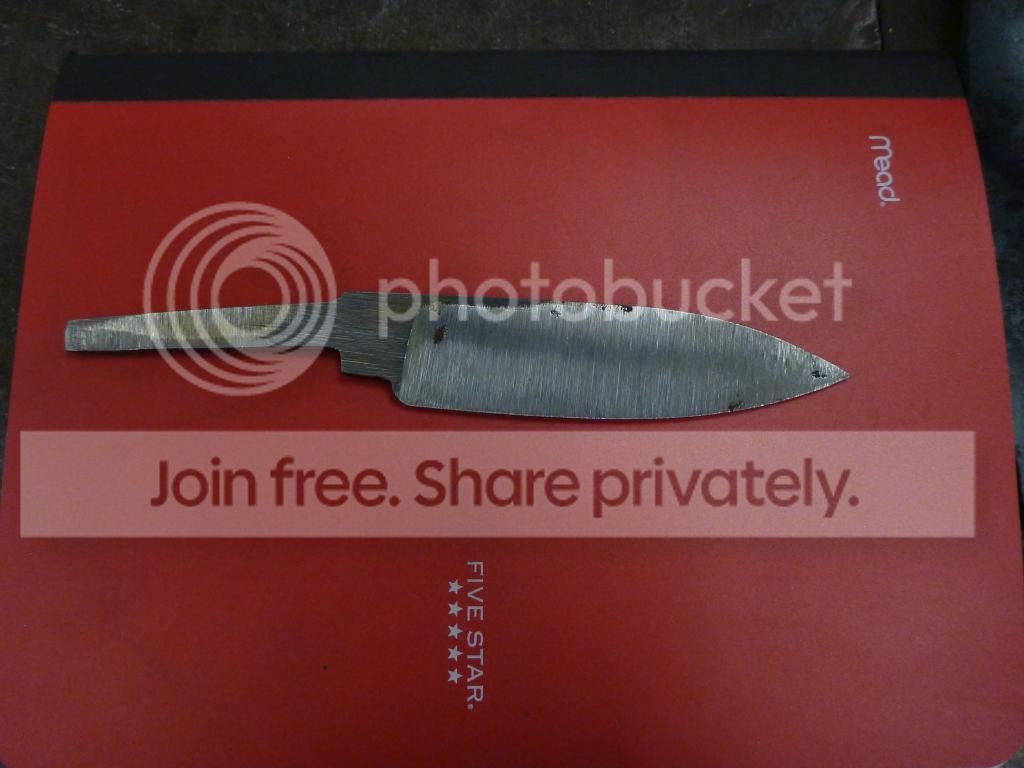
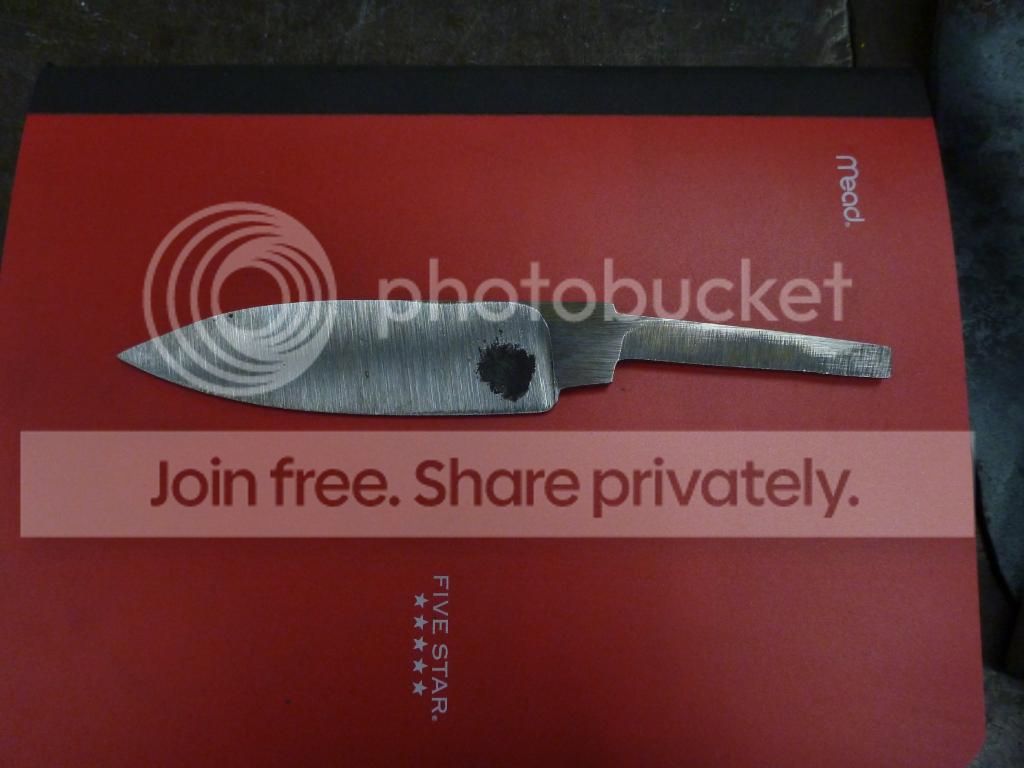
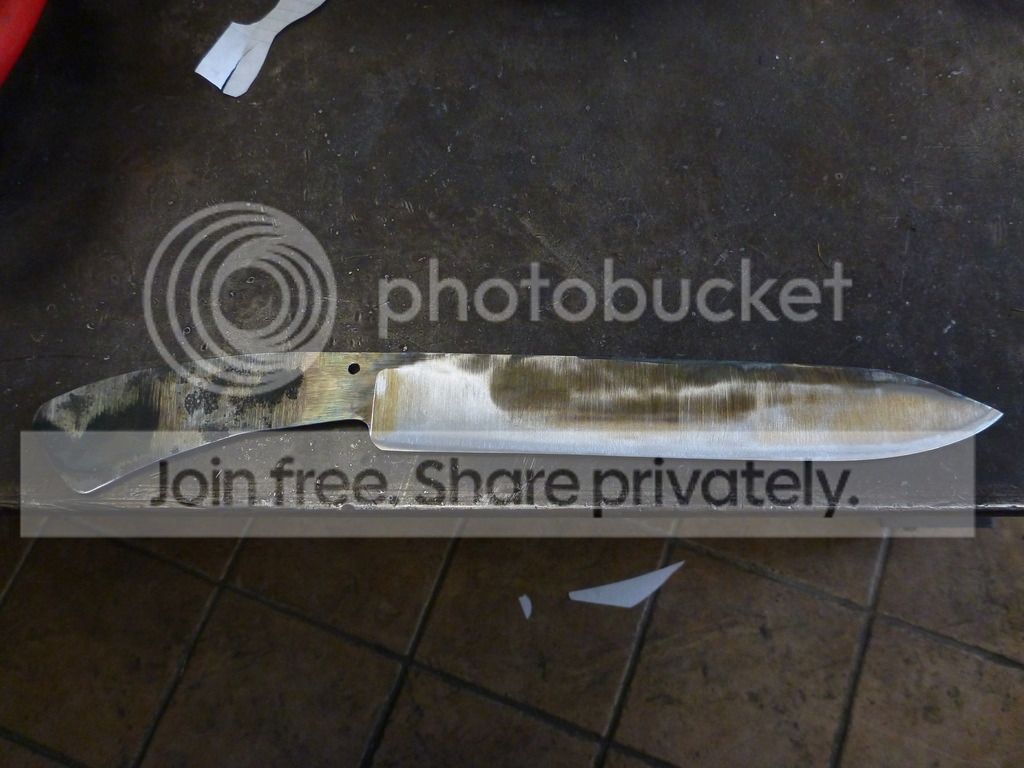
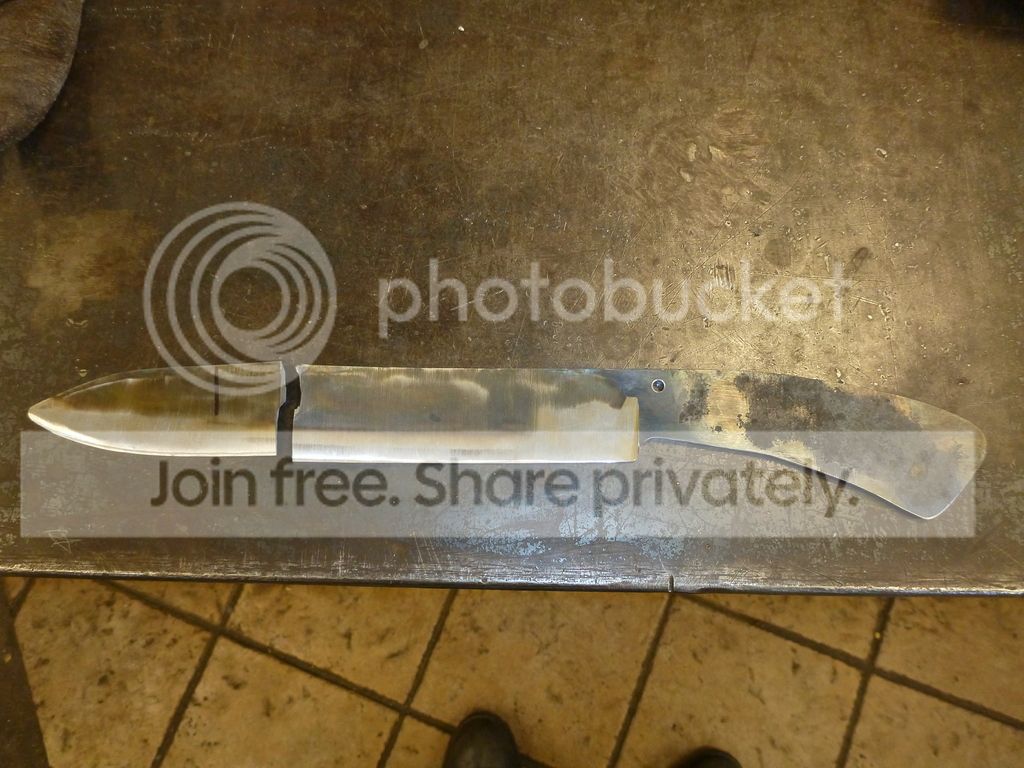
Here are my 2 attempts today, first is on top, 2nd on the bottom.
P1080550_zpskc92bpfh.jpg


The first attempt took 4 hours, granted with starting and stopping to learn each step from Jim. But the 2nd was a straight through and only took a little less than 2 hours, but is about 95% complete. Overall, I'm really happy since I hadn't done but 1 blank before on my own at my house!

It truly is a lot of fun, and Nick and Jim make it enjoyable while also teaching. When you pull a bonehead move like I did, they call you on it. Yet they also help to guide you in your efforts to fix it. It is after midnight and I need some sleep for tomorrow, so goodnight!

More to come tomorrow though, I promise.
 
Today was another great day. It started as kind of a review. Jim went through all the different steps in forging a blade to shape for us in rapid succession, where as yesterday it was more a monkey see, monkey do kind of thing.

Here are a few actions shots.....
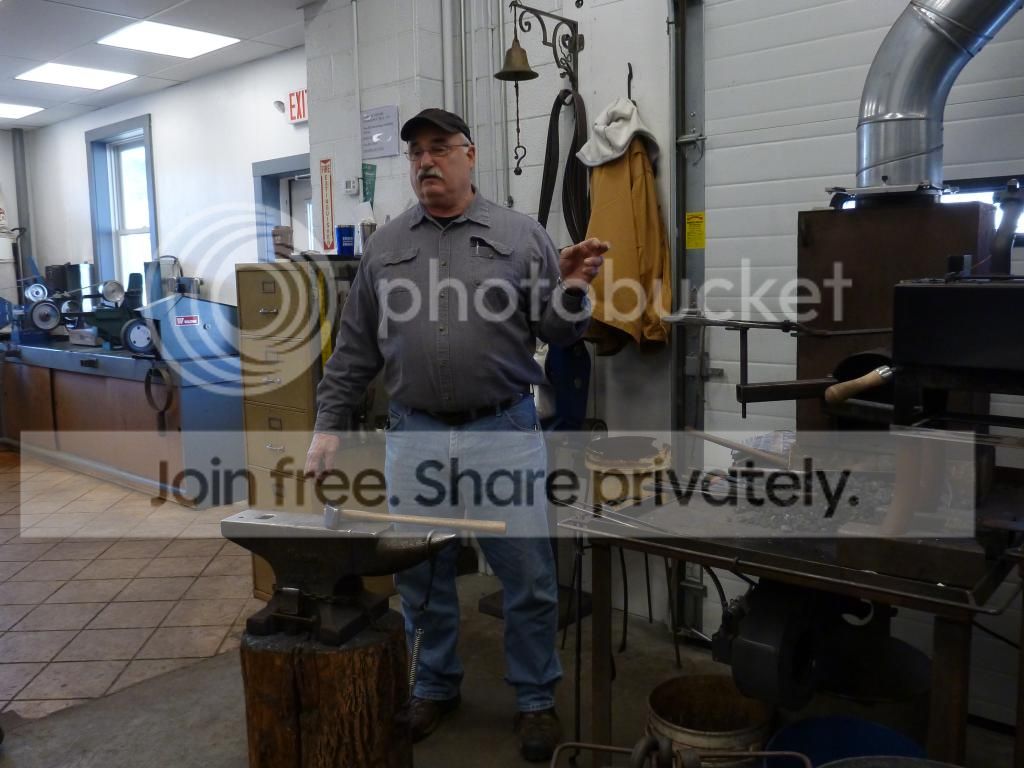
Master Bladesmith Jim Crowell sharing some of his wisdom
P1080557_zps9xewupkh.jpg


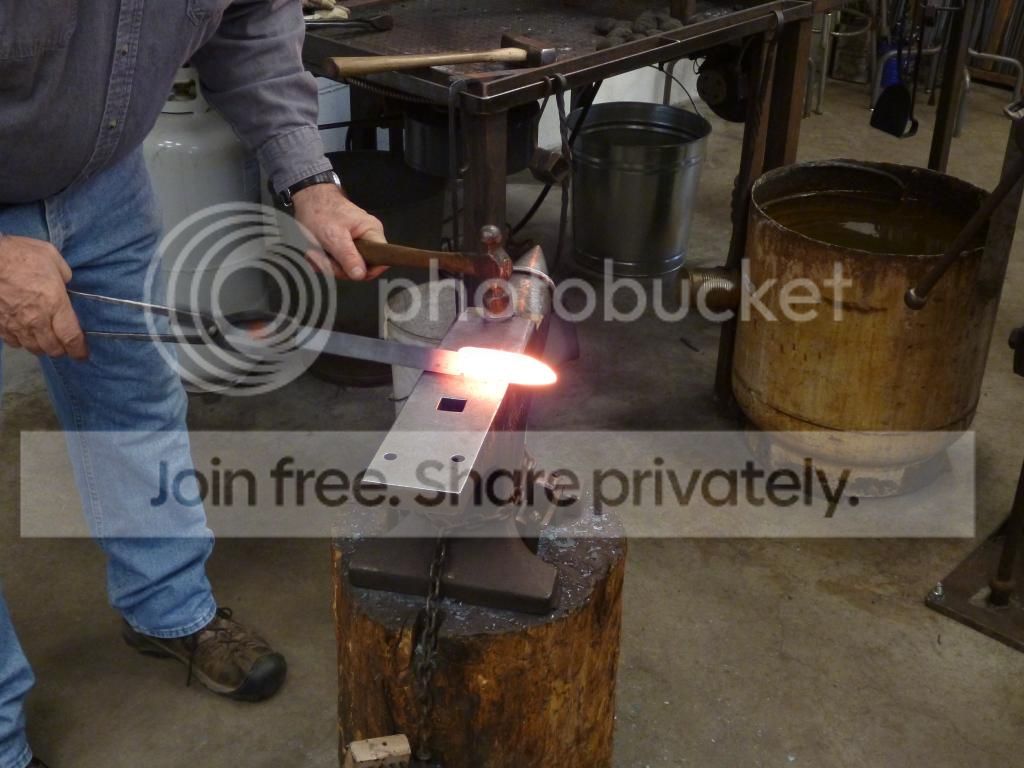
Forging the point
P1080552_zpsmz6sjifb.jpg


P1080555_zps806vrin8.jpg


Making the width uniform again
P1080553_zpsu84de9ri.jpg


Making the pinch
P1080560_zpsvetkgza1.jpg


P1080561_zpsxwtknzft.jpg


Forging the bevels
P1080567_zpsjw7i9sd3.jpg


P1080574_zps53sln49x.jpg


Forging the blade back down
P1080577_zpsgq0uzbj7.jpg


Straightening the blade
P1080578_zpscveuujzl.jpg


Nick waiting to smack the guillotine tool once Jim gets it where he wants it
P1080599_zpsb9n9lxui.jpg


Cutting the knife off with the hardie
P1080605_zpsgrwfetfi.jpg


Forming the tang
P1080607_zpstzdvt919.jpg


At the same time as this was taking place, Jim was also forming a random piece of steel. He was not making a knife, he was making a piece of steel he could break in the vise in order to show grain growth and examples of poor grain structure and how it could change within a single bar.

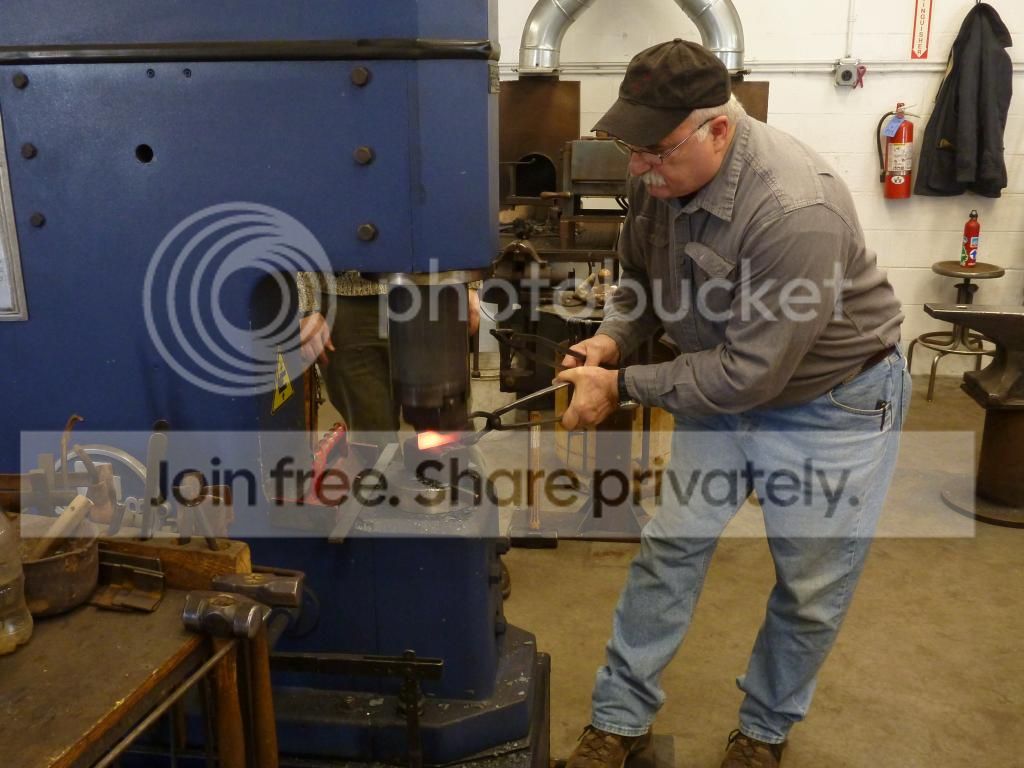
Jim on the power hammer
P1080618_zpsfn6mfnph.jpg


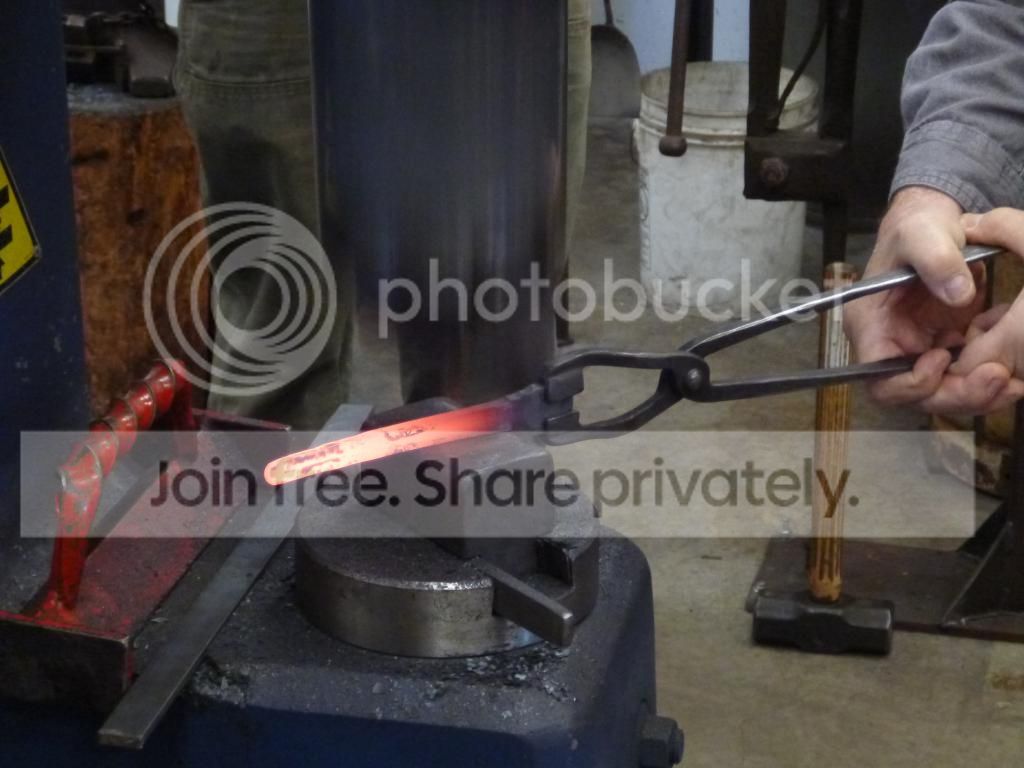
A bit futher along
P1080622_zpstjn1dmlw.jpg


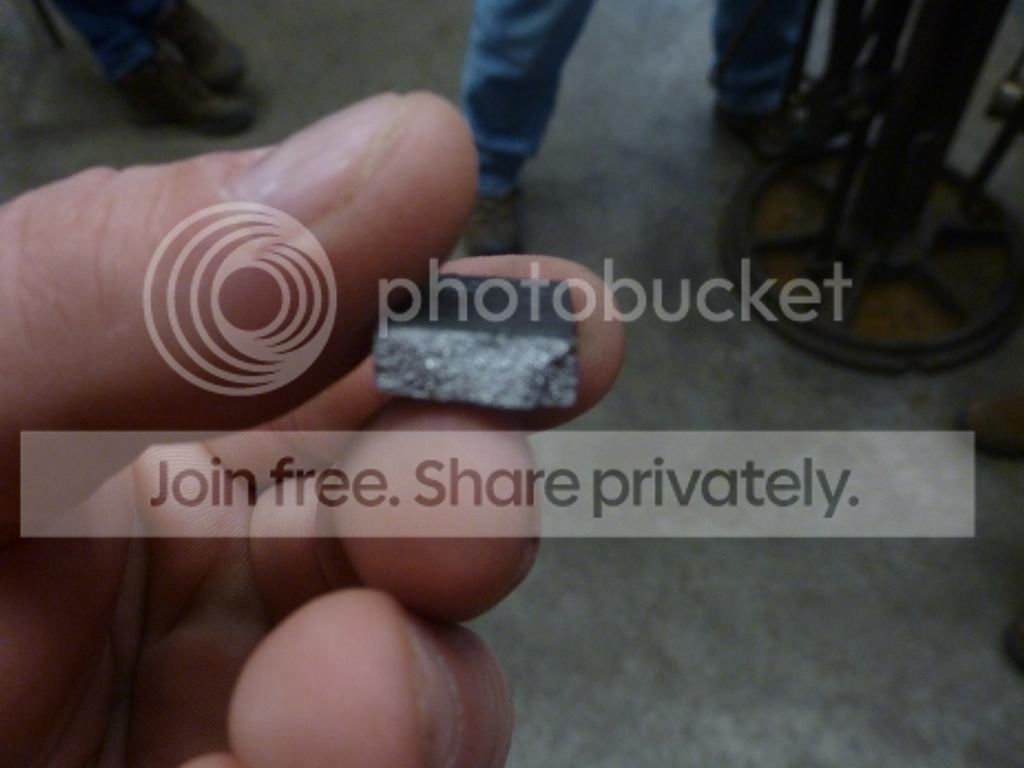
Once in the vise, it was broken and the grain structure was very obvious

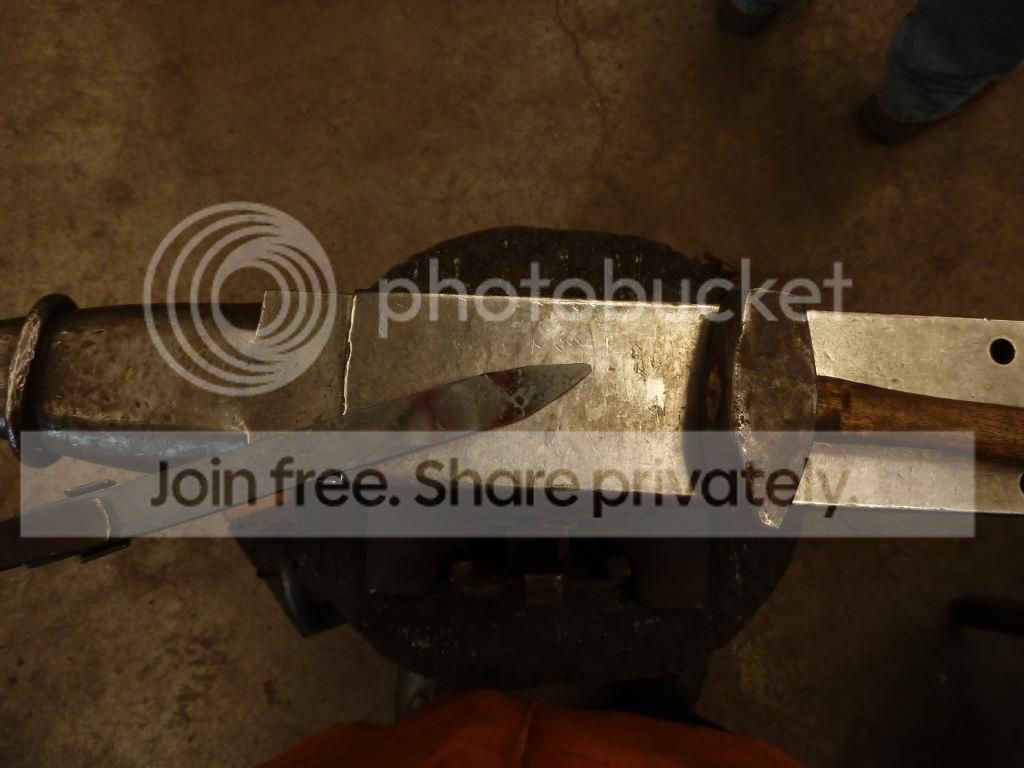
Very course here, sorry for the bad picture, my camera doesn't really do close ups that well
P1080642_zpsaczzsrcq.jpg


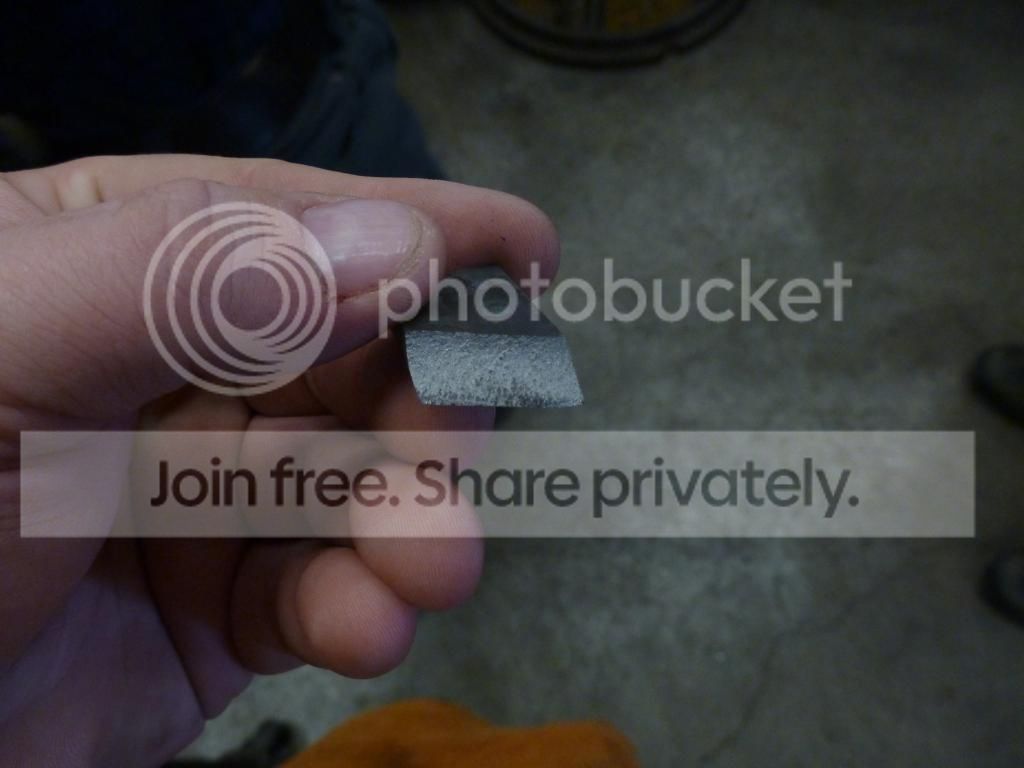
Same piece, but slightly better, smaller grain
P1080647_zpsmjayzg1l.jpg


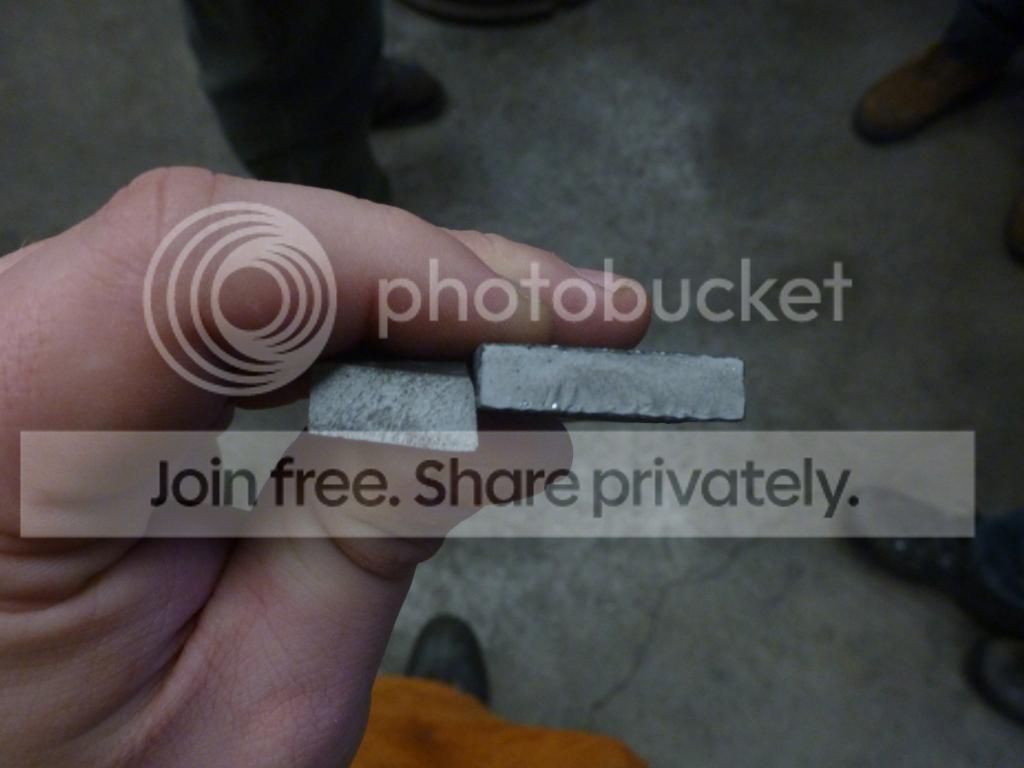
Nick had previously properly treated a file, so the left piece is the 'not as bad' piece from the picture above, with the file being the piece on the right.
P1080648_zpshhhhudgr.jpg


This whole process of showing us the grain growth and how it affected the steel was very educational and amazing. Everyone in the class was surprised at it and how it affected the steel. I can see why so many folks on here recommend doing it themselves!
 
Some folks were not as quick as others in forging their blade to shape (like me). So to help some folks move on, Jim showed us how he grinds his knives.

I took more video at this point than pictures, simply because I wanted to be able to watch how he did it once I leave this class. His technique was not all that different from what I've seen in other videos however. Not saying any is better, but just different. He advised us on technique in terms of stance and our arms, keeping a natural stance with feet not too wide, also our arms locked in tight to our sides/hips and moving the core of your body back and forth in order to reposition the knife. He mentioned it gave us more control/stability and would result in better attempts.

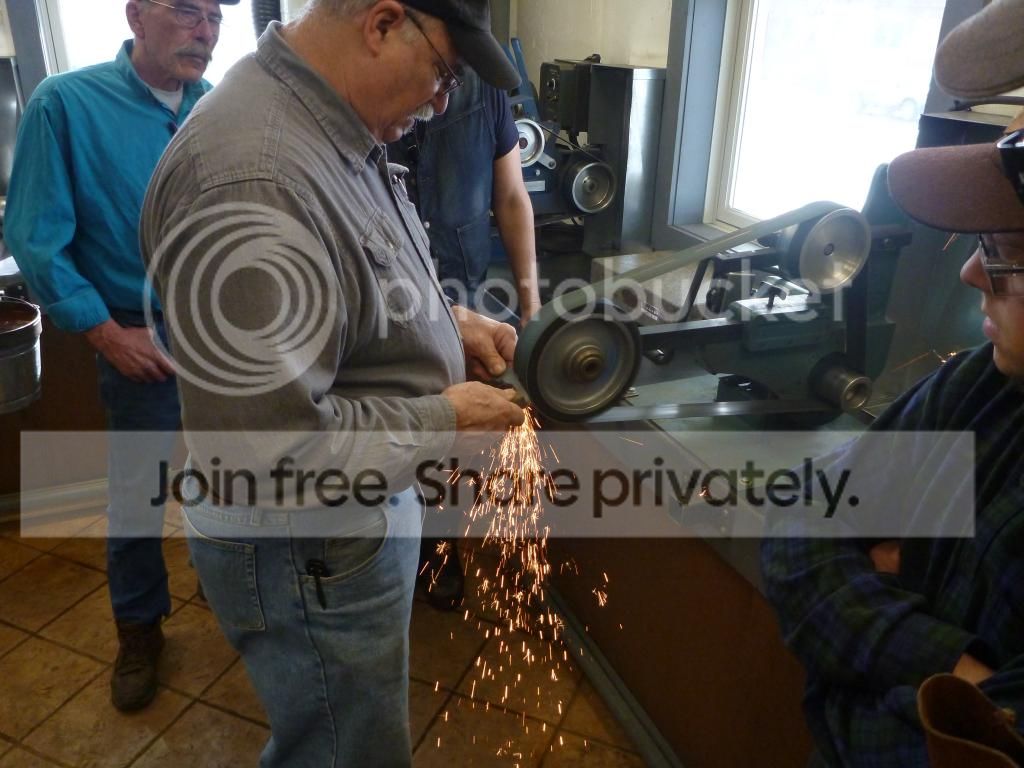
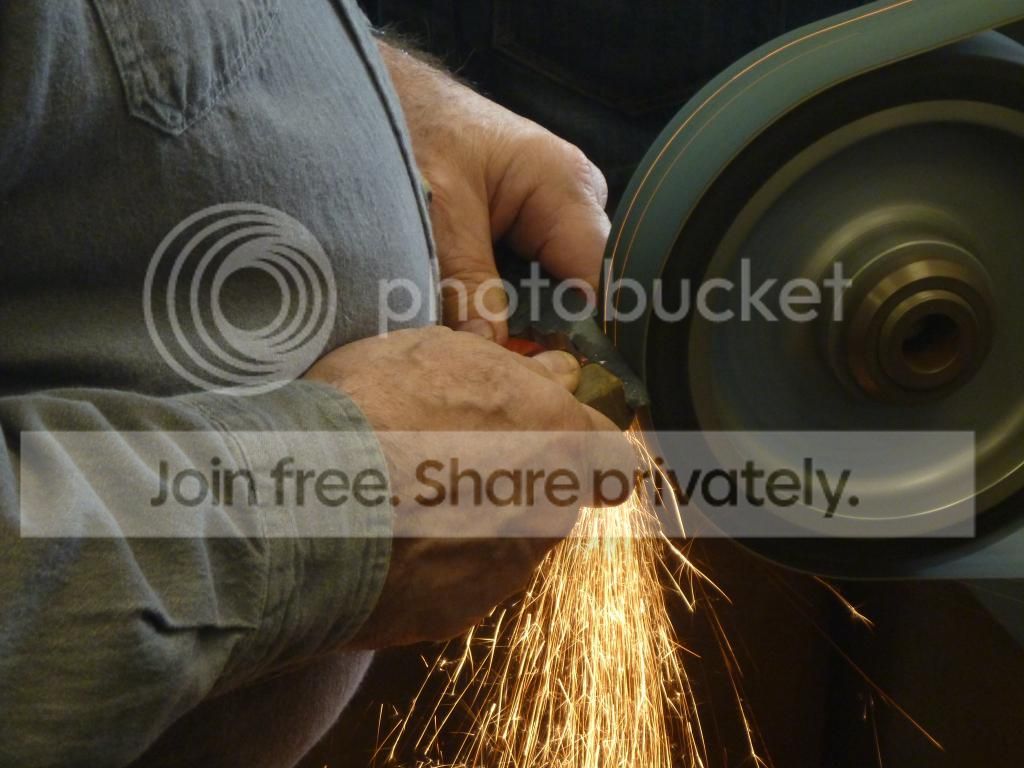
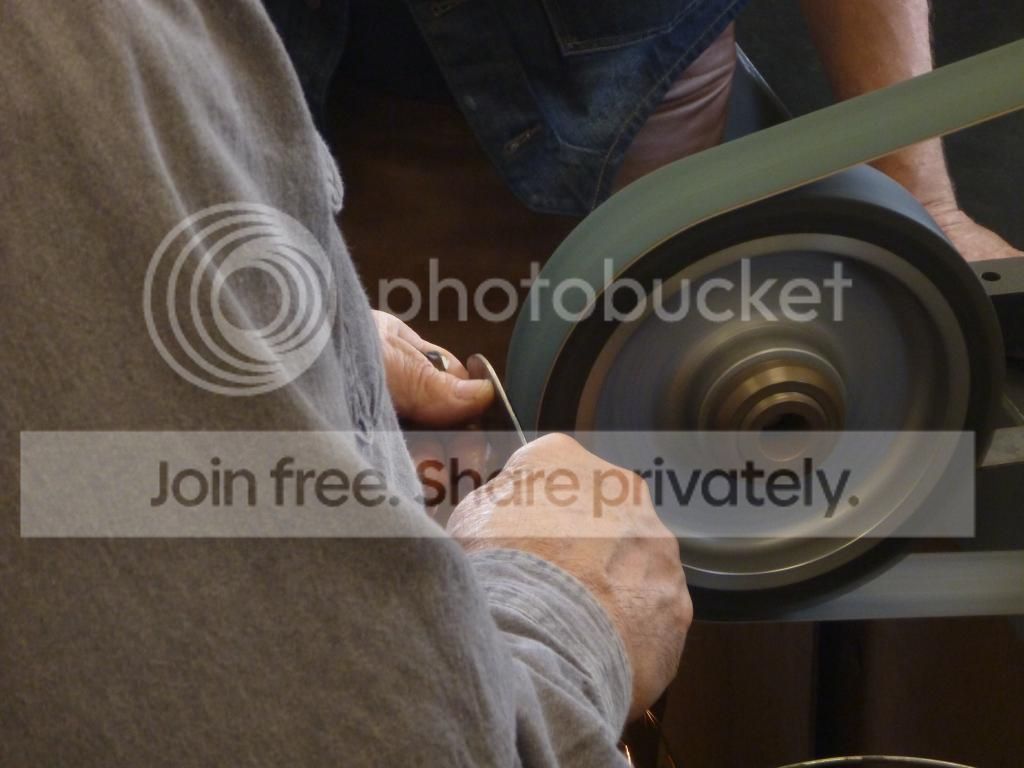
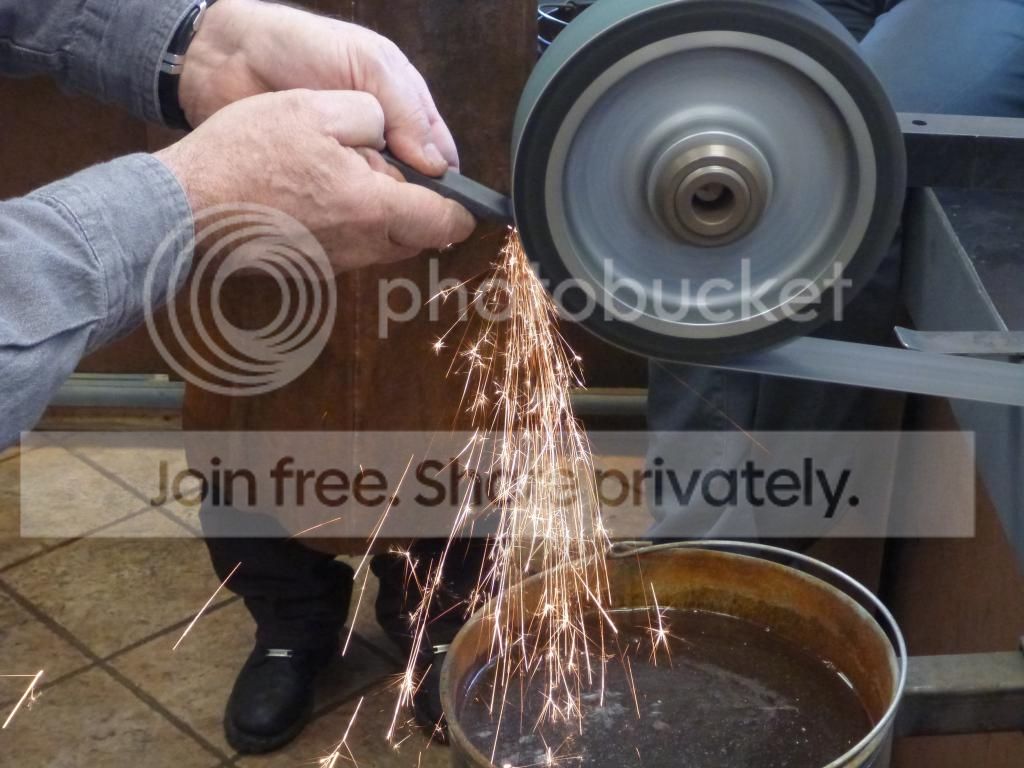
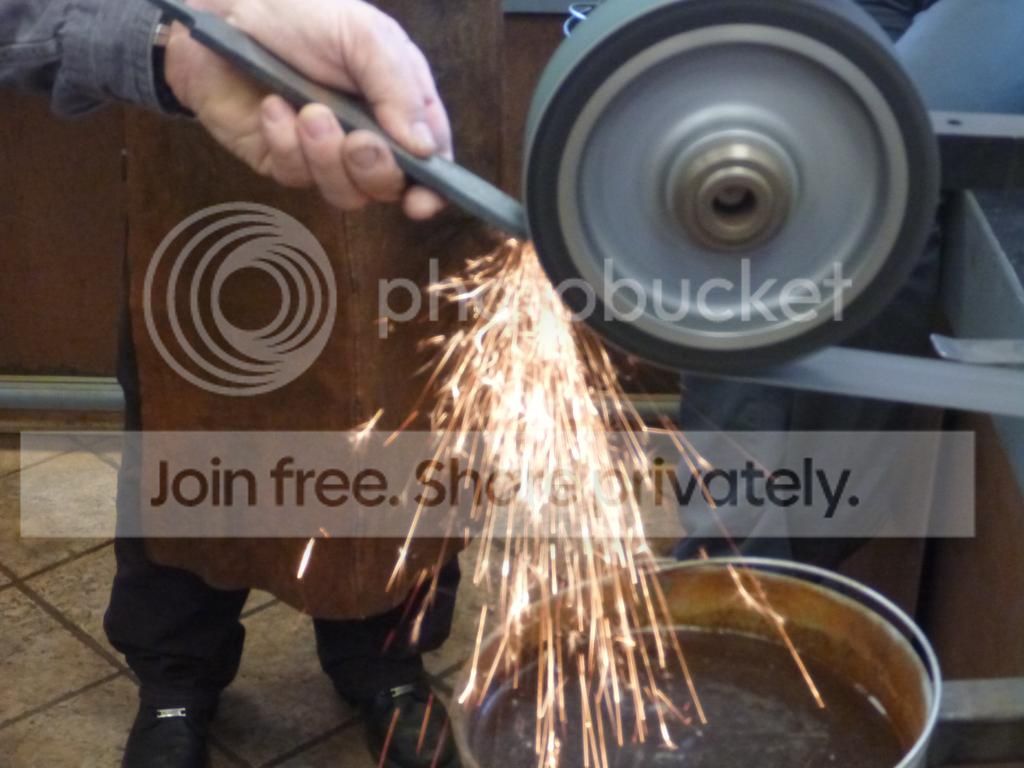
Jim started grinding at the tang, using an older 60 grit belt I believe on a wheel. He mentioned his recommendations for grinders and when I asked him about his belt choices he said he would discuss that with the class tomorrow morning (provided I remind him). He knocked off the scale this way and said while some do use vinegar overnight, he hasn't seen a need for him to do that. He uses a wooden push stick and does prefer grinding with gloves, but he can't here since it is against the rules of the school.

I can't say that the way he ground the knife today, would necessarily be in the same order each time. The rough idea was to knock the scale off and profile/smooth any issues on the contact wheel and then he went to a flat platen for the more detailed work of fixing the choil (on students knives) or the shoulders of the tang and obviously the bevels. He had mentioned he had a surface grinder at his shop and that he does use it, but since the school didn't have one, he ground the ricasso on the flat platen. He did it and it was only off by .002 which I know since he asked Nick to check it. Pretty amazing he could keep it that close free hand in my mind. After the used 60, he bumped up to a 120 and touched up certain areas and ground the bevels to be uniform.

Here are a few pictures
P1080650_zps2fb73wsn.jpg


P1080651_zpstyo1rmwx.jpg


Knocking off the scale on the bevels here
P1080652_zpscaaimmh8.jpg


It was pretty amazing to see first hand how a knife Jim had forged that morning in front of us, suddenly truly LOOKED like a knife after it was quickly and seemingly effortlessly ground to a 120 grit finish. It was an awesome thing to see and definitely helps to provide a path which I want to mimic. I realize it will be a long road ahead, but so far this class has been amazing and really fun as well. Jim and Nick love to joke around as does most of us in the class. We can poke jokes at each other and no one takes it to heart so its always a fun atmosphere. Also the class allows for the helping of others when perhaps Jim or Nick aren't around. Everyone seems to be very open to advice and what others notice when watching someone, so we can all learn from it.

It has been a great 2 days and I've learned a ton so far. I can't believe we still have 8 more days to go and I'm excited.

Incoming day 3 soon!
 
Last edited:
This is great. Thanks for taking the time to share and please keep the updates coming.
 
Just to be honest,*today*was not an intensive day for pictures. I only took one video as well, which I haven't even looked at to see if its any good.*

Today*started out with a quick meeting in the classroom. A few questions had surfaced at dinner the night before, which Jim decided to address in the class so everyone could benefit.*

First up was his forge. Jim uses a relatively small forge. It is a blown burner style, but the actual forge body is a solid piece of cast refractory which resembles a square block with a small hole drilled down center of the shorter side, length wise. Actual dimensions are around 8 by 8 by 14 with the hole being around 4 inches in diameter. He didn't have a picture but drew an image on the white board. I don't think most folks would need to see my drawing, so I'll just say it seems like an average design for a forge and just that the blown burner he said runs on around 2 psi and he can forge weld in it.*

Next up was a tool he designed to help him finish flat guards more easily. It is very similar to one I saw Nick Wheeler use in one of his WIPs or perhaps a video. Best way I can describe it is a larger form of a Lego block! He drew it out on the whiteboard and advised us on how it works and how it helps to speed his production.*

My question was next, which was about his belt progression when he grinds. He uses a 40 or 60 grit X weight belt to remove scale and roughly shape some aspects like the tang and roughly start the bevels. Then he works up to 120, 220, 320 and 400 in a J-weight belt. He likes the flexibility to fit in to tight corners and he uses them like they are free! Once he is done on the grinder, he moves to hand sanding for all his blades.*

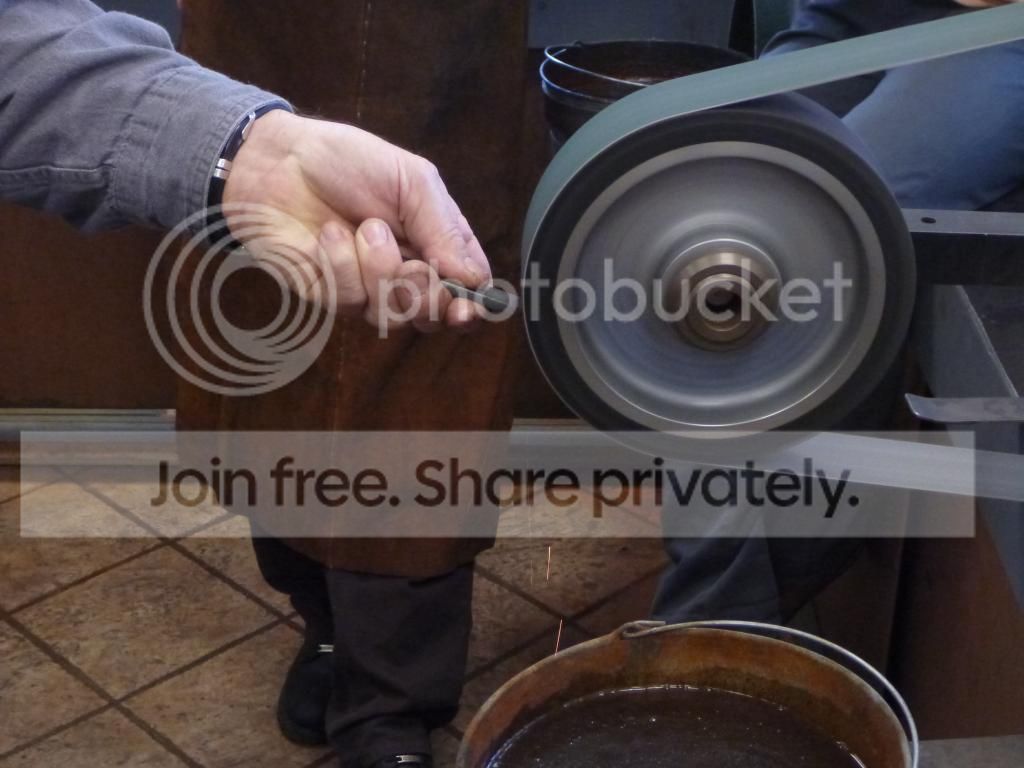
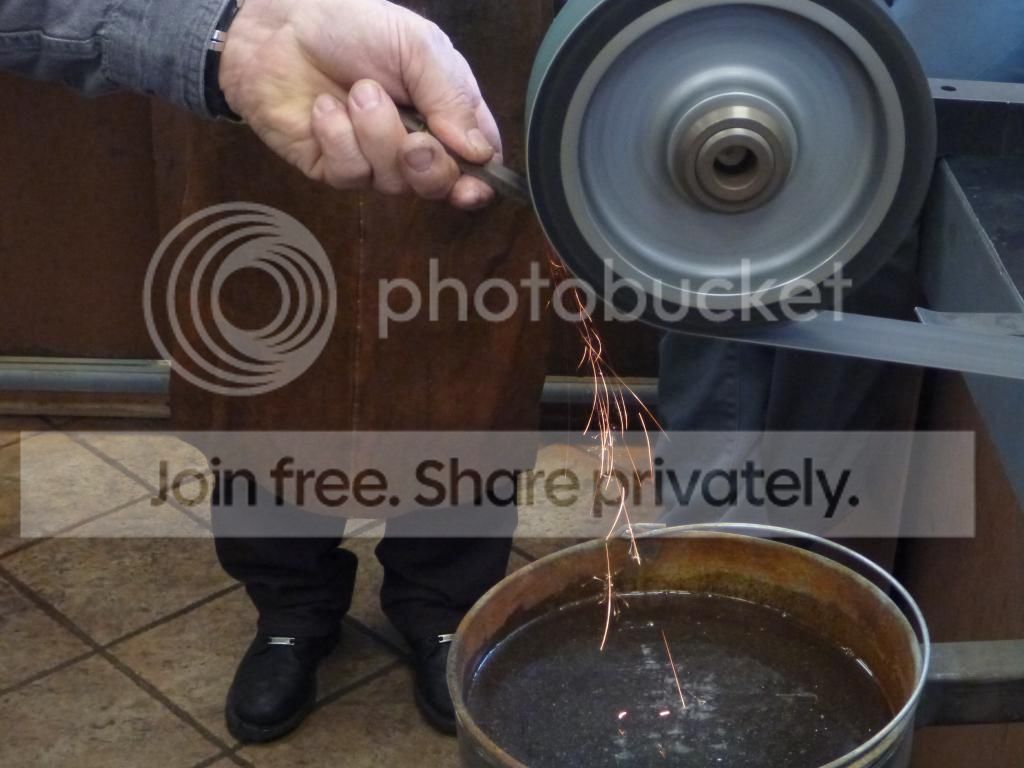
Then we headed over to the shop. The next question was on seeing the spark test (to see the difference between carbon content of differing steels). It was pretty cool to see how they differed. It was also fun to see that the same steel, say 1084, would have a different spark pattern between being annealed and being normalized and then being hardened. I didnt realize this was the case. Below are a few pictures of the tests.*

Wrought Iron Sparking
P1080654_zpsnsqyj6mv.jpg


1050 Steel Sparking
P1080655_zpst3zhpvgk.jpg


5160 Steel Sparking
P1080656_zpsktc0ky5g.jpg


1095 Steel Sparking
P1080658_zpsc0tzycxv.jpg


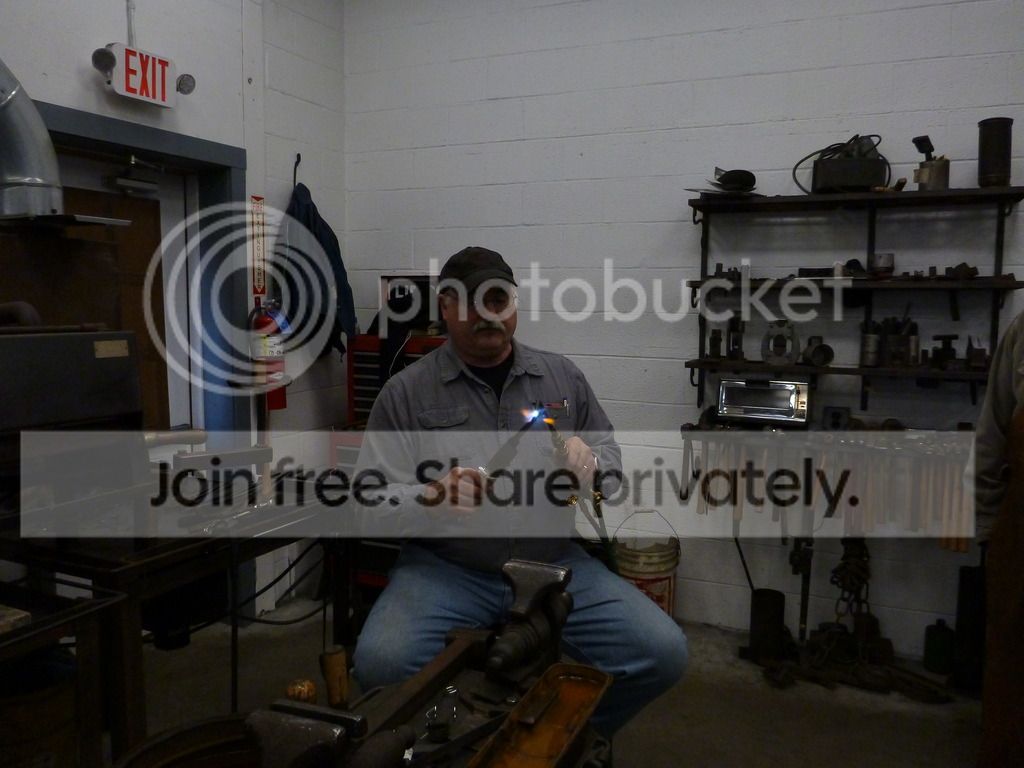
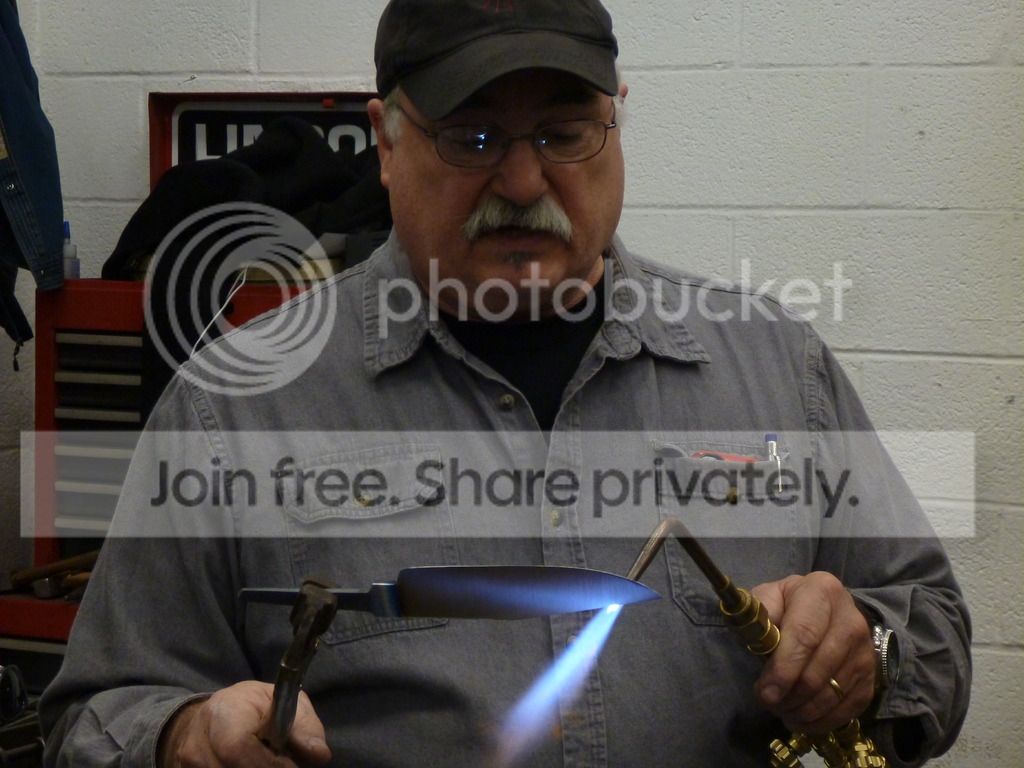
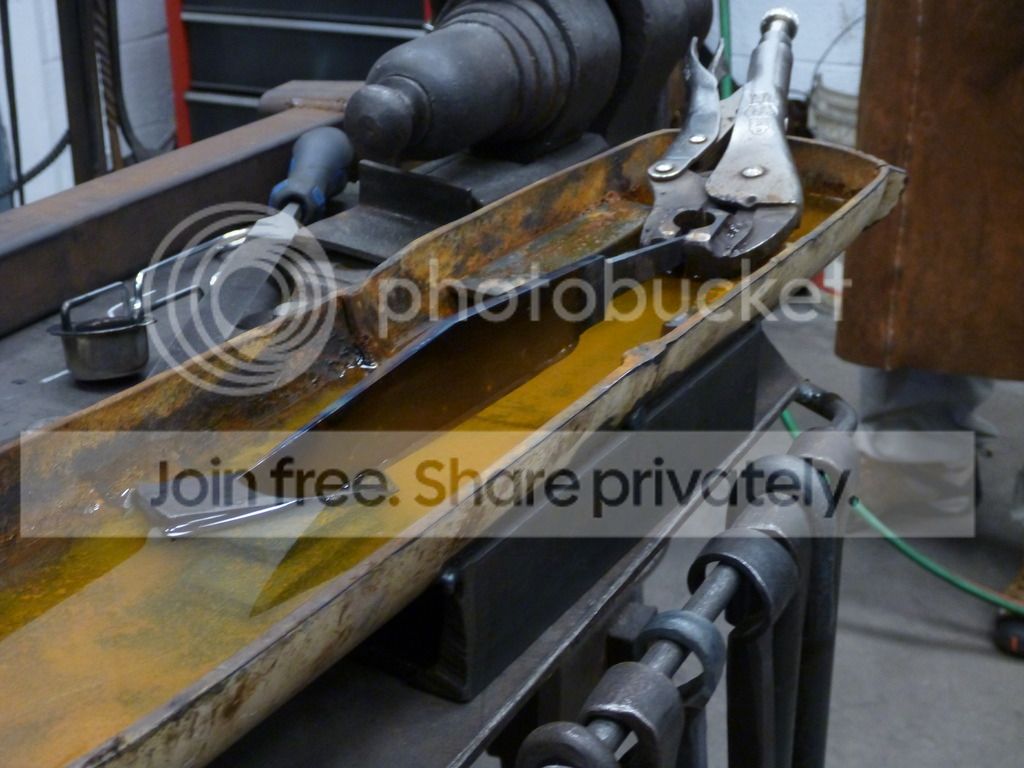
Next up was a heat treating demonstration. Jim has been forging a few knives this whole time in between helping us newbies. Different shapes and designs and I believe all have a purpose of helping in this class at some point. One he had made, was a clip point knife which was kind of tall yet short. He ground it down to remove the scale as he demo'd yesterday as well as cut in the bevels. He then cleaned everything up so that it was a uniform 120 grit across all surfaces. Next came the Oxy Acetaline torch to show us how you can heat treat without a kiln. He used the torch to heat up the ricasso first since it is such a heat sink, then worked his way around the rest of the blade. He was also showing how he could give it a temper line with how he directed the heat. All the lights were dimmed in order to show us the coloring of the blade, but it was still pretty bright since there are several large windows. Once it was heated to his liking, into the oil it went. I was advised the oil the school had was an 11 second oil which they like for the 5160 steel. When the blade was pulled from the oil, it showed a very obvious difference in appearance between the portion which was heated above the austenitizing temperature (this area looked spotted) versus the spine which was left black (this area looked very uniformly covered in oil). Once he cleaned the oil off and ground just a bit, the temper line was visible. He then took it over to the vise and snapped it off so that we could see the slow transition from edge to spine of the different grain structure. It was a much more visually striking demonstration then the smaller piece he forged and broke yesterday (pictures from my day 2 post above show the grain differences).*

After this, he took a bar of steel and heated it up above the austenitizing temperature, and all of us crammed in to the bathroom as the only room without windows. He then brought the steel in and we closed the door so we could examine the decoalescence (sp?) which was pretty dang cool in my mind. It just dulled out and suddenly came back to life and shimmered.*

Next up was the demo for making a full tang knife. Obviously everything was the same to start, make your point, make the pinch, make your bevels, drop the spine back down to level (from the banana look) and straighten everything. But instead of then fullering to start the tang....he measure out about how long he thought he would need for the handle, and cut off the rest to start. He then started doing what he called a fish tail. He used a crosspein hammer and hammered in to the steel with the pein matching the direction of the steel. He moved the tongs and thus the steel up and down (in relation to the hammer) and effectively made a pattern in the steel which could be thought to be similar to a fish's tail. Picture below

'Fish Tail' Forging for the full tang
P1080697_zpszjmpikiy.jpg


He then turned the pein to run across the bar and started at the rear of the ricasso and drew out (which he said was fullering) the steel from the ricasso all the way to the end of what would become the handle. He then flipped it on its spine and curved the belly of the handle down so it would fit the hand better. After going over it a few times and removing the fullering marks, he had a tapered full tang. Then it became our turn!

Jim and Nick have been awesome in helping in any way that they can. Sometimes I think Nick might have a better idea of articulating how I can fix a problem, where as Jim just 'does it' with out real thought anymore. But that I presume is what can happen when you've been doing this as long as he has! When Jim was free, he would watch me forge and critique everything which needed adjusting, position I held the steel at, hammer angle, hammering velocity, steel temperature when I pulled it out and if it was too cold to forge. He really helped everyone to become better, though sometimes I feel like I am not showing even the smallest increment of gains. They both joke around a lot, though Nick seems to have a bit dryer of a sense of humor. It really makes the day go by faster, which kind of stinks since I need as much time in the shop as I can get!

So far, I'm really happy that I took this course. As is so often recommended on here, getting in front of a master who can instruct you will diminish your learning curve dramatically. I feel much more confident now about what I am doing, but certain things will just take time to develop. I do know that being able to do this for 10 days will help cement some of these techniques in my mind far better than a couple weekend forgings at my house ever could. It also allowed me to examine my forging equipment and see what I have that works well and what I should get because I've grown to like it very much. I've found that I prefer to use a square faced hammer instead of the couple rounds I have. Also I thought I needed hammers in the 2-3 pound range, but the truth is I've been using hammers between 1-2 pounds so far and only reach for my heavier hammers in rare circumstances. 3 days in and I'm still having fun and learning tons. It is an excellent course.*

Thanks to you guys who have commented! Glad to know someone is actually reading this thing and enjoys following along! I was afraid I was just taking up bandwidth for no real reason!
 
Well, lovely. That will teach me to trust this forum software. A HUGE post...just gone. Somehow it defaulted me from logged in...to logged out and my whole post is gone. SUCKS!!!!!

This post probably wont be anywhere NEAR as large as that one, simply because I'm tired and need to go to bed!

The day started out with a review of the sequences Jim taught us, since it seemed some students had forgotten steps or were going out of order.

Forging...
Point
Pinch
Bevels
Shoulder (Fuller in the case of a hidden tang)
Tang
Straighten
Normalize

Grinding...
Tang (on contact wheel)
Profile (on contact wheel)
Grind the tang flat (on platen)
Grind the blade bevels (on platen)...someone in the class said 'and cry a lot' to which everyone laughed

Next up was a quick review on the distal taper. Some folks were tapering too much on their blade or not enough. So Jim discussed how on our 4 inch drop point hunters, the taper should start around the time that the spine began its more dramatic curve down towards the tip. He did draw this on the whiteboard, but I'm not going to post a picture of my drawing. I think everyone gets what I'm saying.

We then headed over to the shop for two demonstrations. First up was the grinding sequence. As he ground the knife he had forged, he was teaching us about his thought process. He explained how as he examined the blade he could see where parts were thick or thin, and how he could adjust the angle of the blade on the platen and adjust the pressure in different areas to clean up the grind as he wanted. I've got a great video (I think) of this but youtube is simply taking forever....so I'll have to add that link tomorrow as I leave it to load overnight.

Here is one video of the grinding, I took a few and will post more as I can get them uploaded. [video=youtube;R5ylpjoWNZM]https://www.youtube.com/watch?v=R5ylpjoWNZM&feature=youtu.be[/video]

Next up was forging a large chopper full tang on the power hammer! I must say, that is a rather intimidating piece of equipment. I had to slow down my forging so I would think more about what I was doing. That thing seems likely to really screw up your blade if you make a minor mistake! I'd heard some students in other intro classes had been able to use the power hammer (not sure if it was at NESM or not, and which instructor) but I'm not even sure I really want to. I'm barely grasping the concepts with the hand held hammer, not sure I'd be capable of moving the stock fast enough like Jim and Nick to make use of it. I got a few videos of Jim forging this blade, but as I said before...youtube is SLOW!!!!

After the demos, we were pretty much left to our own devices. Some folks needed to grind, others needed to forge like myself. Jim was available to help on either side of the room while Nick was answering questions while repairing handles for a really large number of hammers it seemed. I had worked for quite a while at slowing down my forging to I could concentrate on hammer placement and how the steel was moving with each blow. It sounds kind of exaggerated as I type it out, I wasn't hitting the steel once per heat or anything ridiculous like that, but just being deliberate. I was by no means perfect, I was asking Jim and Nick for lots of help, but I was explaining what I was seeing wrong and how I thought I should adjust it. Most times I was correct but if I wasn't, then they just gave me another option which I still did myself. This was the first knife I had forged which neither Jim nor Nick had to 'save' for me! Holding it up to Jim's example from the previous day, mine is pretty darn close, though no where near as smooth and clean as his. I do believe though I can clean it up on the grinder. I was feeling pretty proud of myself because the lessons were taking hold and I was finally doing what I was supposed to when I needed to, not by accident and certainly not needing anything to be hammered on by Nick or Jim. Since I finished that forging, I headed over to start grinding.

Wow, nothing like a little grinding to completely remove your self confidence for the day. I was hitting issues on 3 fronts. First, well, isn't it obvious? Its grinding my first steel ever! Grinding the tang and the profiles was pretty good, but the bevels....oye! I know everyone has gone through this but it doesn't make it any less difficult for newbies like me! Jim believes in freehand grinding so we are not using rests even and everyone is struggling. Second issue is that as the students move around, grinders are swapped frequently and there are Baders, a KMG, a TW-90 and a Wilton that all perform differently. So adjusting to each machine and how it tracks can take some time. Third is that my forging sucks! Huge and massive craters that my hammer blows left in the steel. I'd try to grind them out but at some points, Jim said they would just have to remain or I'd have a steel toothpick left! I realize that it will just take practice and I'm hoping that tomorrow will be more fruitful since I only spent about 3 hours grinding today. Most of the other students have probably 8 hours under their belt as of now.

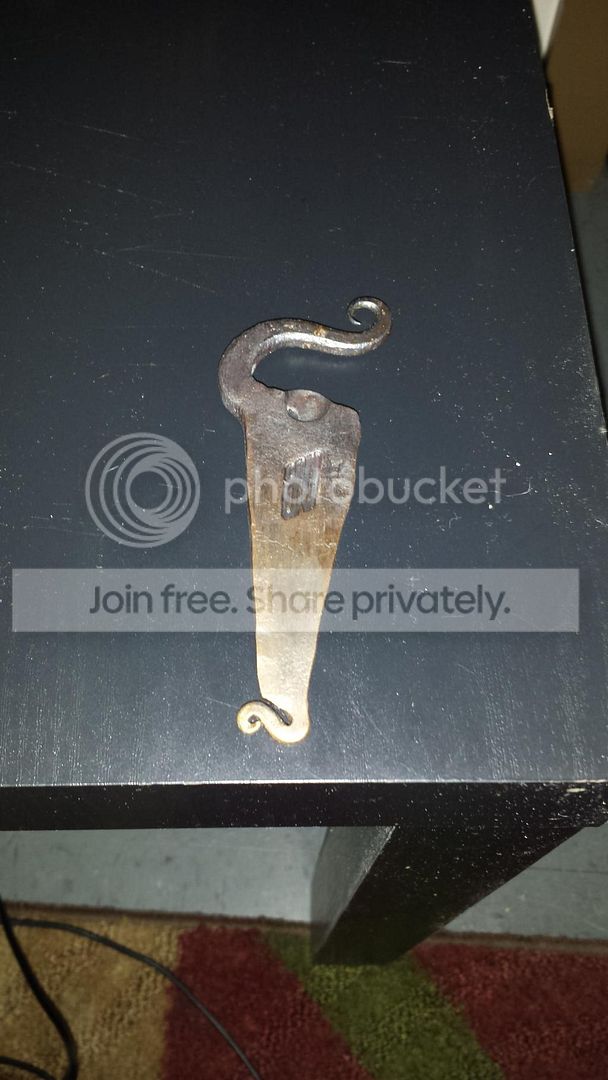
I won a prize in class today. Nick had a spare moment and decided to make a prize for answering a trivia question. He asked who could name 2 of the founding members of the ABS, to which I blurted out Bill Bagwell and Bill Moran. Ta-da! I win! He had made his ice cream cone, which is actually a bottle opener. It is pretty darn cool I think, and I'm glad I won it! What do you all think?
20150305_233411_zpsg4fjwww8.jpg


I will say that staying in the dorm has paid off massively beyond just being cheaper than a lot of motels in the area. Jim frequently goes out to dinner with those of us who want to join him and he is genuinely a funny guy. He enjoys fishing and hunting (as do I) so we are frequently sharing stories regarding either topic. Today Isaiah and I were treated to some extra class time after dinner. Somehow we began discussing the Journeyman testing for the ABS (which I've set a goal for myself in which to test and this class was a step towards that goal) and we were given some priceless information about how the judges see things, how certain forms are important, materials as well as demonstrating a variety of different techniques to the judges. He advised that differences between the knives would help showcase that, such as a full tang knife with bolsters and a hidden tang knife with a single guard. It was awesome to have additional insight to that as I'm definitely in pursuit.

So far the course overall has been a blessing. I can't imagine trying to learn some of this stuff on my own with no one really to see what I'm doing and provide help. Sure there is this forum, but I really don't think I could post a picture and get the kind of information I'd need in a written response. I'm fairly certain my learning curve has been severely shortened by attending and I hope others who read this will decide to do it themselves if they are serious. It is nice to be able to call up a smith or knifemaker and try to ask for help or to learn from them, but Jim said tonight some mastersmiths he knows will not give you an invite unless you have a grinder. The idea being the grinder is a significant investment and shows them that you are serious about truly learning. Kind of made me glad I have one and from what I saw I am the only one in the class with a grinder at this point.

Screw youtube...I'm tired and need sleep. Videos will have to be posted at a later time, sorry folks!

Day 5 is tomorrow, and I'm excited!
 
Last edited:
Hey Eric,

Thanks for doing this exhaustive account of this intro class. It's great having an insight into a student new to NESM.

I just shot a picture of a few Jim Crowell knives that we had lying around. The two small ones are shared by me and my wife.

 
Thanks, this is a really fun thread, keep it coming!
I like that Jim uses a fairly small hammer- As they say, "size matters" but more often than not it matters because good technique is missing.
 
Ok, so I'm a little late with this. Friday I took off after the class and headed 4 hours away to spend the weekend with family I don't get to see often. So Today I am playing catch up. Its Lunch hour on Tuesday and I'm posting what took place on Friday!
Friday we started out with a review of blade tapers. The reason was that there were folks who were asking about guards and bolsters and how they fit on the knives we were trying to create. So Jim took the time to demonstrate the difficulty based on each design. A guard fitting on to a knife is more difficult because the hidden tang design creates an angle which the guard has to be struck up to the ricasso, unlike a full tang and adding bolsters because that is essentially a flat angle (or should be). We then covered drawings and reasons behind a mortise tang and then a framed handle. This was a slightly difficult concept for a few folks to grasp because drawings were all we had instead of a real example in our hand.

We also reviewed grinding a full tang (this was building up to our 'test knife' which is the end goal of the course. The drawings made sure that the concept was clear that the scale removal takes place along side removing some stock in the tang to help the balance of the knife. We wind up making a convex grind in the handle which seems odd, but at the point you grind the rest of the knife it winds up not being as drastic. The convex nature also went straight out the end. I asked if this caused issues with handles being attached, but once it is ground down it turns out that the tang becomes flat once again.

We also once again witnessed a demo of how Jim draws down the spines on his big choppers. It was pretty cool seeing his process especially since he has won so many passed cutting competitions. Using an Oxyacetylene torch he demoed turning the tang blue to soften it (this one was hardened in the oven the night before).
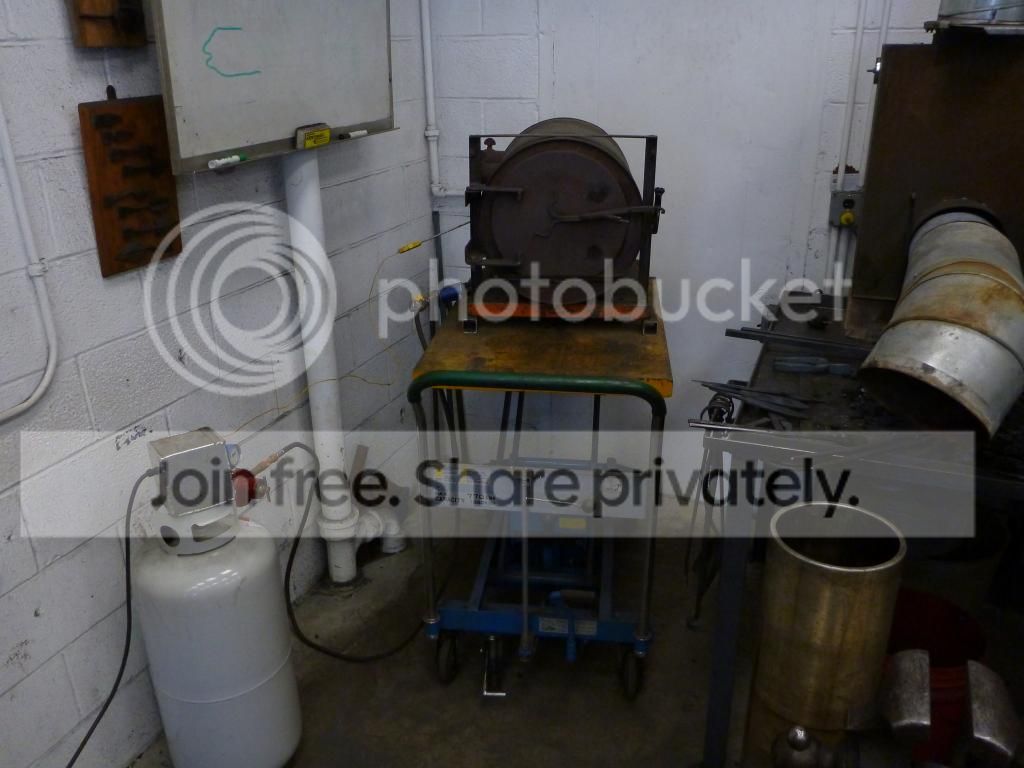
Here is the oven used, gas powered..
P1080713_zps2m3ivq2k.jpg


And here is the knife which with the coloring lines looks rather pretty...
P1080726_zpsk3hpyqjz.jpg


The focus on Friday was on taking more steps towards our test knife. The reason was that if you messed up your knife, you could still have time to make another in order to participate in the testing process. i didn't take a ton of pictures because it was mostly me banging out my test knife at the forge.

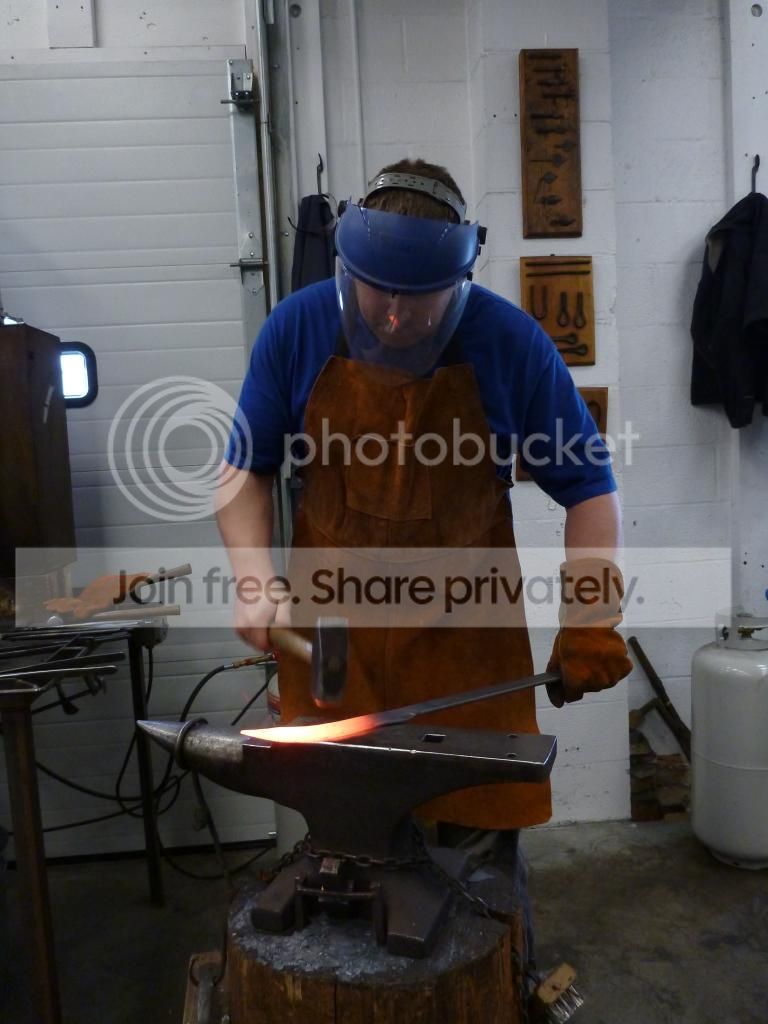
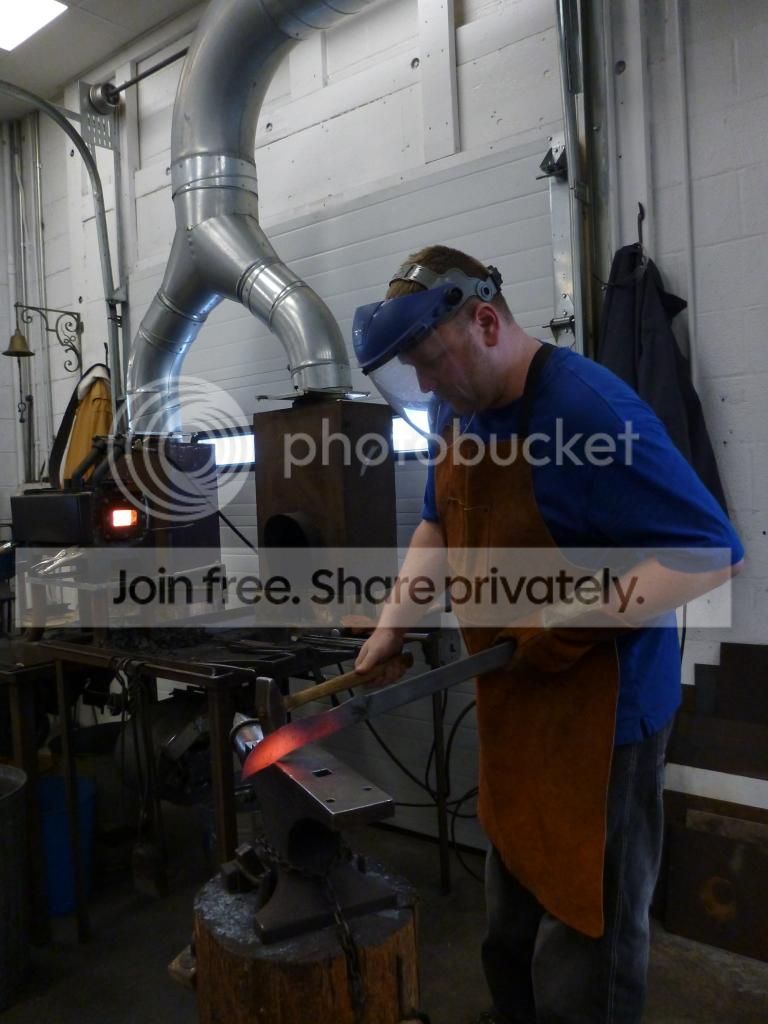
Here are a few photos of me forging.
P1080716_zpsnp5zdguh.jpg


P1080724_zpspysxeppo.jpg
 
Monday of a new week! I was excited to get back to the class, its a blast all around and obviously, if you have an interest, you will want to work on your technique some more!

This day started with review, see a pattern here? A variety of questions from the students led to a saying that came from someone else but we've said it many times this class:
'You may alter the technique but you may never violate the principal'. Students kept asking different questions about how to do things differently than we were shown, and regardless of what they asked, Jim was able to relate it back to what he had taught us. Thus, the reviews every morning of different portions of what he had shown us.

The review of the whole process in each step was as follows:
Point
Pinch
Blade Bevels
Fuller / Tang (depending on hidden tang or full tang)
Normalize
Then on to the grinding portion.....
On a contact wheel,
Profile
Taper Tang
Descale blade (but leave the Ricasso with the scale intact)
Transition to a flat platen,
Clean up tang
Grind Blade Bevels
From here, clean up portions which need it and try to grind the edge to the width of a Nickel

Heat Treating
Bring up to 1500 +/- since we were using 5160
Quench in proper medium (Jim likes Parks 50 @ 120 degrees)
Light grind to see clean metal (which will help show the colors)
Draw Temper for 2 hours of 5160 for 350-375 degrees
Use a torch to draw the tang and ricasso, trying for a blue color (making it soft)
Immerse blade edge in water
Liberally draw spine with the torch pointed away from the point to a blue color

Now Sharpen

From here we discussed how to cure issues when performing the test while chopping the 2x4s. The edge of the knife can do 3 things, chip, wave or waffle, and bend. The cure for all 3 of these conditions is to sharpen at a more abrupt angle. I thought it was kind of interesting that 3 different conditions could be fixed in the same way.

In the shop, today was more pounding and grinding on the test knife. For some reason I wasn't feeling it and had a devil of a time straightening my knife. After probably an hour trying, I had to ask Nick for some guidance and assistance. He showed me to coat the knife edge with soapstone which really helped me to see the edge and the overall alignment better. Once that was done, in the forge to heat up for the normalizing and then I set it aside to cool.

I then moved over the the grinders. I've forged out 7 blades total at this point. 5 drop point hunters, a single clip point and then the test knife, which is mostly a camp knife. I had not ground many knives to this point, so I headed over to practice since I assumed grinding my test knife would be a challenge.....such a wide and long blade would be rough to keep straight while grinding!

It was around this time that Jim finished his test knife, so outside we went to see the fun!
P1080917_zpshx9o6lpb.jpg


P1080916_zpsjxppf9ad.jpg


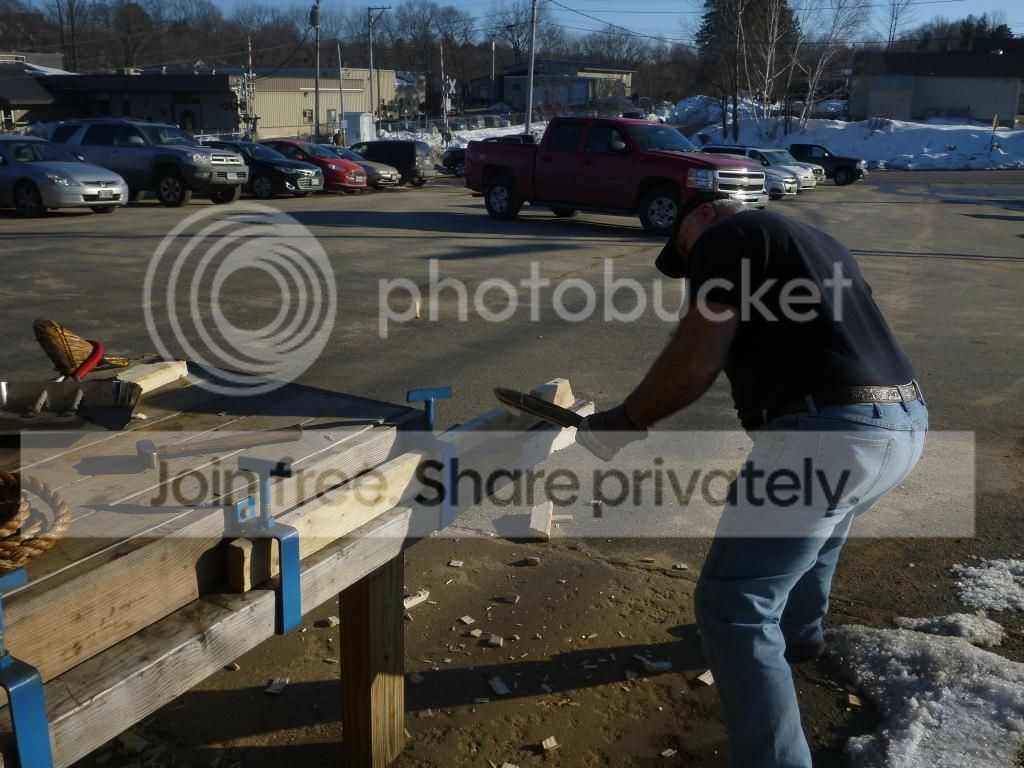
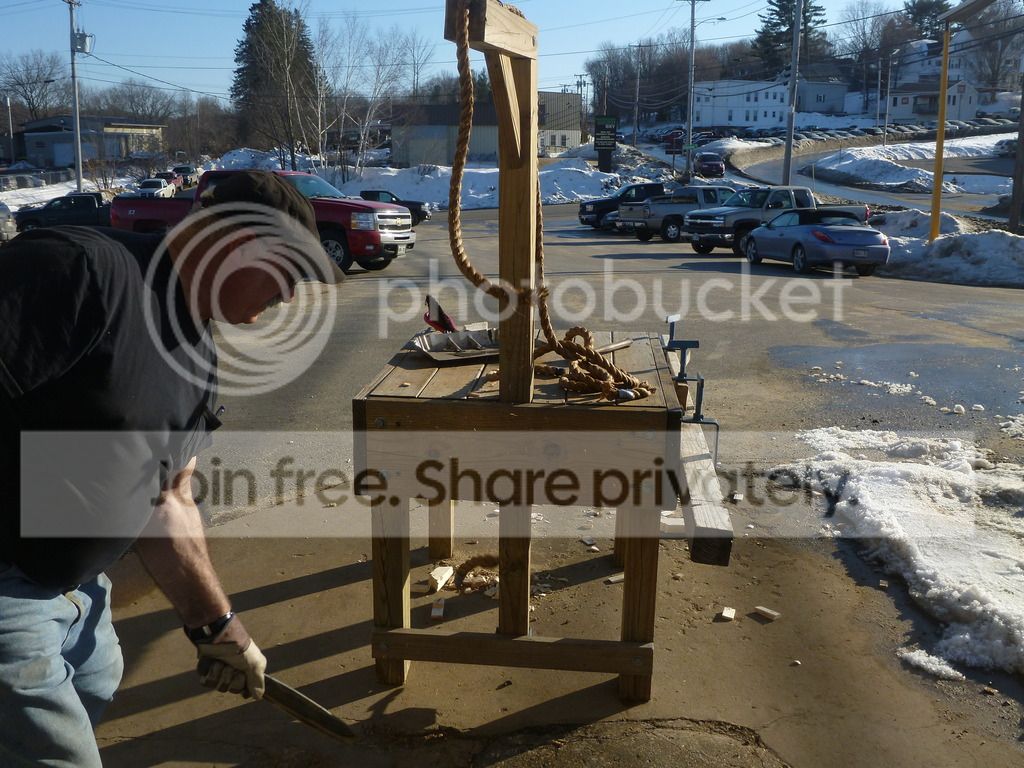
And here is a pretty cool action shot of the rope cutting, notice the piece of rope STILL in the air (between the left leg and the rope support piece)
P1080918_zpsuhx9tipy.jpg


Here comes the bending!
P1080920_zpsekfdm69d.jpg


P1080924_zps2rofxaol.jpg


It is pretty mind blowing to see this whole process from start to finish. A steel bar turned in to a knife that chops through a 2x4 and free standing rope and still bends 90 degrees without breaking. I realize there are lot of videos out there about the test and those who pass it but still, different ballgame to me to see it first hand.

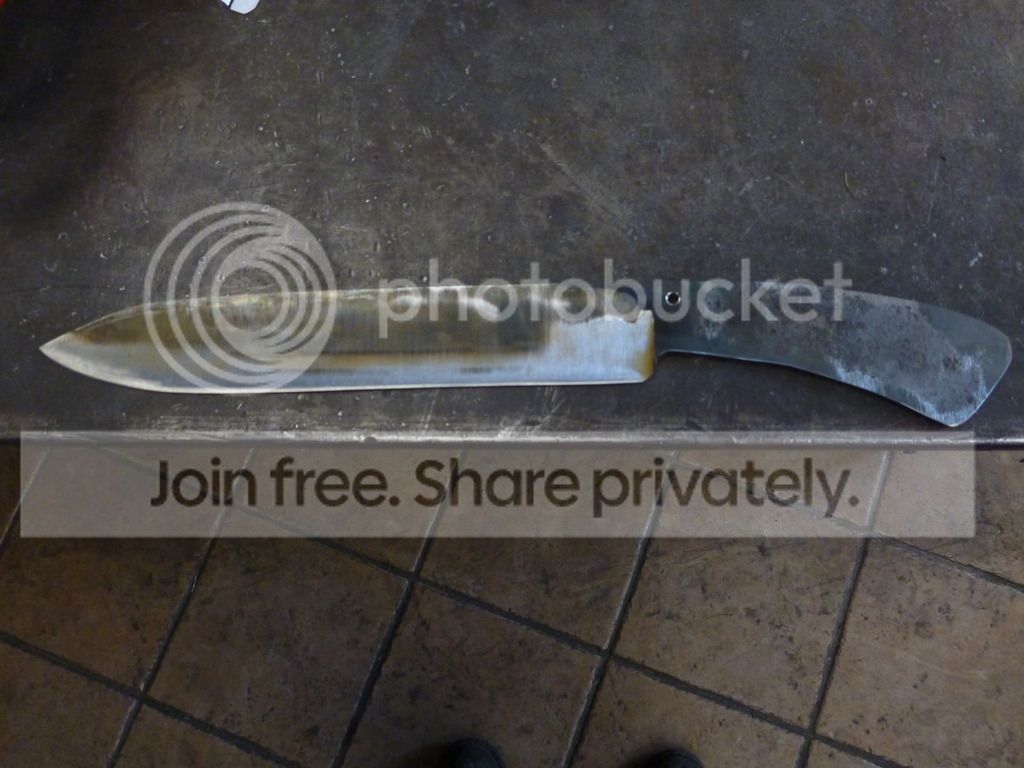
With practicing my grinding, here is my first knife which I ground 100% myself (obviously bad hammer marks are still present!) This is only 60 grit, but I was happy as I started to make grind lines that were somewhat consistent.

P1080911_zps7hmu9m1s.jpg


P1080912_zps06x4wcod.jpg


P1080913_zpszlm8hfz0.jpg


I had barely started grinding the knife above when I was told to get back to my test knife ASAP. Evidently there had been some issues in the previous class where no one was able to pass their test with their knife, including the instructor. So Jim wanted to be sure that we had time to potentially remake our test knife, should we need it. I went and grabbed mine since it was now cool, and began grinding it out, despite only having ground 3 knives total...and 2 of them I had a LOT of help! The day ended with my getting my test knife profiled and some scale removed on the contact wheel, though not enough.

I have to say, I really love this class. Being such a novice, I feel like I've grown leaps and bounds in every avenue of forging and even grinding. The one on one time is priceless since I get critiques whenever I ask as well as randomly if I'm doing something wrong and Jim or Nick spot it from across the room. The forging of the pinch is my most challenging portion. I feel I've got a much better grasp now on the other aspects and I'm planning on taking a bar of mild steel when I get home and just pinching that darn thing every 4 inches across the entire length!!! That being said, I feel much more comfortable with forging now, and I think I've gone from making horrendous forgings (see the knife above and that awesome hammer mark) to being more accurate and having much better hammer control overall. In grinding my test knife so far, I wasn't seeing anywhere near as deep of hammer marks and I think they all might actually be capable of being ground out without making my 1/4 thick steel only 1/8 of an inch thick at the end! I see why Jim wanted us to grind so soon, the grinding gave us a different perspective of our hammering, which helped make me (and I'm sure all the students) significantly better at forging.

Ok, I need to get more sleep tonight, so tomorrow I will post Day 7 (hopefully all of it during lunch) and then Day 8 as well tomorrow night to get caught up.

Hope you all are getting something out of this!
 
Last edited:
Tuesday started off like the rest, in review. I won't bore you with writing it all down again, I've done it a few times so just see the process above! We were advised that we should focus on our test knife since he wanted us to perform the test that day if possible, or Wednesday if need be. During the review of the process, an interesting discussion began between Dereck Glaser (runs the blacksmith portion of the school) and Jim. They began to discuss the meaning of Tempering, since in knife making it seems like tempering is always the step following hardening which draws back the hardness to whatever level you wish. I guess the definition of the word is literally 'to impart strength or toughness to (steel or cast iron) by heating and cooling.' so in effect, the heating up and quenching is also tempering. It was a pretty cool discussion about words an how their meaning can change in a field like this.

Someone had asked if we could heat the steel up to a lesser temperature in the kiln and avoid the drawback of the lower heat, and he was told adamantly NO! It was then explained again about the carbon coming in to solution and the temperature needs to be correct and that only the soak time can change some (more soak for lower temps and less soak for higher temps).

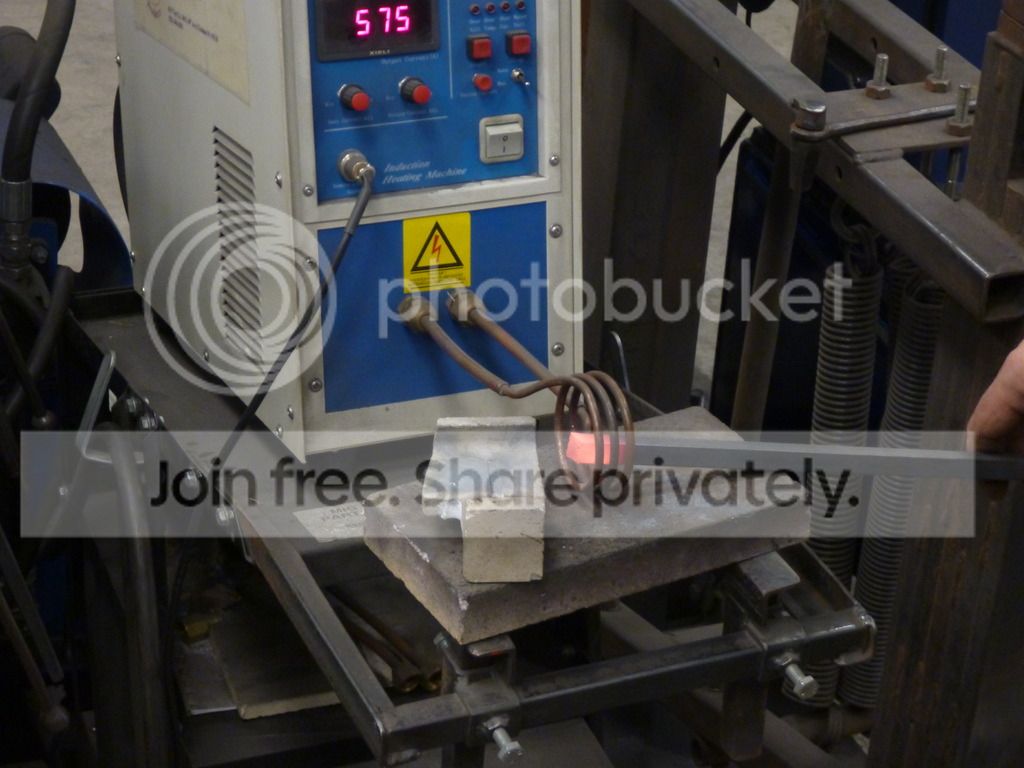
Once in the shop, we got a quick demonstration of a machine I can't recall. It heated up metal via induction, and was a pretty cool tool, here is a picture with a piece of metal heating inside the coil.
P1080930_zpsqqjxt19f.jpg


Then we received quite an in depth review/demo of sharpening, which I have GREAT video of....but its taking forever to upload again! :mad: On the flat grind, Jim likes to sharpen the edge with basically a convex edge. Not sure which kind of grind it is called, but there is no pronounce 2nd bevel as he sharpens, it is one continuous curve that feels as though the whole bevel curves to the point. Once the grinds on the knife are all done, heat treating and tempering as well, then on a 120 grit belt he began working the knife above but right behind the flat platen top wheel. Gently rocking the knife back and forth the entire cutting edge. Once the bur somewhat starts, he jumped to a 220. He refined it a lot then Nick pulled out a 400 grit belt and Jim was able to refine it even more. With just a couple hits on the DMT stones and leather strop and it was cutting cigarette rolling papers someone in the class had in tiny slivers.

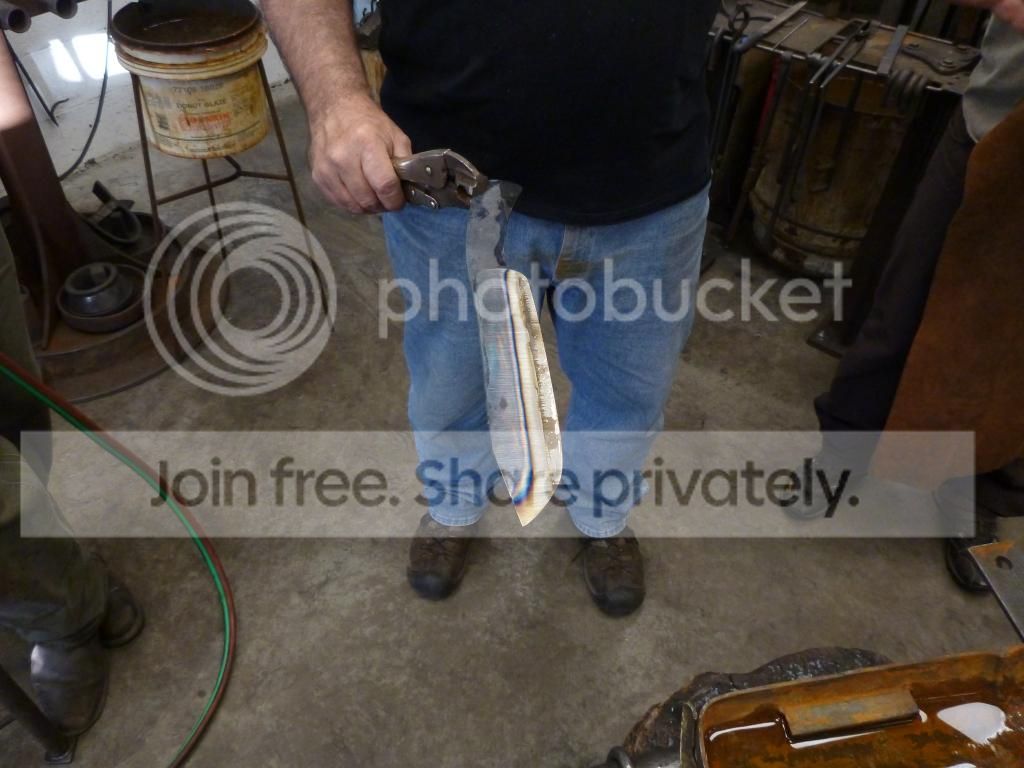
Off we went to work more on our knives. Mine was mostly finished, just needing to be sharpened. So I began, and with some guidance I too was able to shave tiny pieces of paper with no effort. I was hanging around and taking pictures of my knife when Jim started a review of the drawing back of the spine, which first starts with heating the tang to a blue color to soften in. Here are a few shots of this....
P1080939_zpstul6uckl.jpg


This one looks like he was heating the blade edge, but he was actually discussing why he WAS NOT heating the blade there,
P1080941_zpsrqrh5wjc.jpg


Here is that blade in the edge tank, lined up and ready to rock!
P1080943_zpsipei9p8g.jpg


Here the student is transferring their hand placement on the torch, so its hitting the water which got a quick 'Don't do that!' from Jim!
P1080945_zpsbokjh4to.jpg


And last but not least, my blade!
P1080951_zpsx6v9u0ut.jpg


P1080950_zpsogbxgq1t.jpg


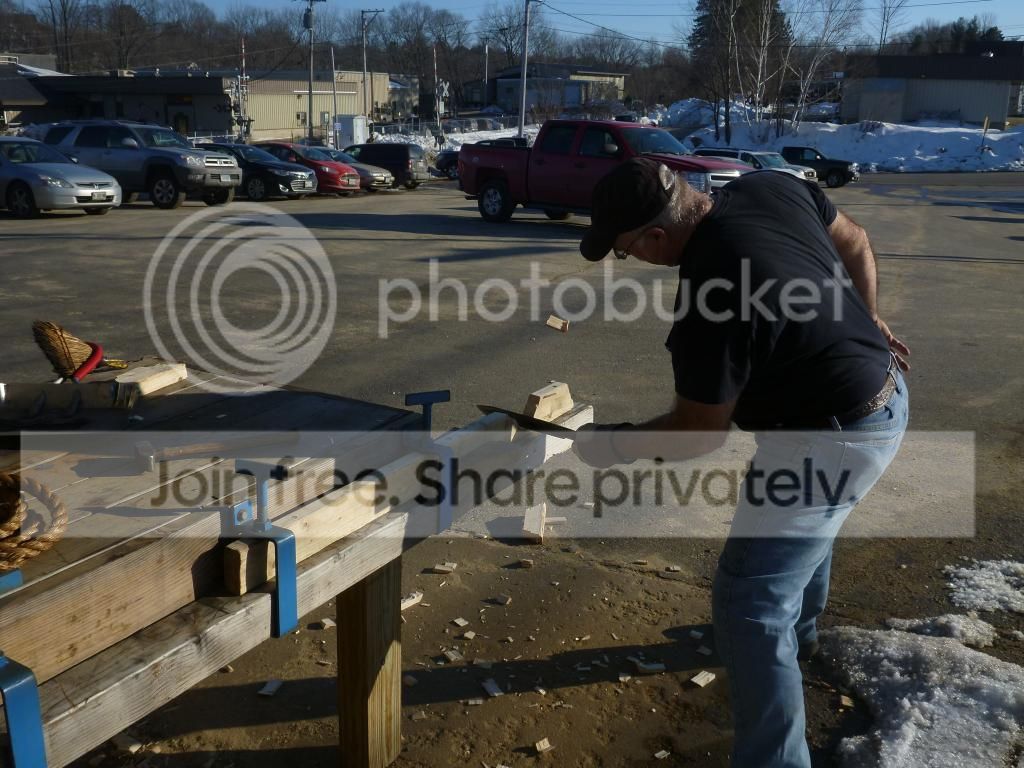
We then all went outside to test. NESM has built quite a rig to hold the 2x4 and rope for the cutting portions of the test. Quite a few folks were pretty confident in their cutting abilities and their knives since Jim had been there to help. A bit too confident in my mind. But some of that was throttled back when the first student had difficulty finding the right way to cut the freestanding rope! On my attempt, my knife was able to cut through the 2x4s, then the rope (which I saved the piece) and then I watched the other folks. Once everyone had tested their knife with the cutting, a picture was taken of everyones knives and we went inside for the bend test.

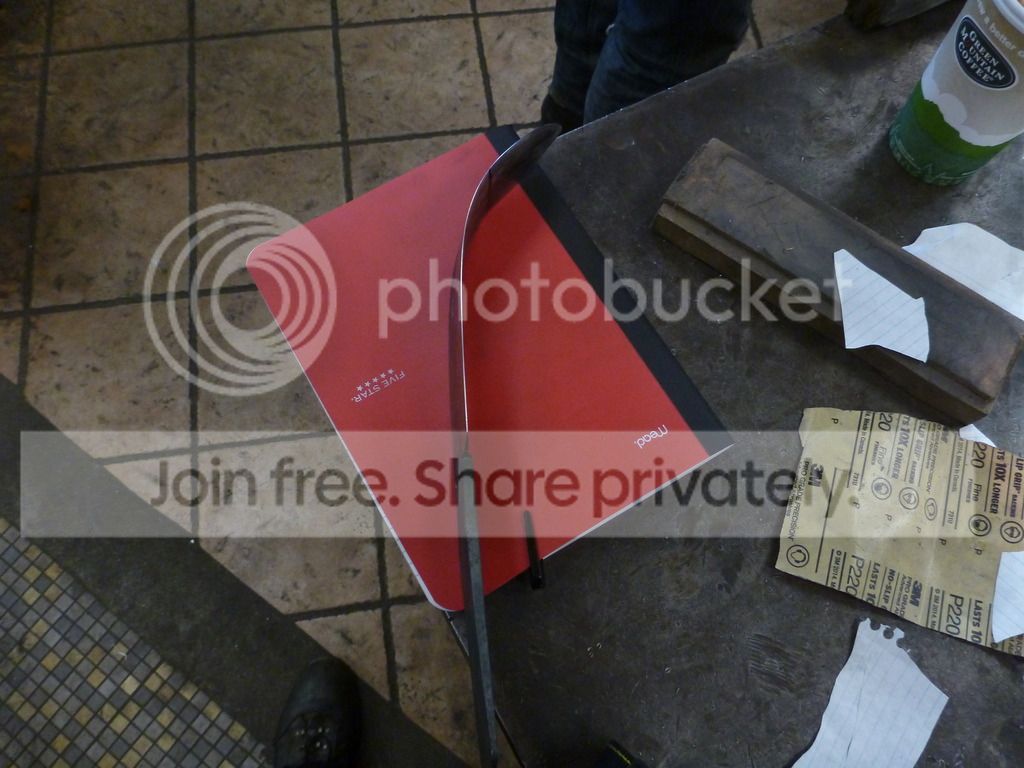
Somehow I was volunteered to go first, so I did. My blade was bending along pretty well and it was kind of an amazing thing. Here this blade had just cut through 2x4's (yeah only one, but twice so I think its plural!) and I am about to bend it 90 degrees! I'm going slowly as Jim advises and he is watching for when I get to 90

SNAP :eek:

Yeah, that sucked. It cracked some at first, Jim said to keep going and then it snapped off. :eek: Even with a mastersmith helping me, I'd somehow screwed up my test knife so it failed. And I wasn't even one of the students who was cocky! I was worried each step of the way. The grain in the knife seemed very uniform and small, so the speculation just begins as to what happened. 2 of the 7 in my class failed. It meant a busy agenda for us on Wednesday since what had taken 3 days for me to make, I needed to get done FAR FASTER now!
I can't seem to find the picture of the broken blade, so I will post it tomorrow.
Edited to add....Found it!
P1080973_zpskhlocvbi.jpg
 
Last edited:
Wednesday was a mad dash to try to build another test knife. Jim pretty much made it his focus to help guide us with every aspect to be sure we knew what we were doing and the proper steps. It was slightly intimidating and I felt the pressure. Yet it was also a great learning opportunity. Due to the increased scrutiny, I was getting some major 1 on 1 advice and it cleared up a few questions I didn't know I had. Also, in the interest of time...I got to use the Glaser power hammer! :D

Jim gave us a quick tutorial about it, and a demonstration about how he holds and controls the stock in the hammer, but yeesh, talk about a giant leap forward. I have errant hammer blows with my 2 pound hammer....its rough to get those out while grinding. What happens when I make a mistake on this huge power hammer that hits about 3 blows per second (I'm guessing there)? Jim dove right in giving instructions, saying 'Harder' when he wanted a longer stroke of the hammer, 'Push it' or 'Pull it' depending on which way I needed to walk the stock through the dies. He even reached over to help guide my hands during the process which actually helped tremendously. That power hammer created the bevels in 2 heats and only 4 minutes of time instead of SIGNIFICANTLY longer for my manual pounding. I finished the handle in a convenient but not quite as flashy style like the 'fish tail' before, normalized and then set the knife aside to cool.

At this point I started grinding on some previously finished blades I had forged to pass the time until my 2nd test knife was cool enough to start to grind. I worked on these for roughly an hour before I could handle my blade, which I then took to the grinder. I remembered the steps in order, the tang, then profile, then cutting in the plunge shape, then removing the scale on the blade bevels. Every step was watching by Jim and a few times he had to step in to show me what I was doing and instruct me on how to fix it. Nothing like 1 on 1 instruction! Once it was ground out to 120, we popped it in the kiln to soak for 10 minutes at 1500, then quenched and we wiped off the oil and immediately popped them in the toaster oven to temper for 2 hours.

Except it wasn't two hours. We'd left them in the oven while we headed to lunch, and once we came back the oven was off and cold to the touch. So we assumed we needed to do it again, so in they went and the timer was set. At this point I grabbed a spare piece of steel and began forging another blade which the design is very similar to the bowie I'd posted earlier which Jim brought to this class. I told him I was trying to copy it, but with my lack of skills it would come out NOTHING like his in the end, to which he laughed and just said to 'get on with it then'. After a while I had quite a great profile pounded out I thought, but it was time to start back on my test knife.

Out of the oven we ground off the blackness from the quench oil and pretty much set our bevels as they needed to be just prior to sharpening. Then it was over to the Oxy-acetylene torch to soften the tang, and then once that was cool enough, we softened the whole spine with the tip in water. We let it cool in the water to room temp, then began sharpening the knife as I'd done the previous attempt.

It was around this time we got a fairly well known visitor and someone whose knives I truly appreciate....ABS Mastersmith Don Fogg!!
P1080954_zpsnm1vj6if.jpg


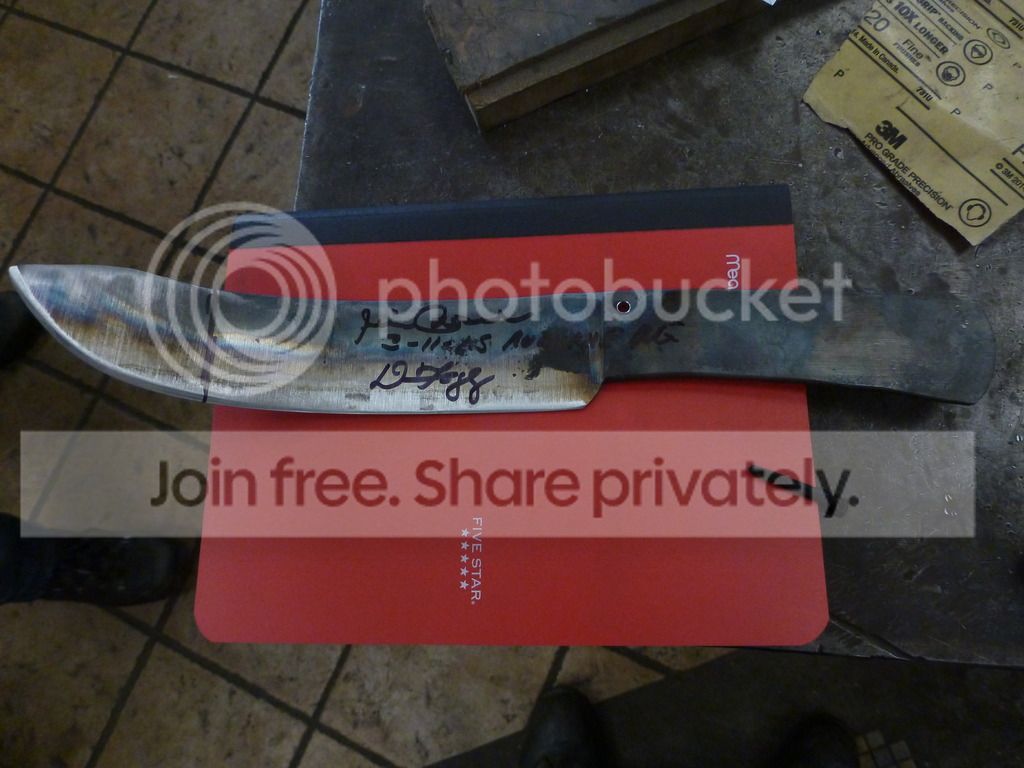
At this point I got to go out and perform the test with 2 mastersmiths watching me! I honestly wasn't that worried about the cutting portions of the test, since my previous knife had done well. And this time was no different, 2x4s were easy and so was the rope. The bend truly worried me since I'd broken my last one. I set up and started pulling on Jim's go ahead. HOLY COW......it was insane how much harder it was to bend this knife than my previous one. Since Jim was watching me and we used the power hammer, I didn't have a lot of errant hammer blows to fix so it meant I didn't have to grind off as much steel. What a beast! I'm not a small guy at 6'3" yet it was a real workout to try to keep the pressure steady and continually bend this knife over. Also as I got closer to what I felt was 90 degrees, I started to worry since my last knife broke around that point. I couldn't help but feel a sigh of relief once Jim said I had reached 90...and then I heard Will Smith from the movie Bad Boys 2 in my head 'Whooooo, that one puckered up my butthole!'

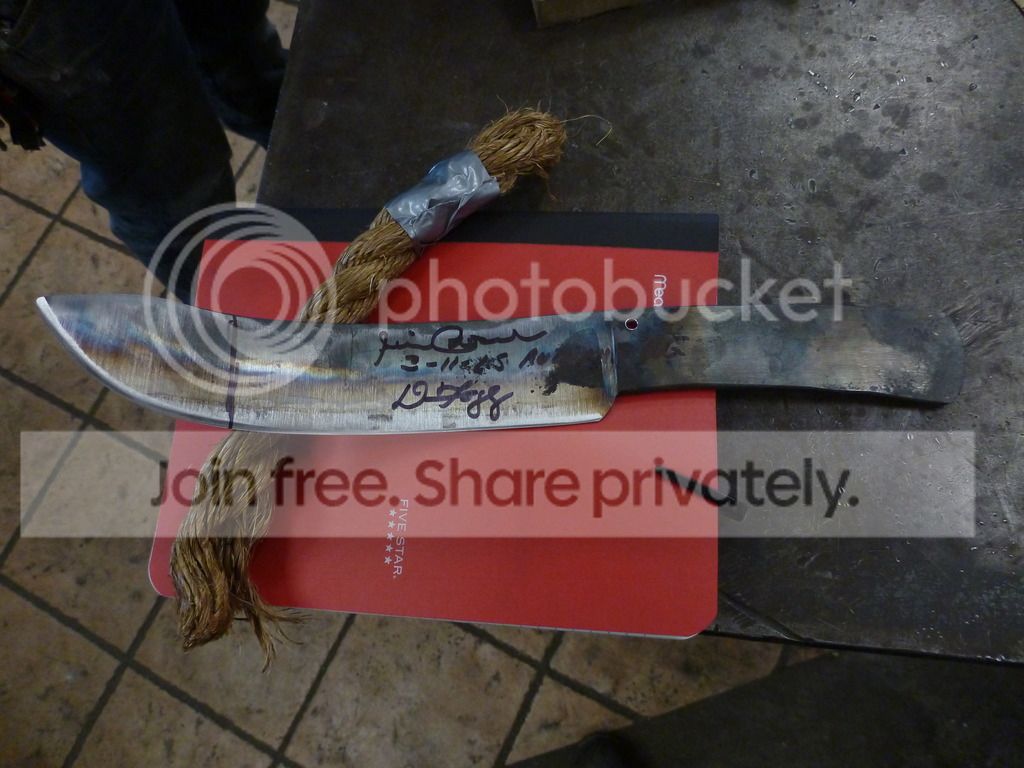
So since I had 2 mastersmiths witness, I had them both sign it!
P1080955_zpsasrquz5q.jpg


P1080956_zps4fs5fevi.jpg


And here is the rope piece I cut with it as well.
P1080959_zpsjmso4zgh.jpg


At this point the day was over, but I somehow managed to put myself in the good graces of Jim and received an invite to dinner with him and Don. How could I possibly say no??? So off we went, got some wings and beer or Hard Cider and I had an amazing time witnessing them reconnect as well as listening to their stories of the good old days! I received some priceless tidbits of information as well as a thought bouncing around in Don's head about a project he left before retiring which was fascinating to me. They refused to let me pay for the whole meal, but it was truly an honor to hang out with them and I tried as my way of saying thank you. Plus....I'd some how lost the key to my truck and I was driving, and Jim managed to find it and save me the cost of a locksmith!

Stay tuned, more to come!
 
This is so cool - thanks for taking the time to do this. Much appreciated!

Eric
 
What a great write up. Thanks for taking the time. I don't think you could have gotten a better instructor than Jim to learn all of this.
 
Wow! Great write up and a super cool experience! That looks like a total hoot and a great way to cram a lot of learning into a small amount of time! Thank you for the write up!
 
Back
Top