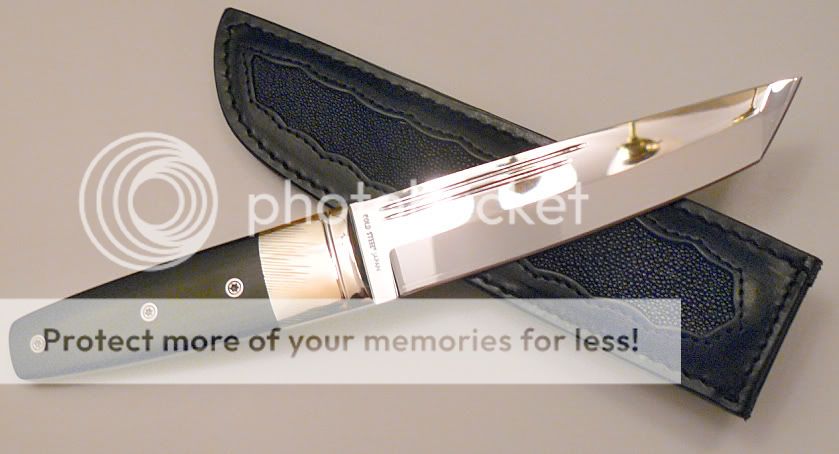
Obviously the traditional Asian shape was useful, or it would not have evolved and thrived.
If you're talking about it being useful as a pocketknife, I think some of the more traditional-leaning designs are pretty useful. One example would be to compare my two Large Regular Sebenzas - one of which is a tanto, and the other a standard blade.
For many purposes, it's helpful to have a smaller radius in the belly as it nears the tip, so the standard profile wins there. The standard profile also provides a much more refined tip, that's very good for initiating cuts into paper, as an example. It works well for clipping things out of the newspaper by starting the cut skew to the paper's surface (trying to use mundane examples here).
OTOH, the standard profile is also pretty weak in the tip area, probably disproportionately so for a blade of its size. So for heavier tasks where there is significant lateral force on the blade, the tanto is much better. An example of that would be prying heavy staples out of paper bindings. Another thing about the tanto is that it gives you a secondary "beater" edge that can be trashed independently of the primary edge, and relatively easily restored. Its shape also creates a secondary point that's very ergonomic in terms of initiating slicing cuts (for example, when cutting paper on a cutting board you don't have to elevate the angle of attack, like you would with the standard). Reeve's interpretation of the tanto carries a fair amount of belly through the primary edge, so it's not that awkward to make cuts in the air with (cutting rope or webbing at a loop, for example).
So, bottom line, comparing these two blades that are the same in every other respect except for profile; I'd say the standard profile is a little more practical overall, and much more practical for something like food prep or skinning. But the tanto is much better for scraping, prying, moderately hard penetration, etc., while still being quite serviceable as a utility blade. It is mainly a matter of whether you want more finesse or more strength up near the tip.
I should note that the standard blade also has a swedge, so it has a secondary edge as well as the tanto, only with different placement and characteristics. For example, I would not want the swedge to be as sharp as the tanto's secondary edge, and neither is as sharp as a primary edge.
Anyway, hope that helps point out a few practical differences from the EDC perspective.