Is there a name for this sort of construction?

Joined
Jan 13, 2001
Messages
10,970
I have this stockman, one of my first slipjoints. It's a good enough knife, but there are a few things about it that bug me enough that I've relegated it to the "just in case I forgot my regular pocketknife" role in my glove compartment. One of them is this small detail, it doesn't affect function any, but I hate it.

dsc0131ra.jpg


dsc0134ji.jpg


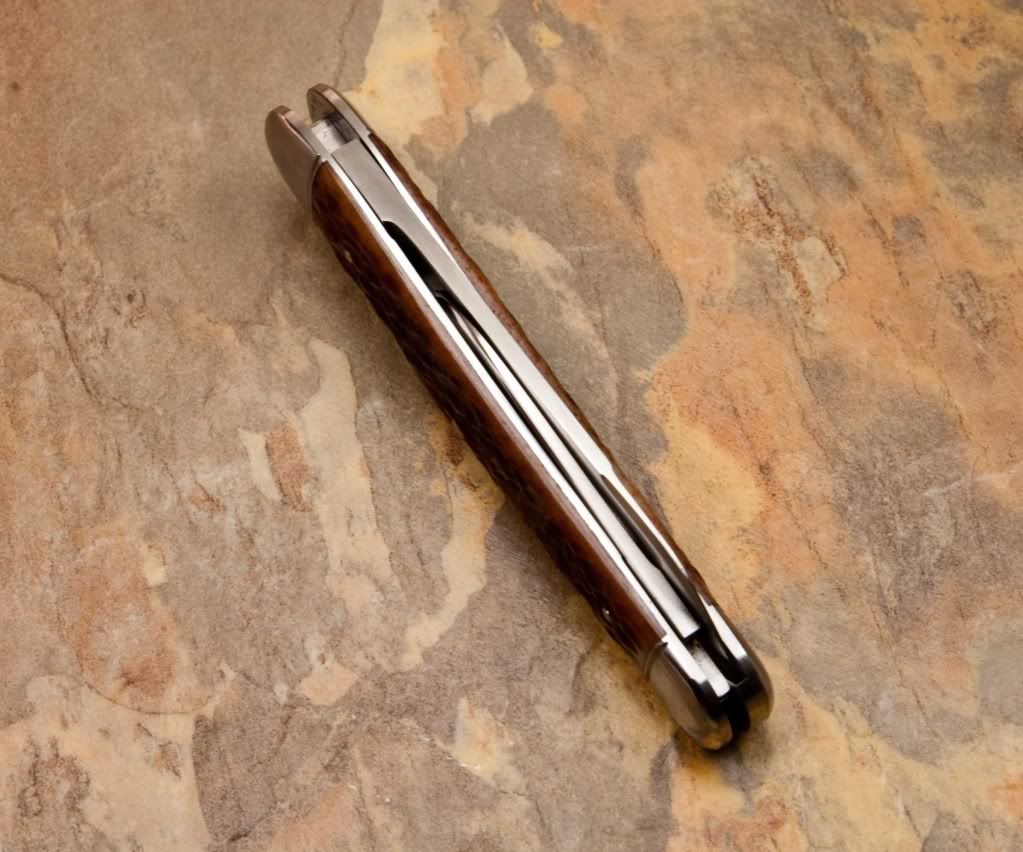
The eagle eyed among you will have noticed that their are four brass liners, when this knife's construction only needs three. The fourth piece of brass is used as a spacer, to keep the spey blade from hitting the liner when closed. It is absolutely ineffective in this particular case as the spey still rubs against the liner.

Is there a specific term for the use of this extra liner? Or is it just known as the "butt ugly manufacturing shortcut so we don't have to crink our blades properly" technique?

- Christian
 
it just known as the "butt ugly manufacturing shortcut so we don't have to crink our blades properly" technique?

- Christian


I think you about nailed it...this was pretty common in some of Schrade's offerings back in the day, 300 Bucks has written about this subject regarding some of the outsourced Buck stockmen knives.
 
I don't know the name but I recently learned that "scales" is the correct term. The whole post is worth reading but I quoted the part about the scales.

http://www.bladeforums.com/forums/s...gaps-*Problem-solved*?p=11135151#post11135151

...The scales are the liners, NOT the handle material. Handle materials are the "covers" or "handles" (of course). This is a big faux pas among collectors and even some handle manufacturers. Anyone working in the knife industry immediately knows a forumite's talking to them when they hear a cover being referred to as a scale. DON'T be one of those people! (I'm referring to everyone here ;):D )...

I was surprised when I saw it on the GEC Calf Roper but I've since noticed it on other stock knives. I used the forumite term, double "liner". You might be right about the longer version of its name. ;)

http://www.bladeforums.com/forums/s...EC-66-Stockman-YIPPEE!!?p=9577330#post9577330
 
I don't know the name but I recently learned that "scales" is the correct term. The whole post is worth reading but I quoted the part about the scales.

http://www.bladeforums.com/forums/s...gaps-*Problem-solved*?p=11135151#post11135151


I was surprised when I saw it on the GEC Calf Roper but I've since noticed it on other stock knives. I used the forumite term, double "liner". You might be right about the longer version of its name. ;)

http://www.bladeforums.com/forums/s...EC-66-Stockman-YIPPEE!!?p=9577330#post9577330
Ah-haaa! ;)
 
A lot of stockman knives have the extra (inner) liner, which functions as a spacer to widen the blade well a little bit, to better fit 'crinked' blades. I think some 2-blade folders, like pen knives with opposing blades on a single spring, also sometimes have the spacer, for the same reason.
 
Per Case's "anatomy of a knife" there are not four liners on this knife, only two. Only the outer ones are called liners. The middle one is a "cut center". They don't address the "little piece", probably also a "cut center." There are no scales on a knife but there are covers.
 
I'm pretty clueless on this stuff but is it this:


Quoted from GEC website,

"Catch Bit
A small piece of metal, usually brass, which acts as spacer to make up the difference between a thin pocket knife blade and a thicker spring that operates it. The catch bit is shaped so that it will not move when the blade is rotated. A pocket knife may also be designed with a thin blade and catch bit to make room for other blades."

http://greateasterncutlery.net/blog/pocket-knives/knife-terminology/

???
 
I'm pretty clueless on this stuff but is it this:


Quoted from GEC website,

"Catch Bit
A small piece of metal, usually brass, which acts as spacer to make up the difference between a thin pocket knife blade and a thicker spring that operates it. The catch bit is shaped so that it will not move when the blade is rotated. A pocket knife may also be designed with a thin blade and catch bit to make room for other blades."

http://greateasterncutlery.net/blog/pocket-knives/knife-terminology/

???

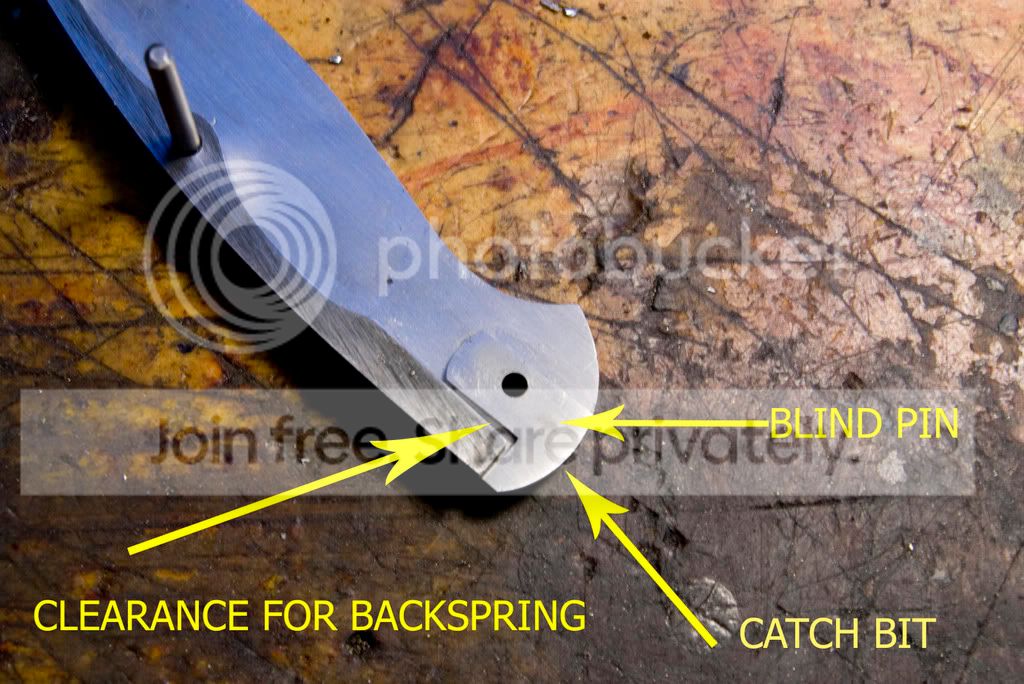
Here's an excellent description of a catch bit:
A catch bit is basically a spacer that makes up the difference between the thickness of the spring and the thickness of the secondary blade. In Jake's last picture, you can see the brass "catch bit". A catch bit allows the master to be longer than what would be achievable if both blade tangs are the same thickness of the backspring.
IMGP3535_edited-1.jpg


This picture shows a a single spring knife with catch bit. You can see how the tip of the master blade is as long as the flats on the tang of the secondary blade. If no catch bit was used the tip of the master could not extend further than the plunge line of the secondary blade.
IMGP8582_0428_edited-1.jpg
 
I'm pretty clueless on this stuff but is it this:


Quoted from GEC website,

"Catch Bit
A small piece of metal, usually brass, which acts as spacer to make up the difference between a thin pocket knife blade and a thicker spring that operates it. The catch bit is shaped so that it will not move when the blade is rotated. A pocket knife may also be designed with a thin blade and catch bit to make room for other blades."

http://greateasterncutlery.net/blog/pocket-knives/knife-terminology/

???

That's an interesting new tidbit of info. :thumbup:

Following reading that, I did some Googling on 'catch bit' and found this thread from the Maker's forum:
http://www.bladeforums.com/forums/showthread.php/699278-What-is-a-catch-bit

I honestly don't know if the OP (here) is the same application, but the above thread is still a very interesting read. :)

(Looks like Jake found this too. ;))
 
Thanks Jake. That is where I first saw about a catch bit. So would you say Christian's knife has a catch bit?
 
Right, it's a catch bit and all your knife needs is to crink the Spey blade just slightly towards the center of the knife as there is plenty of clearance between it and the Sheepsfoot blade.
roland
 
Thanks for the verification Roland.

I just wasn't sure. The only example I had to go on was the pics Jake posted. From what I have seen Mr. Erickson refines just about every production knife design when he renders his custom interpretations. That is why I went with the definition and was still unsure. I guess the big difference would be that Ken's work is integral where as the production knives are pieced together?

Thanks guys for the education.
 
Not a catch-bit. Here is an example of a catch-bit on this Winchester congress pen.

dsc0133an.jpg


Contrast that with the stockman's construction, which uses an entire extra layer of brass.

dsc0136cc.jpg


- Christian
 
Christian's knife has a "side center scale". In the Winchester anatomy photo from Levine's Guide, you can more clearly see the difference in size compared to the catch bit in Ken's description.
 
Oh gotcha Christian. Your first pics, not showing the back of the knife, made it difficult to see that.

My mistake.
 
The naming of knife parts is not uniformly established. It varies with manufacturer, country and even regions within a country. The piece of brass being referred to here functions as a catch bit.
Ken Erickson makes both integral and non integral folders.
roland
 
Back
Top