Is there a name for this sort of construction?

What is the reason for your conclusion?

hrmm...well I work at an undisclosed manufacturer of traditional pocket knives and from your pictures thats what it looks like to me.

In the diagram posted on the first page its also shown as a center scale. In your knife it appears to be added in so that the one blade could be kinked over towards the outside scale allowing room for the other blade which sits on the same spring to lie without rubbing.

What they should have done instead was cut in the blades (when grinding) to allow more room. This would mean the blades would not need kinked as much and therefore not need an extra spacer.
 
Last edited:
I don't know Vandal, we've always called them catch pieces or catch bits at work, "spacer" is just too vague. For all anyone would know you might be referring to shim stock used for cutlering among other things.
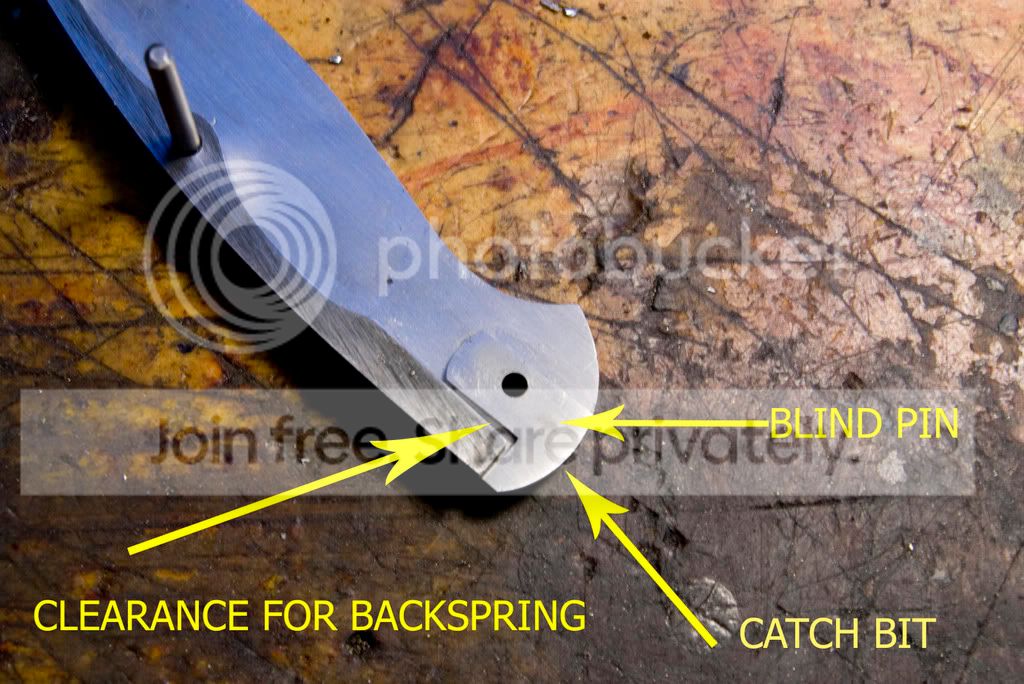
 
I don't know Vandal, we've always called them catch pieces or catch bits at work, "spacer" is just too vague. For all anyone would know you might be referring to shim stock used for cutlering among other things.

Its not a catch bit... heres why.

This was posted earlier, its a picture of a catch bit. (their shape varies per cutlery) First off, catch bits arent usually made of brass. Second, catch bits are used when you have a blade of large stock on one end of a spring and a blade of smaller stock on the other. For example a catch bit might be a thickness of .020 if there is a blade of .093 on one side of the spring with a blade of .073 on the other. This is pretty commonly seen in traditional whittlers.

IMGP3535_edited-1.jpg


In the next picture you can see that the two blades actually appear to be the same thickness. If thats the case it can't be a catchbit.

dsc0131ra.jpg


And lastly, in this picture you can see an entire extra layer of brass running along the bottom of the knife.

dsc0136cc.jpg


Much like a center scale or spacer shown in this diagram.

scales.jpg
 
Vandal, perhaps you did not read the entire thread ? I called it a catch bit and more knowledgeable members posted that this brass piece is not a catch bit and explained why giving the same reasons as you have explained above.
roland
 
I have found this thread to be interesting to say the least. I also hope that everyone can come away with a better understanding of slipjoint construction and the nomenclature used. I am guilty as most are of using the term "scales" to describe the handles or covers on a slipjoint. I do think that perhaps at times , with certain terms, that there are no absolutes. I was looking through a reprint of "A glossary of Old Sheffield trade words and Dialect", compiled and edited by B. Ronald Dyson, M.A. 1936. The definition for "scale" is "is sometimes also loosely used to imply the covering of bone, wood, pearl, etc., rivited on to these metal scales." To say that we improperly use the the term "scale" is certainly in my mind at least , debatable.

"The naming of knife parts is not uniformly established. It varies with manufacturer, country and even regions within a country. The piece of brass being referred to here functions as a catch bit.
Ken Erickson makes both integral and non integral folders.
roland "


I also wanted to clear up a statement in this thread that Roland made. He mentioned that I make both integral and non-integral knives. When I refer to integral construction I am referring to the fact that the bolster and liner (scale) are milled from one piece of 410 or 416. I have not for a very long time soldered bolsters onto liners. If the knife incorporates a "catch-bit" the "catch-bit" is not integral and a separate piece.
 
Ken,

My apologies for assuming you made the catch bits "integral".

Kevin

Kevin,

No apologies necessary!

I do like to think that I can fit the "catch bit" too such close tolerances that folks think they are integral! LOL :eek:
 
Last edited:
Ken, i appologize if i misrepresented how you make your folders. The construction of a folder, particularly multiblades, is more complicated than first meets the eye. I still don't understand some of the details. I thought i did but realize now that some of it was a misconception.
roland
 
Oh good! I know the last thing I want is to speak falsely about your work. I'm glad it was cleared up and I do think it is very impressive that you can fit these knives so well that it fooled at least me :)

Very awesome IMHO.
 
Roland,

Again, no apology necessary. Having a forum like this were we can learn, share, and explore this passion of ours is important to us all. I am just happy being a part of it.
 
Vandal, perhaps you did not read the entire thread ? I called it a catch bit and more knowledgeable members posted that this brass piece is not a catch bit and explained why giving the same reasons as you have explained above.
roland

Yes, I know I was simply replying to ea42's post just above my own.
 
I am not a expert, I am set in my ways. But, I have enjoyed and learned from the thread, and maybe when you guys have forgotten this thread, I will slip some of the words you use in the writing of the future............300
 
Vandal, I know the OP's knife doesn't have a catch bit, I was referring to the Erickson knife and this one:

syp210.jpg
[/IMG]

I think the problem is we have some confusion due to the myriad threads within a thread we have going here! :eek::D:D (Which is partially my fault :o , I tend to go off on a tangent)

We're actually stamping out a bunch of those pieces at work tomorrow, maybe I'll sneek a few shots in if I get some time.


Eric
 
Last edited:
Back
Top