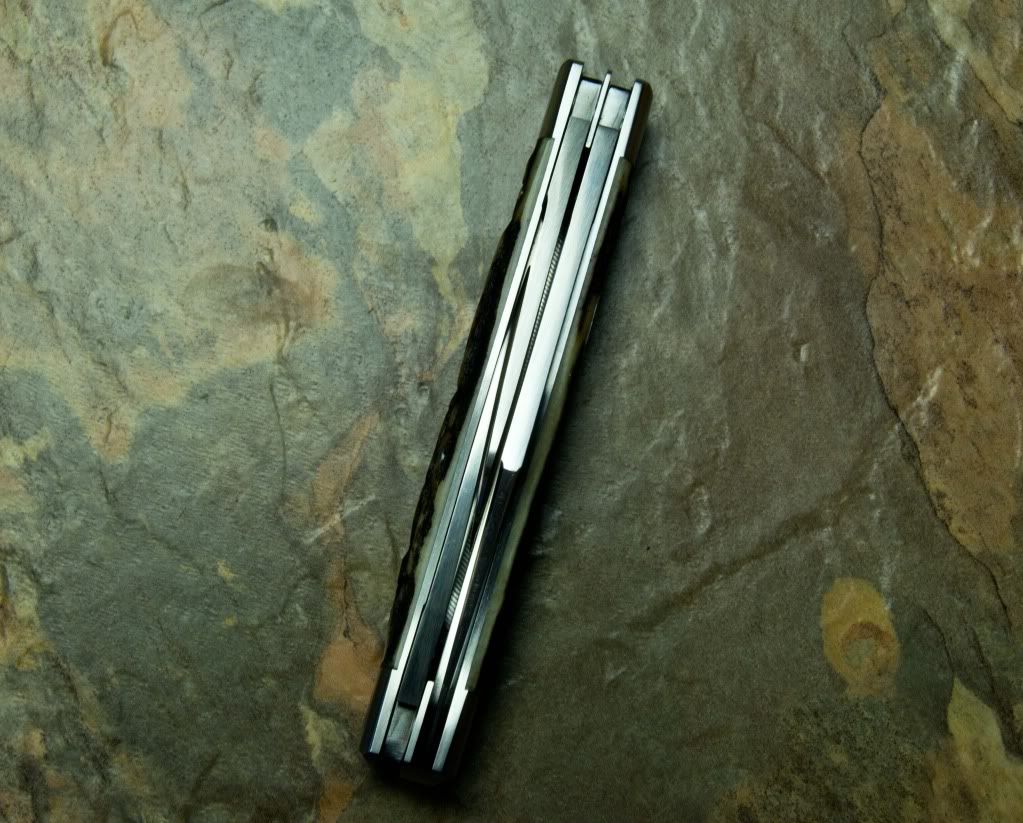
Is there a name for this sort of construction?

Looked some more at the 'terminology' link from Kevin, earlier. Under 'Scale' in that listing, I found the quoted text below (a portion of it bolded for emphasis):
( from site -->: http://greateasterncutlery.net/blog/pocket-knives/knife-terminology/ )
Scale
The lining or side of a pocket knife, usually made of brass. The scale usually has a cover attached on the outside, but on some knives the scale also functions as a cover. A “center” scale is assembled in the middle of each knife to separate the operating parts from each other. A center scale can be full scale or a cut-out scale that has the front part cut out. A “cut-out” scale may also be placed in the side of a knife to provide more working clearance for the blade.
 
I have examined many production stock knives that use a "side center scale" or cut-out center liner installed on the pile side. I have also seen a few examples of hand-made stock knives with this "extra" liner along with the spey blade "crinked" away from center toward this liner!:eek:

I like to think that a properly ground and fit stock knife does not require this liner, and that only the sheepsfoot blade needs to be crinked. Some might say, "it looks like the pen blade is crinked" in the knife shown below. It is not, however it is offset ground for clearance with the center sheepsfoot blade.


DSC00913.jpg
 
an entire extra layer of brass.

dsc0136cc.jpg


- Christian

Christian,

Do you have a photo of the entire back of the knife? I don't understand the point of this extra scale. If it is the same thickness the entire length and does not serve to function like a catch bit, then what is its function?

Thanks,

And yes, I am thoroughly confused now.

Kevin

ETA, or is the "side center scale" basically profiled like the backspring? I could understand that. Along with David's findings that would make sense. Just to make the well wider?
 
Christian,

Do you have a photo of the entire back of the knife? I don't understand the point of this extra scale. If it is the same thickness the entire length and does not serve to function like a catch bit, then what is its function?

Thanks,

And yes, I am thoroughly confused now.

Kevin

ETA, or is the "side center scale" basically profiled like the backspring? I could understand that. Along with David's findings that would make sense. Just to make the well wider?


The "side center scale" is opened up, or as you say, profiled like the backspring. This gives the maker more room to fit the blades without rubs. Downside is that it adds to the thickness of the knife and detracts from the appearance. From a production standpoint I can understand this type of construction.
 
Christian,

Do you have a photo of the entire back of the knife? I don't understand the point of this extra scale. If it is the same thickness the entire length and does not serve to function like a catch bit, then what is its function?

Thanks,

And yes, I am thoroughly confused now.

Kevin

ETA, or is the "side center scale" basically profiled like the backspring? I could understand that. Along with David's findings that would make sense. Just to make the well wider?

Yes, that's what it comes down to. The extra 'scale' is full-length, but milled out (or 'cut out') in the well, so it does make for extra room for the blades.
 
Thanks Christian. That pic along with Ken and David's explanations really helped.

Now it is clear :)

I'm a slow learner sometimes.
 
Here are a couple more pictures to help illustrate the cut out of the side center scale.

dsc0129oy.jpg


dsc0137zg.jpg


- Christian
 
Here are a couple more pictures to help illustrate the cut out of the side center scale.

dsc0129oy.jpg


dsc0137zg.jpg


- Christian

Thank you Christian!

I think I would rather have a custom made by a pro like Ken or just stick with a 3 spring stockman.
 
Roland, a catch bit is a whole different animal from a cut scale. A catch bit is a small wedge shaped piece whose thickness, along with the thickness of the corresponding blade tang next to it, match the thickness of the spring. A catch piece needs the spring to catch on to to prevent it from spinning when the blade next to it is open. The purpose of this piece is to allow, as Christian stated, the blades to be longer. The tips can drop in along side the opposite blade's tang. In the case of a muskrat, with one on either end, it also allows for a thinner knife than one with two springs since the catch piece is much thinner than the blade tangs. The beauty of a catch piece is that it only affects one end of the knife, where a cut scale adds the same thickness all the way through. A great example of this is the Ken Erickson knife posted by Jake on page 1. Youv'e got a fat tanged master blade on one end with a thin tanged pen on the other, with the catch piece making up the difference in thickness, AND allowing for a longer master. Man I hope THAT makes sense, my head's spinning just typing it! All the cut scale does is allow more room for normal length blades to drop in while making for a wider knife. This was pretty popular with the later scout knives since they had all those bulky screwdrivers, etc to fit into knives whose center cut scales were growing thinner by the year. For a stockman it just seems like the lazy way out. You can gain just as much room by properly swedging the blades and offsetting the shoulders, but of course that takes extra time. Here are a few pictures to go along with Christian's excellent shots:

1zlznv9.jpg
[/IMG]

4r81g8.jpg
[/IMG]

345ivl5.jpg
[/IMG]

sdeiit.jpg
[/IMG]

Eric

PS- Ken that stockman is STUNNING!
 
Last edited:
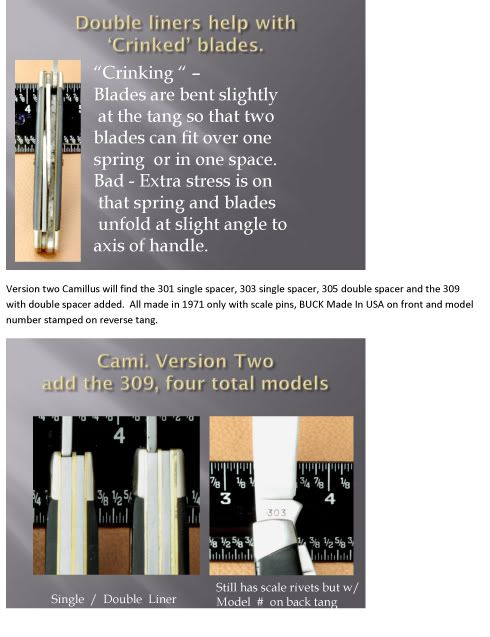
Well, This is one of those details we love to discuss. I am sure a industry wide committee was formed in the early 1800s to clarify the nomeclature. BUT, I don't think so.......You guys have covered the subject well with the available info. I will not argue with the call of the cut-out metal liner being called the 'side center scale'. BUT AGAIN, When I write about it I call it a 'secondary spacer' or a 'cut-out liner'. To me a scale is the outside of a folder, something bone, stag, wood or other substance. The metal is the 'liner'. A piece of metal without a scale attached is a 'cut-out liner' or a 'spacer'. So you will see me use spacer or cut-out liner or even just plain 'double liners' and you can figure out if they are cut-out. Usually or likely I would call it a spacer, because thats what it does, it give space to fit two or more blades into a spot thats too small. The scale is always gonna be what touches my flesh.....as far as Buck folders of my world go the discussion is limited to the older knives. The ones in the center are 'center spacers'. Later two spring models eliminated the 'spacer' by making one spring wider than the other increasing blade well space. Then the center liner was the 'cut-out spacer'.

Begining in 1990ish the Buck factory eliminated the worry of the description when they went to three springs and straight un-crinked blades........300

SMKW2a-2.jpg


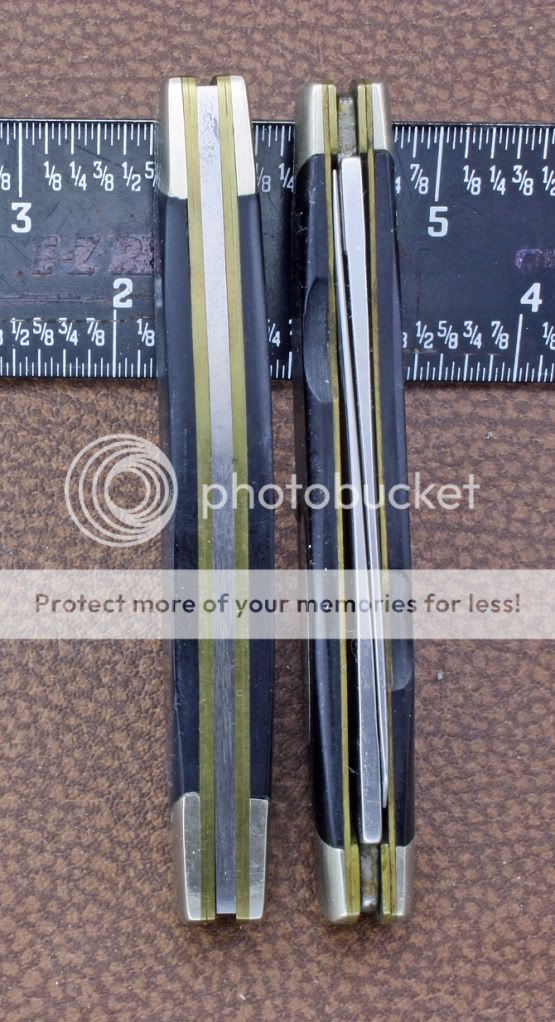
Camillus contract made Buck 313 Muskrat, one spring, two liners and two spacers. (my definitions). And two scales, the black stuff on the outside of the brass.. (Discontinued in late 80s)

313-1.jpg
 
Last edited:
Ah but 300, doesn't it make sense that the knife collecting community should at least use the same vocabulary as the knife manufacturers? Scales and liners are one and the same, but the coverings are either handles or covers. I know the terms have somehow been mixed up on these forums and elsewhere over the years, but at some point they've got to be set right. It's like calling a gunstock the barrel, it's just not what it is.
 
Last edited:
Sure, I can go with standards, lets call it a 'spacer' since thats what it does...... and the metal next to the scale the liner and the part we like to look at and fawn over, that touches our hand the scales....... We can call it the forumite definitions..........~(;- ) 300
 
Last edited:
I don't know the name but I recently learned that "scales" is the correct term. The whole post is worth reading but I quoted the part about the scales.

http://www.bladeforums.com/forums/s...gaps-*Problem-solved*?p=11135151#post11135151


I was surprised when I saw it on the GEC Calf Roper but I've since noticed it on other stock knives. I used the forumite term, double "liner". You might be right about the longer version of its name. ;)

http://www.bladeforums.com/forums/s...EC-66-Stockman-YIPPEE!!?p=9577330#post9577330

man i did not know this. well you learn something if you pay attention long enough.

all good
glad you posted this info

buzz
 
Eric, thank you for correcting my misunderstanding of the function of a catch-bit.
I wonder how many more bits of knife information i mis-understand ?
roland
 
It does make sense to me to use the industry terms so I'm going to use "scales" instead of "liners". Also, I don't want to look like a forumite by using the word "liner"... when I post on the forums. ;) I don't intend to make an issue about it though. I only mentioned it here since the topic is about terminology. 300, use whatever word you prefer... just keep posting those cool photos. :thumbup:
 
Its not a catch bit and its not a liner or scale....its called a spacer. Nothing technical to it...just a spacer.
 
Back
Top