
-
The BladeForums.com 2024 Traditional Knife is available! Price is $250 ea (shipped within CONUS).
Order here: https://www.bladeforums.com/help/2024-traditional/
You are using an out of date browser. It may not display this or other websites correctly.
You should upgrade or use an alternative browser.
You should upgrade or use an alternative browser.
It was only a matter of time, just totally destroyed my b11
- Thread starter 230grains
- Start date


- Joined
- Jun 4, 2008
- Messages
- 1,945
Can I ask how you get so nice and close to the handle? ya know, without hitting it with the belt? And, about how many passes on the sander does it take to do something like that? thanks for the help and the pics!

AZTimT
The Stripetition Finish Guy (inactive)
- Joined
- Oct 15, 2009
- Messages
- 4,506
I wouldn't say they're NICE underneath, but the only dimpling is on the riccaso. Had I been able to chemically strip it and not grind the coating off it probably would have been a lot less work.
You don't like the look underneath? I like it a little better as I don't have to worry about keeping it "pretty".

My B11 coating was tough too. I'll warn you that the same won't-bubble-with-stripper coating is on the Gladius!
 I let it soak and used a little steel wire brush (from the automotive 3 pack of nylon, brass, steel with a toothbrush type handle at walmart or auto parts stores) dipped in the stripper to scrape it off a little at a time as I didn't want to disturb the material underneath. Come to think of it, the sage NMFBM and BOSS Jack gave me the same trouble. The black crinkle NMSFNO, arctic white SFNO and muddy meaner all bubbled up like a teenager with bad skin addicted to sugar.
"Destroying" this one took the most time as I was being careful to get it all off, a homebrew CF style .28 thick partially smoothed sandstorm NMFBM I named Popeye.


- Joined
- Jul 10, 2009
- Messages
- 3,094
How do I get close to the handle? Very carefully.
Time taken? A couple of hours on the grinder. This one is a lot easier to do. An FFBM takes FOREVER in my experience, taking down the saber grind into convex, grinding out the heavy dimpling etc... The worst under the coating IMO is the NMFBM, I wouldn't do another one without some really low grit ceramic belts to attack it. It's convex ground BUT nearly the entire blade is covered in dimples. To strip it it doesn't take that much time, but to achieve a satin finish it takes hours. I've done four NMFBMS, two of mine which were users so the details weren't nearly as important and two for other people where everything had to be perfect. Each time from the start to finish, I was looking at eight hours worth of actual work if you include sharpening time.
Time taken? A couple of hours on the grinder. This one is a lot easier to do. An FFBM takes FOREVER in my experience, taking down the saber grind into convex, grinding out the heavy dimpling etc... The worst under the coating IMO is the NMFBM, I wouldn't do another one without some really low grit ceramic belts to attack it. It's convex ground BUT nearly the entire blade is covered in dimples. To strip it it doesn't take that much time, but to achieve a satin finish it takes hours. I've done four NMFBMS, two of mine which were users so the details weren't nearly as important and two for other people where everything had to be perfect. Each time from the start to finish, I was looking at eight hours worth of actual work if you include sharpening time.
- Joined
- Jun 4, 2008
- Messages
- 1,945
So Tim, the difference on yours is that you don't sand it after you strip it? Im just trying to learn here. I see that 230 sands his to a satin, while your pics seem to me like they look like you might just remove the coating without scratching the metal, so you don't have to sand it afterwards??? I ask, because i am having a hard time visualizing that with a steel wire brush. Doesn't it scratch it too?
And 230, just for instance, the way you get close to the handles and all, how would you go about getting close to the handles on, lets say a NMSFNO with that weird handle where it meets the blade? Im guessing for that you would HAVE to take off the handles??
Thanks again guys, your work is amazing.
Dave
And 230, just for instance, the way you get close to the handles and all, how would you go about getting close to the handles on, lets say a NMSFNO with that weird handle where it meets the blade? Im guessing for that you would HAVE to take off the handles??
Thanks again guys, your work is amazing.
Dave
Last edited:
- Joined
- Jul 10, 2009
- Messages
- 3,094
To get full satin you'd need to take the handles off. On a knife I'm going to beat the hell out of, I don't take the handles off and I hand sand where the slabs meet the ricasso. For actual satin, you're going to need to grind some. If you want to just strip the coating off, use a chemical stripper and a wire brush. There's a reason the factory charges more $$ for a satin finish, it's a lot of work.
- Joined
- Jun 4, 2008
- Messages
- 1,945
But 230 if you hand sand by the ricasso, how do you match it so good with the rest of the blade that is done on the belt? And, if Tim doesn't sand the blade and take all that time to put into it, how would one go about getting the marks from the wire brush out without sanding it? I hope Im explaining this right.thanks
- Joined
- Jul 10, 2009
- Messages
- 3,094
Like I said, if i'm doing it for myself, I generally don't pull the handles as a uniform finish/transition between the blade/riccasso isn't all that important to me. If I'm sanding directly near the handle at all, it isn't to remove dimpling, it's to get rid of the greyish undercoat so generally some hand sanding, then careful grinding against a flat platen takes care of any problems I have. The only not entirely uniform part will be the area directly touching the handle, I get creative sometimes, dowels etc...
If you look close at Tims knives (not the b11 as that is a full height flat grind), but rather the gladius and the NMFBM, you can see dimpling and notice they're very dark. It's a PAIN to get rid of the dimpling on a hardened INFI blade, like I said, thats why the factory charges more for satin finish. Everytime I strip a knife I say i'm going to stop right after I get the coating off, as all of my knives get used. Then I say "Well, maybe i'll clean up the finish some", then before you know it i've got a really heavy grit belt grinding on it, then I have to keep going from there.
If you look close at Tims knives (not the b11 as that is a full height flat grind), but rather the gladius and the NMFBM, you can see dimpling and notice they're very dark. It's a PAIN to get rid of the dimpling on a hardened INFI blade, like I said, thats why the factory charges more for satin finish. Everytime I strip a knife I say i'm going to stop right after I get the coating off, as all of my knives get used. Then I say "Well, maybe i'll clean up the finish some", then before you know it i've got a really heavy grit belt grinding on it, then I have to keep going from there.


- Joined
- Jul 23, 2007
- Messages
- 3,889
It's broken beyond repair.
Send it to me I will dispose of it

Send it to me I will dispose of it
- Joined
- Jun 4, 2008
- Messages
- 1,945
Oh, I think I get it now. But still, no one answered my question. Like on Tim's Gladius, for instance: I don't see any marks from the wire brush....why? did he sand it after the stripping to get RID of those marks? Im still trying to get this right. So, if I understand this right, Tim only uses stripper and a wire brush.......NO Sandpaper, right???
And thanks again, for all the help. Those satin blades are unreal. I like Tim's "CF Finish" look on his Gladius. Any tips on how to start with that for now when mine gets here??
THanks
Dave
And thanks again, for all the help. Those satin blades are unreal. I like Tim's "CF Finish" look on his Gladius. Any tips on how to start with that for now when mine gets here??
THanks
Dave
AZTimT
The Stripetition Finish Guy (inactive)
- Joined
- Oct 15, 2009
- Messages
- 4,506
Yes, they do look better in satin and Mike does excellent work. I'm not competing or knocking anyone else's preferences, I just prefer the aged/antique look and uniqueness of each knife having its own INFI fingerprints with the dimples. Many people don't like them though and want that pristine satin finish. He is not lying when he says it is a pain to get rid of them either! I only put between 45 minutes to 2 hours into mine depending on how hard it is to get the coating off. I also have no belt sander or interest in removing the handles at this point in time. Since I am doing it for me, I go for a certain look and once I achieve it, I just don't pursue it any further and start enjoying it. That is definitely the hard part though, to resist cleaning it up "just a little bit more". 
From the experience of having heavily used the satin, doublecut, coated and CF blades is how I figured out that CF is the least headache for me. It's cheaper, easier to do with common tools and just works without worrying about it. If I wanted a knife to look professionally satin, I would send it in to Busse or to someone who has the tools, experience, time and willingness to do it knowing that while the end results of either will not be identical, both are going to turn out amazing. There is a lot of good talent out there! Keep up the good work Mike! :thumbup:
Dave, to answer your questions on mine, here ya go and maybe this will help out others as well. I'll tell you everything I can think of, but most of it becomes trial and error. If you aren't sure, just start slow and you will build your confidence quickly with experience without messing anything up. If you do make a mistake, you will learn how to not make it again as you think about how to fix it as you are doing it.
Yes, you pretty much nailed it except you forgot about the scotch brite wheel. I use klean strip premium in a big plastic tub. The coating gets brushed away with a soft steel wire brush that is softer than the INFI and therefore doesn't scratch it up as you remove the coating. Do it in fresh air outside if possible due to strong vapors from the stripper. Any areas that are hard to remove just keep brushing with the brush loaded with stripper (the extra strength formula is like a gel you can dip the brush in). A .22 cal bore cleaning brush works well for the talon holes.

When it is all done I use extra fine 1/2" wide x 6" scotch brite wheels mounted on a bench grinder to remove the dark gray residue (I believe it is either an acidic pretreat for coating or the decarb layer that can rust if left on) on the blade under the coating. The scotch brite wheel is also good for cleaning up near the handle if you are careful. This yields the look you see on all my stripped blades. With practice you can get them to look almost identical to a factory competition finish minus the convexed edge. If you get a coarser scotch brite wheel you can take it down to a ghetto satin without the need for a belt sander, but it takes a very, very long time. The NMFBM was finished only with the very fine and the B11 with the coarse.

The only sanding I ever do is near the edge if I am convexing the shoulder of the V-edge so that it blends in a little better. That is done with a mousepad backed 3M automotive sanding disc that mounts to a drill chuck, also available at the auto parts stores, and 80 grit discs. They wear down quickly to somewhere around 100-200 grit around the circumference where you make the most contact so one disc will pretty much do one or two knives. I run mine on my drill press set at 320 rpm and I never get my INFI warmer than I can touch with my own bare hands. At that speed the sanding disc can't hurt you if you bump it, the metal stays cool and I just take my time doing it until I am satisfied with the results.


I also use the exact same discs to smooth the handles and it works very well due to the ability to round them smoothly like I show on my finger below. If I need it the handle really smooth I use a 220 grit disc, but I prefer a little texture for my skin to stick to and 80 grit/320 rpm does just that without showing any visible scratches. I go to either autozone or checker/schuck's/kragen/o'reily auto parts for mine.

From the experience of having heavily used the satin, doublecut, coated and CF blades is how I figured out that CF is the least headache for me. It's cheaper, easier to do with common tools and just works without worrying about it. If I wanted a knife to look professionally satin, I would send it in to Busse or to someone who has the tools, experience, time and willingness to do it knowing that while the end results of either will not be identical, both are going to turn out amazing. There is a lot of good talent out there! Keep up the good work Mike! :thumbup:
Dave, to answer your questions on mine, here ya go and maybe this will help out others as well. I'll tell you everything I can think of, but most of it becomes trial and error. If you aren't sure, just start slow and you will build your confidence quickly with experience without messing anything up. If you do make a mistake, you will learn how to not make it again as you think about how to fix it as you are doing it.
Yes, you pretty much nailed it except you forgot about the scotch brite wheel. I use klean strip premium in a big plastic tub. The coating gets brushed away with a soft steel wire brush that is softer than the INFI and therefore doesn't scratch it up as you remove the coating. Do it in fresh air outside if possible due to strong vapors from the stripper. Any areas that are hard to remove just keep brushing with the brush loaded with stripper (the extra strength formula is like a gel you can dip the brush in). A .22 cal bore cleaning brush works well for the talon holes.
When it is all done I use extra fine 1/2" wide x 6" scotch brite wheels mounted on a bench grinder to remove the dark gray residue (I believe it is either an acidic pretreat for coating or the decarb layer that can rust if left on) on the blade under the coating. The scotch brite wheel is also good for cleaning up near the handle if you are careful. This yields the look you see on all my stripped blades. With practice you can get them to look almost identical to a factory competition finish minus the convexed edge. If you get a coarser scotch brite wheel you can take it down to a ghetto satin without the need for a belt sander, but it takes a very, very long time. The NMFBM was finished only with the very fine and the B11 with the coarse.
The only sanding I ever do is near the edge if I am convexing the shoulder of the V-edge so that it blends in a little better. That is done with a mousepad backed 3M automotive sanding disc that mounts to a drill chuck, also available at the auto parts stores, and 80 grit discs. They wear down quickly to somewhere around 100-200 grit around the circumference where you make the most contact so one disc will pretty much do one or two knives. I run mine on my drill press set at 320 rpm and I never get my INFI warmer than I can touch with my own bare hands. At that speed the sanding disc can't hurt you if you bump it, the metal stays cool and I just take my time doing it until I am satisfied with the results.
I also use the exact same discs to smooth the handles and it works very well due to the ability to round them smoothly like I show on my finger below. If I need it the handle really smooth I use a 220 grit disc, but I prefer a little texture for my skin to stick to and 80 grit/320 rpm does just that without showing any visible scratches. I go to either autozone or checker/schuck's/kragen/o'reily auto parts for mine.
- Joined
- Jul 10, 2009
- Messages
- 3,094
Tim, whats funny is, I actually LOVE the look of your knives and the rustic raw metal. A lot better than my satin actually. They also look A LOT better after use than a satin blade. All my knives look like hell after using them a couple times. I think what happens with me is I always set out to get the finish you get, and get carried away and end up investing ten hours into a knife that I really didn't need to. I'm an insane tinkerer so I always have to say "Maybe if I try it this way this time".
I will say that the next saber ground knife I strip I'm doing it your way with some scotchbrite wheels on my benchgrinder and just convexing the edge on a belt grinder. Either that or I'm buying some tougher belts.
I will say that the next saber ground knife I strip I'm doing it your way with some scotchbrite wheels on my benchgrinder and just convexing the edge on a belt grinder. Either that or I'm buying some tougher belts.
- Joined
- Jul 10, 2009
- Messages
- 3,094
Just put a lot more work into her. Figured I've done this much, I might as well try and make it look a little more "factory" satin. The knife is flat ground, but i've blended it to as close to 0 as possible. I also took down the dimpling on the ricasso. Now I'm happy with it.
I have to say, this knife lends its self to being made amazingly sharp, I took it all the way down to hand stropped on leather and .5 micron diamond compound. I'm sure there's a way to get them sharper, but i've yet to figure it out.
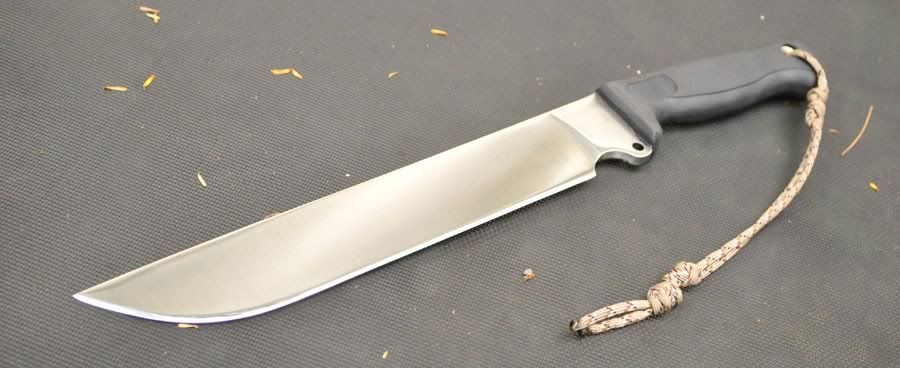
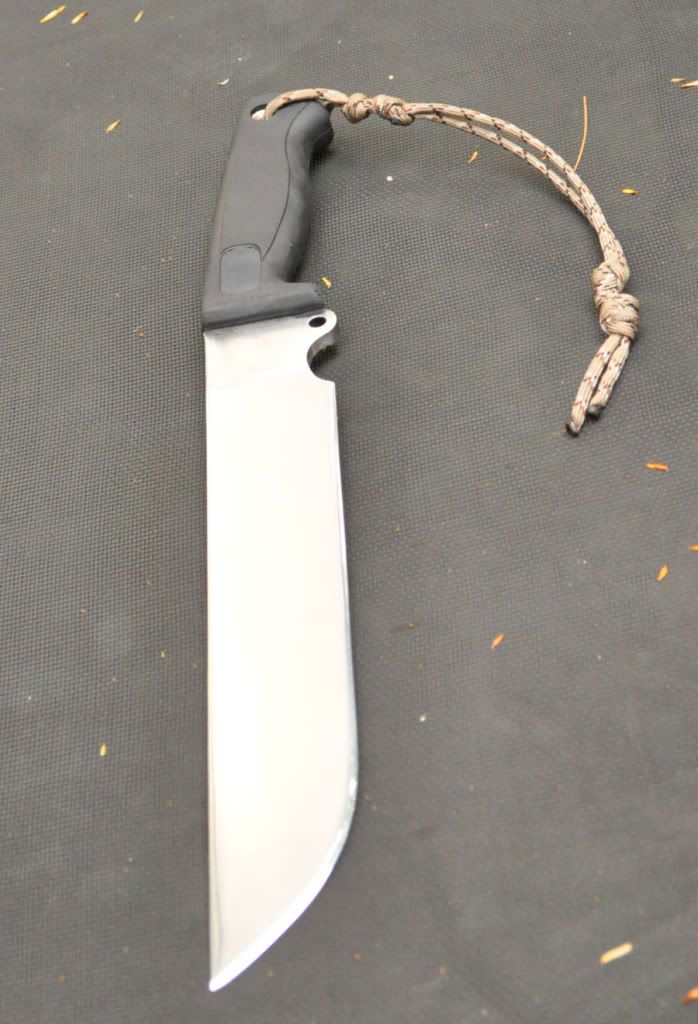
I have to say, this knife lends its self to being made amazingly sharp, I took it all the way down to hand stropped on leather and .5 micron diamond compound. I'm sure there's a way to get them sharper, but i've yet to figure it out.


mymindisamob
Platinum Member
- Joined
- Feb 1, 2005
- Messages
- 15,214
Nekkid INFI rules! I don't let many blades go long without stripping them myself. Nice work by the way.:thumbup:
- Joined
- Jun 4, 2008
- Messages
- 1,945
Wow, thanks so much Tim and Mike. Personally, I also like the look of the more raw looking Infi, as opposed to the satin, just because of how easy it is to scratch it when you use it. You guys really really answered all of my questions on the subject. Thanks to both of you for taking the time to really explain the details.
Dave
Dave
