
Keep these scales or send them back?

Joined
Sep 29, 2009
Messages
1,614
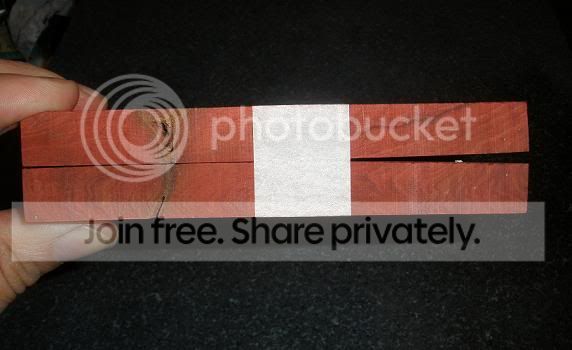
I just received a set of scales and am not sure if this problem is worth dealing with or not. The scales have a but of a curve in them. Now the only scales I've actually put on a knife so far have been micarta and they're naturally rather flat. I'm squeezing them together here so you can see the amount of bow that's in them. looking at them not squeezed the ends don't sit against each other so they're bowed in the middle basically. Is it worth trying to sand these flat? I was thinking if I did I don't know how thick they're gong to be by the time I'm finished. They're 3/8" now and I don't want them to be too thin to work with after I get them flat.

What say you guys? Keep them or return them for a refund?
scales.jpg
 
You should be able to sand those flat and still have plenty of thickness.

Alot of scales don't come flat. Maybe they should but even then, they might not stay flat. I'd just flatten them and not deal with back and forth shipping. Just my opinion. Good luck which ever way you go.:thumbup:
 
if you have access to a mill you can do what i do. i put mine in a mill and take off the high ends and work my way close to the middle but not all the way. once i do that i flip them over and clean up that entire side which becomes the bottom side. final shaping takes care of the other side.
 
Quick pass on the sander will flatten those out, with plenty left over. Might be more concerned with those cracks, unless they're just on the side?

Larry
 
I don't have a mill so that's out. The voids are basically just on the sides I was just more concerned about the bowing.
 
Um.... turn them over.....

Matt, Bill gave some good advice here, at least the way I understood him. When you look at the scales and it is shaped like the letter U, turn them upside down and leave them sit for a while. A lot of the time they will even out on their own.
The scales moved because moisture was escaping from one side of the scale quicker than the other and the ends curved upward.

After they settle a bit flip them again and leave for several hours, then flip again. They should become flat enough that you will be able to true them up on a granite slab by hand with sandpaper. I would wait on truing them up until you are ready to use them. When you finish them be sure to give them a good finish sealing all exposed surfaces to prevent any more movement.

I hope this helps.
What kind of wood are they? Redheart?
 
Last edited:
Matt, Bill gave some good advice here, at least the way I understood him. When you look at the scales and it is shaped like the letter U, turn them upside down and leave them sit for a while. A lot of the time they will even out on their own.
The scales moved because moisture was escaping from one side of the scale quicker than the other and the ends curved upward.

After they settle a bit flip them again and leave for several hours, then flip again. They should become flat enough that you will be able to true them up on a granite slab by hand with sandpaper. I would wait on truing them up until you are ready to use them. When you finish them be sure to give them a good finish sealing all exposed surfaces to prevent any more movement.

I hope this helps.
What kind of wood are they? Redheart?

Damn Mark you should get into the wood business as a profession ;). Yep Redheart they are. IT's a farily hard wood from what I understand so I can do something like a CA finish on them was what I was thinking.

Really... they will usually flatten out after a while? I know you are the man when it comes to this stuff, so I'll give it a shot. God knows I probably have enough wood to last me a few years so I can be patient with letting them sit.
 
Practice your flattening skills. Some day when you buy some mother of pearl and you have to sand them flat with out wasting any material you will appreciate what you have learned now with wood.
Food for Thought.
 
That's not bowing at all. Bowing produces a radius type curvature. Could be the photo angle, but the spaced end just looks thinner than the tight end. What is the measurement exactly? Snipe happens, but should be flattened by the producer. Problem on very inexpensive wood is labor eats up all the profit. Comes under the heading of getting what you pay for and sometimes less.
 
That's not bowing at all. Bowing produces a radius type curvature. Could be the photo angle, but the spaced end just looks thinner than the tight end. What is the measurement exactly?


If you're meaning the measurement between the gap at the other end it's 3/16"
 
No, I mean the actual wood thickness. It appears from the photo the end with the gap has thinner wood . If so it's called snipe. Bowed scales produce a curved gap in the center. Is the wood thickness the same at both ends?
 
I would just sand them flat. That's pretty easy to do. I wouldn't turn them around though. Turning them around would miss-match the grain and wouldn't look good, IMO.
 
Many years ago I used to build two or three custom rifles a year. I had an order for a ultra supreme 26-06 on a Springfield action. I ordered a super deluxe stock. When I got it it had many splits in the grain. I took it down and showed it to a gunsmith friend talking about how poor the quality was. His advice "Send that piece of junk back and who did you order it from?"

I sent it back and they sent me another stock and I finished it up. Some time later I visited my friends shop and saw the most beautiful stock I had ever seen in his custom rack. I asked him where he got that stock, he handed me the rifle, I knew that stock, but could not place it.

Then he told me that it was the stock I sent back. He proceeded to advise me that when I learned to work with materials instead of fighting them and to take advantage of the beauty nature provided I would be a stock maker, until that time I was put a parts changer.

This was a lesson well heard and influences me to this day, over 50 years later!
 
No, I mean the actual wood thickness. It appears from the photo the end with the gap has thinner wood . If so it's called snipe. Bowed scales produce a curved gap in the center. Is the wood thickness the same at both ends?

Larry they're a 1/2 thick at all ends. Maybe it'm going crazy but I've had them turned over since I read the idea. They're still not perfectly flat but it appears to be a bit of an improvement.... Is it possible to have that happen in about 2 days?
 
Ed do I read that correctly? The same friend who said send back the stock, then bought it and used it? Maybe he could have shown you how to work it instead. :-)
 
Sorry to take so long to get back to you, I just got back from Blade Show, It was a great show, one of my best ever!

The lesson learned was that I had passed over one of the finest stocks I had ever seen because of some minor flaws, I wanted perfection, something you never find in nature. He worked with the stock and inspired me to attempt to work with nature and the beauty she gives us. I am still learning, he coached me and I am still learning.

Yes he called the outfit that sold me the stock and bought it from them, for two reasons, first he loved the wood and second he wanted to teach me a lesson I will never forget.
 
Back
Top