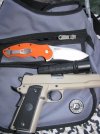
KERSHAW TYRADE G-10 vs SPYDERCO MANIX M2

Funny how most of us ask the big makers for the new fancy blade steel or material, then wonder why the price is so much, lol.

The fancy blade steel where it's going to make a difference, i.e. the edge and not the spine lol

But that still doesn't answer the question: wouldn't a full slab of CPM-D2 be cheaper than going through the compositing process?
 
The fancy blade steel where it's going to make a difference, i.e. the edge and not the spine lol

But that still doesn't answer the question: wouldn't a full slab of CPM-D2 be cheaper than going through the compositing process?

I brought up issues along those lines, i.e. the costs, and never did get an answer.

Good luck getting an honest, straight answer as to the cost of a homogeneous blade versus a "composite" blade.
 
But that still doesn't answer the question: wouldn't a full slab of CPM-D2 be cheaper than going through the compositing process?

Thomas has said it before, IIRC, it`s still cheaper to use the CB technology over using a full premium blade.
 
I sent Thomas a PM to find out.

If I`m wrong, my bad. But if I`m right, next round of scotch is on you, lol.
 
But that still doesn't answer the question: wouldn't a full slab of CPM-D2 be cheaper than going through the compositing process?

Good luck getting an honest, straight answer as to the cost of a homogeneous blade versus a "composite" blade.

orthogonal1 have we not been honest and straight with regards to really any question asked upon us on this forum?

This is a bit of a tough question to answer, as there are many factors that can alter the overall equation.

When doing a costing sheet for a particular model many dynamics can change the matrix. Is this a model we construct and produce in volume, or is it a special project we have never put together before? What are the direct material costs, direct labor costs, factory overhead? Is there a high potential for rework? All these and more are taken into account as we do our precise calculations.

As for the reason, the original Tyrade was designed as a flagship, LE piece. We pursued the composite blade with the Tyrade in such a way that it mirrored the carbon fiber inlay within the front Ti slab. It aesthetically looked the part of a Ken Onion custom, which was our goal. Producing the CPM-154 carriage was again more of us utilizing all premium materials throughout the piece. The goal here was not to be composite blade economical, but to put forth a blade/handle designer piece that could be appreciated by our most valued customers. It indeed personified at the show, and was awarded the Overall Knife of the Year. I don’t think the Tyrade would have received that recognition should we have done a solid blade, no matter what the material.

Picture135.jpg


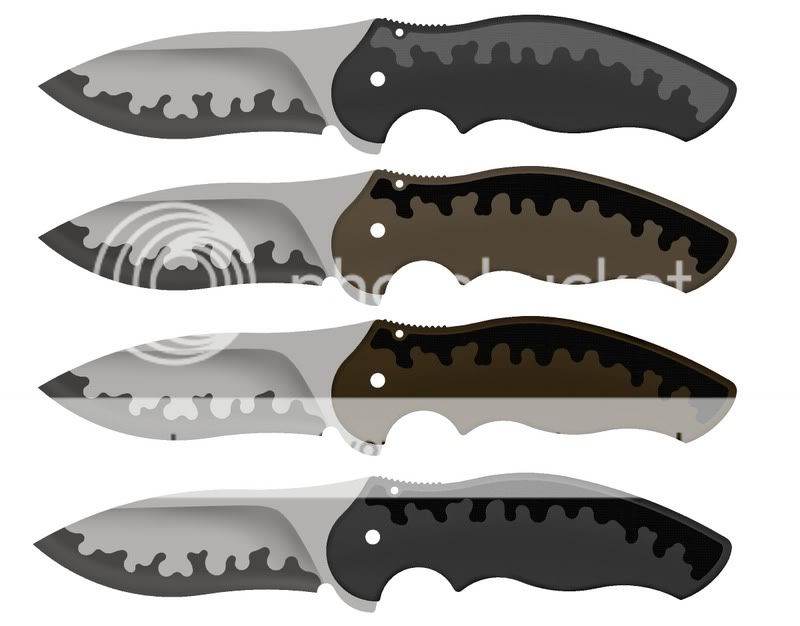
A few early proto concepts

TRIADE5107RENDERINGS.jpg


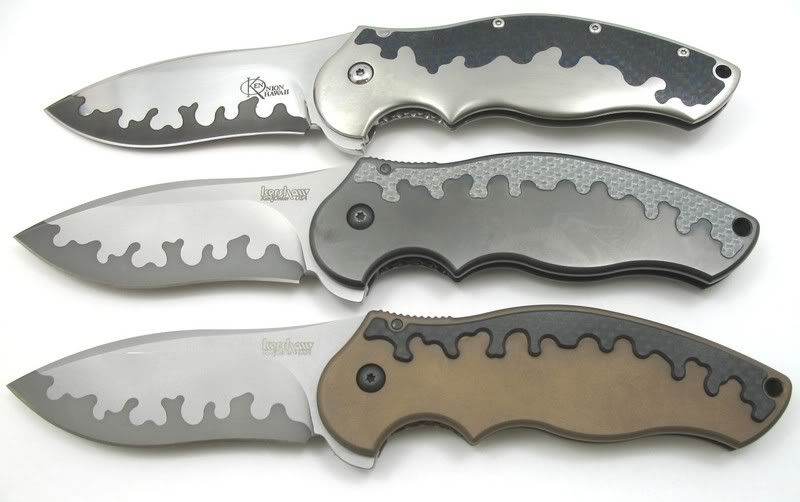
A couple alongside Ken's custom

Tyrade1-1.jpg


These G-10 Tyrades were leftover blades from the original run that didn’t pass QC due to etching issues. We opted to salvage these blades rather than destroy them, so a stonewashed & bead blasted finish were applied. A few boutique runs in G-10 were created, and here is an image of both together.

Picture341.jpg


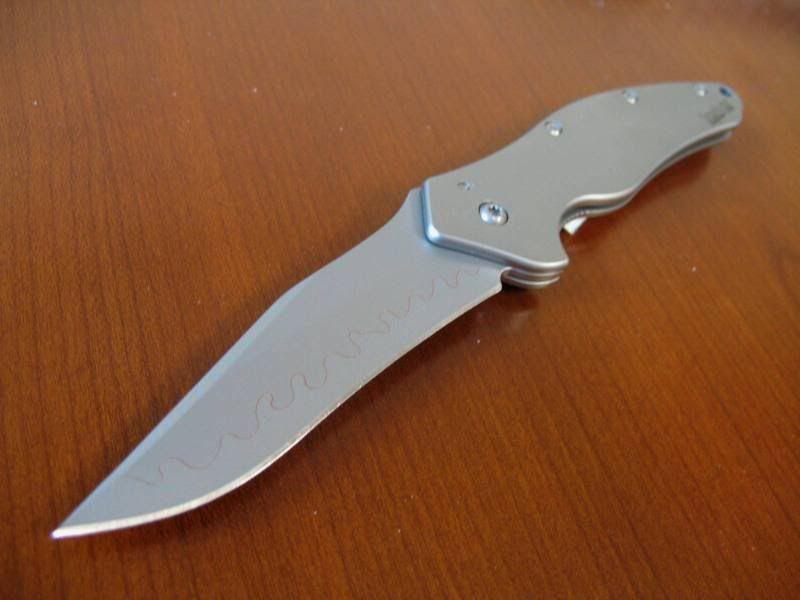
As to CB technology and cost savings, it’s true that it can save up to 30% depending on the project. We have been fortunate that our signature 14C28N Sandvik steel has been a great host with this technology, and we have used it exclusively (outside the Tyrade, and the upcoming Volt, and Speedform) with additional high end steels to create a look to go along with the performance and reduced cost. I've seen street price on a few LE CB, USA made Shallots in a 14C28N/ZDP-189 combo for sub $75 that should prove that out.

Picture256.jpg


Hopefully this helps understand a bit more about our CB’s and pricing. It’s as honest and straight forward as I can be.

 
I think that's a pretty good answer. I also think that the Ti Tyrade below the Onion Custom looks fantastic. Natural Ti color with the silver CF would have been beautiful. How many of those Protoss were made and is it possible to find one in a lifetime?
 
Natural Ti color with the silver CF would have been beautiful. How many of those Protoss were made and is it possible to find one in a lifetime?
Well if I recall correctly, there was only 1 done up in the natural Ti anodizing/silver twill G-10 combo. You don't know where my office is do you Tony? :D
 
Thomas has said it before, IIRC, it`s still cheaper to use the CB technology over using a full premium blade.


That's funny, I never read that.

Where did he say it? When I brought the topic up he was silent.

As to CB technology and cost savings, it’s true that it can save up to 30% depending on the project. We have been fortunate that our signature 14C28N Sandvik steel has been a great host with this technology, and we have used it exclusively (outside the Tyrade, and the upcoming Volt, and Speedform) with additional high end steels to create a look to go along with the performance and reduced cost. I've seen street price on a few LE CB, USA made Shallots in a 14C28N/ZDP-189 combo for sub $75 that should prove that out.

Hopefully this helps understand a bit more about our CB’s and pricing. It’s as honest and straight forward as I can be.

A nice 8 year SM, anything from Speyside will be fine, lol.:D
 
Well if I recall correctly, there was only 1 done up in the natural Ti anodizing/silver twill G-10 combo. You don't know where my office is do you Tony? :D

Fortunately for you, unfortunately for me I don't know the whereabouts of your office. :D It's a beauty though. Love that silver twill G-10. Is it used in anything besides the Blur?
 
orthogonal1 have we not been honest and straight with regards to really any question asked upon us on this forum?

This is a bit of a tough question to answer, as there are many factors that can alter the overall equation.

...

As for the reason, the original Tyrade was designed as a flagship, LE piece. We pursued the composite blade with the Tyrade in such a way that it mirrored the carbon fiber inlay within the front Ti slab. It aesthetically looked the part of a Ken Onion custom, which was our goal. Producing the CPM-154 carriage was again more of us utilizing all premium materials throughout the piece. The goal here was not to be composite blade economical, but to put forth a blade/handle designer piece that could be appreciated by our most valued customers. It indeed personified at the show, and was awarded the Overall Knife of the Year. I don’t think the Tyrade would have received that recognition should we have done a solid blade, no matter what the material.

...


As to CB technology and cost savings, it’s true that it can save up to 30% depending on the project. We have been fortunate that our signature 14C28N Sandvik steel has been a great host with this technology, and we have used it exclusively (outside the Tyrade, and the upcoming Volt, and Speedform) with additional high end steels to create a look to go along with the performance and reduced cost. I've seen street price on a few LE CB, USA made Shallots in a 14C28N/ZDP-189 combo for sub $75 that should prove that out.

...

Hopefully this helps understand a bit more about our CB’s and pricing. It’s as honest and straight forward as I can be.


I'm not sure if it does answer the question as to whether it is less expensive to make.

I understand the potential is there, but the same can be said for MIM blades.

Not sure if street price is a good indicator of cost of production - street price could simply indicate a lower profit per knife is being made.

As a rough guesstimate, what is the savings per blade of a homogeneous cpmD2 blade versus the current composite? A buck, two bucks?
 
Well if I recall correctly, there was only 1 done up in the natural Ti anodizing/silver twill G-10 combo. You don't know where my office is do you Tony? :D

Fortunately for you, unfortunately for me I don't know the whereabouts of your office. :D It's a beauty though. Love that silver twill G-10.

I know where it is. Do I have to come out there or is USPS me sufficient? :D
 
I understand the potential is there, but the same can be said for MIM blades.
MIM is a ways out with it being cost effective, but the same can't be said for CB's. At this point with MIM, there are serious up front costs, and rework/scrapped blades are frequent. Etching (when done) has really been the only problem with CB. There are also no upfront costs associated with any CB project.

Not sure if street price is a good indicator of cost of production - street price could simply indicate a lower profit per knife is being made.
IMO, your changing the subject here. Street price and production costs are obviously quite different, so, let's take MSRP then, a 14C/ZDP combo Shallot runs $135, the same configuration is solid ZDP would run $150+ (sorry for not being exact, but haven't run a true costing sheet). Minimal savings yes (10%), but a savings none the less.
Again it will depend on the pattern being used. If it's a knife we turn and burn 10's of thousands, savings will again be influenced.

Cost savings increase with the more exotic/expensive steels that are out on the market. Typically Crucible steels do not fall on higher end price wise compared to comparable Hitachi, Bohler, etc steel.
 
here's mine, it's my edc......and I'm happy with it!!!!!


attachment.php


attachment.php
 

Attachments

  • IMG_0653.jpg
    IMG_0653.jpg
    69.4 KB · Views: 204
  • IMG_0654.jpg
    IMG_0654.jpg
    40.2 KB · Views: 205
that grey colored tyrade is really nice, inmop that looks way nicer than the tan colored one.
 
As for the reason, the original Tyrade was designed as a flagship, LE piece. We pursued the composite blade with the Tyrade in such a way that it mirrored the carbon fiber inlay within the front Ti slab. It aesthetically looked the part of a Ken Onion custom, which was our goal. Producing the CPM-154 carriage was again more of us utilizing all premium materials throughout the piece. The goal here was not to be composite blade economical, but to put forth a blade/handle designer piece that could be appreciated by our most valued customers. It indeed personified at the show, and was awarded the Overall Knife of the Year. I don’t think the Tyrade would have received that recognition should we have done a solid blade, no matter what the material.

...

As to CB technology and cost savings, it’s true that it can save up to 30% depending on the project. We have been fortunate that our signature 14C28N Sandvik steel has been a great host with this technology, and we have used it exclusively (outside the Tyrade, and the upcoming Volt, and Speedform) with additional high end steels to create a look to go along with the performance and reduced cost. I've seen street price on a few LE CB, USA made Shallots in a 14C28N/ZDP-189 combo for sub $75 that should prove that out.

Thanks for the information.

I'm not sure if it does answer the question as to whether it is less expensive to make.

I think it does. My first question was why was 154CM used instead of a cheaper steel. The answer was because they wanted higher-end materials used all around, and I can understand that. As for whether compositing is cheaper: I think the prices they are sold at as well as Thomas's explanation says it.

Now another question :D

Is compositing a blade cheaper than laminating? That's not considering the "coolness" factor, of course lol
 
MIM is a ways out with it being cost effective, but the same can't be said for CB's. At this point with MIM, there are serious up front costs, and rework/scrapped blades are frequent. Etching (when done) has really been the only problem with CB. There are also no upfront costs associated with any CB project.

IMO, your changing the subject here. Street price and production costs are obviously quite different, so, let's take MSRP then, a 14C/ZDP combo Shallot runs $135, the same configuration is solid ZDP would run $150+ (sorry for not being exact, but haven't run a true costing sheet). Minimal savings yes (10%), but a savings none the less.
Again it will depend on the pattern being used. If it's a knife we turn and burn 10's of thousands, savings will again be influenced.

Cost savings increase with the more exotic/expensive steels that are out on the market. Typically Crucible steels do not fall on higher end price wise compared to comparable Hitachi, Bohler, etc steel.


Sad to hear about MIM. The Offsett is too radical for my daily carry.

You brought up street price with "I've seen street price on a few LE CB, USA made Shallots in a 14C28N/ZDP-189 combo for sub $75 that should prove that out."

So, it appears you're saying any cost savings per unit at this time is minimal at this point.

So, when are these knives with Hitachi, Bohler, etc steel coming?
 
Hitachi is already out. ZDP-189.

The Bohler M390 (?) edge will be out probably September on the RJ Martin designed Volt.
 
Hrrrm. Tough one. Kershaw and Spyderco are my two favorite production knife manufacturers.

I'm gonna say Manix 2. What puts it over the top for me are the details:

-Raised jimping around handle
-Jimping on thumb ramp and throughout radius of choil
-Prescence of a forward choil (which I personally like)
-Large lanyard tube (just a nice touch)
-CRK-esque "pivot bushing"

Truth is, either would be a great companion, but I'm giving the nod to Spyderco on this one.
 
Back
Top