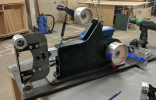
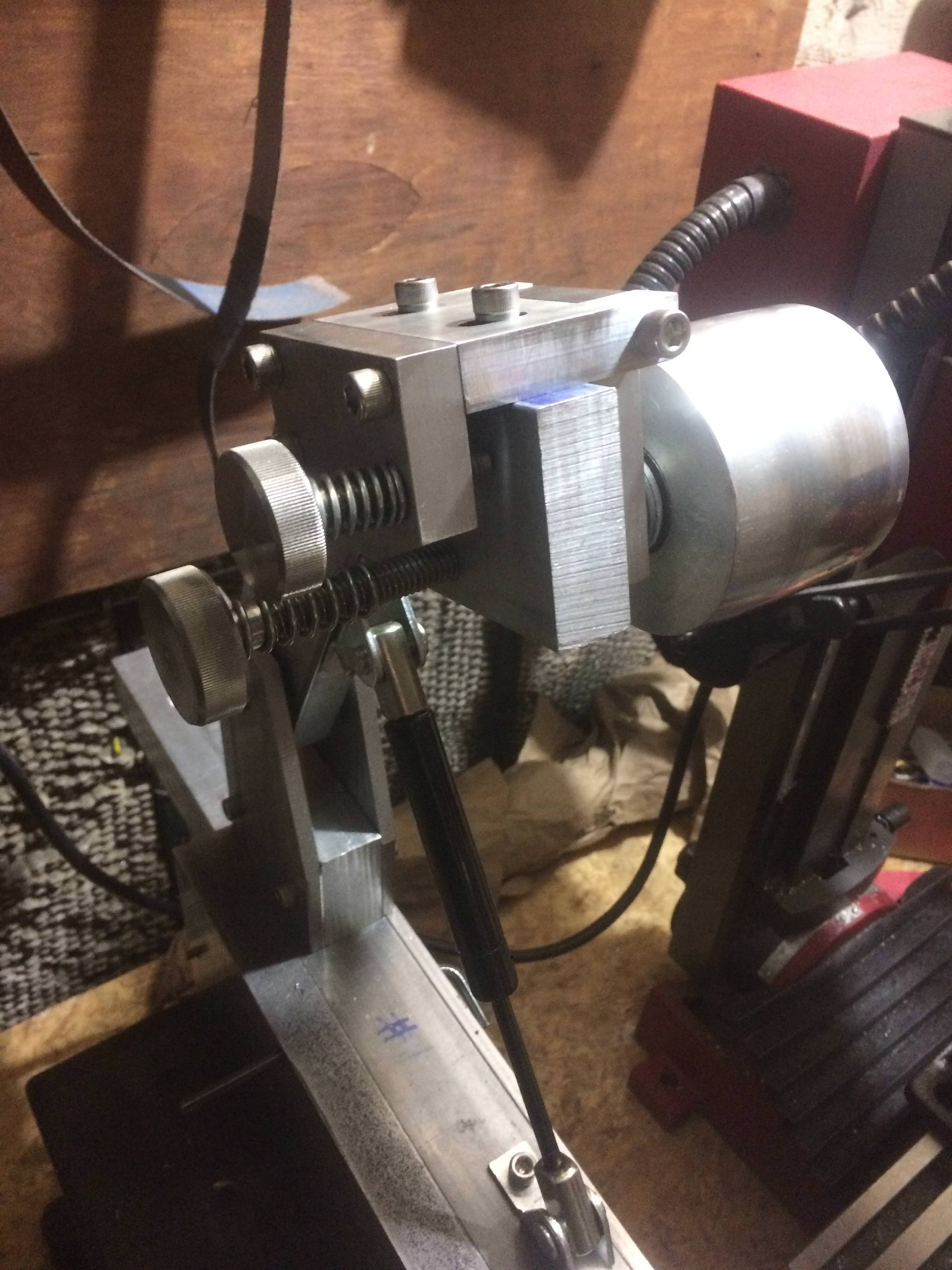
Knife Grinder Build advice

I solved this problem on my KMG by loosening the bolt that fastens the tracking wheel, inserting a 0.005" shim on one side of the bolt, and retightening, thereby changing the rotational alignment of the tracking wheel. As for placement of the shim, it was very counter-intuitive - use trial and error.
 
It sure looked welded on the last pictures. Take the hinge apart. Drill one of the two holes larger. Get a longer bolt and a washer for that hole. It wont be as clean looking, but you'll be able to adjust. Another thing to check would be for burrs or dirt on the face of the motor and the frame.
 
Ok, let's start over.

I am using a 170N gas strut, which I think could be too much tension.

If anything it's on the low end. I use a gas strut with 2x that force. Sometimes drive wheel spin can throw the belt off that would have stayed on (albeit off center). For example, when using a very high friction attachment, a little bit of water on the belt of my grinder causes the drive wheel to spin and throw the belt even though it was tracking properly.

When running the belt in normal operation the tracking wheel is canted over at quite an angle to get the belt to run central on the platen.
In reverse it comes straight off, no matter how I adjust the tracking.

This says to me that there is run out between the drive wheel and the platen wheels. When the belt is traveling from the drive, over the tracking, then to the platen, it can be corrected by an extreme adjustment of the tracking wheel. When running from the drive, over the platen, and then the tracking wheel, it comes off before the tracking wheel can correct it.

I built all of my grinders in very similar fashion as yours with slot and tab assembly of coil plate. The problem with this is that plate is not terribly flat, and the one side that is acting as a reference plane may be throwing the drive wheel axis out of relation, or the stacking of the tool arm, and plate platen arm may be doing the same to the platen wheels. This plate is unpredictable and 75% of the time seems flat enough everything works, but 25% of the time there's some glaring issue that results in symptoms like yours. Without a CMM it's almost impossible to measure which axis has the most deviation from the theoretical reference plane.


I have experimented with moving the tracking wheel position on the shaft (in and out) and it doesn't have any significant effect. What seems to make a bit of difference is the height of the tracking arm, the higher it is the more angle is required on the tracking wheel. That said I only have 40mm of adjustment on the arm, and I imagine the force exerted by the strut changes over that distance too.

I would shim the tracking wheel out to the point that when the adjustment axis is "level" and the tracking adjustment is nominal (face of the tracking wheel is parallel to the face of your reference plane) the center is in the same plane as the center of the drive wheel. Then leave it for the time being.

I didn't notice if you mentioned, is your drive wheel crowned or flat? I'm a huge proponent of only 1 crowned wheel per system. Every tracking issue I've personally had was impossible to resolve until I eliminated any crowned wheels other than the one doing the tracking.

That said, start with shimming the drive motor in one axis like P.Brewster described. Shim one side out. Test a belt by hand. What does it do? If it wants to slide off the machine, note which direction. Remove the shims and shim the other side of the motor. Test by hand again. Does the belt move off in the same direction as before? I like doing this kind of trouble shooting with drastic changes, because the results are more observable. Shim it .030" one way, then the other. If the belt comes off in opposite directions, you know that the resolution lies between +.030 and -.030. If the belt comes off with +.030 but at -.030 it just goes over center without coming off, then you likely know that the solution is between .0 and -.030.

If the results are indeterminable with shimming the drive wheel, then the problem may lie in your platen wheels.

I can't work out what element of the geometry is skewing it. Or whether it is the pulleys which are the problem. I bought the pulleys from an ebay seller in poland who manufactures them. They were quite cheap. From eyeballing it it could be that the tracking wheel is not quite evenly crowned.

I've bought really cheap pulleys, chinese, american made, fiber, aluminum, even made a couple myself. Outside of limiting a system to a single crowned pulley, they all work fine.

 
Same as others have said, but I would cut slot (red in photo below) in the tracking bracket so that you can twist the hinge in both directions (blue arrows) to adjust for any jankyness in your tracking arm pivot, etc.

 
As I think someone mentioned before, I’d run the belt over JUST the drive and platen wheels. Just pull the tool arm out as tight as you can by hand. If it tracks center, you know for sure it’s your tracking wheel that’s throwing things off.
 
I can't work out what element of the geometry is skewing it.
You can try this to check alignment .You can use some true flat wood board . you can use even some thread .Set them /wood board or thread/ on the drive wheel to touch both sides and move them on both idler wheel to see if they are parallel .Then check tracking wheel with drive wheel ...use tracking bolt to get that wheel as much as you can to be parallel to drive wheel .Even better is to check tracking wheel with one of idler wheel , provided that idler wheel a OK with drive wheel ....Somewhere you have misalignment which will be visible by eyes if you try this way :thumbsup:
BszOTk5.jpg


PS. If idler wheel are parallel with drive wheel , take of gas spring and lower down tracking arm and then check alignment between idler and tracking wheel .....
 
Last edited:
I built a grinder that isn't nearly done as nicely as this one. Getting everything shimmed up and lined up didn't take me very long at all....maybe 20 minutes. Cheap plastic wheels on it.
Looking at your last picture it seems like your drive wheel is crowned...maybe that is it?
 
Any angular run out on a crowned wheel will try and override whatever the tracking wheel is doing. In perfect alignment, it's probably not a big deal. None of our grinders have perfect alignment. Flat wheels have almost no influence on the belt path until the angular run out of them is severe, like visible to the eye. But slight changes in a crowned wheel cause relatively large belt path changes. More than 1 crowned wheel is like trying to drive with your mother in law screaming at you in the back seat. "Why didn't we go that way?" "Oh look a sign did you see the sign I didn't know they had signs here DID YOU LOOK?" pretty soon you just drift over the centerline and into that bridge abutment for the sweet silence death will bring.
 
Thank you everyone.
Sorry that I am not being that quick at implementing all of your insightful recommendations.
I will hopefully have some time next week to do more testing.
This is the most responsive and helpful forum I have ever encountered!!
The drive wheel is indeed crowned.
I'll run it with the drive and platen and see what happens.
Then I will throw the drive wheel on the lathe and take off the crown.
Then I will triple check alignment etc
Then I will slot the tracking arm bracket for skew adjustment.
Will update as soon as I can.
 
"Dueling" crowns can pose a problem, but if I'm not mistaken, it's normally a left/right shimmy, rather than throwing belts completely off.
Part of the issue could also be a bow in your flat platen plate, which would cause your idlers to skew. Do you have a contact wheel you could try, or any other attachments? If not, you might bolt one of your flat platen idlers directly to a tool arm (spaced out so that wheel centers still align) and see if that's an improvement. You may need a longer tool arm due to the smaller diameter of the wheel though.
Alternatively, you could remove the platen and one idler from your platen frame and see if tracking improves one way or the other.

Before completely removing the crown, I might also just reduce the angle by 1/2 of what it currently is, and see what effect that has too.

I'd also recommend starting with a fresh belt, as your current belt may be stretching out on one side.

I know we're throwing a lot at you at once. Good luck!
 
"Dueling" crowns can pose a problem, but if I'm not mistaken, it's normally a left/right shimmy, rather than throwing belts completely off.
Part of the issue could also be a bow in your flat platen plate, which would cause your idlers to skew. Do you have a contact wheel you could try, or any other attachments? If not, you might bolt one of your flat platen idlers directly to a tool arm (spaced out so that wheel centers still align) and see if that's an improvement. You may need a longer tool arm due to the smaller diameter of the wheel though.
Alternatively, you could remove the platen and one idler from your platen frame and see if tracking improves one way or the other.

Before completely removing the crown, I might also just reduce the angle by 1/2 of what it currently is, and see what effect that has too.

I'd also recommend starting with a fresh belt, as your current belt may be stretching out on one side.

I know we're throwing a lot at you at once. Good luck!

If the tracking wheel and the drive wheel are both crowned and have conflicting alignment in the red axis, I think that's where you see a "shimmy" because they fight each other and cause that wobble. If they're misaligned in the blue axis, that's where you get belts thrown off except in extreme travel of the tracking wheel. That's my belief anyway. Red axis movements make relatively small belt moves, small movements in the blue axis make big belt movements. That's why on a grinder that tracks on the motor, you want a long lever between the adjustment screw and the hinge, where you have a very short lever on a tension arm tracking grinder.

upload_2018-8-11_11-33-27.png


For example my latest build, only the drive wheel is crowned and the motor rotates in the blue axis for tracking. It will throw the belt from one side of the contact wheel to the other with about half the angular travel required on my tension arm tracking grinder.

1F64SWN.jpg
 
If the tracking wheel and the drive wheel are both crowned and have conflicting alignment in the red axis, I think that's where you see a "shimmy" because they fight each other and cause that wobble. If they're misaligned in the blue axis, that's where you get belts thrown off except in extreme travel of the tracking wheel. That's my belief anyway. Red axis movements make relatively small belt moves, small movements in the blue axis make big belt movements. That's why on a grinder that tracks on the motor, you want a long lever between the adjustment screw and the hinge, where you have a very short lever on a tension arm tracking grinder.

View attachment 963630


For example my latest build, only the drive wheel is crowned and the motor rotates in the blue axis for tracking. It will throw the belt from one side of the contact wheel to the other with about half the angular travel required on my tension arm tracking grinder.

1F64SWN.jpg
Kuraki, I can't figure out how that works in horizontal. Is there a clearance hole in the main plate with nuts on each side to maintain position when changing belts?
 
You mean to keep the motor from tipping too far? There's nothing yet but I was going to add something like you describe when I figured out what the maximum adjustments needed for tracking were.

It doesn't need to maintain position since tension in the belt brings it back to where the set screw is set. Just keep from flying the other way.
 
This is the tracking wheel setup I designed for my build. Both my drive & tracking wheels are crowned, and it tracks perfectly in either forward/reverse. Im running a 50lb has spring. Could go heavier and it would be the same.
j21SMKV.jpg
 
Last edited:
Back
Top