KnifeMaker... What do you use to finish your edge??

I use a rod guided sharpener I made, and then a leather belt. I really like the precision I can achieve, and knowing the sharpening angle . I just got a 2X72 leather belt for power stropping. I tested it dry on a knife and I was very impressed. It should rock with some compound.

IMG_6604.jpg
 
I'm just in the final stages of making my first knife, but have quite a bit of sharpening under my belt (pardon the pun). Richard turned me on to the paper wheels and I've since grown to really like them. Right now, I work up a Burr at 220 on the craftsman, then power strop on the slotted paper wheel loaded with green compound. After that, a few passes on loaded linen. Whittles hair every time... just have to be careful not to burn the steel with the fast-moving grinder or sharpen off the tip, as with any belt sander.
 
for knives its a used 9micron belt that is run wet and slow then a few strokes on a CrOx loaded leather bench strop (4x12 ish in size)
for razors 12k or 16k hand hone and a barbers leather strop i am looking at a 20k grit tho jsut to see
 
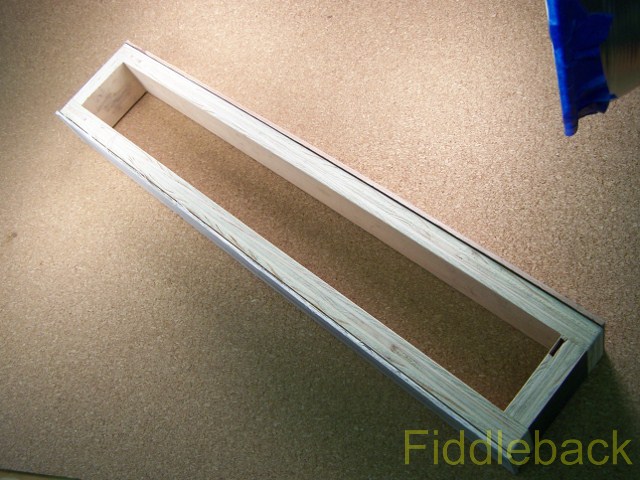
Its plywood, ripped 2" wide and joined into a long rectangle. The top and bottom sides are 24" long and the sides are 3". This allows you to clamp it to the table for stability, and to clamp sanding belts to the faces for sharpening. The long length lets you have a very long stroke with the knife against the abrasive, which, I find allows for great control of the angle by hand/eye. One face is covered in thick leather, for convexing, and the other side has a strip of balsawood glued to it. The compound I use on the Bals wood is a spray on liquid I bought after seeing it at Blade Show. It is roughly 600 grit, but you can really go fine with this stuff! In this picture you can see the fixture, and the layers glued to each face.

20110815101_4384-vi.jpg


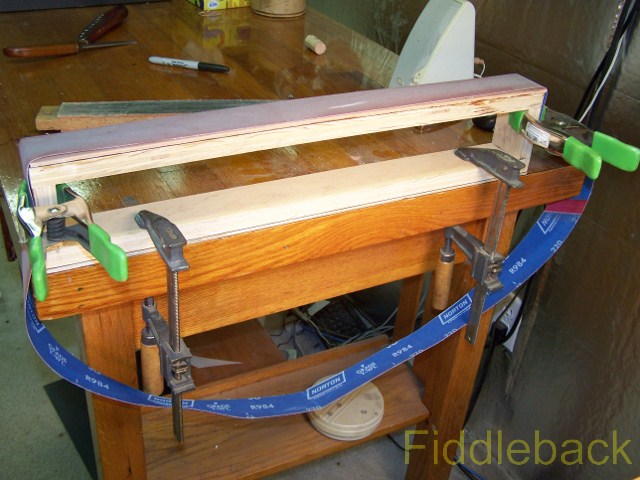
In this pic, you can see the fixture clmaped to my desk, and a 2x72" 240 grit belt clamped tightly to the sides. Ready to start sharpening. After 240 I go to a 400 grit belt, then switch to the balsa side to finish, then strop. For Scandi's, I've been just using the balsa side and strop. It really excels at Scandi's.

20110815101_4388-vi.jpg


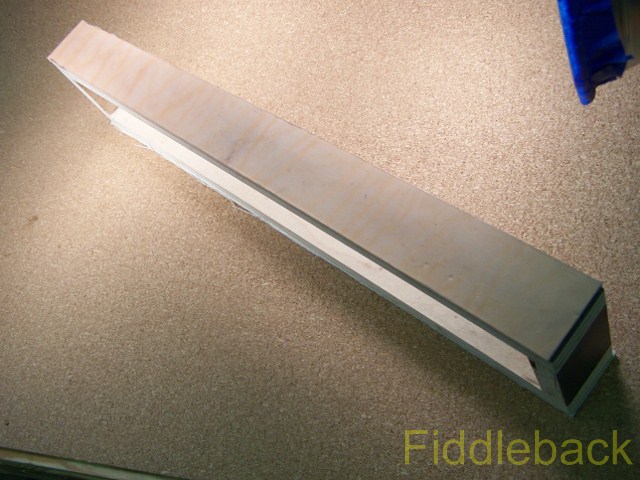
Leather side:

20110815101_4385-vi.jpg


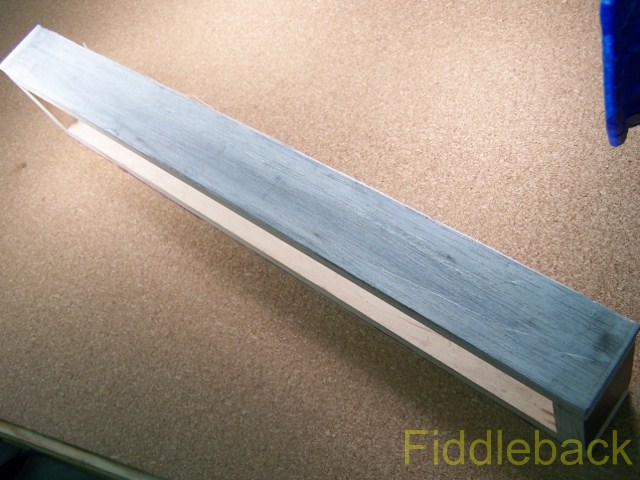
Balsa side with compound.

20110815101_4386-vi.jpg
 
@ alb1k :
Sweet sharpening rig! :)

btw, how did you attach the stones to the rod? I see metal-backing which is welded (?) to the rod. But what's between the metal backing and the sharpening stone itself?

I also used spherical rod-ends (spherical joints) in a sharpening rig. If you're curious, there's a thread here:
http://www.bladeforums.com/forums/s...Inspired-by-WickedEdge-and-ApexPro-Pict-Heavy

The stones are attached to metal 1" strap with epoxy. I used the same strap (backing) on the rod and spot welded it. I used low profile velcro to attach the stones to the rod. I think the same set up would work fine with your sharpener.
 
I have used paper wheels, japanese water stones, 2x72 belts and regular washita and black arkansas stones and they all do an excellent job. Currently, I use the wicked edge system as when I send them off to a customer I can tell him the exact angle to use when the time comes to re-sharpen. Yes, it takes a little longer but I am not into this for the cash as I would be on short rations if so. JW
 
i used to use a guided system and many times i would clamp up a blade i have sharpened before and start to resharpen it only to have the stone cutting somewhere else on the edge other than where the edge actually is. sometimes it would start to cut on the shoulder and other times it would start to cut on the very edge like a micro bevel.

has anyone ever really thought about how the guided systems work? in order to have a set angle you need 3 points to be of a certain length in order to have the angle be correct. if any of the 3 lengths are off then the angle is off. if you sharpen a knife say 2" wide and then one that is 1 1/2" wide with the rod in the same slot, the angle is going to be different on both knives. getting the blade in slightly angled can change things too. a knife that has a ffg blade can be a hassle too.
 
Last edited:
i used to use a guided system and many times i would clamp up a blade i have sharpened before and start to resharpen it only to have the stone cutting somewhere else on the edge other than where it actually is. sometimes it would start to cut on the shoulder and other times it would start to cut on the very edge like a micro bevel.

has anyone ever really thought about how the guided systems work? in order to have a set angle you need 3 points to be of a certain length in order to have the angle be correct. if any of the 3 lengths are off and the angle is off. if you sharpen a knife say 2" wide and then one that is 1 1/2" wide with the rod in the same slot, the angle is going to be different on both knives. getting the blade in slightly angled can change things too. a knife that has a ffg blade can be a hassle too.

I see what you're getting at. Good explanation of what is essentially high school trigonometry.

Of course, as you've discovered ... even if you have the angle correct, it's possible to get the position wrong (and end up putting a micro-bevel in place, for example). I've had this happen to me, too.

In the machine shops associated with the physics labs where I've worked, I've seen a number of fairly elaborate systems for controlling position and angle in three dimensions -- to prevent problems such as this. The more modern systems use 3-axis micro-positioners with micron (a micron is one millionth of a meter) position accuracy and precision. These really modern systems are often used in ultra-high vacuum systems or when producing high-quality optics.
 
The more modern systems use 3-axis micro-positioners with micron (a micron is one millionth of a meter) position accuracy and precision. These really modern systems are often used in ultra-high vacuum systems or when producing high-quality optics.

That's what I use :D ;).

I set the edge on a slack belt with a sharp 220, move to 400, and then to a dull 800 loaded with rouge. I'll either leave them at that or gently thin out the bur with a buff. To finish, I use a leather strop block or take a gentle higher angled pass on the buff. To clarify, when using the buff, I'm not really applying any pressure to the edge, just bringing it into contact,

--nathan
 
After Roman Landes' presentation at Ashokan on what happens to steel during the sharpening process, including the analysis he did of what happens at the extreme edge when blades are sharpened without coolant (water or oil) in which he found that even sharpening by hand on a stone without coolant the last few microns of the edge heat up from friction enough to ruin the hardness, I no longer establish my edges on the belt, I put my final bevel and initial edge on blades by hand with DMT brand diamond stones wetted with water with a little dish soap added to increase wetting. According to Roman's presentation of his research any time you are grinding the edge dry, whether by hand on a stone, or on a grinder with abrasive loaded (paper) wheels or a belt you are ruining the only part of the knife that actually matters, the edge and the couple of microns of steel that support it

-Page
 
Page, does he have any documentation/research available for mass consumption? I'd like to check out his work.

--nathan
 
I recently bought the paper wheels and can say I will never go back to any other type of sharpening. I took a knife that I had just made with no edge at all to shaving sharp in less than 2 minutes, and I was being very conservative and could of done a much faster job but I took my time instead.
 
Page, does he have any documentation/research available for mass consumption? I'd like to check out his work.

--nathan

Here's his book, he has promised us an English version soon. By day he is a turbine metallurgist for a Rolls Royce Jet engine division in Germany, in his free time he makes some of the sharpest kitchen knives you will ever see.

http://www.amazon.de/Messerklingen-Stahl-Technologische-Betrachtung-Messerschneiden/dp/3938711043

He has a lot of other material out there as well, but most of it is in Deutsch

-Page
 
i think that some guys think too much :D. i have ground tool bits on a lathe and had them hot enough to sizzle water and they still turned steel just fine all day long. it takes a lot more heat to ruin an edge than what most people think. it takes a lot more heat to ruin an edge than what is created when sharpening by hand or by powered equipment of any kind (unless you hold the blade in one spot too long and burn the blade)

i find it hard to believe what roman says. i know the knives i make hold up really well and i sharpen them on a belt sander and finish the edge with the slotted paper wheel.

today when i made this post i was not feeling well and was not clear in what i was saying. one thing i meant to say that the part i find hard to believe is that a small piece of burr that comes off an edge hand sharpening can hold enough heat to burn someone in the eye.

i know that an edge can be ruined by too much heat but i'm wondering if the ammount of heat caused by any of the powered sharpening systems that run dry is enough to worry about when it comes to blade life. will it cause a blade to cut a few feet less of cardboard or peel one less apple?
 
Last edited:
i think that some guys think too much :D. i have ground tool bits on a lathe and had them hot enough to sizzle water and they still turned steel just fine all day long. it takes a lot more heat to ruin an edge than what most people think. it takes a lot more heat to ruin an edge than what is created when sharpening by hand or by powered equipment of any kind (unless you hold the blade in one spot too long and burn the blade)

i find it hard to believe what roman says. i know the knives i make hold up really well and i sharpen them on a belt sander and finish the edge with the slotted paper wheel.

until you understand the difference between the high speed steel or carbide that lathe bits are made of and the spring steel that John Deere cultivator discs are made from that you told me you torch cut your blanks from, further conversation is pointless. From what I remember from Roman's lecture, Roman's analysis of the thermodynamics of sharpening came about when he was dry sharpening and a small fleck of the wire edge (burr) hit him in the eye and stuck. The doctor that removed the fleck of steel from the surface of his eye informed him that it had actually burned the eye where it hit so he started investigating why. Believe what you want, my money is on the German Metallurgical Engineer.

-Page
 
Maintaining an extremely sharp edge during normal use is about impossible. You can sharpen a knife to the point that a strand of hair can be pressed against the edge and *bink* half the hair is gone. And cut apart one cardboard box and that cool showy edge is gone. It might still shave hair okay, but it won't be truly razor sharp (a badly abused term).

Roman is probably sharpening at a very acute angle, which might tend to contribute to that heat problem. I believe he also did a lot of work optimizing razor blades for disposable razors. In his world, maximizing the durability of a very sharp edge probably dictates wet grinding, whereas someone with a thicker edge and reduced extreme-fine-edge stability requirement might not notice as much of a difference.
 
i think that some guys think too much :D. i have ground tool bits on a lathe and had them hot enough to sizzle water and they still turned steel just fine all day long. it takes a lot more heat to ruin an edge than what most people think. it takes a lot more heat to ruin an edge than what is created when sharpening by hand or by powered equipment of any kind (unless you hold the blade in one spot too long and burn the blade)

i find it hard to believe what roman says. i know the knives i make hold up really well and i sharpen them on a belt sander and finish the edge with the slotted paper wheel.

IMHO, I've always found just about anything you say hard to believe.

Very interesting that even you have finally conceded that belt grinders are better than those stinking wheels. Never thought you would get it.

Now if you could only apply the same logic to a loaded leather belt, you could spend the rest of your days undoing the mis-information you've been spouting for years.

I'm sure further discussion is pointless for me too.
 
Back
Top