Knifemaking PITA moments ;)

The procedure is to rout out the handle to a depth of about 1/32-1/16", leaving a 1/8" border around the perimeter (use a 1/4" ball burr on a flex shaft/dremel). Then flatten the border and tang to be a perfect fit. This creates an epoxy reservoir that will assure a good bond. Now you can glue up and clamp away with little or no oozing and a perfect fit. I do the same on the ends of a hidden tang handle. You only need it to seat on the guard along the edge. Gaps are easy to eliminate if you take the center of the handle out of the situation.

Stacy,

Do you rout out the inside of the handle material or just the tang?

Also, do you not clamp the middle of the handle while it's glued up?
 
Last edited:
My biggest disappointment moment seems to be getting straight holes drilled in my hidden tang handles. I measure everything three times and the hole is always a half degree off or so. I have a decent drill press but the thing doesn't spin dead straight. Seems to wobble just a teeny bit. I don't know if it's bearings or a bent spindle or what but it is annoying.

Are you starting your holes with a center drill before using a regular drill bit? This prevents wobble on the surface and guides the drill bit in a straighter direction. If your drill press wobbles the bit, though, I can see how you have problems. Maybe, it's not your press but your chuck? Often, the chucks on presses leave a bit to be desired. . . . Just some thoughts.
 
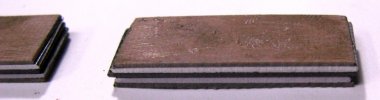
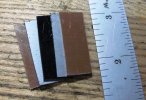
This was a PITA as well. G/flex left overnight for curing. G10 liner slipped and cured out of place.

Bob,

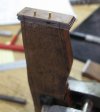
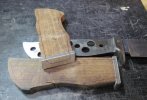
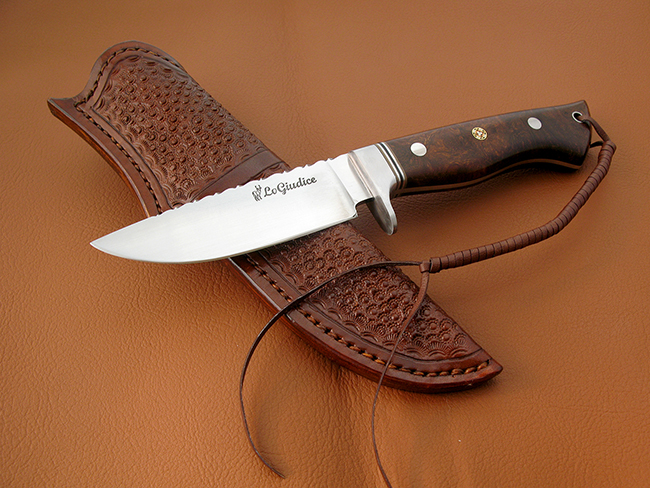
I drill and pin each spacer onto the guard-side face of the handle scale with 2 different 1/16" diameter pins to prevent their movement during glue-up or forever after. It takes quite a bit of extra work to get things flat and squared.

There's a lot of photos and steps left out, but I glue spacers together using CA, attach them to the scale with CA, mark, drill, pin, and then square them up.

IMG_6585_600.jpg

IMG_6594_600.jpg

IMG_6605_600.jpg

IMG_6607_600.jpg

IMG_6723_650.jpg


Mike L.
 
Mike, i was gonna ask you how you did that. Thanks a lot.

If you ever had a chance to elaborate on your methods on this process I would be all ears. Very beautiful knives
 
My biggest PITA is just that I never seem to get a straight run through a batch. Always seem to get a knife or two that I muck up in some way and have to spend a bunch of time fixing. I've started making checklists now for my whole process which seems to be helping in terms of planning things out. Who knows, maybe one day I'll do the equivalent of bowling a perfect game... Something to work toward anyway :)
 
I've started making checklists now for my whole process which seems to be helping in terms of planning things out. Who knows, maybe one day I'll do the equivalent of bowling a perfect game... Something to work toward anyway :)

This is what got me into trying to fully document my entire "best" process, in order to avoid my usual mistakes. The intent was that I would go through a quality checklist before proceeding into the next step . . . kind of like an instruction sheet on how to make my knives. The only problem is that the steps keep evolving as I learn more.
 
Realizing that the deep etch I just made isn't parallel to the spine, and knowing I just cut the value of the knife at least 30%.

I'm also still not overly excited by grinding bevels. The next thing I buy is going to be a 2x72 with a VFD and flatter platen, and then build some new jigs. I have to spend too much time hand sanding to get them flat and symmetrical off of my current grinder.
 
Every step in the process can be aggravating, really. The only way I get anything finished is sheer stubbornness. :D
 
Are you starting your holes with a center drill before using a regular drill bit? This prevents wobble on the surface and guides the drill bit in a straighter direction. If your drill press wobbles the bit, though, I can see how you have problems. Maybe, it's not your press but your chuck? Often, the chucks on presses leave a bit to be desired. . . . Just some thoughts.


I don't use a center drill but I do punch the starting points so the bit doesn't wander. The hole doesn't end up off to the side of the intended hole by a fraction of a degree it ends up at an angle to the center line of the intended hole. So when I insert the tang into the handle block the blade is not in a straight line with the handle but canted a bit. I think the wobble problem might be that the chuck got knocked out of alignment by the previous owner. I have a small Harbor Freight drill press which I was using for precision work like handle pins Etc. Then I accidentally bumped the chuck and got the same problem as the floor standing drill press. It took a little while to knock it straight again. The chucks are just press fit, correct? I suppose I could try knocking the chuck straight on the big drill press.
 
Last edited:
Yes, AFIK, all drill chucks have a taper where they mate to the driveshaft.

The most common taper for chucks is the Jacobs Taper (JT). JT are numbered. Midway down this wiki is the dimension of the different JT. http://en.wikipedia.org/wiki/Machine_taper

The two usual causes of out-of-round conditions in chucks is a raised burr on a chuck jaw or debris inside the ways of jaws (i.e. the groove where the chuck jaws live). Jacobs chucks are rebuildable, and you can purchase rebuild kits rather cheaply assuming the chuck body is not damaged. Hit up youtube for instructions on rebuilding a chuck.

If your chuck is beat, or not a Jacobs or other reputable brand, they are surprisingly inexpensive (given the materials and precision involved) to purchase and upgrade your machine. If I were made of money, I'd put an Allbrecht keyless chuck on every drill I owned. :)

To buy the correct chuck, you need to remove the old one and determine which taper your drill press has, and order accordingly.

Another aspect of removing frustration from hole drilling is sharp drill bits. I bought a Drill Doctor a number of years ago, and have been extremely pleased with it. A dull drill is the work of the devil. It makes you lean real hard on your drill press, causing both the drill bit and drill press to flex, causing oversize holes. Seriously, at $140, a Drill Doctor 750x is a very reasonable long-term investment -- you never have to replace drills, and you can even sharpen carbide masonry bits to cut hardened steel!

 
Stacy,

Do you rout out the inside of the handle material or just the tang?

Also, do you not clamp the middle of the handle while it's glued up?

Wood is a lot easier to remove than metal, so I do the material removal on the handle scales. I often drill extra holes in the tang to allow the epoxy to bridge from one side to the other. This is called "epoxy rivets" or "epoxy pillars". I clamp the handle with several light force clamps. Usually three of them - end, middle, end.

If you were referring to my statement about "the ends of a hidden tang handle", what I was referring to was a one piece handle with a blade having a stick tang. Many people try and make the end of the handle fit against the guard as a flat-to-flat joint. I chamfer the tang hole in the handle out toward the edge so it only leaves a small flat rim. This makes fitting the handle much easier as well as puts epoxy on the guard for a more secure seal. If you made the joint flat to flat and it was perfect, all the epoxy would get squeezed out of the joint when the handle was clamped against the blade and guard in curing. The tang would be secure, but a tiny crack could open up between the guard and handle due to swelling and shrinking.
I will probably get some shop time later today. I'll shoot some photos when I am out there.
 
Yes, AFIK, all drill chucks have a taper where they mate to the driveshaft.

The most common taper for chucks is the Jacobs Taper (JT). JT are numbered. Midway down this wiki is the dimension of the different JT. http://en.wikipedia.org/wiki/Machine_taper

The two usual causes of out-of-round conditions in chucks is a raised burr on a chuck jaw or debris inside the ways of jaws (i.e. the groove where the chuck jaws live). Jacobs chucks are rebuildable, and you can purchase rebuild kits rather cheaply assuming the chuck body is not damaged. Hit up youtube for instructions on rebuilding a chuck.

If your chuck is beat, or not a Jacobs or other reputable brand, they are surprisingly inexpensive (given the materials and precision involved) to purchase and upgrade your machine. If I were made of money, I'd put an Allbrecht keyless chuck on every drill I owned. :)

To buy the correct chuck, you need to remove the old one and determine which taper your drill press has, and order accordingly.

Another aspect of removing frustration from hole drilling is sharp drill bits. I bought a Drill Doctor a number of years ago, and have been extremely pleased with it. A dull drill is the work of the devil. It makes you lean real hard on your drill press, causing both the drill bit and drill press to flex, causing oversize holes. Seriously, at $140, a Drill Doctor 750x is a very reasonable long-term investment -- you never have to replace drills, and you can even sharpen carbide masonry bits to cut hardened steel!


Thanks for all that info. I'll definitely look into that. I have the DD 750X. It is a good bit of kit for sure.
 
Wood is a lot easier to remove than metal, so I do the material removal on the handle scales. I often drill extra holes in the tang to allow the epoxy to bridge from one side to the other. This is called "epoxy rivets" or "epoxy pillars". I clamp the handle with several light force clamps. Usually three of them - end, middle, end.

If you were referring to my statement about "the ends of a hidden tang handle", what I was referring to was a one piece handle with a blade having a stick tang. Many people try and make the end of the handle fit against the guard as a flat-to-flat joint. I chamfer the tang hole in the handle out toward the edge so it only leaves a small flat rim. This makes fitting the handle much easier as well as puts epoxy on the guard for a more secure seal. If you made the joint flat to flat and it was perfect, all the epoxy would get squeezed out of the joint when the handle was clamped against the blade and guard in curing. The tang would be secure, but a tiny crack could open up between the guard and handle due to swelling and shrinking.
I will probably get some shop time later today. I'll shoot some photos when I am out there.

You're awesome Stacy, thanks! I've been just grinding on my tang and not the scales. Do you do both the tang and the scales/handle material?
 
I started out with various box cutter/utility knives. I still use them for certain things, but I'll never do away with the head knife. They just cut smoother for me. For tight radius cuts tip the handle back faaar. At times the wood is nearly touching the leather. A super sharp head knife will burnish the edge too.

There are some great deals on vintage knives, don't buy a crappy (new) Tandy knife.

The worst part of sheath making for me is forgetting to put a d ring on the belt loop before sewing it up. I've also forgotten to put a Sam Browne stud on (and lining it) before cementing the top panel to the welt.

I've gotten pretty good at taking a finished sheath apart. Box cutters are good for cutting the glue line. :o
 
Goof-ups on the finish is the big one. Burning handle material. Not so much anymore, but overgrinding a handle.

The list used to be really long but I've since narrowed it down :)

I overground the butt-end of an ironwood handle just a few weeks ago. And I'll second that it's frustrating - especially when it's a material that costs more than the blade steel. I think my biggest one is using the mini files too much on one side of the tang slot on guards.

Oh, and Stezann; some slow cure epoxies can be cleaned up with a damp paper towel before they fully cure. I have to do this frequently with JB Weld.
 
This is what got me into trying to fully document my entire "best" process, in order to avoid my usual mistakes. The intent was that I would go through a quality checklist before proceeding into the next step . . . kind of like an instruction sheet on how to make my knives. The only problem is that the steps keep evolving as I learn more.

I see the same thing for sure, my checklist keeps changing! I think that's ok though, it still beats just having to remember everything I think!
 
Its always a 2 steps forward and 4 steps back thing for me.

The smallest things in the beginning of starting your knife build absolutely affect the later processes. Some dumb little thing in the beginning throws everything off later.

If I scratch a blade, well the handle likely has to come off now. That means I have to completely re-do the handle, which means I have to make a whole new kydex sheath because its molded to/for the old handle.

I would say that Kydex scratches are the absolute bane of my knifemaking. I've almost literally cried over that.

Rust/stains are another. I've used cans and cans of various waxes and spray lubricants, but it still gets me sometimes. I cant help but use carbon steel though!
 
Bob,

I drill and pin each spacer onto the guard-side face of the handle scale with 2 different 1/16" diameter pins to prevent their movement during glue-up or forever after. It takes quite a bit of extra work to get things flat and squared.

There's a lot of photos and steps left out, but I glue spacers together using CA, attach them to the scale with CA, mark, drill, pin, and then square them up.

Mike L.

That is a very useful tip Mike. I've been thinking about doing some liner stacks and I will definitely put this to use.

Bob
 
I can't believe no one has mentioned hand sanding. I usually make knives in batches of 3 or 4. When I get to the hand sanding stage, I sometimes start another batch. Then I get that to the hand sanding stage and, well, start another batch. Then I have 8 to 12 knives that need hand sanding. It isn't like there is much to screw up with hand sanding (other than the occasional fish hook), but it is the part of knifemaking that I enjoy the least. I spend anywhere from 45 minutes to a couple hours hand sanding knives depending on their size and what grit I want to take them to. I would love to hire that portion out to someone at minimum wage, until minimum wage goes up to 13 bucks an hour! I like the end result enough to do it, but just barely.
 
I can't believe no one has mentioned hand sanding. I usually make knives in batches of 3 or 4. When I get to the hand sanding stage, I sometimes start another batch. Then I get that to the hand sanding stage and, well, start another batch. Then I have 8 to 12 knives that need hand sanding. It isn't like there is much to screw up with hand sanding (other than the occasional fish hook), but it is the part of knifemaking that I enjoy the least. I spend anywhere from 45 minutes to a couple hours hand sanding knives depending on their size and what grit I want to take them to. I would love to hire that portion out to someone at minimum wage, until minimum wage goes up to 13 bucks an hour! I like the end result enough to do it, but just barely.

Yeah I hear that. For me it's made worse by the fact that hand sanding really makes my hands hurt the next day or two. I always seem to suffer from any process that's repetitive, and hand sanding is a huge culprit.

I've finally decided that I actually don't much like satin finishes. They look great when they leave the shop, but it doesn't take much time in the woods to make them look pretty gnarly. And often fear of getting that first scratch seems to hold people back from really using their knives. That's a big part of the reason which I've decided to at least try switching to a tumbled finish...
 
Back
Top