Learning to make knives WIP (Changed Title)

Joined
Dec 5, 2013
Messages
1,180
UPDATE 2/27/2014: Rather than start another thread I decided to change the title on this and just update it as I try, fail, learn and grow.

I wasn't going to do a WIP on my first knives because I am the type of person who doesn't like to show anything but my best work. I'm going to have to eat a little humble pie here and get some help. I posted a thread a while back asking about a design for my first knife. Some thought it was too complex while others thought I should go for it. Nothing ventured, nothing gained...right? I decided to start with making three knives that I felt would allow me to explore many different aspects/techniques of construction. All three are similar in design, made from 440c, but are different in finishing techniques/materials.

This will be more of a coaching WIP. I will likely skip posting some steps in the making of these knives. I will be asking a lot of questions on techniques and posting back on how it worked out. There may not always be a chronological sequence to the build since I am doing three knives.

So, I will just jump in here. This knife is based on the design I posted in another thread. It is modified some for a friend who wants to use it for dressing out deer.

Untitled by Ranger_Bob, on Flickr

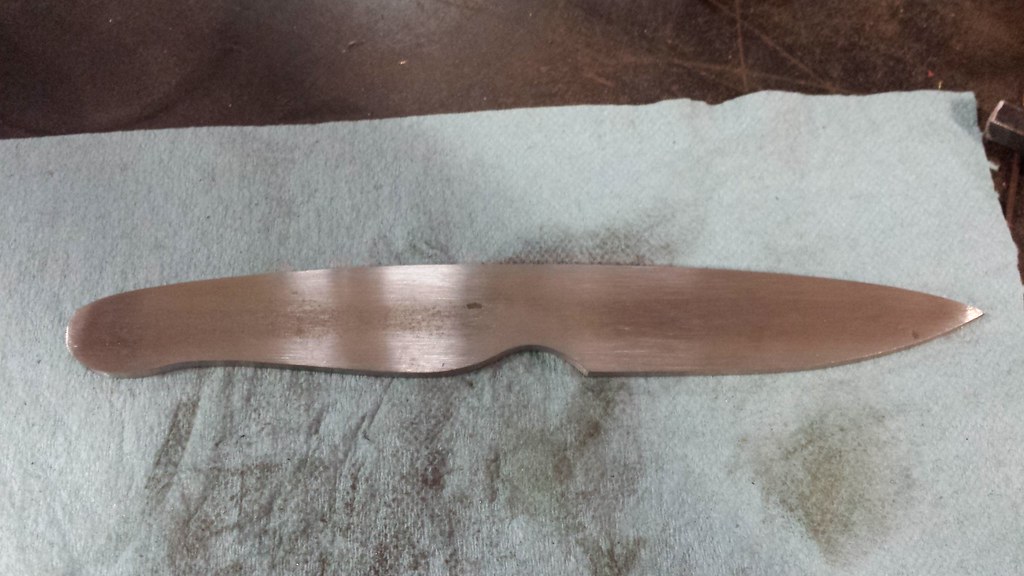
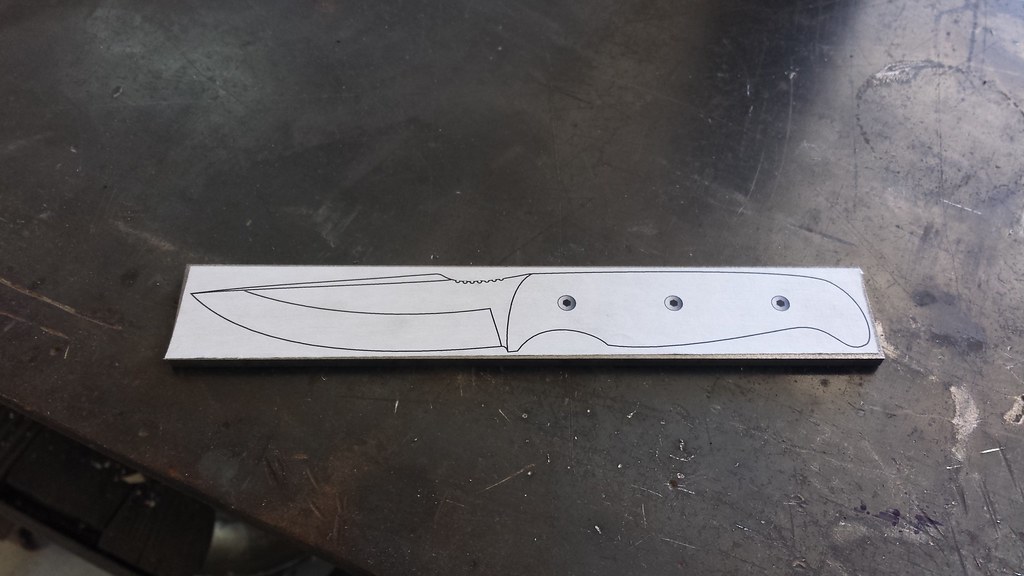
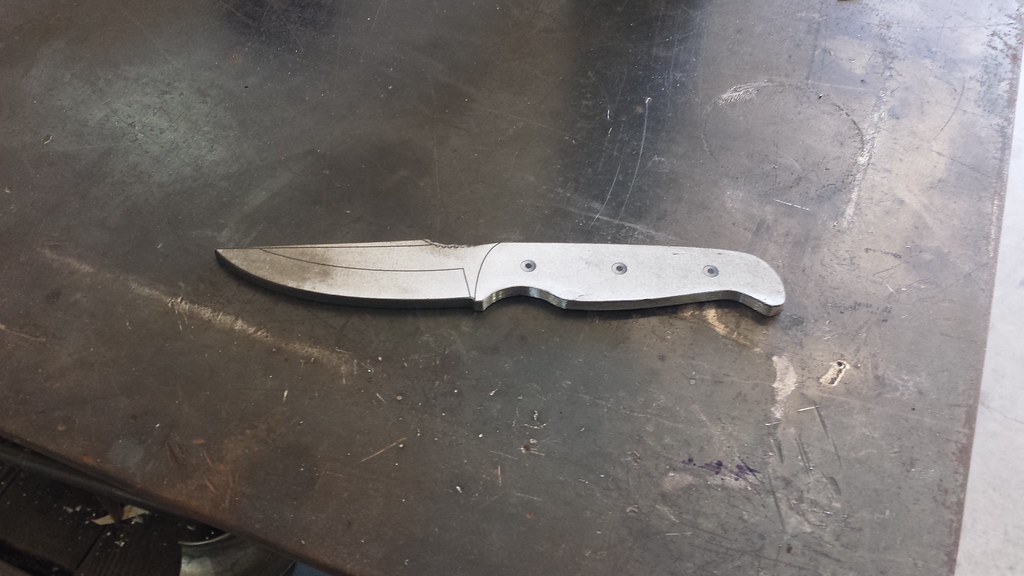
Since I was only going to make one in this shape, I thought I could just glue the paper to the steel and profile on the grinder. The glue kept heating up and the paper would come loose. Since I couldn't dunk the blank with the paper attached, I would have to wait for the steel to cool and the glue to re-adhere. Lesson learned!

Untitled by Ranger_Bob, on Flickr

It did work however! I would not use this technique again.

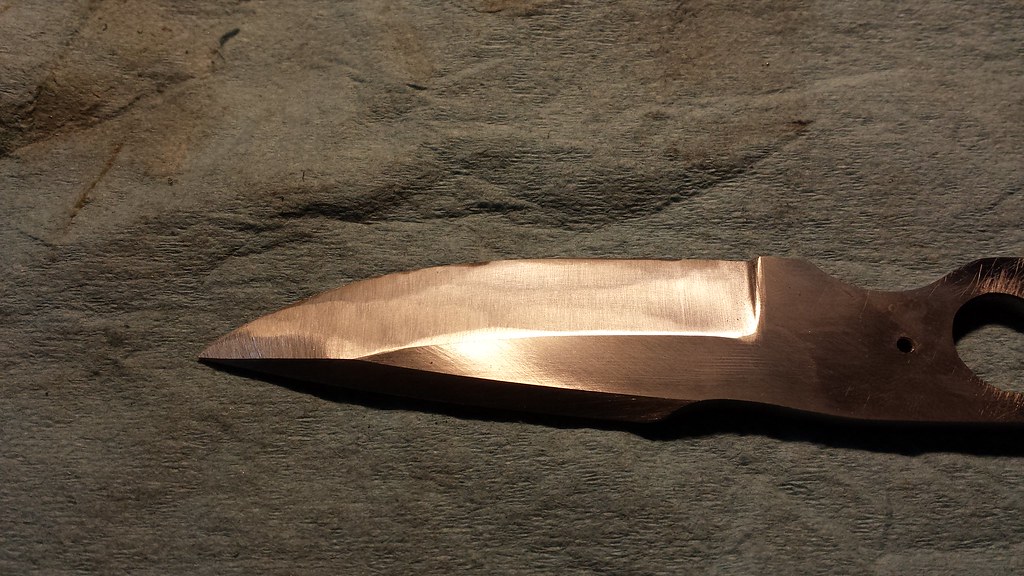
Below is my first ever flat grind. I had already profiled another knife and attempted a hollow grind. I will show that knife later; I don't think I ruined it...yet.
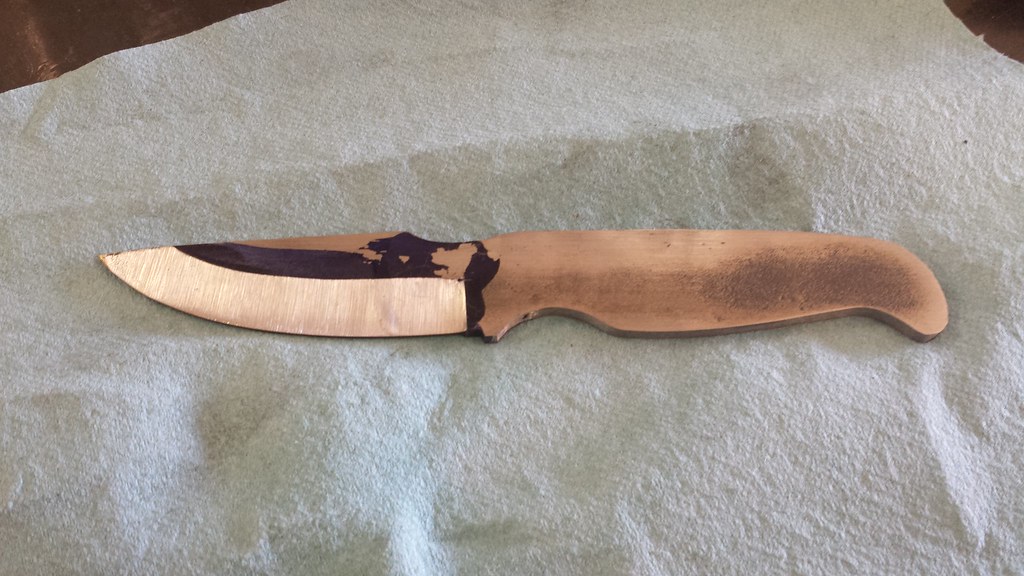

Untitled by Ranger_Bob, on Flickr

Here's the blade a little further along. You can see I've penciled in some changes on the drawing. This knife will have 304L bolsters, stabilized/dyed maple burl scales, 1/4" mosaic pins and a liner that has yet to be determined. I know it is not really a skinner.
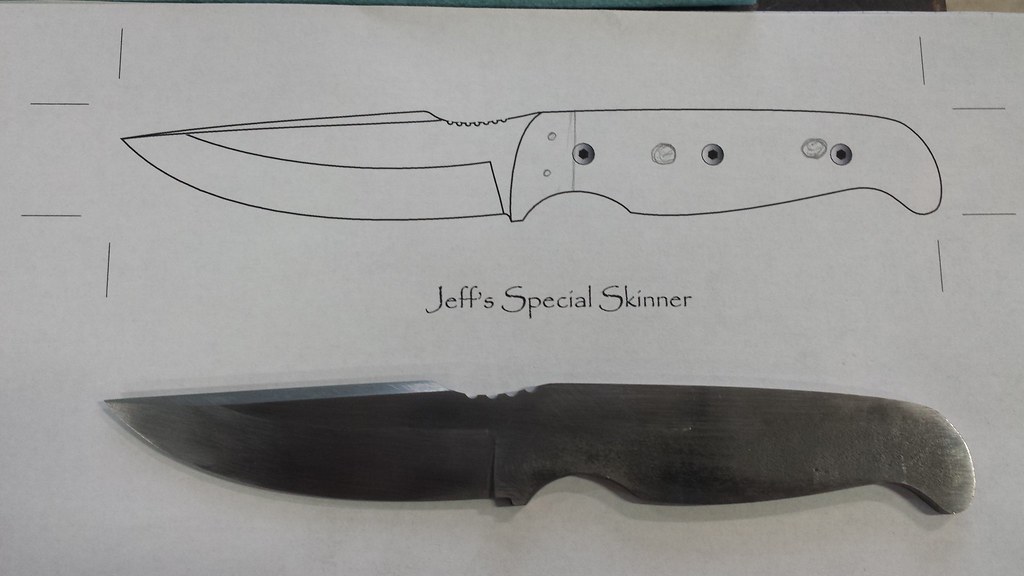

Untitled by Ranger_Bob, on Flickr

Here's where I am now. I made the bolsters yesterday and I don't like them. I think the front edge needs to be ground at an angle. I don't know if I can adjust these or if I need to start over.
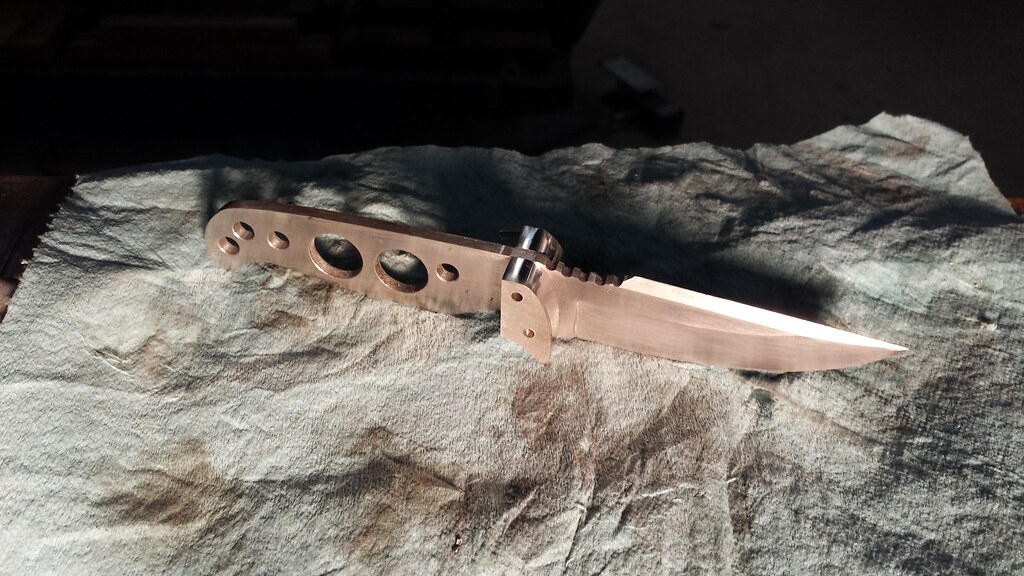

Untitled by Ranger_Bob, on Flickr

I am open to any suggestions on what and how to improve. I specifically would like some advice on how to proceed with the bolsters right now. The knives are all still pre-HT.

Bob
 
Last edited:
I use files not grinder to profile blades; however, I have had success with the 3M 77 spray adhesive. It seems to plasticize the paper and is at least water resistant.

OT
 
What I do with bolster,you already have the front of the bolsters finished that is good, now pein the bolster to the blade with some brass pins,then shape the bolster to your likeing. I get mine to about 80% finished before attaching the handle scales.
The reason to use brass pins is so you can see them to tap them out with a punch after shaping. To attach permanantly,taper the holes and leave about .060 pin sticking out each side and pien them on. Start with a smaller hammer 4oz or so and get them good and set then switch to a BFH and pound them good. The pins will hide every time.

Stan
 
Last edited:
What I do with bolster,you already have the front of the bolsters finished that is good, now pein the bolster to the blade with some brass pins,then shape the bolster to your likeing. I get mine to about 80% finished before attaching the handle scales.
The reason to use brass pins is so you can see them to tap them out with a punch after shaping. To attach permanantly,taper the holes and leave about .060 pin sticking out each side and pien them on. Start with a smaller hammer 4oz or so and get them good and set then switch to a BFH and pound them good. The pins will hide every time.

Stan

Thanks Stan. Exactly what I needed. You make some fantastic looking knives!

Bob
 
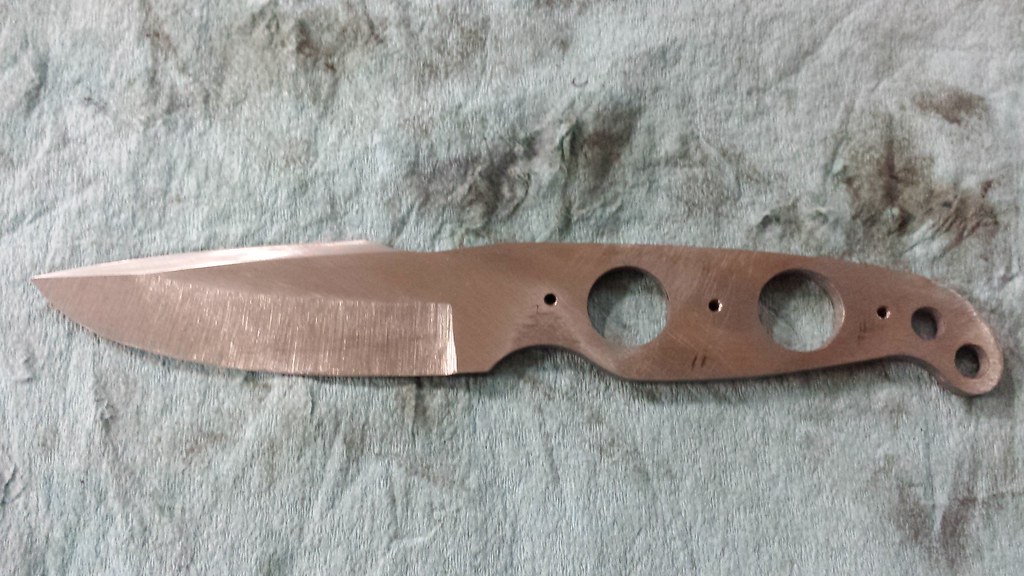
This is my first blade of the three which makes it the very first blade I profiled and ground bevels on. The hollow grinds are not very consistent. I felt most comfortable grinding these at about 1/3 speed with a 120grit belt. 1/3 speed on my grinder is probably about 1200 feet per minute. This knife will get a milled black peel-ply G10 handle w/OD G10 liners attached with countersunk stainless socket head screws. It has a 1/4" lanyard hole but I've not decided if I will use it or not. If I do put a lanyard hole in the scales, I will add a flared stainless tube in the hole.

Bob


Untitled by Ranger_Bob, on Flickr
 
I took the blade from the previous post back to the grinder to see if I could clean up the hollow grinds with a 220 belt. I made it significantly worse. I do believe this one is now ruined. It is at zero edge in several spots and it is very inconsistent. I know a lot of people think the hollow grind is easier than the flat but I just can't seem to get it. I think I will have to cut up some mild steel and just practice. I'm pretty disappointed in how this one ended up.


Untitled by Ranger_Bob, on Flickr

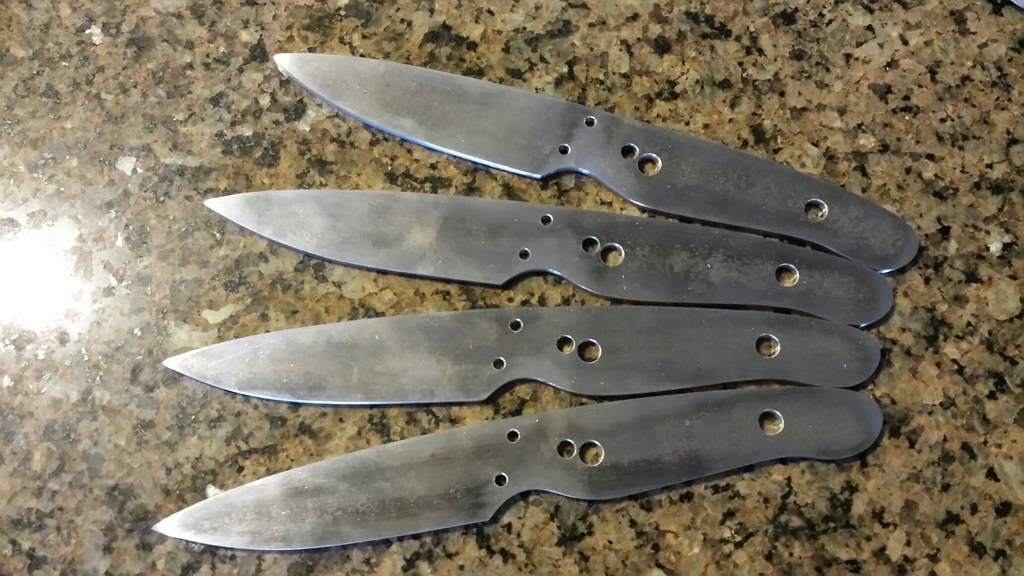
This is the third knife. This is 1/8" 440C and I think I'm just going to drill holes and send it out for HT. It will be flat ground and I will try to do it all after HT.


Untitled by Ranger_Bob, on Flickr

Bob
 
Today I followed Stan's advice about temporarily pinning the bolsters on. Pinning and shaping the bolsters went nicely. I really hammered the pins to make sure they wouldn't come loose while shaping. So getting the pins back out was a pretty serious task. I got them off eventually. I would say my lesson-learned here was when you go to knock the pins back out, support the blade as close to the pins as possible on a very solid surface and hit the punch with plenty of accuracy and confidence. I started out a little tentative and wasn't getting much done. The pins and opposite bolster came off the knife as one piece. I cut the pins off the back of the bolster and punched them out into a piece of a 2x4. Wish I'd have thought to take pictures of the ordeal.

I also drilled the holes in the blank for the third knife. I actually drilled holes on four identical blanks. I guess I won't have a first knife; I'll have first knives! But I do have a first screwed up knife so maybe that counts for something. The two pin holes next to each other are because I haven't decided on handle options for all of them yet. The two 1/4" holes are for if I use bolsters and the additional 3/16" hole is for if I don't use a bolster. Best laid plans...right?

Bob


Untitled by Ranger_Bob, on Flickr
 
After thinking about it for a while and having a little success grinding another knife using a simple jig, I decided to go ahead and grind these four identical blades (shown in previous post) before heat treat. Here's one of them; all four came out about the same.

I'm starting to figure out my belt sequence. I am knocking the edges off freehand with a used 50 grit Blaze. I'm bringing the edge back on a 45 degree angle and then running a quick 30 degree grind on the sides just to keep the grit on my other belts. I'm not cutting all the way into the lines like some do; I don't feel I'm accurate enough to try that. Once I've knocked the sharp corner off, I switch to a new 60 grit Blaze, clamp the blade to a vise jaw from my Kurt, and grind down to my lines. I just do a straight plunge about 1/4" in front of where I want the final grind to end up. I then switch to a 120 grit Blaze to refine the grind and cut the cleaner plunge. I'm hanging the 120 grit belt over the edge of the platen about 3/16" just to soften its cutting action slightly when shaping the plunge.

I'm still trying to figure out what to do after the 120 grit. I tried a Trizact A45 but it is too stiff to work into the plunge. It does cut really flat though! I ordered some Norzon 120 and 220 grits and some 400 grit Hermes RB346MJ A/O belts from Tru-Grit to see how they work for me. I've already determined that I'm not a real fan of the J-Flex belts because of the bump at the splice.

Bob


Untitled by Ranger_Bob, on Flickr


Untitled by Ranger_Bob, on Flickr
 
Well, I made a great beginner mistake on the knife from the first post. I started playing around with the filework on the spine and succeeded in making it look like crap! So, I cut out another and made a few adjustments to it. I lowered the butt of the handle about 1/2" so that the tip will be more inline with the turning motion of the wrist and I also flattened out the thumb notch on the spine so I could do a cleaner pattern with my new checkering file. I also decided to taper the tang instead of skelotonizing it with drilled holes.

Bob


Untitled by Ranger_Bob, on Flickr
 
So I changed the title of this thread. Rather than starting a bunch of new threads I will just update this thread as a kind of log as I learn knifemaking.

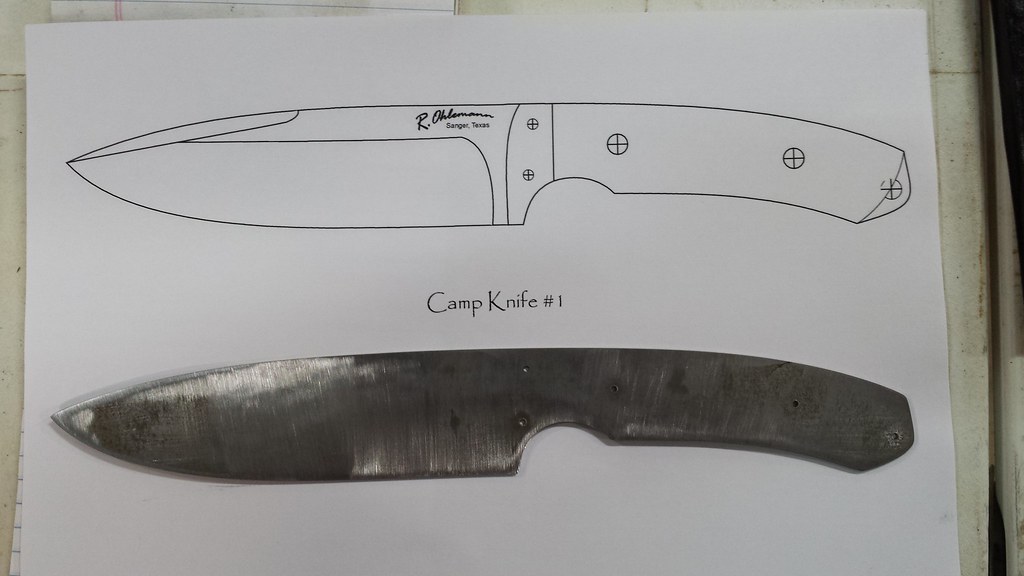
Here's some of my recent progress. I asked for feedback on this design a while back.


CAMP-KNIFE-01 by Ranger_Bob, on Flickr

I made a couple small changes to the profile and then made this pattern in 16ga steel.


Untitled by Ranger_Bob, on Flickr

Then cut out a blank.


Untitled by Ranger_Bob, on Flickr

Then ground the bevels.


Untitled by Ranger_Bob, on Flickr

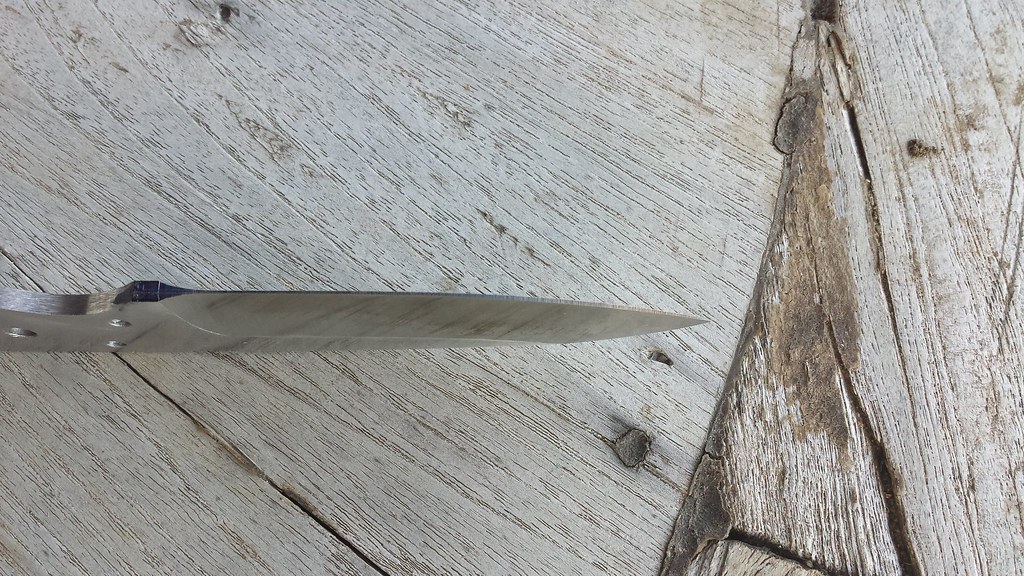
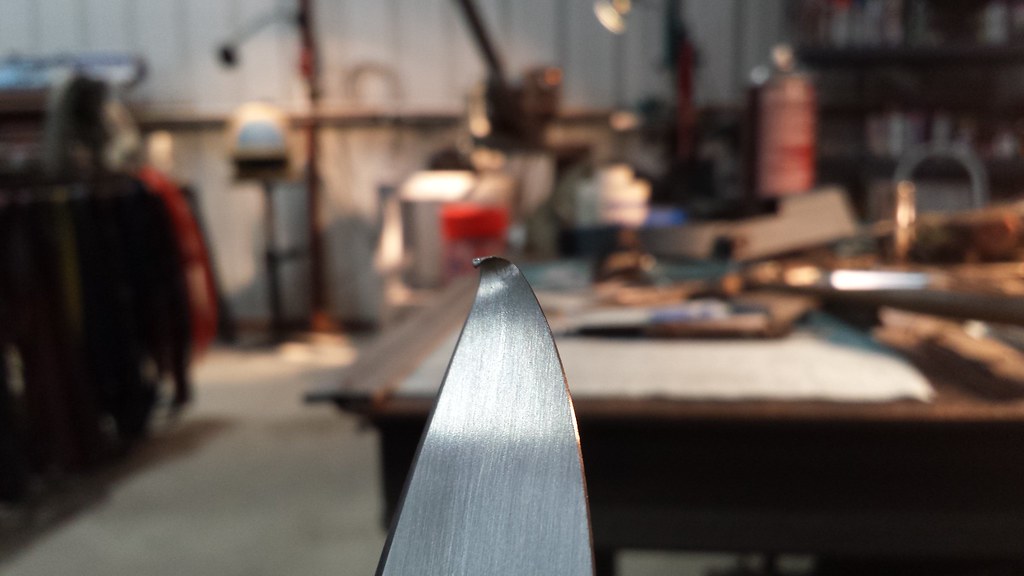
After I got the bevels ground I spent a couple hours hand sanding the bevels. I then punched the tang to drill holes and took the knife to the drill press. As I was fumbling around at the drill press, I knocked the knife off the drill table and it went tip first into the concrete floor.


Untitled by Ranger_Bob, on Flickr

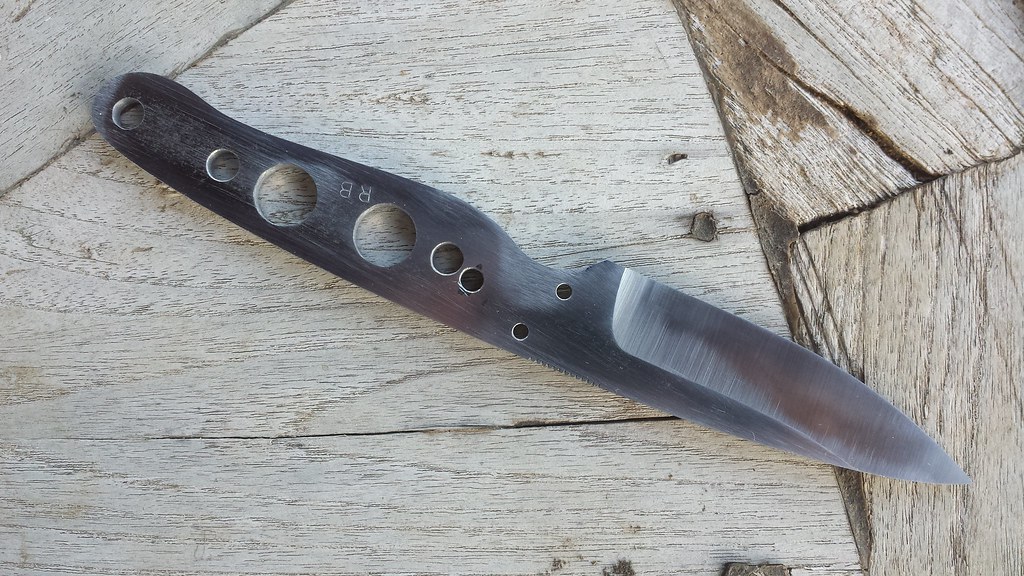
After a cooling off period, I cut out and ground a new knife. I also ground the tip off and re-shaped the tweaked blade. With the shorter blade, I thought it felt pretty butt heavy so I decided to put handles on it to see what the balance was going to be like. It's too heavy, I'm going to drill some holes in the tang to cut weight. You can see I have a pretty good batch to send out for my first heat treat.


Untitled by Ranger_Bob, on Flickr

Since I was working with my first handle, I decided to shape it a little. It is just shaped on the grinder, mostly with a slack belt between the idler and the top of the flat platen with a little bit of small wheel on the finger notch. The scales are just held on with standoffs.


Untitled by Ranger_Bob, on Flickr

So that's where I'm at; just puttering along with nothing complete yet. Hoping to get all these blades in the mail this Monday to get HT done by Texas Knifemakers Supply.

Bob
 
As limited as my experience is, I think I can offer you one tip. In one of the most recent pictures you show a blade that you "knocked off the drill table". That used to happen to me to until I started making it a point to clamp any blade down that was going to sit in a work area. I never leave them just laying around any more, unless they are in my office (with its padded, carpeted floor). Even then they are WELL back from the edge of the desk.

I find that the vise-grip style clamps are the best for my purposes, a I can lock something down quickly and securely (especially compared to screw-down C-clamps).

General shop safety tip, and one that has kept me from damaging several blades.

Oh, and when removing the clamps, always keep one hand on the blade so the simple act of unclamping it doesn't send it flying.
 
As limited as my experience is, I think I can offer you one tip. In one of the most recent pictures you show a blade that you "knocked off the drill table". That used to happen to me to until I started making it a point to clamp any blade down that was going to sit in a work area. I never leave them just laying around any more, unless they are in my office (with its padded, carpeted floor). Even then they are WELL back from the edge of the desk.

I find that the vise-grip style clamps are the best for my purposes, a I can lock something down quickly and securely (especially compared to screw-down C-clamps).

General shop safety tip, and one that has kept me from damaging several blades.

Oh, and when removing the clamps, always keep one hand on the blade so the simple act of unclamping it doesn't send it flying.

I really need to put some kind of a table next to the drill press. My mitering bandsaw is next to it and the control box has become a gathering point for drills, countersinks and stacks of "to be drilled" materials. To your point, I placed one of those 16" flat tool hanging magnets on the surface of my work table. Whenever I set a blade down it goes on the magnet and stays secure. It's shown under the knife in post #10 (I usually keep blades pointing the other way).

Bob
 
Last night I decided to start another blade that I had been working on in Illustrator. Everything was going fine until I was cleaning up the plunges. It is so frustrating that a fraction of second can ruin so much hard work. The overhanging edge of the belt hit the ricasso. In this case, I guess it's not ruined; I'll just add a sharpening notch. Makes me wonder about certain design elements in custom knives. Things like the Spanish/sharpening notch or the extra large ricasso's seem to be a great way to CYA when making knives.

You can see the jacked up ricasso.


Untitled by Ranger_Bob, on Flickr

I'll just modify it to this and I should be fine.


CAMPFIGHTER-LINE-DRAWING by Ranger_Bob, on Flickr
 
They are looking great. This thread is making me really frustrated that my grinder is still not repaired!!!! Aaaagh. Seriously, though - the knives are looking good!
 
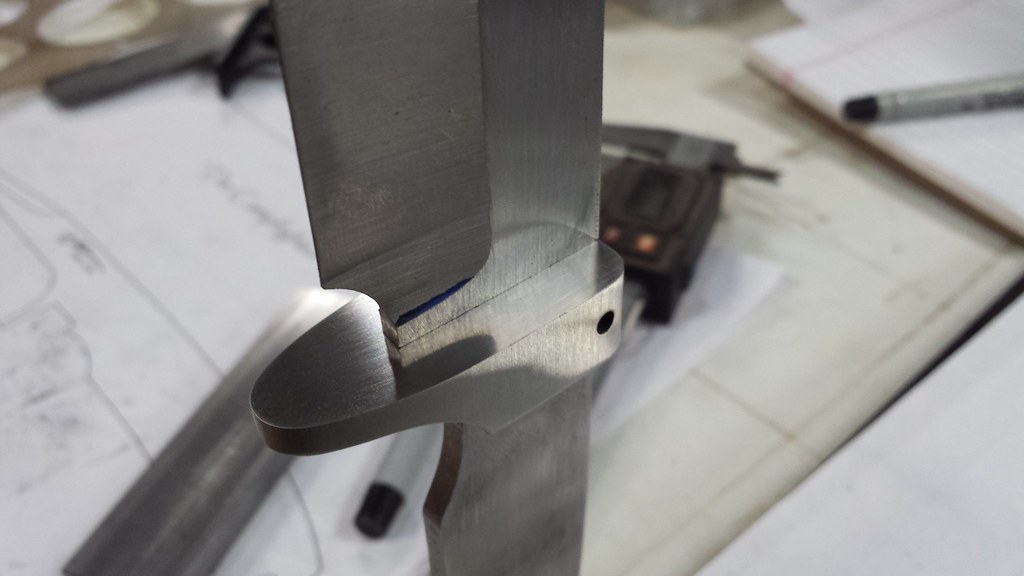
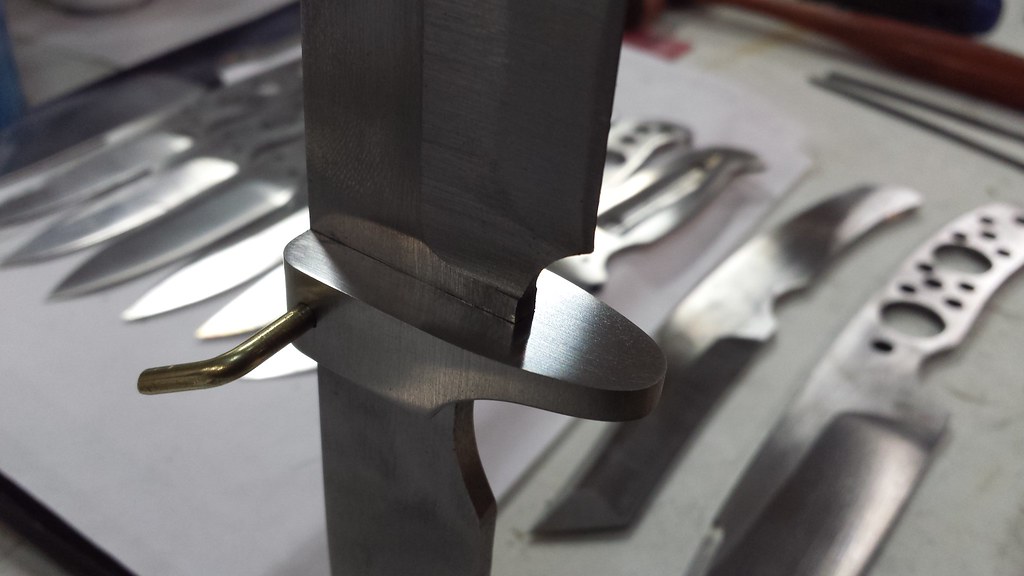
This is the knife from post #15 that I kind of screwed up the ricasso. I ground out a notch to clean up the mistake. Today I finished fitting my first guard. It is made from 304L. I slotted it with a 5/32" 4-flute, carbide end mill. I then carefully surface ground the flats of the knife on the flat platen until I achieved the fit shown here. I don't know if I will be able to duplicate my success on future projects but, I'm pretty happy with this.

Bob


Untitled by Ranger_Bob, on Flickr


Untitled by Ranger_Bob, on Flickr
 
Back
Top